
有色金属

Search documents
14%的国际投资者,计划在2026年向中国注入更多资金
Sou Hu Cai Jing· 2026-02-02 12:14
Group 1 - As of January 31, 3057 listed companies have disclosed performance forecasts, with 1638 companies expecting positive results, accounting for 53.6% [1] - Among the sectors, non-ferrous metals and non-bank financials are performing well by seizing cyclical opportunities, while hardware, semiconductors, and automotive parts are showing strong performance as new growth drivers [1] - Traditional industries like steel are experiencing continuous optimization in profit structures [1] Group 2 - According to BNP Paribas, 14% of investors plan to increase their investments in Chinese funds by 2026, indicating a shift from previous capital withdrawal trends [1] - The sentiment towards the Chinese market is strengthening, with expectations of a turning point that began last year [3] - The February stock recommendations from brokerages are focused on sectors such as electronics, machinery, and non-ferrous metals, with high interest in specific stocks like Haiguang Information, Tencent Holdings, China Pacific Insurance, and Zijin Mining [3] Group 3 - Fund managers believe the semiconductor industry is in an accelerating upturn, with structural supply-demand imbalances highlighting the Alpha attributes of sectors like computing power, storage, optical modules, and global semiconductor equipment [3] - CITIC Securities suggests that the narrative of rising prices across resources and cycles may continue throughout the first quarter, emphasizing the importance of sectors with competitive advantages in global pricing power, such as chemicals, non-ferrous metals, electric equipment, and new energy [3] - There is a cautionary note regarding the speculative nature of the precious metals sector, suggesting a need for vigilance [3]

投资者对有色行情需保持理性
Guo Ji Jin Rong Bao· 2026-02-02 12:12
Core Viewpoint - The recent volatility in the prices of non-ferrous metals and related stocks highlights the importance of risk management for investors in the stock market [1] Group 1: Market Dynamics - Non-ferrous metal prices are influenced by multiple factors including macroeconomic conditions, monetary policy, global supply and demand, and geopolitical issues, leading to significant price volatility [1] - Historical trends show that the non-ferrous metal sector often experiences sharp price increases followed by sudden declines, indicating that short-term irrational market behavior can drive prices [1] - A recent forecast from a company with "silver" in its name indicated potential significant losses in 2025 due to market price fluctuations affecting the fair value of embedded derivative financial instruments [1] Group 2: Risk Management Strategies - Investors should establish a comprehensive risk management system and maintain a consistent risk awareness to navigate the volatile non-ferrous metal sector [2] - It is crucial for investors to understand the underlying logic of commodity price fluctuations and to conduct thorough research on industry cycles and market rules before making investment decisions [2] - Investors are advised to focus on the fundamentals of listed companies, analyzing their business models, hedging strategies, and financial accounting methods to identify quality companies with solid performance rather than merely price-driven stocks [3] Group 3: Investment Diversification - A diversified investment portfolio is essential to mitigate risks associated with the non-ferrous metal sector, avoiding excessive concentration in a single sector [3] - Investors should consider including non-ferrous metals as part of a broader investment strategy, combining it with other stable sectors and low-risk assets like bonds to maintain balance during market fluctuations [3] Group 4: Discipline in Trading - Adhering to investment discipline and avoiding emotional trading is critical, as irrational market movements can lead to impulsive decisions [4] - Establishing clear profit-taking and stop-loss rules, along with reasonable return targets and risk thresholds, is essential for effective trading [4] - Maintaining a rational and cautious investment mindset is vital for long-term success in the market, as risk control remains a top priority regardless of market conditions [4]
过年杀猪啦
Datayes· 2026-02-02 12:10
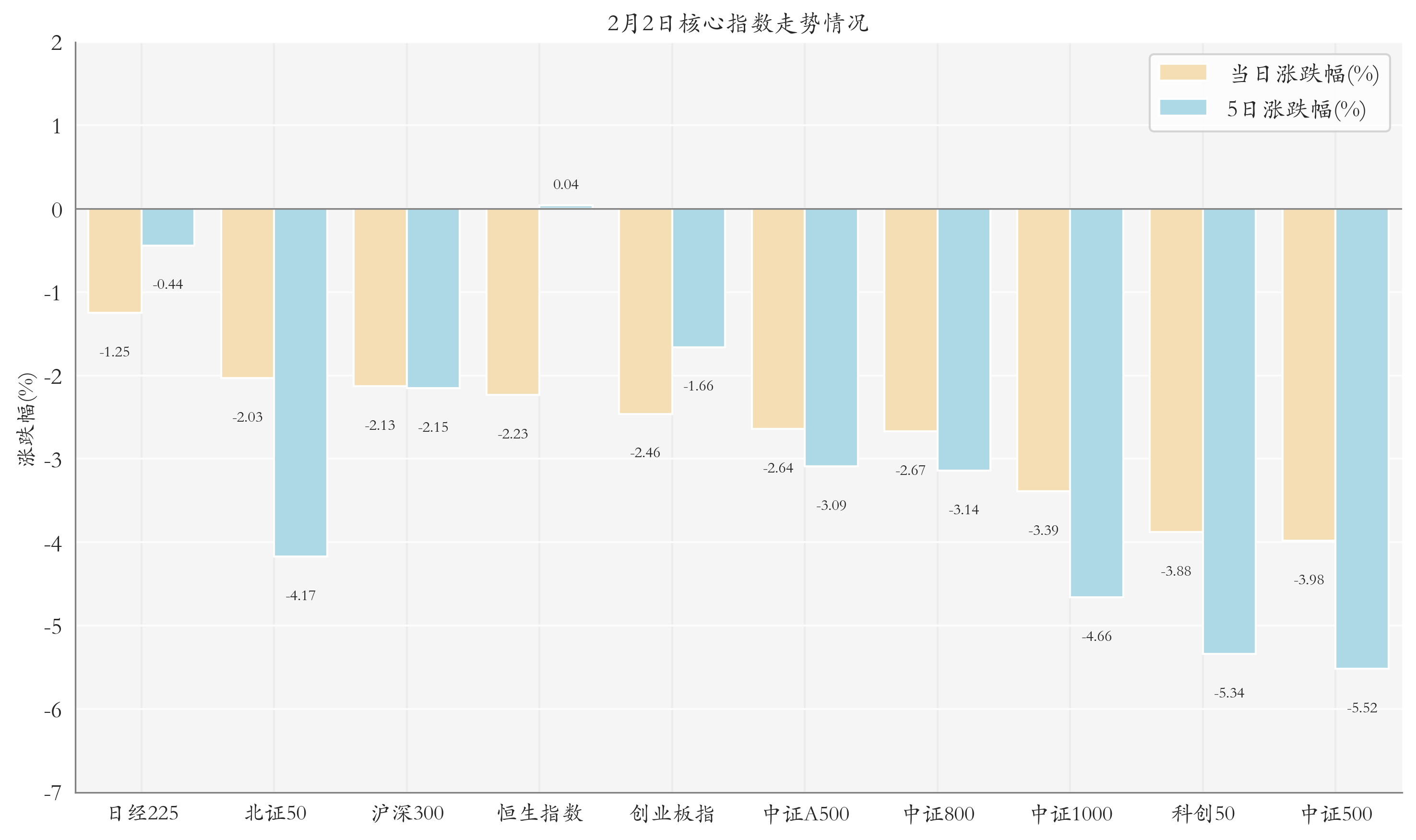
Market Overview - The A-share market experienced a collective decline on February 2, with the Shanghai Composite Index falling by 2.48%, the Shenzhen Component Index by 2.69%, and the ChiNext Index by 2.46% [12] - The total trading volume across the three markets was 26,069.20 billion, a decrease of 2,558.2 billion from the previous day, with over 4,600 stocks declining [12][14] - The smart grid sector showed resilience, with several stocks such as Tongguang Cable and Baobian Electric reaching their daily limit [12] Sector Performance - The white wine sector rebounded, driven by rising consumption and increasing prices, with Moutai's wholesale price rising by 160 yuan to 1,770 yuan per bottle [12] - The commodity futures market saw significant declines, with precious metals and energy sectors experiencing sharp drops, including a more than 15% decline in gold [13] - The electronic industry faced the largest net outflow of funds, with Zhongji Xuchuang leading the outflow [25][26] Investment Insights - The current market conditions suggest a potential shift in investment styles, with discussions around inflation recovery and corporate profit recovery gaining traction [11] - The relative PE-TTM ratio of the CSI 1000 compared to the CSI 300 is at 3.55, indicating a high valuation level [11] - The market is characterized by crowded trades in certain sectors, necessitating significant fundamental changes for excess returns, while less crowded sectors may yield better returns with minor improvements [11] Key Stocks and Funds - Notable net inflows were observed in the electric power equipment, banking, and food and beverage sectors, while the electronic and non-ferrous metal sectors saw significant outflows [26] - Major stocks with net inflows included Xinye Technology and West Materials, while Zhongji Xuchuang and Zhaoyi Innovation faced the largest outflows [26][30]






食品饮料ETF领涨;14只ETF单月扩容超百亿元丨ETF晚报
2 1 Shi Ji Jing Ji Bao Dao· 2026-02-02 11:54
ETF Industry News - The three major indices experienced fluctuations and declines, with the Shanghai Composite Index down 2.48%, the Shenzhen Component Index down 2.69%, and the ChiNext Index down 2.46%. However, several ETFs in the food and beverage sector saw gains, including the Wine ETF (512690.SH) up 1.48%, the Huabao Food and Beverage ETF (515710.SH) up 0.86%, and the Yinhua Food and Beverage ETF (159862.SZ) up 0.79% [1] - The non-ferrous metal sector saw multiple ETFs decline significantly, with the Industrial Bank Gold ETF (159315.SZ) down 10.02%, the Gold Stocks ETF (159321.SZ) down 10.01%, and the Guotai Non-ferrous Metal ETF (159881.SZ) down 10.01% [1] - Guotai Junan Securities predicts a positive outlook for the food and beverage sector by 2026, highlighting four main lines of focus: cost dividend release, operational efficiency improvement, innovation-driven growth, and opportunities for reversal in certain sub-industries. The upcoming Spring Festival is expected to be a significant catalyst, and the imminent introduction of national standards for prepared dishes is also seen as a positive for the industry [1] ETF Market Performance - In January, the stock ETF market experienced a cumulative net outflow of over 790 billion yuan, with the last trading day seeing a net outflow of over 3.7 billion yuan. Popular thematic ETFs such as non-ferrous metals, chemicals, and satellite ETFs saw inflows, while broad-based ETFs like the CSI 300 ETF and the SSE 50 ETF faced significant outflows [2] - The thematic ETFs have gained popularity, with 14 ETFs expanding by over 10 billion yuan each in January. Resource-related and technology-related ETFs have shown particularly strong performance, with the Gold ETF seeing a scale increase of 33.54 billion yuan and the Southern CSI Non-ferrous Metal ETF increasing by 24.22 billion yuan [3][4] - The overall performance of ETFs varied, with money market ETFs showing the best average performance at 0.00%, while commodity ETFs had the worst average performance at -8.88% [11] Sector Performance - In terms of sector performance, the food and beverage, banking, and household appliance sectors ranked highest today, with daily gains of 1.11%, 0.17%, and -0.49% respectively. Conversely, the non-ferrous metals, steel, and basic chemicals sectors ranked lowest, with daily declines of -7.62%, -5.93%, and -5.69% respectively [8] - Over the past five trading days, the food and beverage, communication, and banking sectors have shown positive performance, with gains of 3.14%, 2.47%, and 0.59% respectively, while the non-ferrous metals, steel, and comprehensive sectors have shown declines of -8.68%, -7.66%, and -7.6% respectively [8]
策略周报:1 月第 4 周立体投资策略周报:ETF 净赎回规模收窄-20260202
Guoxin Securities· 2026-02-02 11:54
Group 1 - In the fourth week of January, the total net outflow of funds was 148.3 billion, compared to a net inflow of 173.9 billion in the previous week [1][8] - The short-term sentiment indicator is at a high level since 2005, with the recent weekly turnover rate (annualized) at 627%, placing it in the 90th percentile historically [1][12] - The long-term sentiment indicator is at a medium-low level since 2005, with the recent A-share risk premium at 2.48%, in the 46th percentile historically [2][12] Group 2 - The top three industries by trading volume percentage in the past week were semiconductor (99%), non-ferrous metals (98%), and defense industry (97%), while the lowest were food processing (0%), transportation (0%), and real estate (1%) [2][14] - The highest financing transaction percentage industries were machinery equipment (86%), electric power equipment (82%), and social services (79%), while the lowest were banking (14%), non-bank financials (20%), and real estate (20%) [2][14]
注意!A股超4600股下跌背后:聪明资金已在这三条战线完成集结
Sou Hu Cai Jing· 2026-02-02 11:47
Core Viewpoint - The market experienced a significant downturn, with major indices like the Shanghai Composite Index dropping by 2.48%, and over 4600 stocks declining, indicating a severe market sentiment shift towards panic selling [1] Group 1: Market Overview - The overall market sentiment is extremely negative, with a notable decrease in trading volume to 2.61 trillion, suggesting that many investors are hesitant to engage [1] - The primary driver of the market decline is identified as the cyclical sectors, particularly the non-ferrous metals sector, which fell over 7% [1] Group 2: Investment Opportunities - The first identified opportunity is in the electric grid equipment sector, which saw a surge in stock prices despite the overall market decline, driven by the increasing demand for stable power supply in AI data centers [2] - The second opportunity lies in CPO (Co-Packaged Optics) modules, which showed strong performance due to significant profit growth from leading companies, indicating robust demand in the global computing infrastructure [3] - The third opportunity is in the liquor industry, particularly high-quality brands that have undergone long-term adjustments, attracting long-term investors looking for stable core assets [4] Group 3: Market Dynamics - The immediate trigger for the market decline was a significant drop in gold and silver prices in international markets, which created a ripple effect in the A-share market [6] - The internal issue was the excessive speculation in cyclical sectors, which had previously seen rapid price increases, leading to a high trading density that made them vulnerable to external shocks [6] Group 4: Strategic Recommendations - Investors are advised to avoid bottom-fishing in recently plummeted cyclical stocks, as their adjustments may not be over [7] - Focus should shift towards sectors representing future technology, such as AI power infrastructure and high-growth hard technology, as indicated by market movements [7] - A change in investment strategy is recommended, moving from speculative narratives to a focus on tangible orders and financial performance [7]
有色金属日报-20260202
Guo Tou Qi Huo· 2026-02-02 11:47
Report Industry Investment Ratings - Copper: Not clearly defined in the given rating table, but based on the analysis, there is still a configuration demand [2] - Aluminum: "ななな" (no clear English equivalent provided), indicating a certain market situation, with short - term pressure on prices [3] - Alumina: "な女女", with a significant surplus in the market [3] - Casting Aluminum Alloy: Follows the fluctuation of Shanghai Aluminum, with low market activity [3] - Zinc: ★☆☆, indicating a bearish trend with limited operability [1][4] - Lead: Not clearly defined in the rating table, but with downward pressure on prices [6] - Nickel and Stainless Steel: Market sentiment is panicked, suggesting caution [7] - Tin: ★☆☆, expected to decline further [1][8] - Carbonate Lithium: Not clearly defined in the rating table, with high short - term uncertainty [9] - Industrial Silicon: Not clearly defined in the rating table, with a short - term oscillating trend [10] - Polysilicon: ☆☆☆, with the futures price expected to be under pressure [1][11] Core Views - The prices of various non - ferrous metals are affected by multiple factors such as supply - demand fundamentals, market sentiment, and policy. Each metal has its own unique market situation and price trend [2][3][4] Summary by Metal Copper - Last week, copper prices basically achieved the annual increase target set by overseas investment banks at an extreme speed, deviating from the supply - demand fundamentals. The resource premium has cooled rapidly. In the first quarter, the global copper concentrate supply and demand are the tightest. Copper still has a configuration demand unless domestic demand is completely falsified. Copper prices are expected to be low first and then high [2] Aluminum, Alumina, and Aluminum Alloy - Shanghai Aluminum hit the daily limit down. Short - term macro and fundamentals suppress aluminum prices. The pre - holiday inventory performance is worse than in previous years. Casting aluminum alloy follows the fluctuation of Shanghai Aluminum with low market activity. The alumina market is in significant surplus, and the cash cost support is low [3] Zinc - The "Wash Panic" spreads, and long positions are continuously reduced. After the sentiment fades, the market corrects rapidly. The market is expected to return to the fundamentals. During the Spring Festival, supply and demand are both weak. The price may enter a sideways consolidation after testing the cost support [4] Lead - The inclusion of recycled lead in delivery reduces the risk of soft cornering. The "Wash Panic" affects the market, with weak terminal battery demand. The price of lead has declined significantly, and the support level is seen at 16,700 yuan/ton [6] Nickel and Stainless Steel - The market trading is active, but the downstream is cautious in purchasing. The inventory of steel mills is low, and traders are reluctant to sell at low prices, supporting the spot price. However, market sentiment is panicked [7] Tin - After the market sentiment reversed last Thursday night, Shanghai Tin fell rapidly and hit the daily limit on Monday. It is expected to decline further. The market focus has shifted to the supply - demand fundamentals [8] Carbonate Lithium - Carbonate Lithium hit the daily limit. The exchange policy affects market participation. The price is in a high - level oscillation, and short - term uncertainty is extremely high [9] Industrial Silicon - Industrial Silicon oscillated and closed down. There are plans for production cuts, but the implementation is uncertain. The downstream demand is weak, and the short - term trend is oscillating [10] Polysilicon - The price of polysilicon has fallen to around 47,000 yuan/ton. The industry is trying to curb内卷. The downstream demand is weak, and the de - stocking is difficult. The futures price is expected to be under pressure [11]
【招银研究|资本市场快评】如何看待A股大跌——短期震荡消化不改中期趋势
招商银行研究· 2026-02-02 11:46
Core Viewpoint - The recent decline in the A-share market is primarily driven by external liquidity shocks and internal capital withdrawal, with a significant impact from the hawkish stance of the new Federal Reserve chairman [2]. Group 1: Market Decline Reasons - The core trigger for the market drop is the hawkish expectation of the Federal Reserve's balance sheet reduction, leading to a global liquidity repricing [2]. - The A-share market, which has been largely liquidity-driven since the bull market began on September 24, 2024, is particularly sensitive to changes in policy expectations [2]. - Domestic factors, including reduced leverage by exchanges and significant ETF redemptions, have further suppressed market sentiment, with a record net redemption of 780 billion yuan in January [2]. Group 2: A-share Market Outlook - The current pricing of the A-share market reflects a certain bias against the Federal Reserve's hawkish stance, with expectations that the new chairman will balance interest rate cuts with the realities of dollar liquidity [3]. - As the market approaches a reasonable valuation, regulatory goals for cooling the market will likely be achieved, leading to a potential shift towards more positive policy [3]. - Historical patterns suggest a strong likelihood of a spring rally between the Lunar New Year and the Two Sessions, with a historical probability of around 90% for market gains during this period [3]. - Defensive attributes are expected from undervalued domestic assets during periods of external volatility, as evidenced by the resilience of banking and food and beverage sectors [3]. - Following stabilization of market sentiment, there is potential for continued investment in AI technology and overseas manufacturing, alongside increased allocation to high-dividend sectors like banking and consumer goods to enhance portfolio resilience [3].


“沃什交易”下市场快速降温
Tebon Securities· 2026-02-02 11:45
Market Analysis - The A-share market experienced a significant decline, with the Shanghai Composite Index falling by 2.48% to close at 4015.75 points, marking a substantial drop below the 4100-point level [2] - The Shenzhen Component Index dropped by 2.69%, reaching its largest single-day decline since January, while the ChiNext Index fell by 2.46% [2] - Over 4600 stocks in the market declined, with more than 100 stocks hitting the daily limit down, indicating a sharp decrease in market risk appetite [2] Sector Performance - Resource stocks faced heavy losses, with declines of 7.63% in non-ferrous metals, 5.65% in steel, and 5.43% in coal and oil sectors, reflecting concerns over industrial demand as the manufacturing PMI fell to 49.3 [5] - Defensive sectors such as food and beverage, and banking showed resilience, with increases of 1.15% and 0.13% respectively, attracting risk-averse capital [5] - The high-voltage power sector surged by 3.84%, driven by policy catalysts from the National Development and Reform Commission and the National Energy Administration [5] Commodity Market - The commodity index saw a significant drop of 4.37%, with most commodities declining sharply, while only a few chemical products showed gains [7] - Precious metals like gold and silver experienced steep declines, with silver dropping by 17.00% and gold by 15.73%, reflecting a market shift away from high-volatility assets [7][8] - The market exhibited extreme differentiation, with only a few products like caustic soda and PVC showing upward movement amidst widespread declines [7] Bond Market - The government bond futures market showed mixed results, with the 30-year contract rising by 0.18% while shorter-term contracts experienced slight declines [10] - The central bank's net withdrawal of 755 billion yuan indicates a stable liquidity environment, with expectations of continued monetary easing supporting bond market sentiment [10] - The overall market liquidity remains stable ahead of the upcoming Spring Festival, with a focus on the central bank's liquidity tools [10] Investment Strategy - The report suggests a shift from a previous bullish trend to a more volatile market environment, recommending a focus on sectors like photovoltaic, commercial aerospace, and precious metals for medium to long-term investments [12] - The commodity market is expected to undergo a period of consolidation after rapid declines, with potential for upward movement in precious metals in the medium to long term [12] - The report emphasizes the importance of monitoring macroeconomic indicators and policy developments to identify investment opportunities [12]
市场点评丨沪指险守4000点,资源股大面积跌停
Sou Hu Cai Jing· 2026-02-02 11:44
Market Overview - A-shares experienced a significant decline on February 2, 2026, with all three major indices dropping over 2%, and the Shanghai Composite Index closing at 4015.75 points, down 2.48% [1] - The total trading volume in A-shares reached 2.61 trillion, with 770 stocks rising and 4647 stocks falling [1] Market Sentiment and Structure - The recent market downturn is primarily driven by emotional and trading structure factors rather than fundamental issues, indicating that rapid declines can be a characteristic of a slow bull market [1] - The adjustment is seen as a normalization of market leverage and sentiment, correcting the previous overly optimistic outlook and speculative capital [2] Federal Reserve and Economic Outlook - The nomination of Kevin Warsh as the new Federal Reserve Chair has limited impact on the current market adjustment, serving more as a final catalyst [3] - The Fed is unlikely to shift to a hawkish stance immediately due to soft employment data and stable inflation, with no significant room for rate cuts unless unemployment rises substantially [3] Commodity Market Insights - The non-ferrous metals sector, which had the highest gains in January, is expected to undergo a correction due to leverage and sentiment, but will likely return to an upward trend in commodity prices once this phase is completed [3] - Concerns regarding the sustainability of U.S. long-term debt, the independence of the dollar monetary system, and structural changes in resource demand are expected to maintain upward pressure on upstream resource prices [3] Industry Developments - Tesla announced the upcoming launch of its third-generation humanoid robot, with plans for annual production of 1 million units, indicating a shift in production lines at its Fremont factory [4] - The ramp-up period for the humanoid robot production is expected to be longer than that for automotive products due to its independent supply chain and first-principles design [4]