新能源汽车

Search documents
海科新源:签署长期合作协议 向比亚迪锂电池湖北项目供应协议所购产品每年至少10万吨
Zheng Quan Shi Bao Wang· 2026-01-26 11:24
人民财讯1月26日电,海科新源(301292)1月26日公告,公司与深圳市比亚迪(002594)锂电池有限公 司(简称"比亚迪锂电池")签署长期合作协议暨湖北项目管输合作协议,协议有效期三年,在协议有效期 内,海科新源以管输方式向比亚迪锂电池湖北项目供应协议所购产品每年至少10万吨。产品的实际采购 数量以双方签署的相关协议为准。 ...

特斯拉Cybercab将于4月量产!原型车正开展冬测!
Xin Lang Cai Jing· 2026-01-26 11:09
近日,特斯拉首席执行官埃隆・马斯克通过社交平台确认,Cybercab将于2026年4月在得克萨斯超级工厂正式启动 量产。 目前该车原型车正在美国阿拉斯加开展冬季测试。 马斯克直言,由于Cybercab采用近100%的新零部件与全新生产流程,初期生产将"极其缓慢",符合典型的S型产 能曲线规律。 据特斯拉内部测试数据显示,2026年上半年该车周产量或仅数百台,全年产能恐难突破10万辆。 在低温续航保障方面,搭载50kWh电池组的原型车在零下数十度环境中,能量衰减率控制在预期范围内,可稳定 实现200-250英里(约321-402公里)的城市续航目标,满足全天候运营需求。 针对暴雪、凝霜等恶劣天气,其搭载的FSD V14系统通过视觉摄像头与雷达的协同工作,可自动采取减速、循迹 行驶等策略,传感器识别精度未受明显干扰。 尽管该项目进展迅猛,Cybercab仍需跨越三大障碍:全新制造工艺的良率爬坡风险、完全无人运营的保险责任界 定难题,以及欧洲市场的监管审批进度。特斯拉Cybercab量产后的市场表现如何,让我们拭目以待。 近日,特斯拉首席执行官埃隆・马斯克通过社交平台确认,Cybercab将于2026年4月在得克萨 ...



《2025新能源汽车安全认知报告》:汽车隐藏式门把手存量超千万
Ge Long Hui· 2026-01-26 10:38
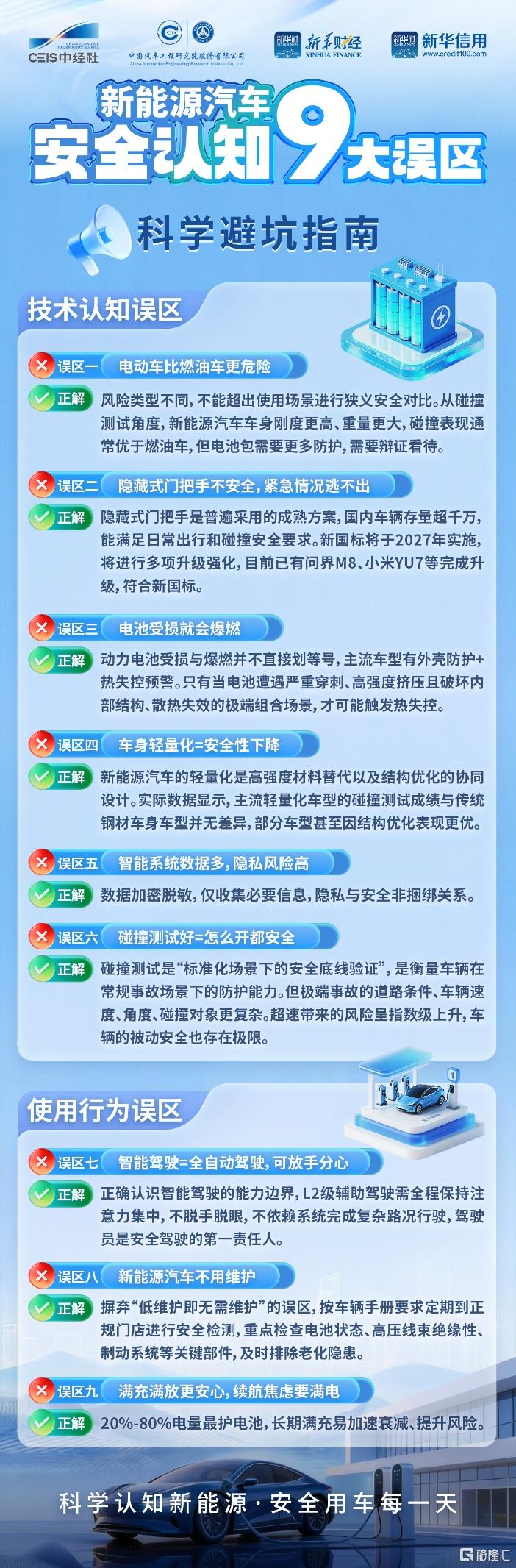
Core Insights - The seminar on "New Energy Vehicle Safety Standards and 'Going Global' Trust" highlighted the importance of establishing safety standards and building user trust in the context of the global expansion of the new energy vehicle industry [1] - The report released by the China Economic Information Agency and the China Automotive Engineering Research Institute provides a comprehensive overview of the current state of new energy vehicle safety, public misconceptions, and challenges in global markets [1] Industry Overview - The safety technology of new energy vehicles in China has developed a comprehensive system covering passive protection, active warning, and scenario adaptation, with national standards continuously upgraded and international rules accelerating mutual recognition [1] - Despite rapid technological advancements, public understanding of issues such as battery safety, intelligent driving capabilities, and data privacy remains significantly lagging, affecting consumer confidence and market acceptance [1] Misconceptions Analysis - The report categorizes and analyzes nine typical misconceptions in the safety domain of new energy vehicles, including: - Misunderstanding the safety comparison between electric vehicles and fuel vehicles [2] - Overgeneralizing the safety of hidden door handles [2] - Incorrectly associating battery damage with inevitable combustion [2] - Misconceptions about lightweight vehicle materials leading to perceived safety reductions [2] - Overemphasizing privacy concerns related to vehicle data [2] - Confusing collision test results with real-world accident protection [2] - Misunderstanding the capabilities of intelligent driving systems [5] - Neglecting regular safety checks due to misconceptions about low maintenance [2] - Confusing range anxiety with charging safety [2] Safety and Development Balance - The report emphasizes that addressing safety issues in the new energy vehicle sector requires a problem-oriented and systematic approach, ensuring that safety requirements are integrated throughout the development process [2] - Long-term, new energy vehicles are seen as a key driver for high-quality economic development and strategic significance in high-end manufacturing, energy transition, and digitalization [2] Recommendations for Stakeholders - The industry is encouraged to adhere to safety standards, promote robust technological evolution, and enhance public understanding of safety features and proper usage of intelligent driving systems [7]
科创新源:预计2025年净利润同比增长73.62%~131.49%
Xin Lang Cai Jing· 2026-01-26 10:35
科创新源公告,预计2025年度净利润为3000万元至4000万元,同比增长73.62%至131.49%。报告期内, 随着麒麟电池、神行电池等一批新型电池不断推广应用,带动公司新能源汽车动力电池散热液冷板业务 快速增长,规模盈利能力快速提升。 ...
观车 · 论势 || 动力电池报废新规开启产业新篇
Zhong Guo Qi Che Bao Wang· 2026-01-26 10:34
Core Viewpoint - The introduction of the "Interim Measures for the Recycling and Comprehensive Utilization of Waste Power Batteries for New Energy Vehicles" marks a significant regulatory shift aimed at establishing a comprehensive management framework for battery recycling, emphasizing lifecycle management and digital solutions to enhance the sustainability of the new energy vehicle industry [1][2]. Group 1: Regulatory Innovations - The "Vehicle-Battery Integrated Scrapping" system addresses industry pain points by mandating that scrapped vehicles must include their power batteries, preventing the illegal sale of batteries in black markets [1][2]. - The digital identity management system for power batteries introduces unique dynamic codes for each battery, enabling full-chain traceability and proactive regulatory measures, which can enhance consumer confidence and optimize resource allocation for companies [1][2]. - A comprehensive responsibility system and strict penalty mechanisms are established, holding all stakeholders accountable and imposing administrative penalties for non-compliance, with severe cases potentially leading to criminal liability [2][3]. Group 2: Challenges in Implementation - Market-level challenges include the need to address the knowledge gap and financial concerns of vehicle owners, particularly those in the ride-hailing and freight sectors, who may resist the new regulations due to perceived short-term financial losses [2][3]. - Small and medium-sized enterprises face significant compliance costs and technical adaptation challenges, which may lead to the elimination of potentially viable companies during industry consolidation [3][4]. - Regulatory challenges include regional disparities in enforcement capabilities and the need for improved data-sharing mechanisms among departments to effectively identify and address violations [3][5]. Group 3: Recommendations for Successful Implementation - The establishment of a market-based recycling pricing mechanism and incentives for compliant battery disposal can help balance interests and reduce the appeal of black market sales [4][5]. - Government support for small enterprises through subsidies, low-interest loans, and tax reductions can facilitate compliance and encourage collaboration among industry leaders to support smaller firms [4][5]. - Strengthening grassroots enforcement capabilities and enhancing inter-departmental collaboration are crucial for effective regulation, alongside the development of detailed technical standards for battery recycling and utilization [5].
“金标”难掩颓势 大众安徽2025年再度亏损
Zheng Quan Ri Bao Wang· 2026-01-26 10:27
Core Viewpoint - Jianghuai Automobile (600418) has announced a significant expected loss for 2025, primarily due to the operational losses of its joint venture, Volkswagen Anhui, which is projected to incur a total loss of approximately 4.32 billion yuan [1][2]. Group 1: Financial Performance - Jianghuai Automobile expects a net profit loss of about 1.68 billion yuan for 2025, with a substantial contribution to this loss coming from Volkswagen Anhui's investment loss of approximately 1.08 billion yuan [1]. - Volkswagen Anhui's cumulative losses from 2023 to 2025 are estimated to reach around 11.5 billion yuan, indicating a persistent financial struggle despite a reduction in losses in 2025 compared to the previous year [2]. Group 2: Market Position and Product Strategy - Volkswagen Anhui is positioned as a testbed for Volkswagen's strategy in China, focusing on new energy vehicles and new retail approaches, but has yet to achieve significant scale or market impact [2][3]. - The company currently has only one mass-produced model, the "Yuzhong 06," which has not gained traction in mainstream sales or public interest, with reports suggesting cumulative sales may be below 10,000 units [2]. Group 3: Competitive Challenges - The competitive landscape in the domestic new energy vehicle market is characterized by a new paradigm that includes smart cabins, assisted driving, and user engagement, which Volkswagen Anhui must navigate to avoid being seen as a "resource black hole" [3]. - The upcoming product launch in 2026, which includes three new models, is critical for Volkswagen Anhui to establish a complete product matrix and potentially reverse its financial trajectory [3][4]. Group 4: Future Outlook - The success of new models in the competitive market will depend on Volkswagen Anhui's ability to address shortcomings in intelligent experiences, cost structures, and channel efficiency [4]. - The market's focus has shifted from the narrative surrounding the brand to the urgency of identifying when and how a financial turnaround will occur [4].
特斯拉、小米等推“7年超低息”,影响几何?
高工锂电· 2026-01-26 10:23
Core Viewpoint - The article discusses the impact of a new wave of low-interest financing options introduced by Tesla and followed by other domestic automakers in China, highlighting the challenges in the electric vehicle (EV) market, particularly in the price range of 150,000 to 200,000 yuan [2][4][5]. Group 1: Financing Strategies - Tesla has introduced a 7-year low-interest financing plan in China, with rates as low as 0.5% annually for models like the Model Y, effectively translating to an annualized rate of about 0.98% [3]. - Other companies such as Xiaomi, Li Auto, Xpeng, and Geely have also launched similar 7-year low-interest or low monthly payment plans, typically structured around down payment thresholds and limited-time promotions [4]. - The financing strategies are primarily aimed at higher-priced models, with Tesla's low-interest plan mainly covering vehicles priced above 200,000 yuan [6]. Group 2: Market Dynamics - The current financial strategies are not merely aimed at boosting sales but reveal a structural signal where both government and corporate incentives are pushing demand towards the 150,000 to 200,000 yuan range, which is a challenging segment for electric vehicle adoption [5][10]. - The latest data from the China Passenger Car Association indicates that the 150,000 to 200,000 yuan price range is the only segment where the penetration rate of new energy vehicles is not expected to increase from 2024 to 2025, remaining at 43% [11]. - In contrast, the penetration rates for other price segments, such as 100,000 to 150,000 yuan and 200,000 to 300,000 yuan, have seen increases to 51% and 60%, respectively, indicating a divergence where policies and corporate strategies are pushing upwards while market structure is slipping in the middle [12]. Group 3: Implications for Battery Manufacturers - The complexity for battery manufacturers is increasing as the market dynamics shift, with the focus not just on the volume of new energy vehicles sold but also on which price segments are driving growth and the corresponding battery configurations [13]. - If the 7-year low-interest financing leads to more transactions in the 200,000 to 300,000 yuan range, there will likely be a higher demand for larger battery capacities and faster charging configurations, benefiting mid-to-high-end models [13]. - Conversely, if the 150,000 to 200,000 yuan segment continues to be squeezed from both ends, battery manufacturers may face a scenario of scale growth with limited kWh elasticity, leading to increased cost and price pressures on the supply chain, particularly for battery cells and materials [14].
机器人行业发展核心竞争力探讨:从成本到数据,机器人进步新范式
Shenwan Hongyuan Securities· 2026-01-26 10:12
行 业 及 产 业 2026 年 01 月 26 日 行 业 研 究 / 行 业 点 相关研究 《整车出海、机器人预期强化;同时关注 业绩确定性白马——2026/1/12- 2026/1/18 汽车周报》 2026/01/19 证券分析师 戴文杰 A0230522100006 daiwj@swsresearch.com 黄忠煌 A0230519110001 huangzh@swsresearch.com 联系人 戴文杰 A0230522100006 daiwj@swsresearch.com 从成本到数据,机器人进步新范式 看好 ——机器人行业发展核心竞争力探讨 本期投资提示: 本研究报告仅通过邮件提供给 中庚基金 使用。1 评 ⚫ 新能源汽车与人形机器人两大硬科技产业具备高度同构性,2026 年人形机器人的发展 节点对标 2012-2014 年的新能源汽车,而新能源汽车的产业演进路径也为机器人行业 提供了清晰的阶段对标框架。二者均依托成熟大规模制造业与 AI 算法跃迁,国内新能 源车借国家战略驱动爆发,完成政策到市场、技术到生态的演进;2026 年机器人技术 刚迈过"可用"门槛,政策推动、资本热度空前,与彼 ...
深向科技在IPO前融资1.73亿美元,淡马锡、联想创投等参投
Jing Ji Guan Cha Wang· 2026-01-26 09:57
Core Insights - Shenxiang Technology Co., Ltd. has completed a financing round before its listing in Hong Kong, raising approximately 1.2 billion RMB (about 173 million USD) [1] - The investors in this financing round include Temasek's ABC Impact, Lenovo Group's global technology industry fund, PwC Capital, and battery manufacturer Xinwanda [1] - The combination of institutional investors and industrial capital reflects a collaborative participation, with Xinwanda having direct cooperation potential with Shenxiang Technology in the new energy heavy truck business [1]
广东9万亿压舱,安徽逆袭河南,下个万亿省份是谁?中国外贸暗涌
2 1 Shi Ji Jing Ji Bao Dao· 2026-01-26 09:18
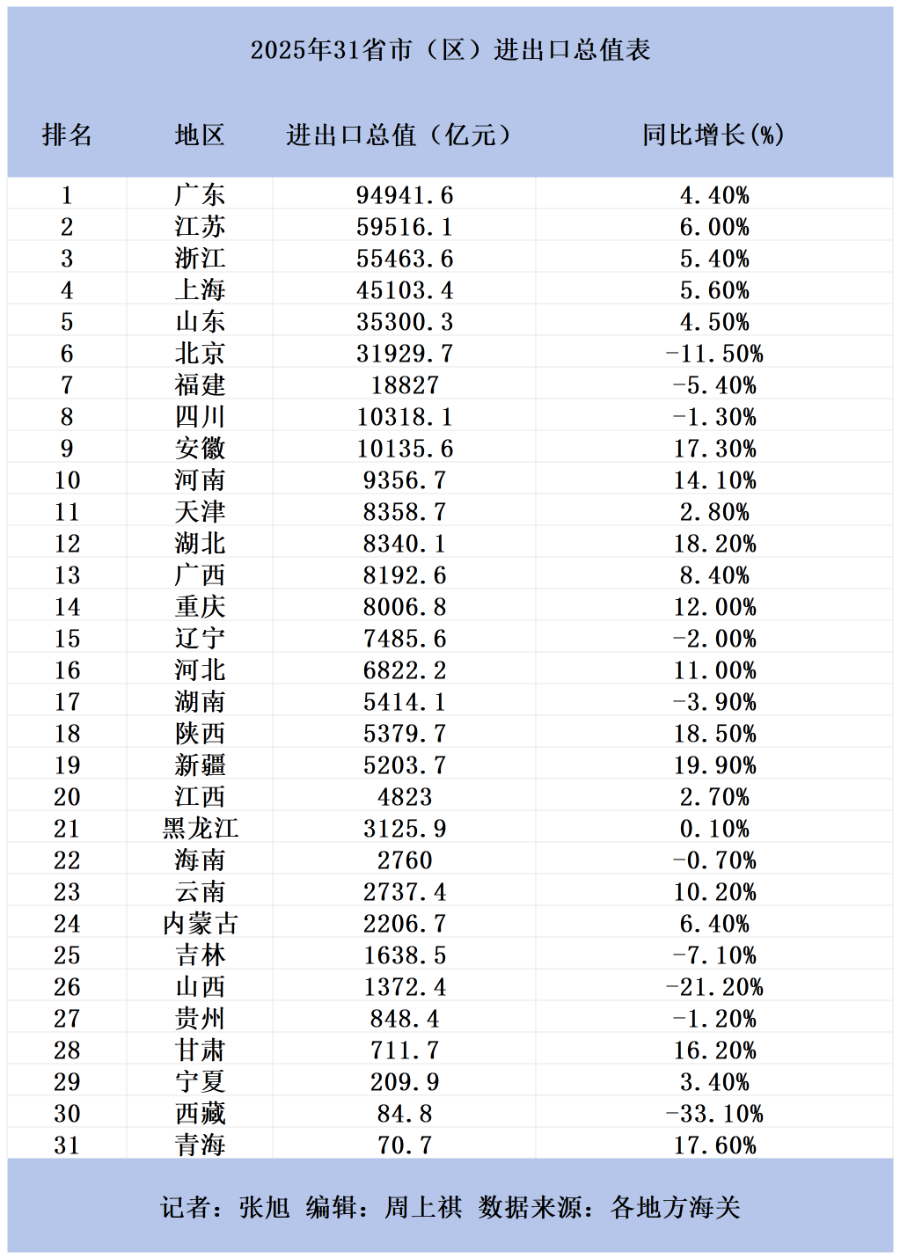
21世纪经济报道 记者张旭 北京报道 近日,31个省份2025年外贸数据陆续公布。2025年,全国进出口总值达45.47万亿元,增长3.8%,外贸总值突破万亿元的省份增 至9个。 从总值来看,广东凭借9万亿元的成绩继续领跑全部省份。江苏、浙江、上海、山东、北京分列第二至第六位,外贸总值在3万 亿元至6万亿元之间。安徽以10135.57亿元的成绩,成为中部首个、全国第九个外贸总值破万亿元省份。 从同比增速来看,共有17个省份跑赢3.8%的"全国线",21个省份实现同比正增长,新疆增长19.9%排名全国第一。而在外贸大 省中,安徽以17.3%增速领跑。曾经的"中部外贸第一省"河南,则以14.1%的增速,位居十大外贸省份第二。2025年,河南进出 口总值达9356.73亿元,有望在2026年突破万亿元大关。 对于广东外贸成绩单,广东外语外贸大学广东国际战略研究院执行院长、教授韩永辉向21世纪经济报道记者表示,广东拥有全 国最完备的制造业体系和产业链配套能力,这是其外贸长期领跑的根本支撑。民营经济活跃且外贸主体持续扩容,形成强大的 市场韧性。 此外,广东在跨境电商、海外仓、保税物流等新型贸易方式上领先全国,同时依托粤 ...