
金融

Search documents
国泰海通 · 晨报1203|宏观:通胀能否回升——2026年国内通胀展望
国泰海通证券研究· 2025-12-02 09:55
Core Insights - The article discusses the outlook for domestic inflation in 2026, focusing on the core Consumer Price Index (CPI) and Producer Price Index (PPI) trends, highlighting the need for effective fiscal policies to stimulate demand and support price recovery [2][3][4]. Group 1: Core CPI Analysis - The core CPI has recently returned to the 1% range, indicating a positive signal, but this is attributed to specific factors rather than a broad recovery in domestic demand [2]. - The sustainability of "old momentum" is questioned, with expectations for increased fiscal support in 2026, particularly towards the service sector, but concerns about diminishing multiplier effects are raised [2][3]. - The direction of the price base is contingent on effective fiscal spending to create a positive demand cycle, emphasizing the need for structural changes in fiscal policy rather than mere continuation of existing measures [3]. Group 2: 2026 Inflation Projections - It is anticipated that the core CPI will shift focus from physical consumption driven by "trade-in" policies in 2025 to the recovery elasticity of "service CPI" in 2026, dependent on effective domestic demand policies [4]. - The PPI is expected to experience a recovery influenced by the interplay between real estate sector challenges and supply-side reforms, with potential for gradual improvements as policies are implemented [4].


法媒:墨西哥吸引外资势头良好 国内投资大幅下降
Sou Hu Cai Jing· 2025-12-02 09:44
Group 1 - Mexico recorded a historic foreign direct investment (FDI) of $40.9 billion in the first three quarters of 2025, representing a year-on-year increase of 14.5% [1] - The U.S. accounts for 39% of the foreign investment in Mexico, indicating a strong economic connection between the two countries [1] - The diversification of FDI sources is evident, with Spain contributing 14%, Japan 7%, and the Netherlands 6% [1] Group 2 - A significant portion (68%) of FDI comes from companies already operating in Mexico reinvesting their profits, but the ability to attract new enterprises has not seen substantial growth [2] - FDI is not merely capital injection; it also includes technology transfer, which is crucial for creating higher-income job opportunities and entering global high-value chains [2] - Despite record FDI, Mexico's GDP is nearly stagnant, with a significant decline in domestic investment, leading the central bank to lower the 2025 economic growth forecast from 0.6% to 0.3% [2]
IDC中国区研究总监高飞:金融大模型的落地离不开生态协同
2 1 Shi Ji Jing Ji Bao Dao· 2025-12-02 09:43
0:00 四是智能体与人机协同,借鉴多智能体协同与人机协同的经验,让AI从"工具"升级为"业务伙伴";推动 业务流程的智能化重构,实现更高效的决策与执行。 在被问及国外金融大模型实践对中国的借鉴意义时,高飞从合规安全、场景选择、技术能力、人机协同 及生态合作五个维度展开分析: 一是合规与安全优先,应将合规与安全作为大模型应用的首要前提。加强模型可解释性、数据治理与隐 私保护,构建完善的负责任AI治理框架。 二是场景驱动与渐进实施,优先选择ROI高、可控性强的场景进行试点,逐步扩展至更复杂的决策领 域,避免"一步到位"带来的技术与业务风险。 三是工程化与平台化能力建设,提升大模型的工程化与平台化水平,发展低代码开发、模型管理与自动 化运维能力;降低技术门槛,加速创新场景落地。 21世纪经济报道记者 杨坪 实习生 陈慧 深圳报道 近日,在由深交所、港交所、广期所联合举办的2025年大湾区交易所科技大会上,IDC中国区研究总监 高飞接受了21世纪经济报道等多家媒体的采访。 高飞表示:"从全球金融行业大模型落地实践来看,中外实践共性多于差异。目前,全球金融行业大模 型已进入加速落地与场景扩展阶段,众多头部金融机构已在 ...
五部门发文加强数据要素建设 鼓励地方推出算力券等支持措施
Xin Lang Cai Jing· 2025-12-02 08:52
Core Viewpoint - The National Development and Reform Commission, along with four other departments, has released an opinion aimed at strengthening data element discipline construction and digital talent development, proposing specific measures across four key areas: enhancing data element disciplines, promoting vocational education in the data industry, fostering academic research in the data field, and facilitating collaboration among industry, academia, and research [1][4]. Group 1: Enhancing Data Element Disciplines - The opinion supports the establishment of digital colleges in comprehensive universities to integrate relevant academic resources [2][5]. - It encourages specialized universities in fields such as science, finance, law, media, and arts to strengthen the construction of advantageous majors related to data technology, analysis, security, digital economy, finance, management, law, governance, media, and art [2][5]. Group 2: Promoting Vocational Education in the Data Industry - The opinion proposes the establishment of a coordinated system for vocational education in the data industry, involving government oversight, industry guidance, and enterprise participation [3][6]. - It encourages the creation of regional industry-education joint entities based on industrial parks to facilitate talent cultivation, innovation, and high-quality development of the data industry [3][6]. Group 3: Fostering Academic Research in the Data Field - The opinion emphasizes the need for strategic research in the data field, focusing on key issues such as data property rights, pricing, and trading [3][6]. - It calls for in-depth research on foundational theories and policy laws related to data elements, keeping pace with advancements in technologies like artificial intelligence, blockchain, and privacy-preserving computing [3][6]. Group 4: Facilitating Collaboration Among Industry, Academia, and Research - The opinion highlights the importance of strengthening the leading role of enterprises in constructing application scenarios, identifying technical needs, and implementing results [1][4]. - It encourages data companies to participate in vocational education, collaborating on student training, technology research, product innovation, and result transformation [3][6].
2025西安国际创业大赛收官
Shan Xi Ri Bao· 2025-12-02 07:48
Core Insights - The 2025 Xi'an International Entrepreneurship Competition concluded successfully, focusing on enhancing the innovation capabilities of enterprises [1] - The competition emphasized four key sectors: information technology, high-end equipment, biomedicine and health, and new energy and materials [1] - A total prize pool of ten million yuan was established, along with various policy packages to support projects, including "investment before equity" and talent recognition [1] Summary by Categories Competition Structure - The competition utilized a multi-stage format including preliminary, semi-final, and final rounds, resulting in 40 advanced technology projects being selected [1] - The event adopted a "competition instead of evaluation" mechanism to attract talent and innovation [1] Regional Collaboration - The competition expanded its reach through external city tracks, engaging with regions like the Northeast industrial base and the Yangtze River Delta economic zone [1] - It aimed to deepen regional innovation collaboration and enhance the industrial chain [1] Financial Support - Financial institutions such as Xi'an Investment Holdings, Xi'an Financial, and Xi'an Bank provided comprehensive financial services to participating projects [1] - Several partnerships and cooperation agreements were formed during the competition, indicating strong interest from industrial parks and financial institutions [1]

ETF今日收评 | 标普消费ETF涨超2% 传媒ETF跌超2%
Mei Ri Jing Ji Xin Wen· 2025-12-02 07:42
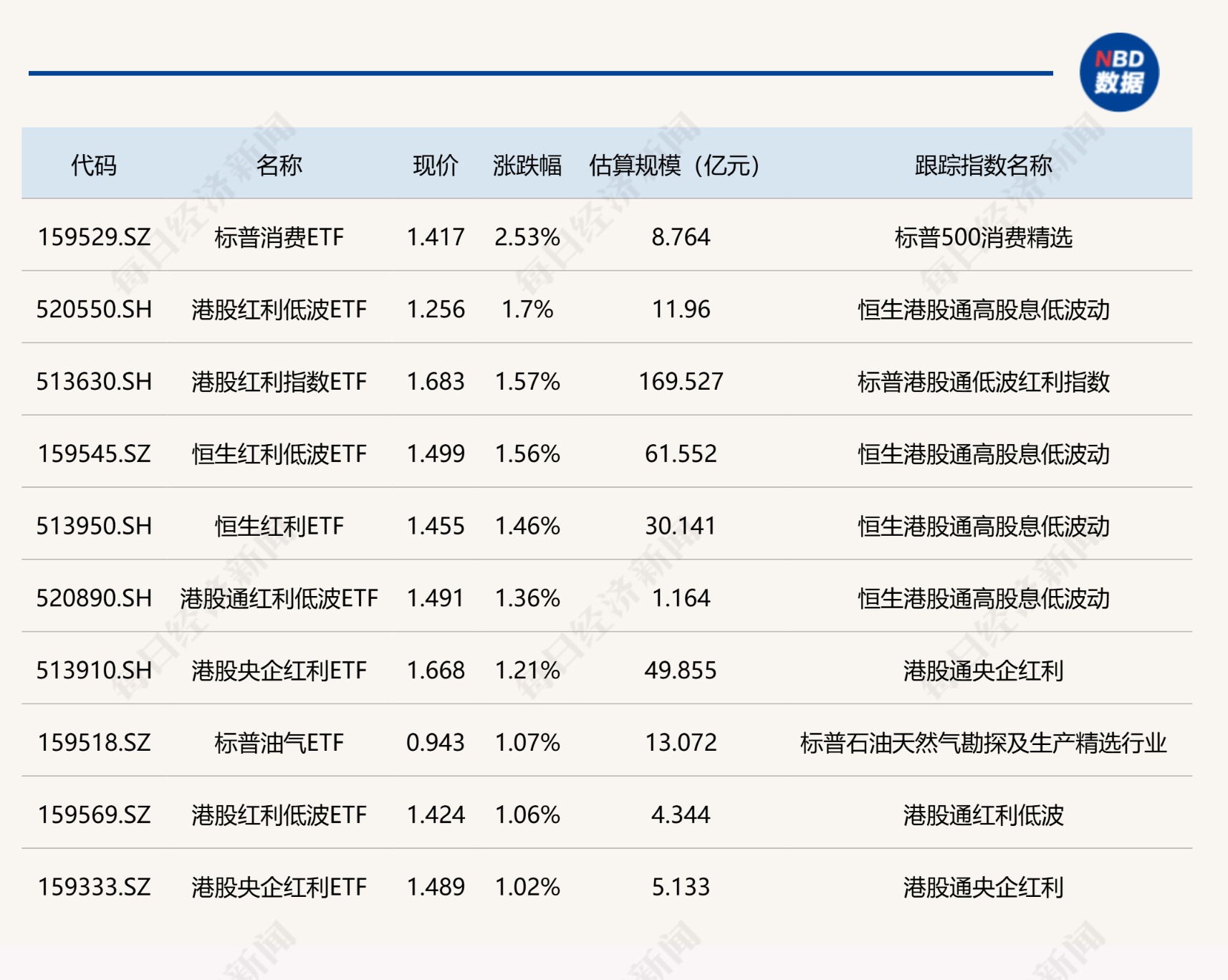
Market Overview - The market experienced fluctuations throughout the day, with the Shenzhen Component Index and the ChiNext Index both dropping over 1% at one point [1] - The Fujian sector showed strong performance, while the battery and shipping sectors faced declines [1] ETF Performance - The S&P Consumer ETF rose by over 2%, and several dividend-related ETFs increased by more than 1% [1] - Specific ETF performance includes: - S&P Consumer ETF: 2.53% increase, estimated size of 8.764 billion [2] - Hong Kong Dividend Low Volatility ETF: 1.7% increase, estimated size of 11.96 billion [2] - Hong Kong Dividend Index ETF: 1.57% increase, estimated size of 169.527 billion [2] - Other notable ETFs include the Hang Seng Dividend Low Volatility ETF and the Hang Seng Dividend ETF, both showing increases around 1.5% [2] Institutional Investment Trends - Analysts suggest that some institutions may sell high-valuation, volatile growth stocks to lock in annual returns, shifting towards high-dividend, high-safety margin Hong Kong dividend sectors [2] - The period from December to January is noted as a peak for insurance premiums, leading some insurance funds to quickly build positions in high-dividend assets to match liability costs, creating a rigid buying pressure [2] Media Industry Outlook - Long-term prospects for the media industry are expected to improve due to a gradual recovery in content supply, ongoing AI technology integration, and supportive policies alongside consumer recovery expectations [4] - Companies in the film and television, gaming, and advertising sectors are recommended for their strong performance, as well as those involved in digital assets and AIGC-related technologies [4]
对话普华永道王建平:金融科技投资必须从“规模增长”转向“效能提升”
Xin Lang Cai Jing· 2025-12-02 07:05
Core Insights - The financial system in China is at a historical juncture, with a focus on building a strong financial nation and enhancing the quality and resilience of the financial system [1][9][10] - Financial institutions are adopting a pragmatic approach towards AI, characterized by a strategic embrace and cautious tactical implementation, emphasizing the importance of return on investment [2][11] - AI is expected to become a key strategic and tactical element for financial enterprises in a competitive landscape, with those failing to adapt likely losing their competitive edge [10][16] Group 1: Changes in Financial Services - Customer decision-making and recognition patterns are evolving due to AI, necessitating a transformation in service models by financial institutions to meet increasingly sophisticated customer needs [3][12] - The competitive landscape is shifting, with smaller players leveraging AI to gain market share, posing new challenges for traditional financial institutions [3][13] Group 2: Operational Changes in Financial Institutions - AI is driving upgrades across various industries, creating new demands for financing, risk management, and insurance, leading to new business opportunities for banks, brokers, and insurance companies [4][13] - The future competition among financial institutions will largely depend on their ability to effectively utilize AI [4][13] Group 3: AI in Financial Infrastructure - AI is enhancing the foundational infrastructure of finance, enabling self-optimization, proactive decision-making, and continuous evolution, which is a step beyond mere digitalization [6][14] - AI's integration into cloud computing allows financial institutions to access AI capabilities as easily as utilities, significantly lowering technical barriers [6][14] Group 4: Recommendations for Financial Institutions - Continuous investment in core technologies, talent development, and collaboration with tech companies is essential for building AI-driven financial infrastructure [7][15] - Financial institutions should focus on developing AI scene exploration mechanisms, accumulating high-quality data, and enhancing overall AI literacy among employees [8][16]
宇树科技双足机器人专利获授权,可用于教育娱乐等领域
Qi Cha Cha· 2025-12-02 07:05
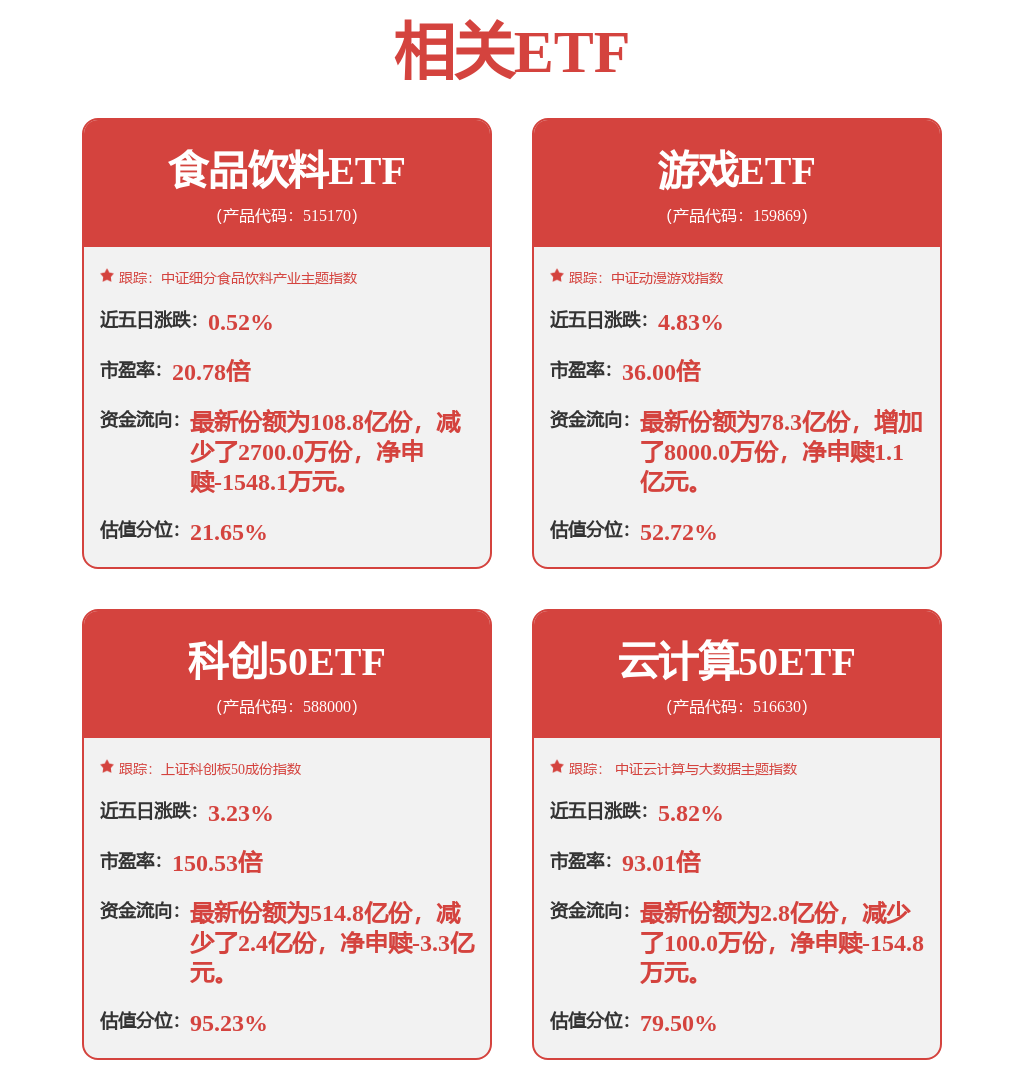
Group 1 - Hangzhou Yushu Technology Co., Ltd. has recently received authorization for its "biped robot" patent, which is designed for applications in inspection, security, transportation, education, entertainment, service, industrial operations, and surveying, with a focus on its shape [1] Group 2 - Food and Beverage ETF (Product Code: 515170) tracks the CSI Sub-Industry Food and Beverage Theme Index, with a recent five-day change of 0.52%, a price-to-earnings ratio of 20.78 times, and a net redemption of 15.48 million yuan [3] - Gaming ETF (Product Code: 159869) tracks the CSI Animation and Gaming Index, showing a five-day increase of 4.83%, a price-to-earnings ratio of 36.00 times, and a net subscription of 110 million yuan [4] - Sci-Tech 50 ETF (Product Code: 588000) tracks the SSE Sci-Tech 50 Index, with a five-day change of 3.23%, a price-to-earnings ratio of 150.53 times, and a net redemption of 330 million yuan [5] - Cloud Computing 50 ETF (Product Code: 516630) tracks the CSI Cloud Computing and Big Data Theme Index, with a five-day increase of 5.82%, a price-to-earnings ratio of 93.01 times, and a net redemption of 15.48 million yuan [5]

和音:中国经济的“稳”与“进”为世界注入信心
Ren Min Ri Bao· 2025-12-02 03:23
中国始终坚持开放合作、互利共赢,稳步扩大制度型开放,以自身高质量发展助力其他国家发展。中国 构建的新发展格局,绝非封闭的国内单循环,而是开放、相互促进的国内国际双循环。22个自贸试验区 主动对接国际高标准经贸规则,外资准入负面清单持续"瘦身",自贸协定、自贸伙伴数量不断增加,清 晰传递出中国积极扩大自主开放的坚定决心。从产品买卖、投资设厂到协同研发,陶氏、阿斯利康等外 企外资深化在华布局,展示中国市场与制度环境的强大"磁吸力"。以开放促改革促发展、以合作谋共 赢,中国经济赋能世界发展的作用将愈发凸显。 稳健的增长态势、澎湃的创新动能与广阔的开放胸襟,推动中国经济这艘巨轮乘风破浪、持续前行, 为"十五五"规划开局起步打好基础。阔步走向现代化的中国,将不断提升高质量发展成色,携手各国共 享机遇、共创繁荣。 "中国的'十五五'规划建议中蕴含哪些发展机遇?""十五五"规划建议发布以来,国际社会高度关注中国 经济向新而行、聚势而强,"双碳"、人工智能、新质生产力等成为各方读懂中国机遇的关键词。中国经 济的"稳"与"进",持续为世界注入信心和正能量。 近期,高盛、德意志银行、摩根士丹利等外资机构纷纷看好中国经济增长预期。 ...
11月PMI数据点评:价格改善加速,制造业PMI收缩放缓
Western Securities· 2025-12-02 02:40
Report Summary 1. Report Industry Investment Rating No industry investment rating information is provided in the report. 2. Core Viewpoints - In November, the manufacturing PMI contraction slowed down, with synchronized improvement in production and demand, accelerated improvement in the price index, and a slowdown in procurement contraction. Meanwhile, the service industry fell into the contraction range, and the construction industry remained below the boom - bust line for four consecutive months. More efforts are needed to promote various economic stabilization policies [1][5][35]. - In November, the bond market fell into a "ceiling - floor" oscillation pattern again due to the lack of strong policy and fundamental drivers. Most institutions are waiting for clear guidance from incremental information. The important meetings in December and subsequent key economic data releases are expected to determine the market direction. Historically in December, interest rates tend to decline, but the bullish sentiment in the market has concerns, and the year - end allocation market is yet to start [4][35]. 3. Summary by Directory I. November PMI Data Overview - Manufacturing: The manufacturing PMI in November was 49.2%, up 0.2 percentage points month - on - month, remaining below the boom - bust line for eight consecutive months. The production index reached the critical point, external demand improved significantly, the price index improved at an accelerated pace, finished - product destocking accelerated, and procurement contraction slowed [8]. - Non - manufacturing: The service industry fell into the contraction range, with its business activity index dropping 0.7 percentage points to 49.5%. The construction industry showed a slight recovery, with its business activity index rising 0.5 percentage points to 49.6%, remaining below the boom - bust line for four consecutive months [11]. II. Manufacturing: Synchronized Improvement in Production and Demand, Accelerated Improvement in Price Index - Production: The manufacturing PMI production index reached 50.0% in November, returning to the boom - bust line after a brief fall into the contraction range last month, up 0.3 percentage points month - on - month, but weaker than the seasonal performance [15]. - Demand: External demand improved significantly, driving overall demand to pick up. The new export order index rose notably, and demand improvement was higher than production. Small - enterprise PMI rebounded, and the high - energy - consuming industry's prosperity level rebounded from a low level [18]. - Price: The "anti - involution" policy advanced steadily, and with the coordinated stabilization of supply and demand, the price index improved at an accelerated pace. The main raw material purchase price index and the ex - factory price index rose by 1.1 and 0.7 percentage points respectively, and the index difference between them increased to 5.4 percentage points, indicating a narrowing profit margin for enterprises [21]. - Inventory: Finished - product destocking accelerated, and procurement contraction slowed. The raw material inventory index remained flat at 47.3%, and the finished - product inventory decreased by 0.8 percentage points. The enterprise procurement willingness increased, and the procurement volume index rose to 49.5% [24]. III. Non - manufacturing: Service Industry Falls into Contraction Range, Construction Industry Shows Slight Recovery - Service Industry: After the concentrated release of consumption demand during the National Day Golden Week last month, consumer - related service industries declined in the off - season, and the service industry fell into the contraction range. However, financial activities continued to strengthen, and new - energy industries maintained steady growth [28]. - Construction Industry: Construction activities recovered in November, with the construction business activity index rising 0.5 percentage points to 49.6%, remaining below the boom - bust line for four consecutive months. The business activity index of the housing construction industry increased significantly, and that of the civil engineering construction industry remained above 52% [31]. IV. Impact on the Bond Market - In November, the bond market was in a "ceiling - floor" oscillation pattern due to the lack of strong policy and fundamental drivers. Most institutions were in a wait - and - see mode. The important meetings in December and subsequent key economic data releases are expected to determine the market direction. Historically in December, interest rates tend to decline, but the bullish sentiment has concerns, and the year - end allocation market is yet to start [4][35].