
食品制造业

Search documents
前三季度GDP同比增长5.2%,国家统计局权威解读
Zheng Quan Shi Bao· 2025-10-20 04:20
Economic Growth - The GDP for the first three quarters reached 10,150.36 billion yuan, with a year-on-year growth of 5.2% [1] - The GDP growth rate for the third quarter was 4.8%, a decrease of 0.4 percentage points from the second quarter [2] - The total economic output in the third quarter was 35.5 trillion yuan, surpassing the projected total for the world's third-largest economy in 2024 [1] Investment Trends - Fixed asset investment (excluding rural households) for the first three quarters was 3,715.35 billion yuan, a year-on-year decrease of 0.5% [3] - Excluding real estate development, fixed asset investment grew by 3.0% [3] - Industrial investment increased by 6.4%, contributing 2.1 percentage points to overall investment growth [3] Employment and Income - The average urban survey unemployment rate for the first three quarters was 5.2%, with a slight decrease in September [5] - The per capita disposable income for residents was 32,509 yuan, reflecting a nominal growth of 5.1% year-on-year [6] - The growth rate of rural residents' income continued to outpace that of urban residents [6] Policy and Economic Support - The government has implemented supportive macroeconomic policies to stabilize economic performance [8] - New quality productivity is being cultivated, contributing to high-quality development and innovation [7] - Positive indicators, such as the manufacturing purchasing managers' index rebounding for two consecutive months, suggest accumulating favorable conditions for the economy [8]
前三季度项目投资保持增长,投资结构继续优化
Guo Jia Tong Ji Ju· 2025-10-20 02:38
Core Insights - The overall fixed asset investment in China for the first three quarters of the year reached 371.535 billion yuan, showing a year-on-year decline of 0.5%, primarily influenced by the real estate sector [1] - Excluding real estate development investment, project investment increased by 3.0% year-on-year [1] Group 1: Industrial Investment - Industrial investment grew by 6.4% year-on-year, contributing 2.1 percentage points to total investment growth [1] - Mining investment increased by 3.7%, while manufacturing investment rose by 4.0%, with consumer goods manufacturing up by 6.3% and equipment manufacturing up by 1.6% [1] - Investment in electricity, heat, gas, and water production and supply surged by 15.3%, contributing 1.1 percentage points to total investment growth, with renewable energy investments (solar, wind, nuclear, and hydropower) collectively growing by 13.9% [1] Group 2: Infrastructure Investment - Infrastructure investment saw a year-on-year increase of 1.1%, contributing 0.2 percentage points to total investment growth [1] - Private investment in infrastructure grew by 7.0%, accounting for 20.0% of total infrastructure investment, an increase of 1.1 percentage points from the previous year [1] - Notable growth in private investment was observed in water management (42.4%) and air transport (24.4%) [1] Group 3: Equipment Investment - Equipment purchase investment maintained a growth rate of over 10%, with a year-on-year increase of 14.0%, contributing 2.0 percentage points to total investment growth [2] - This segment accounted for 16.6% of total investment, an increase of 2.2 percentage points compared to the previous year [2] Group 4: High-Tech Service Investment - Investment in high-tech services grew by 6.1% year-on-year, representing 5.3% of total service investment, an increase of 0.5 percentage points from the previous year [3] - Information service investment experienced significant growth of 33.1% [3] Group 5: Agricultural and Related Investment - Investment in the primary industry increased by 4.6% year-on-year, with forestry investment growing by 40.0% and fishery investment by 12.9% [4] - The food processing industry saw a 14.3% increase in investment, while food manufacturing grew by 10.8% [4] - Investment in electricity and heat production and supply rose by 17.9% [4] Future Outlook - The focus will be on implementing new policy financial tools to accelerate project construction and stimulate private investment in new productivity, emerging services, and new infrastructure [4]
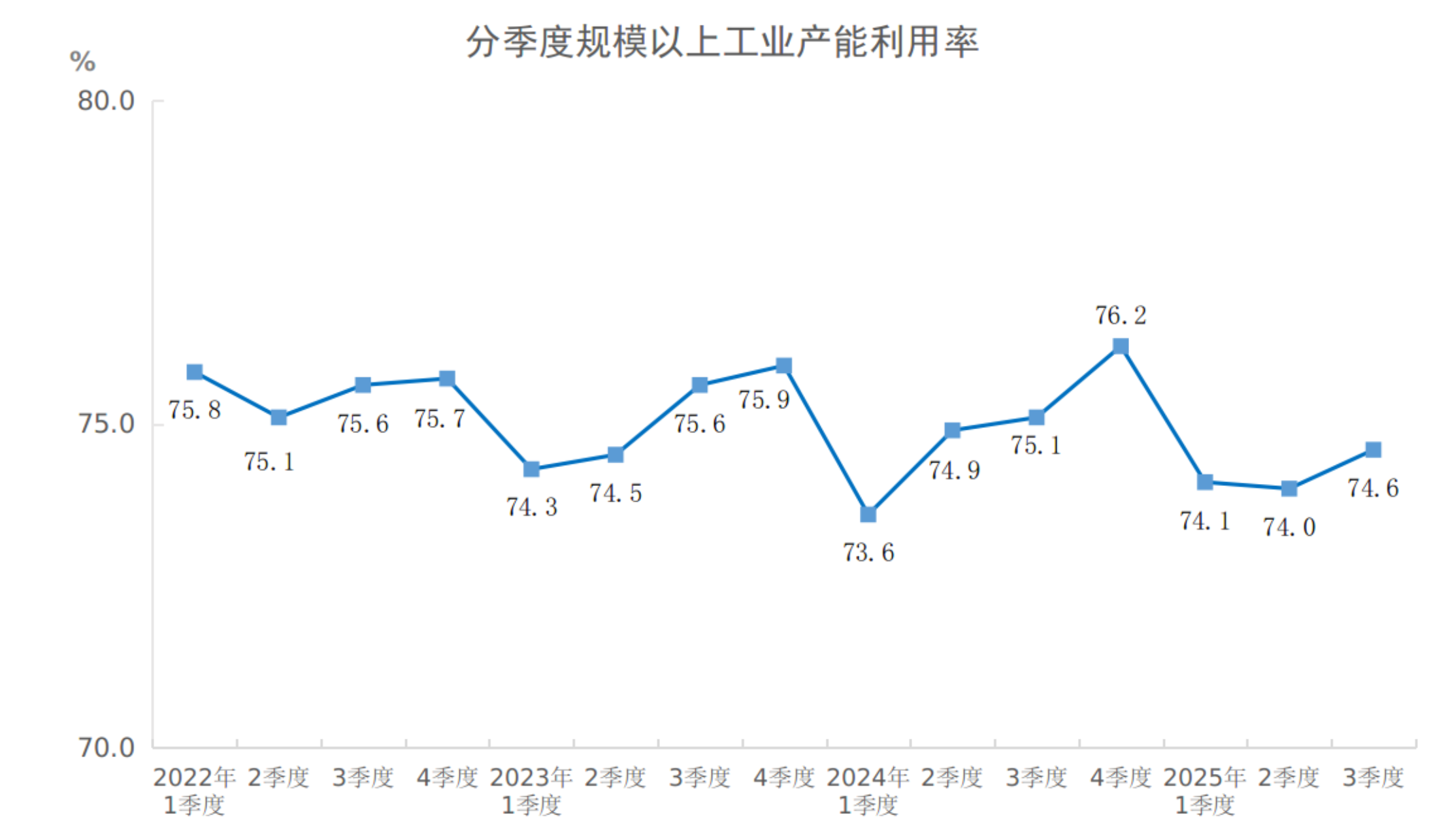
国家统计局:三季度,全国规模以上工业产能利用率为74.6%
Guo Jia Tong Ji Ju· 2025-10-20 02:12
Core Insights - The national industrial capacity utilization rate for large-scale industries in Q3 2025 is 74.6%, an increase of 0.6 percentage points from Q2, but a decrease of 0.5 percentage points compared to the same period last year [1] Group 1: Overall Capacity Utilization - The capacity utilization rate in the mining industry is 72.5% [1] - The manufacturing industry has a capacity utilization rate of 74.8% [1] - The electricity, heat, gas, and water production and supply industry shows a capacity utilization rate of 74.3% [1] Group 2: Industry-Specific Capacity Utilization - The coal mining and washing industry has a capacity utilization rate of 68.9% [1] - The food manufacturing industry reports a capacity utilization rate of 70.1% [1] - The textile industry has a capacity utilization rate of 77.2% [1] - The chemical raw materials and chemical products manufacturing industry shows a capacity utilization rate of 72.5% [1] - The non-metallic mineral products industry has a capacity utilization rate of 62.0% [1] - The black metal smelting and rolling processing industry reports a capacity utilization rate of 80.1% [1] - The non-ferrous metal smelting and rolling processing industry has a capacity utilization rate of 77.8% [1] - The general equipment manufacturing industry shows a capacity utilization rate of 78.9% [1] - The special equipment manufacturing industry reports a capacity utilization rate of 75.5% [1] - The automobile manufacturing industry has a capacity utilization rate of 73.3% [1] - The electrical machinery and equipment manufacturing industry shows a capacity utilization rate of 74.9% [1] - The computer, communication, and other electronic equipment manufacturing industry reports a capacity utilization rate of 79.0% [1]
2025年三季度全国规模以上工业产能利用率为74.6%
Guo Jia Tong Ji Ju· 2025-10-20 02:01
Core Insights - The industrial capacity utilization rate for Q3 2025 is reported at 74.6%, showing a decrease of 0.5 percentage points compared to the same period last year [4] - The mining industry has a capacity utilization rate of 72.5%, down by 2.1 percentage points year-on-year [4] - The manufacturing sector's capacity utilization stands at 74.8%, reflecting a decline of 0.4 percentage points from the previous year [4] - The electricity, heat, gas, and water production and supply industry maintains a capacity utilization rate of 74.3%, unchanged from the previous year [4] Industry Breakdown - In the mining sector, coal mining and washing have a capacity utilization rate of 68.9%, down 3.8 percentage points year-on-year [4] - The oil and gas extraction industry shows a high capacity utilization rate of 91.2%, an increase of 1.0 percentage points from the previous year [4] - The food manufacturing industry has a capacity utilization rate of 70.1%, decreasing by 0.6 percentage points [4] - The textile industry reports a capacity utilization of 77.2%, down by 0.7 percentage points [4] - The chemical raw materials and products manufacturing industry has a capacity utilization rate of 72.5%, down 3.5 percentage points [4] - The black metal smelting and rolling industry shows a strong capacity utilization rate of 80.1%, up by 2.7 percentage points [4] - The non-metallic mineral products industry has a low capacity utilization rate of 62.0%, slightly up by 0.3 percentage points [4] - The automotive manufacturing industry reports a capacity utilization of 73.3%, with a minor increase of 0.1 percentage points [4] - The computer, communication, and other electronic equipment manufacturing industry has a capacity utilization rate of 79.0%, up by 1.1 percentage points [4]

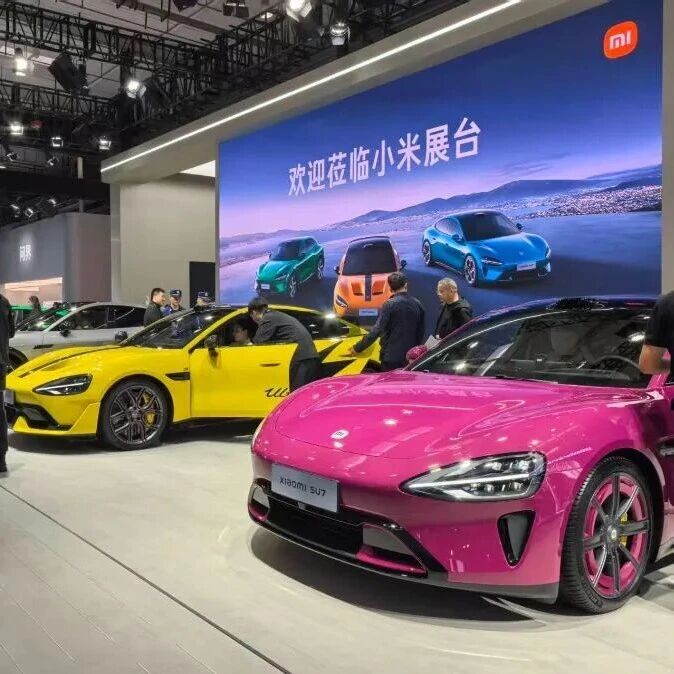
雷军称小米汽车交付量达40万台
21世纪经济报道· 2025-10-16 14:08
Core Viewpoint - The development of intelligent connected vehicles is at a historical opportunity period, requiring industry-wide collaboration to build a new ecosystem for shared growth [1]. Group 1: Industry Development - Xiaomi has delivered approximately 400,000 vehicles since announcing its entry into the automotive sector four and a half years ago, with one and a half years since product launch [2]. - The first half of the intelligent connected vehicle development has seen initial completion in electrification, while the second half is focusing on deepening intelligence, with innovations reshaping product definitions, production models, business models, and user experiences [2]. - The combination of advanced driver assistance systems is a focal point for the industry, with rapid development and significant improvements in experience and safety [2]. Group 2: Technological Innovations - AI large models are expected to provide limitless possibilities for intelligent connected vehicles, enhancing user experience without the need for internet connectivity [2]. - Voice control experiences are being improved through emotion recognition, optimized algorithms, and multi-modal interaction capabilities, allowing vehicles to recognize users and their environments [2]. - The voice synthesis technology is becoming more human-like, capable of learning and optimizing based on user habits and preferences [2]. Group 3: Strategic Vision - The long-term vision positions vehicles as intelligent mobile spaces, with Xiaomi's overall strategy encompassing a holistic ecosystem of people, vehicles, and homes [3]. - The interconnectedness of different scenarios and terminals within the smart ecosystem will enable vehicles to leverage AI computing power, creating vast application opportunities [3]. - The intelligent connected vehicle industry is complex and requires a collaborative ecosystem transformation rather than a single-point breakthrough [3].

光大证券晨会速递-20251015
EBSCN· 2025-10-15 03:24
Group 1: Macroeconomic Insights - In September 2025, China's exports grew by 8.3% year-on-year, driven by strong demand from non-US economies, capacity expansion overseas, and a low base effect from the previous year [2] - The export growth is expected to continue, supported by sustained demand from non-US economies and potential "export rush" due to high uncertainty in China-US trade relations [2] Group 2: Real Estate Sector - China Jinmao (0817.HK) has been included in the "China's 500 Most Valuable Brands" for 21 consecutive years, enhancing its brand value and operational efficiency, leading to a significant sales increase of 27.3% to 80.7 billion yuan in the first nine months of 2025 [3] - The profit forecasts for 2025-2027 have been raised to 1.25 billion, 1.43 billion, and 1.58 billion yuan, with corresponding PE ratios of 13.7, 12.0, and 10.8 times, maintaining a "Buy" rating [3] Group 3: Chemical Industry - Salt Lake Industry (000792.SZ) benefited from rising potassium chloride prices due to global supply tightening, leading to better-than-expected performance in Q3 2025 [4] - The profit forecasts for 2025-2027 have been adjusted to 6.149 billion, 6.648 billion, and 7.337 billion yuan, maintaining a "Buy" rating [4] Group 4: Advanced Materials - Zhongyan Co., Ltd. (688716.SH) is the largest producer of PEEK in China and is expected to achieve net profits of 29 million, 48 million, and 69 million yuan from 2025 to 2027, with EPS of 0.24, 0.39, and 0.57 yuan per share [5] - The company has surpassed UK-based Victrex to become the largest seller of PEEK in the Chinese market, receiving an "Add" rating [5] Group 5: Construction Sector - Honglu Steel Structure (002541.SZ) reported a new order signing of 22.267 billion yuan in the first three quarters of 2025, a year-on-year increase of 1.6%, with Q3 orders up by 4.2% [7] - The company’s steel structure product output reached approximately 3.61 million tons, a year-on-year increase of 11%, with profit forecasts for 2025-2027 set at 747 million, 774 million, and 854 million yuan, maintaining a "Buy" rating [7] Group 6: Pet Industry - Zhongchong Co., Ltd. (002891.SZ) achieved a revenue of 1.43 billion yuan in Q3 2025, a year-on-year increase of 15.9%, but net profit decreased by 6.6% due to reduced investment income [8] - The profit forecasts for 2025-2027 have been revised down to 441 million, 545 million, and 668 million yuan, maintaining an "Add" rating [8]
金龙鱼旗下梁汾醋业增资至约6.8亿元
Mei Ri Jing Ji Xin Wen· 2025-10-14 07:47
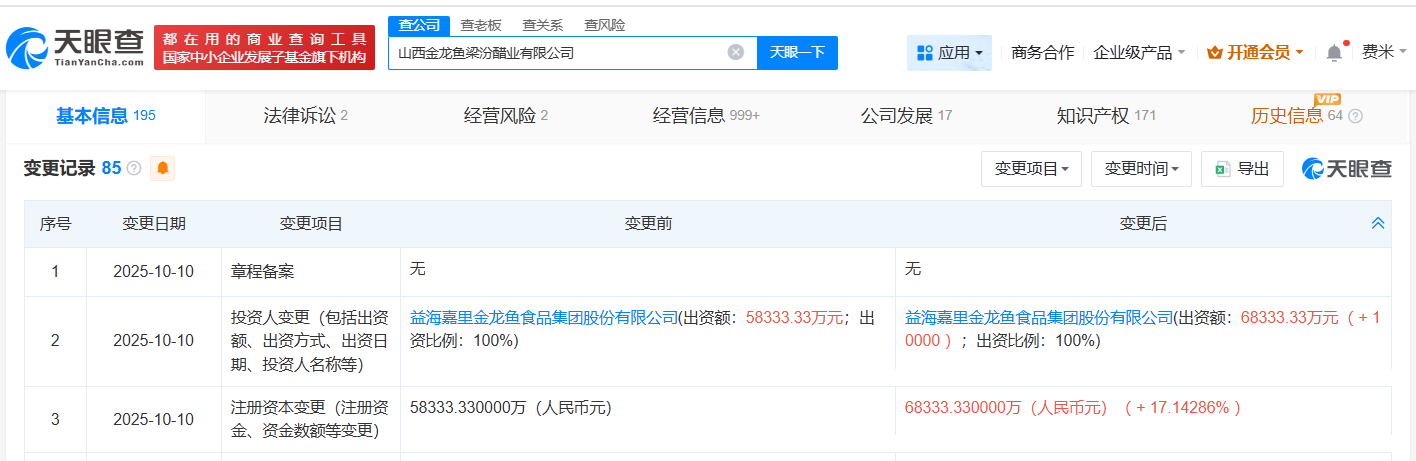
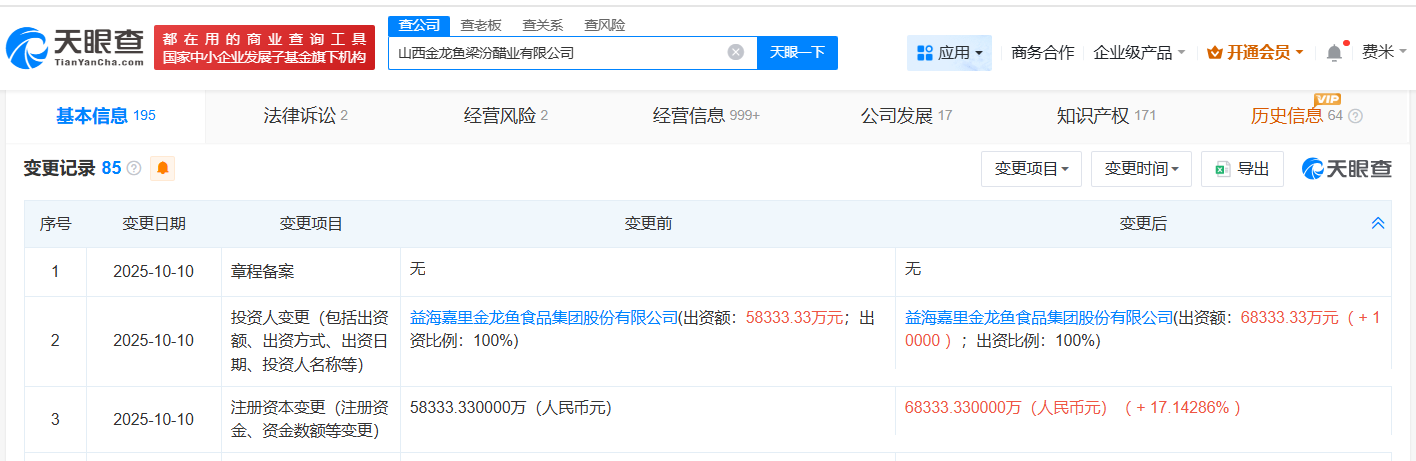
Core Insights - Shanxi Liangfen Vinegar Co., Ltd., a subsidiary of Yihai Kerry Group, has increased its registered capital from approximately 580 million RMB to about 680 million RMB, marking a growth of around 17% [1][2]. Company Information - The company was established in November 2010 and is wholly owned by Yihai Kerry Group [1][2]. - The legal representative of the company is Zhang Lin [1][2]. - The business scope includes the research and development of vinegar products, technical consulting, and technical services [1][2]. Financial Changes - The registered capital change reflects an increase from 583.33 million RMB to 683.33 million RMB [2][3]. - The capital increase is significant for the company's operational capacity and potential market expansion [1][2].
金龙鱼旗下梁汾醋业增资至约6.8亿
2 1 Shi Ji Jing Ji Bao Dao· 2025-10-14 07:31
Core Points - Shanxi Liangfen Vinegar Co., Ltd. has increased its registered capital from approximately 580 million RMB to about 680 million RMB, representing an increase of around 17% [1] - The company was established in November 2010 and is wholly owned by Yihai Kerry Group [1] Company Information - The legal representative of Shanxi Liangfen Vinegar Co., Ltd. is Zhang Lin [1] - The company's business scope includes research and development of vinegar products, technical consulting, and technical services [1] - The registered capital after the increase is approximately 680 million RMB [2] Ownership Structure - Yihai Kerry Group holds 100% of the shares in Shanxi Liangfen Vinegar Co., Ltd. with a subscribed capital of 683.33 million RMB [3]
社保基金三季度现身4只股前十大流通股东榜
Zheng Quan Shi Bao Wang· 2025-10-14 01:28
Core Viewpoint - The social security fund has emerged as a significant shareholder in several companies, indicating potential investment interest and confidence in these firms [1] Group 1: Shareholding Details - The social security fund's 413 portfolio is the fifth largest shareholder in Huaxin Cement, holding 12.81 million shares, which accounts for 0.95% of the circulating shares [1] - The social security fund's 422 portfolio is the second largest shareholder in Jinling Mining, with a holding of 8.81 million shares, representing 1.48% of the circulating shares [1] - The social security fund's 420 portfolio ranks as the ninth largest shareholder in Yingweik, owning 6.51 million shares, which is 0.77% of the circulating shares [1] - The social security fund's 118 portfolio is the tenth largest shareholder in Zhongchong Co., holding 1.44 million shares, accounting for 0.47% of the circulating shares [1]


券商晨会精华 | 市场关注向产能出清行业、顺周期方向及防御品种集中
智通财经网· 2025-10-14 00:40
Market Overview - The market opened lower but rebounded, with the Sci-Tech Innovation 50 Index initially down nearly 3% before closing up over 1% [1] - The total trading volume in the Shanghai and Shenzhen markets was 2.35 trillion, a decrease of 160.9 billion compared to the previous trading day [1] - By the end of the trading session, the Shanghai Composite Index fell by 0.19%, the Shenzhen Component Index dropped by 0.93%, and the ChiNext Index declined by 1.11% [1] Sector Performance - Sectors such as rare earth permanent magnets, non-ferrous metals, and semiconductors saw significant gains, while automotive parts and gaming sectors experienced declines [1] Investment Insights - Huatai Securities noted that the market is focusing on industries undergoing capacity clearance, cyclical sectors, and defensive stocks [2] - CITIC Construction emphasized the strategic investment opportunities in rare metals due to strengthened export controls, particularly highlighting the strategic value of antimony and tungsten in the context of geopolitical tensions [3] - The tungsten market is showing signs of recovery, with August exports nearing pre-control levels, while molybdenum demand is increasing, indicating a shift in China's manufacturing landscape [3] - Galaxy Securities pointed out a weak recovery in the food and beverage sector during the National Day and Mid-Autumn Festival, with a focus on third-quarter earnings reports [4] - The firm suggests prioritizing investments in sectors with supply clearance and valuation bottoms, as well as growth stocks in new categories and channels [4]


