
公用事业

Search documents
中泰国际:持续看好美国加征关税的公告
ZHONGTAI INTERNATIONAL SECURITIES· 2025-04-07 02:11
Market Overview - The Hang Seng Index fell 2.5% last week, closing at 22,849 points, while the Hang Seng Tech Index dropped 3.5% to 5,313 points. The Hong Kong Chinese Enterprises Index rose 0.6% as funds flowed back into high-dividend central state-owned enterprises [1] - Average daily trading volume in Hong Kong stocks decreased by 2.3% to HKD 253.4 billion, with significant inflows of HKD 63.2 billion through the Stock Connect, supporting the market [1] - The valuation of Hong Kong stocks has significantly recovered, with the AH premium at a four-year low, indicating potential for short-term pullbacks due to external pressures and liquidity concerns from company placements [1] Geopolitical and Economic Impact - The announcement of "reciprocal tariffs" by the U.S. has heightened market volatility, with tariffs on Chinese exports expected to rise to 66-67% when considering previous tariffs [2] - The Federal Reserve's cautious stance amid inflation uncertainty has led to increased risk aversion in global markets, impacting asset prices across various sectors [2] - The geopolitical tensions between the U.S. and China are expected to elevate risk premiums for Chinese assets, with potential negative impacts on emerging markets and Hong Kong stocks [2][3] Sector Analysis Consumer Sector - Haier Smart Home's stock fell 8.0% due to the unexpected increase in tariffs, which could negatively affect the investment climate for export-oriented companies [4] - The healthcare sector saw a 1.39% increase in the Hang Seng Healthcare Index, although some companies in the CXO sector experienced declines due to tariff impacts [4] Public Utilities and Environmental Sector - The public utilities sector is expected to benefit from new pricing governance policies aimed at improving pricing mechanisms for water and gas services, potentially leading to increased service charges [5][10] - The performance of public utility stocks has been mixed, with some companies like China Water Affairs showing strong revenue growth due to their high exposure to domestic water supply operations [11] Energy Sector - The coal price has decreased by 20.6% year-on-year, which may alleviate some negative impacts on the thermal power industry despite a decline in power generation [8] - The public utilities sector is expected to see a positive impact from the government's pricing reforms, particularly in water and gas operations [10] Company-Specific Insights WuXi Biologics - WuXi Biologics is projected to see a 9.6% increase in revenue for FY24, driven by a significant rise in new project numbers and improved demand in North America and Europe [13][14] - The company has a robust order backlog, with a 5.1% year-on-year increase expected by the end of FY24, supporting steady revenue growth [14] Market Sentiment - The overall performance of Hong Kong stocks in FY24 has been disappointing, with 83.3% of selected stocks underperforming market expectations, indicating a challenging operating environment [7] - The public utilities sector has shown more stability, with a lower error rate in earnings forecasts compared to other sectors [7]
特朗普在豪赌美国国运!我们该如何应对?
格隆汇APP· 2025-04-06 09:43
Core Viewpoint - The article discusses the implications of Trump's recent "reciprocal tariff" executive order, which imposes a 10% minimum tariff on global trade partners and a 34% tariff specifically on China, highlighting the potential economic risks and market reactions associated with this policy [1][2][3]. Group 1: Objectives of the Tariff Policy - The primary goal of the tariff policy is to alleviate the U.S. debt burden by increasing revenue through higher tariffs [5]. - Another objective is to stimulate the return of manufacturing jobs to the U.S. by making domestic production more financially attractive [6]. - The policy aims to reshape the geopolitical landscape and re-establish U.S. dominance in international trade [7]. Group 2: Market Reactions - Following the announcement, U.S. stock markets experienced significant declines, with the Dow Jones dropping 2.72%, S&P 500 down 3.16%, and Nasdaq falling 4.24% within two days [12]. - Global markets also reacted negatively, with Japan's Nikkei 225 index down 2.6% and Vietnam's stock market plummeting 7% [13]. - The volatility in the markets reflects concerns over the uncertainty of the tariff policy and its long-term implications [14]. Group 3: Investment Strategies - In the U.S. market, a cautious approach is recommended, avoiding high-valuation tech stocks and focusing on defensive sectors such as utilities and healthcare [24]. - For Hong Kong stocks, it is advised to reduce exposure to export-oriented companies and increase holdings in domestic consumption and financial sectors [34]. - In the A-share market, investors are encouraged to consider undervalued blue-chip stocks and sectors benefiting from domestic demand and technological advancements [34]. Group 4: China's Response and Market Risks - China is likely to implement reciprocal tariffs on U.S. goods, particularly in agriculture and energy, while also diversifying its export markets [37]. - Long-term strategies may include tax reductions and infrastructure investments to boost domestic demand, alongside enhancing regional trade cooperation [38]. - Potential risks include increased import costs leading to domestic inflation and the impact of reduced U.S. demand on export-oriented companies [38].


如何看待特朗普全球关税加征后续影响?
ZHONGTAI SECURITIES· 2025-04-06 03:25
Group 1: Tariff Policy Overview - Trump signed an executive order imposing a 10% "minimum baseline tariff" on all trade partners, with an additional 34% tariff specifically on China[1] - This is the largest new tariff policy announced since Trump took office in January 2025, affecting numerous countries and regions[1] - Certain goods, including copper, pharmaceuticals, semiconductors, and energy, are exempt from these tariffs[1] Group 2: Economic Implications - The tariffs are expected to significantly exceed market expectations, potentially leading to a collapse of the global trade order and a slowdown in economic growth[2] - The U.S. economy may face short-term stagflation, while a mid-term global economic slowdown is increasingly likely[3] - China's reliance on exports has increased since 2018, making it vulnerable to the pressures from Trump's tariffs[3] Group 3: Domestic Policy Response - In response to the tariffs, domestic policies may shift towards monetary easing, including potential interest rate cuts and liquidity measures[4] - The focus will be on managing expectations rather than fiscal stimulus, with a priority on maintaining market confidence[4] Group 4: Investment Strategy - Investment strategies should shift from high-risk tech stocks to defensive and safe assets, such as bonds and utilities[5] - Key sectors to focus on include gold, non-ferrous metals, and military industries due to the geopolitical instability caused by the tariffs[5]
新华保险又出手了!这次举牌的是北京控股 险资热衷举牌的逻辑是什么?
Mei Ri Jing Ji Xin Wen· 2025-04-03 15:50
Core Viewpoint - Xinhua Insurance has increased its stake in Beijing Enterprises Holdings Limited, acquiring an additional 150,000 shares, bringing its total ownership to approximately 5% of the company's total issued shares [1][2]. Group 1: Investment Activity - Xinhua Insurance acquired 150,000 shares of Beijing Enterprises on March 26, 2025, through a secondary market auction, which represents 0.01% of the total issued shares [1][2]. - Prior to this acquisition, Xinhua Insurance held 6,278,850 shares, which accounted for 4.99% of Beijing Enterprises' total issued shares [2]. - After the transaction, the total shares held by Xinhua Insurance increased to 62,938,500, representing 5% of the total issued shares of Beijing Enterprises [2]. Group 2: Financial Performance of Beijing Enterprises - In 2024, Beijing Enterprises reported a revenue of 84.064 billion yuan, reflecting a year-on-year growth of 2.13% [1]. - The net profit attributable to the parent company for 2024 was 5.123 billion yuan, which is a decline of 6.82% compared to the previous year [1]. - The basic earnings per share for Beijing Enterprises stood at 4.07 yuan [1]. Group 3: Strategic Rationale - Xinhua Insurance plans to categorize its investment in Beijing Enterprises as part of its equity investment management strategy [3]. - The company has been actively increasing its stakes in various listed companies since 2024, including Shanghai Pharmaceuticals and GuoYao Group, indicating a strategic shift towards equity investments [3]. - The Vice President of Xinhua Insurance stated that the company's investment activities are aimed at achieving long-term stable returns while adapting to current market conditions [3]. Group 4: Industry Trends - Since 2024, multiple insurance companies have been actively increasing their stakes in various sectors, including banking and utilities [3][4]. - For instance, Ping An Life has triggered multiple stake increases in banks such as China Merchants Bank and Postal Savings Bank [3]. - Longcheng Life has also shown a preference for infrastructure-related stocks, increasing its holdings in companies like Datang Renewable and China Water Affairs [4]. Group 5: Market Conditions - According to GuoXin Securities, insurance companies are facing pressure on their asset side due to declining long-term interest rates and ongoing volatility in the equity market [5]. - The report suggests that insurance companies are likely to continue increasing their allocation to high-dividend and high-capital appreciation potential stocks to meet long-term and stable demand [5]. - The strategy of acquiring stakes in listed companies is seen as a way to smooth accounting profits and reduce volatility in investment returns [5].


新华保险举牌北京控股H股,年内多家险资巨头举牌
Zhong Guo Ji Jin Bao· 2025-04-03 13:22
Core Viewpoint - Xinhua Insurance has increased its stake in Beijing Holdings to 5% through secondary market transactions, marking its second stake increase this year, following its acquisition of Hangzhou Bank in January [1][2][5]. Group 1: Company Actions - Xinhua Insurance announced the acquisition of an additional 150,000 shares of Beijing Holdings, raising its total holdings to 62,938,500 shares, which represents 5% of the company's total equity [3][4]. - The company has been active in the capital market, having previously increased its stakes in several companies, including China National Pharmaceutical Group, Shanghai Pharmaceuticals, and Haitong Securities [5][6]. Group 2: Financial Metrics - As of March 26, Xinhua Insurance's equity assets amounted to 317.47 billion yuan, accounting for 21.13% of its total assets, which were reported at 1,692.297 billion yuan with a net asset value of 96.24 billion yuan [4][6]. - The solvency ratio of Xinhua Insurance stands at 217.55%, indicating a strong capital position [4]. Group 3: Market Trends - The insurance sector has seen increased activity in the capital markets, with several major insurance companies, including China Life and Ping An Life, participating in stake increases across 13 listed companies this year [6]. - The banking sector has emerged as a favored investment area for insurance capital, followed by public utilities and energy companies, reflecting a strategic focus on stable and high-quality companies [6].
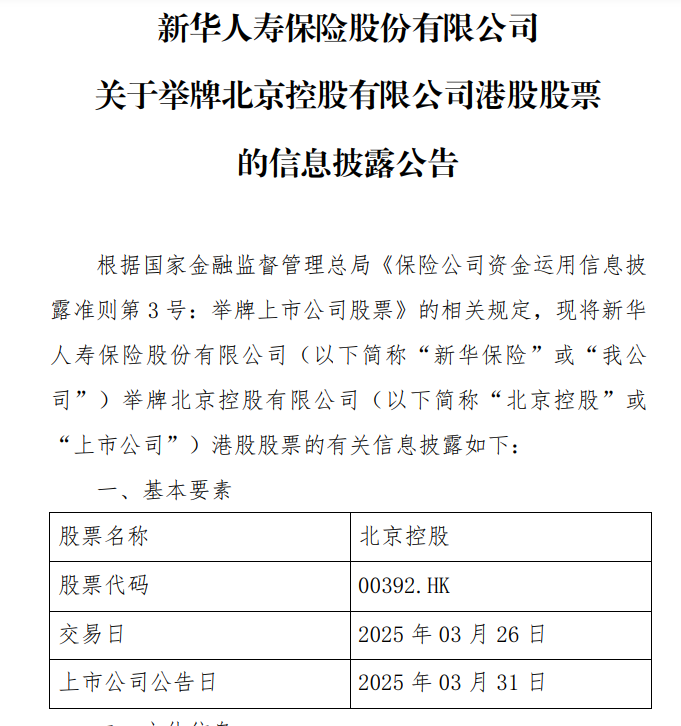
新华保险举牌北京控股,持仓市值超19亿港元
Huan Qiu Lao Hu Cai Jing· 2025-04-03 10:04
Group 1 - Xinhua Insurance increased its stake in Beijing Enterprises Holdings by acquiring 150,000 shares, raising its ownership to 62.9385 million shares, which is 5.00% of the total issued shares, triggering a mandatory disclosure [1] - The market value of Xinhua Insurance's holdings in Beijing Enterprises is approximately HKD 1.94 billion [1] - Beijing Enterprises reported a revenue of HKD 84.064 billion for 2024, a year-on-year increase of 2.13%, but its net profit decreased by 6.82% to HKD 5.123 billion [1] Group 2 - This is the second time Xinhua Insurance has made a significant stake acquisition in 2023, having previously acquired 5.45% of Hangzhou Bank from the Commonwealth Bank of Australia, increasing its stake to 5.87% [2] - The trend of frequent stake acquisitions by insurance companies reflects a broader pattern, with over six insurance firms having made stake acquisitions in 13 listed companies since 2025 [2] - The focus of these acquisitions is primarily on bank stocks and public utility stocks, with five of the 13 targeted companies being banks, indicating a preference for high-dividend assets in a low-interest-rate environment [2]
美股创两年多最差季度表现,科技股普跌,投资者转向欧洲市场
Jin Rong Jie· 2025-04-03 01:05
Group 1 - In Q1 2025, the US stock market experienced its worst quarterly performance since 2022, with the Nasdaq Composite down 10.4%, S&P 500 down 4.6%, and Dow Jones down 1.28% [1] - The decline in tech stocks was significant, with Tesla down approximately 36%, Nvidia down over 19%, and Apple down over 11%. The "Magnificent Seven" tech stocks index fell 14.83% [1] - Despite the overall downturn, defensive stocks provided stable returns, with seven out of eleven S&P 500 sectors achieving positive returns, including energy up nearly 8% and healthcare up 5% [2][3] Group 2 - The European market showed strong performance in Q1 2025, with the Stoxx Europe 600 index rising about 5%, contrasting with the US market [2] - Increased defense spending in Germany and other European countries led to significant gains in defense-related stocks, with Rheinmetall up 134.73% and Thales up 91.48% [2] - Analysts suggest that many US stocks, particularly in tech, are overvalued, while energy, healthcare, and utility sectors are undervalued, indicating a potential shift in investment focus towards international stocks [3]





【广发资产研究】资产配置如何应对“东升西落”叙事?——债务周期下的资产配置新策略系列之四
戴康的策略世界· 2025-04-03 00:21
戴康 CFA 广发证券发展研究中心 董事总经理(MD)、首席资产研究官 邮箱:daikang@gf.com.cn 报告摘要 ● 引言: 开年以来,"Deepseek"触发中美科技此消彼长叙事,恒生科技为代表的中国科技资产领涨全球,而美股&美元表 现不佳。战略层面:"Deepseek"带来中国科技资产的价值重估,但并未逆转(逆全球化加剧、债务周期错位、AI产业趋 势)三大底层逻辑,因此,全球资产配置仍然是反脆弱的"全球杠铃策略"。而战术层面:"全球杠铃策略"应该如何调整,来 应对"东升西落"的新叙事? ● 美股:低波动—>高波动,下调↓权重。 过去两年,标普500维持偏低的波动率,一定程度上源自内部成分股之间偏低的相 关性,偏低的相关性则源自AI产业叙事下(7姐妹为代表的)美股科技龙头与非科技龙头间的分化,增加美股的分散性。当 前,标普500内部成分股间的相关性仍处于历史低点。我们判断,2025年,均值回归的牵引力、美国经济衰退压力(美股或 面临系统风险)、美国AI产业趋势一枝独秀的格局被打破(科技股独立行情门槛变高)等因素都将带来美股个股间相关性提 升(美股科技龙头与非科技龙头之间的分化将收敛)—>美股波动率 ...
公用事业行业资金流出榜:中国广核等6股净流出资金超5000万元
Zheng Quan Shi Bao Wang· 2025-04-02 09:36
Market Overview - The Shanghai Composite Index rose by 0.05% on April 2, with 18 out of 28 sectors experiencing gains, led by textiles and apparel (1.45%) and beauty and personal care (1.01%) [1] - The sectors with the largest declines were defense and military (1.17%) and non-ferrous metals (0.87%), with public utilities ranking third in terms of decline [1] Capital Flow Analysis - The main capital flow showed a net outflow of 8.051 billion yuan across the two markets, with 9 sectors seeing net inflows [1] - The non-bank financial sector led with a net inflow of 1.787 billion yuan and a daily increase of 0.58%, followed by the telecommunications sector with a net inflow of 963 million yuan and a daily increase of 0.97% [1] - A total of 22 sectors experienced net outflows, with the pharmaceutical and biological sector leading with a net outflow of 2.759 billion yuan, followed by the electronics sector with a net outflow of 2 billion yuan [1] Public Utilities Sector Performance - The public utilities sector declined by 0.80% with a net outflow of 1.09 billion yuan, comprising 132 stocks, of which 20 rose and 106 fell [2] - Among the stocks in this sector, 44 saw net inflows, with the top three being Shaoneng Co. (39.724 million yuan), Guangdong Electric Power A (27.7136 million yuan), and Hunan Development (20.6605 million yuan) [2] - The stocks with the highest net outflows included China General Nuclear Power (1.399735 billion yuan), Qianyuan Electric Power (1.218559 billion yuan), and China Nuclear Power (1.042745 billion yuan) [2] Public Utilities Sector Capital Inflow Rankings - The top stocks by capital inflow included: - Shaoneng Co. with a rise of 3.67% and a turnover rate of 17.31%, net inflow of 39.724 million yuan [3] - Guangdong Electric Power A with a rise of 1.95% and a turnover rate of 3.20%, net inflow of 27.7136 million yuan [3] - Hunan Development with a rise of 10.00% and a turnover rate of 0.70%, net inflow of 20.6605 million yuan [3] Public Utilities Sector Capital Outflow Rankings - The stocks with the highest capital outflows included: - China General Nuclear Power with a decline of 1.89% and a turnover rate of 0.44%, net outflow of 139.9735 million yuan [4] - Qianyuan Electric Power with a decline of 4.70% and a turnover rate of 6.81%, net outflow of 121.8559 million yuan [4] - China Nuclear Power with a decline of 0.96% and a turnover rate of 0.37%, net outflow of 104.2745 million yuan [4]



【广发资产研究】资产配置如何应对“东升西落”叙事?——债务周期下的资产配置新策略系列之四
戴康的策略世界· 2025-04-02 07:33
戴康 CFA 广发证券发展研究中心 董事总经理(MD)、首席资产研究官 邮箱:daikang@gf.com.cn ● 美股:低波动—>高波动,下调↓权重。 过去两年,标普500维持偏低的波动率,一定程度上源自内部成分股之间偏低的相 关性,偏低的相关性则源自AI产业叙事下(7姐妹为代表的)美股科技龙头与非科技龙头间的分化,增加美股的分散性。当 前,标普500内部成分股间的相关性仍处于历史低点。我们判断,2025年,均值回归的牵引力、美国经济衰退压力(美股或 面临系统风险)、美国AI产业趋势一枝独秀的格局被打破(科技股独立行情门槛变高)等因素都将带来美股个股间相关性提 升(美股科技龙头与非科技龙头之间的分化将收敛)—>美股波动率加大—>资产配置组合中下调↓美股权重。 ● 中资股: 短期事缓则圆,中长期行情驱动力有望更健康。 短期视角,我们在 25.2.28《牛市二阶段,事缓则圆》 提示: 周线6连阳后,港股短期行情有所透支,事缓则圆,等待政策落地和科技产业叙事验证。从历史经验看6连阳后不建议追涨领 先板块,反而应关注本轮落后的低波、股息、价值、质量因子,如:银行、公用事业、石油石化、电信服务等。更长期视 角,本轮 ...