生猪养殖

Search documents
建信期货生猪日报-20250731
Jian Xin Qi Huo· 2025-07-31 01:16
1. Report Industry Investment Rating No relevant content provided. 2. Core View of the Report - In the short - term, due to increased group sales at the end of July and weak demand in the off - season, pig prices are likely to remain under pressure. In the long - term, although pig supply shows a slight increase, favorable policies such as the anti - involution initiative, high - quality development of the pig industry, and strengthened environmental protection in some regions will have a positive impact on pig prices, and the impact of subsequent policies on production capacity needs attention [8]. 3. Summary by Directory 3.1 Market Review and Operation Suggestions - **Futures Market**: On the 30th, the main 2509 contract of live pigs opened slightly lower, then rose, fell back, and fluctuated downward, closing with a negative line. The highest price was 14,240 yuan/ton, the lowest was 14,005 yuan/ton, and the closing price was 14,075 yuan/ton, a decrease of 0.49% from the previous day. The total open interest of the index decreased by 33 lots to 186,242 lots [7]. - **Spot Market**: On the 30th, the average price of ternary pigs nationwide was 13.93 yuan/kg, a decrease of 0.01 yuan/kg from the previous day [7]. - **Demand Side**: The utilization rate of pigsties is high, and the enthusiasm for secondary fattening is average, mainly in a wait - and - see state. Due to the hot weather, terminal demand is weak, and the orders of slaughtering enterprises are average. With the increase in the number of pigs sold by enterprises at the end of the month, the operating rate and slaughter volume of slaughtering enterprises have slightly increased. On July 30th, the slaughter volume of sample slaughtering enterprises was 137,400 heads, an increase of 800 heads from the previous day and 3,900 heads from a week ago [8]. - **Supply Side**: According to Yongyi data, the planned slaughter volume of sample enterprises in July was 23.88 million heads, a month - on - month decrease of 1.19% compared with June. At the end of the month, the slaughter progress of the breeding side accelerated, the enthusiasm for slaughter increased, the slaughter weight decreased slightly, and the utilization rate of pigsties for secondary fattening was high, with more pigs for secondary fattening still to be slaughtered [8]. 3.2 Industry News - As of July 24th, the average profit per self - bred and self - raised pig was 162 yuan/head, a week - on - week increase of 51 yuan/head; the average profit per pig purchased as a piglet was - 63 yuan/head, a week - on - week increase of 63 yuan/head [9][11]. 3.3 Data Overview - The average market sales price of 15 - kg piglets in the week of July 24th was 542 yuan/head, the same as the previous week [18]. - As of the end of the second quarter of 2025, the national pig inventory was 424.47 million heads, a year - on - year increase of 2.2% and a month - on - month increase of 7.16 million heads or 1.72%. From the second quarter of last year to the second quarter of this year, the month - on - month changes were 1.7%, 2.8%, 0.11%, - 2.37%, and 1.72% respectively [18]. - As of the week of July 24th, the average slaughter weight of national pigs was 128.48 kg, a decrease of 0.35 kg from the previous week, a month - on - month decrease of 0.27%, and an increase of 3.09 kg compared with the same period last year, a year - on - year increase of 2.46% [18].
分析人士:生猪期货远月预期走强
Qi Huo Ri Bao· 2025-07-30 23:34
Core Viewpoint - Since early June, live pig futures prices have shown a trend of fluctuating upward, but recently have experienced a pullback due to overall macro sentiment. As of July 30, the main contract for live pig futures closed at 14,075 yuan/ton, an increase of 600 yuan/ton or 4.5% from the closing price of 13,475 yuan/ton on June 9 [1]. Group 1: Market Dynamics - The live pig spot price has continued to decline since August 2024 due to excess production capacity. As of June 2025, the number of breeding sows in China was 40.43 million, showing a negligible decline of less than 1% from the peak at the end of 2024 [1]. - The Ministry of Agriculture and Rural Affairs has implemented a series of regulatory measures since June, including suspending the expansion of breeding sows and regulating secondary fattening. Following these measures, leading breeding companies quickly responded, leading to a rebound in live pig spot prices from their lows [1]. - As of July 3, the average daily price of live pigs in the mainstream market was 15.5 yuan/kg, an increase of 1.56 yuan/kg or 11% from the low point in early June [1]. Group 2: Supply and Demand Analysis - Despite the rebound in prices, supply-side pressures have not been effectively alleviated, and the current period is characterized by weak demand. The price of live pigs has shown a pullback after reaching a high in July [2][3]. - The recent "anti-involution" measures in the pig industry are expected to effectively eliminate outdated production capacity and control the weight of market pigs, which may lead to a decrease in live pig inventory [2]. - The average daily slaughter volume has decreased by 7.93% compared to June, making it difficult to absorb the output, and the spot price in Henan has dropped from 15.5 yuan/kg at the beginning of the month to 14 yuan/kg [3]. Group 3: Future Outlook - The "anti-involution" measures are expected to gradually take effect, potentially reducing the number of breeding sows to 39.5 million. This is likely to provide bottom support for long-term contracts [4]. - The increasing proportion of large-scale breeding enterprises is expected to smooth out the volatility of pig prices, reducing the impact of significant fluctuations in production capacity on prices [4]. - In 2024, the number of breeding sows among major listed companies is projected to increase by 6.12%, and the annual output of the top 10 listed pig companies is expected to reach 142.75 million heads, an increase of 10.56% compared to 2023 [4].
牧原股份:公司2025年6月的全程成活率在86%左右
Mei Ri Jing Ji Xin Wen· 2025-07-30 08:44
(文章来源:每日经济新闻) 牧原股份(002714.SZ)7月30日在投资者互动平台表示,公司2025年6月的全程成活率在86%左右,是 生猪从出生到出栏上市全过程的成活率。当前公司生猪养殖完全成本中,饲料成本占比在55-60%左 右。后续公司会充分发挥猪群的生长潜力,提升猪群健康水平,从而降低料肉比,提高饲料转换效率; 同时根据原材料价格及时调整饲料配方,有效降低饲料成本。 每经AI快讯,有投资者在投资者互动平台提问:公司成活率在行业中处于较低水平,为什么完全成本 还能领先呢?请问公司饲料造肉成本多少?保育育肥阶段的饲料价格多少? ...


牧原股份荣获证券之星供应链影响力奖
Zheng Quan Zhi Xing· 2025-07-30 02:10
该奖项是由证券之星联合妙盈科技等专业权威机构,在中国首席经济学家论坛等指导下设立的ESG领域权威奖项,旨在挖掘并表彰在环境(如低碳减排、绿 色供应链)、社会(如乡村振兴、公益慈善)及公司治理(如合规管理、风险防控)三大维度实现卓越实践,推动经济效能与社会责任深度融合的企业。 近日,证券之星第三届ESG新标杆企业评选结果揭晓,牧原股份(002714)凭借在环境、社会和治理(ESG)领域的卓越实践,荣获"供应链影响力奖"。 在供应链创新方面,牧原股份不断加大研发投入,积极探索新技术、新模式的应用。公司自主研发的智能化空气过滤猪舍、智能巡检机器人等创新技术,不 仅提高了养殖效率,降低了生产成本,还为供应链的高效运作提供了有力支持。此外,牧原还通过大数据分析、物联网技术等手段,实现了对供应链的实时 监控和精准管理,进一步提升了供应链的智能化水平。 在推动绿色供应链建设方面,牧原股份更是走在了行业前列。公司积极响应国家"双碳"目标,通过种养循环、无供热猪舍、光伏发电等绿色低碳技术的应 用,大幅降低了温室气体排放,实现了经济效益与环境效益的双赢。 2024年,牧原的温室气体减排价值达到529.14万吨二氧化碳当量,温室气 ...

建信期货生猪日报-20250730
Jian Xin Qi Huo· 2025-07-30 01:16
Report Information - Report Title: Pig Daily Report [1] - Date: July 30, 2025 [2] Industry Investment Rating - Not provided Core View - The pig price may continue to face pressure in the short - term due to increased group sales at the end of July and weak demand in the off - season. However, long - term pig prices are expected to be positively affected by factors such as anti - involution initiatives, high - quality development of the pig industry, and strengthened environmental protection efforts [10] Summary by Section 1. Market Review and Operation Suggestions - **Futures Market**: On the 28th, the main 2509 contract of live pigs opened higher, then fluctuated and declined, closing with a negative line. The highest was 14,350 yuan/ton, the lowest was 14,085 yuan/ton, and the closing price was 14,150 yuan/ton, down 0.49% from the previous day. The total open interest of the index decreased by 7,058 lots to 186,275 lots [9] - **Spot Market**: On the 29th, the average price of ternary live pigs in the country was 13.94 yuan/kg, down 0.1 yuan/kg from the previous day [9] - **Demand Side**: The utilization rate of pigsties is high, and secondary fattening is mainly in a wait - and - see state. Due to the hot weather, terminal demand is weak, and slaughterhouse orders are average. With the increase in enterprise sales at the end of the month, the slaughter rate and volume of slaughterhouses have slightly rebounded. On July 29th, the slaughter volume of sample slaughterhouses was 136,600 heads, 700 heads less than the previous day but 3,000 heads more than a week ago [10] - **Supply Side**: In July, the planned sales volume of sample enterprises was 23.88 million heads, a 1.19% month - on - month decrease from June. At the end of the month, the sales progress of the breeding side accelerated, the enthusiasm for sales increased, the sales weight decreased slightly, and the utilization rate of secondary fattening pigsties was high, with more secondary fattening pigs to be sold in the future [10] 2. Industry News - As of July 24th, the average profit per head of self - breeding and self - raising was 162 yuan/head, a weekly increase of 51 yuan/head; the average profit per head of purchasing piglets for breeding was - 63 yuan/head, a weekly increase of 63 yuan/head [11][13] 3. Data Overview - **15kg Piglet Price**: In the week of July 24th, the average market sales price of 15kg piglets was 542 yuan/head, the same as the previous week [21] - **National Pig Inventory**: At the end of the second quarter of 2025, the national pig inventory was 424.47 million heads, a year - on - year increase of 2.2% and a month - on - month increase of 7.16 million heads (1.72%). From the second quarter of last year to the second quarter of this year, the month - on - month changes were 1.7%, 2.8%, 0.11%, - 2.37%, and 1.72% respectively [21] - **Pig Slaughter Weight**: In the week of July 24th, the average slaughter weight of national pigs was 128.48 kg, a decrease of 0.35 kg from the previous week (a month - on - month decrease of 0.27%) and an increase of 3.09 kg compared with the same period last year (a year - on - year increase of 2.46%) [21]
综合晨报:中美继续推动关税展期90天,美7月消费者信心指数回升-20250730
Dong Zheng Qi Huo· 2025-07-30 00:42
1. Report Industry Investment Ratings No relevant content provided. 2. Core Views of the Report - The report covers various sectors including finance and commodities, analyzing the impact of economic events and policies on different assets. In the financial sector, it discusses the influence of trade negotiations, GDP forecasts, and central bank policies on gold, stock indices, and bonds. In the commodity sector, it assesses factors such as production, demand, and geopolitical events affecting coal, iron ore, agricultural products, and energy - related commodities. Overall, it provides investment suggestions based on the current market situation and future expectations in each sector [12][26][32]. 3. Summary by Relevant Catalogs 3.1 Financial News and Reviews 3.1.1 Macro Strategy (Gold) - The US 6 - month JOLTs job openings were 7.437 million, slightly lower than expected. Sino - US trade talks are optimistic, and the extension of tariffs is negative for gold. The dollar index is strong, and gold lacks the momentum to break through and rise in the short term. It is recommended to expect short - term gold to remain in a consolidation pattern with increased volatility [11][12][13]. 3.1.2 Macro Strategy (Stock Index Futures) - The IMF raised China's 2025 GDP growth rate to 4.8%. Sino - US trade talks led to a 90 - day extension of the suspended 24% reciprocal tariffs, which is beneficial for the stock market. It is recommended to allocate various stock indices evenly [14][15][16]. 3.1.3 Macro Strategy (Foreign Exchange Futures - US Dollar Index) - Trump may impose 20% - 25% tariffs on India. The third round of Sino - US trade talks ended with tariff extensions but no significant progress in other aspects, causing the dollar index to oscillate at a high level. It is recommended that the dollar index will oscillate at a high level in the short term [17][19][20]. 3.1.4 Macro Strategy (US Stock Index Futures) - Sino - US trade talks will continue to extend the suspended 24% reciprocal tariffs. The US consumer confidence index in July rebounded, but the job openings in June decreased slightly, and the market is cautious about future economic data. It is recommended to be aware of the risk of pullbacks [21][22][24]. 3.1.5 Macro Strategy (Treasury Bond Futures) - The central bank's income perception index declined in the second quarter. The central bank conducted a 449.2 - billion - yuan 7 - day reverse repurchase operation, with a net injection of 234.4 billion yuan. It is recommended to go long after the market negatives are mostly cleared in early August [25][26][27]. 3.2 Commodity News and Reviews 3.2.1 Black Metals (Steam Coal) - On July 25, the price of steam coal in the northern port market remained stable. Downstream demand was weak, and the market was in a stalemate. It is recommended to pay attention to the change in daily consumption growth rate [28]. 3.2.2 Black Metals (Iron Ore) - Anglo American's iron ore production in the second quarter of 2025 increased year - on - year, and sales were slightly different. The iron ore price oscillated at a high level. It is recommended to wait and see for now [29]. 3.2.3 Agricultural Products (Soybean Oil/Rapeseed Oil/Palm Oil) - Indonesia's B50 biofuel plan may increase palm oil consumption by 3 million tons. The EU will allow Indonesian palm oil to enter the market with zero tariffs. It is recommended not to short, be cautious when going long, and choose P2601 and Y2601 contracts, while paying attention to China's actual soybean oil exports [30][31][32]. 3.2.4 Agricultural Products (Cotton) - New cotton in Xinjiang has entered the boll - setting stage with good growth. Brazil's cotton harvesting progress was 21.7% as of July 26. US cotton growth was slightly slower, and the excellent - good rate declined. It is recommended that the 9 - month contract may be weak in the short term, and the 1 - month contract may oscillate and adjust, while paying attention to Sino - US trade negotiation results [33][34][36]. 3.2.5 Agricultural Products (Pigs) - Tiankang Bio's pig - raising cost dropped to 13 yuan/kg at the beginning of 2025. It is recommended to use a reverse - spread strategy [37][38]. 3.2.6 Black Metals (Rebar/Hot - Rolled Coil) - The CMI index in July increased by 5.54% year - on - year. Steel prices rose, mainly driven by expectations of the Politburo meeting and environmental protection restrictions during the parade. It is recommended to be cautious in the short term as the market may fluctuate greatly [39][40][41]. 3.2.7 Black Metals (Coking Coal/Coke) - The auction price of coking coal in the Lvliang market increased. After the previous sharp rise in the futures market, it has recently fallen to digest some sentiment. Coke enterprises have started the third round of price increases. It is recommended to pay attention to position management [42][43][44]. 3.2.8 Non - ferrous Metals (Copper) - Peru is considering approving a 6 - billion - dollar mining project. The EU and the US will establish a metal alliance. The US copper price premium declined. It is recommended to go long on dips unilaterally and pay attention to the internal - external reverse - spread strategy [45][46][48]. 3.2.9 Non - ferrous Metals (Lithium Carbonate) - Jiangte Motor's actual controller changed, and the stock resumed trading. After the position limit took effect, the speculative sentiment receded. It is recommended not to short too early on the left side and wait for a safer point to go long [49][50]. 3.2.10 Non - ferrous Metals (Lead) - Adriatic Metals' silver production in the second quarter increased by 23% quarter - on - quarter. The lead market oscillated weakly. It is recommended to pay attention to short - term callback buying opportunities and manage positions well, and wait and see for arbitrage [51][52][53]. 3.2.11 Non - ferrous Metals (Zinc) - Newmont and Fresnilloplc's zinc concentrate production increased quarter - on - quarter. The zinc market fundamentals weakened, but the decline led to better spot trading. It is recommended to wait and see unilaterally, pay attention to the mid - term monthly spread positive - spread opportunity for arbitrage, and wait and see for internal - external trading [54][55][58]. 3.2.12 Non - ferrous Metals (Nickel) - PT Vale obtained a 2.2 - million - ton nickel ore quota. It is recommended to wait and see in the short term and pay attention to shorting opportunities on rallies in the medium term [59][60][61]. 3.2.13 Energy Chemicals (Crude Oil) - Trump will give Russia 10 days to reach a cease - fire agreement. API crude oil inventory increased. Oil prices rose, and the short - term risk premium may increase. It is recommended that the short - term trend is oscillating and strengthening [62][63][65]. 3.2.14 Energy Chemicals (Carbon Emissions) - On July 29, the CEA closing price was 73.32 yuan/ton, down 0.46% from the previous day. It is recommended that CEA will oscillate in the short term [66][67]. 3.2.15 Energy Chemicals (Caustic Soda) - On July 29, the caustic soda market in Shandong was stable. Supply was expected to increase, and demand was stable. It is recommended that the caustic soda price may rise slightly but with limited increase [68][69]. 3.2.16 Energy Chemicals (Pulp) - The price of imported wood pulp showed different trends among different varieties. It is recommended to be aware of the risk of capital speculation on low - valuation pulp [70][71]. 3.2.17 Energy Chemicals (PVC) - The PVC powder market price weakened. It is recommended to be aware of the risk of capital speculation on low - valuation PVC [72]. 3.2.18 Energy Chemicals (PTA) - The PTA spot market was quiet, and the basis was weak. Supply and demand were in a tight - balance state. It is recommended that the PTA price may oscillate slightly stronger in the short term with increased volatility [73][74]. 3.2.19 Energy Chemicals (Urea) - In July 2025, the urea开工 load rate decreased month - on - month. It is recommended to view the urea market as oscillating in the short term [75][76]. 3.2.20 Energy Chemicals (Styrene) - Sinopec raised the pure benzene listing price by 100 yuan/ton. It is recommended to pay attention to macro - sentiment changes for styrene and view pure benzene as oscillating in the short term [77][78]. 3.2.21 Energy Chemicals (Bottle Chips) - Bottle chip factory export quotes were mostly stable, with some slightly decreasing. It is recommended to pay attention to the opportunity of expanding the processing fee by going long on dips [79][80]. 3.2.22 Energy Chemicals (Soda Ash) - On July 29, the soda ash market in South China was stable. The futures price continued to fall. It is recommended to operate carefully and wait for policy guidance [81]. 3.2.23 Energy Chemicals (Float Glass) - On July 29, the price of float glass in Hubei remained unchanged. The futures price dropped significantly. It is recommended to operate cautiously on the long - short side and focus on the long - glass short - soda - ash arbitrage strategy [82][83][84].
牧原股份股价下跌2.19% 公司创新模式入选联合国案例
Jin Rong Jie· 2025-07-29 18:36
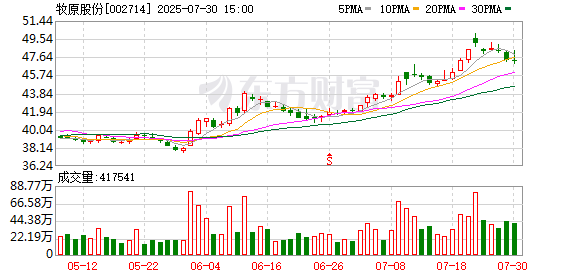
Group 1 - The stock price of Muyuan Foods on July 29 was 47.28 yuan, down by 1.06 yuan, a decrease of 2.19% from the previous trading day. The trading volume was 436,200 hands, with a transaction amount of 2.068 billion yuan [1] - Muyuan Foods' main business is pig breeding and sales, with primary products including commercial pigs, breeding pigs, and piglets. The company employs a "self-breeding, self-raising large-scale integrated" business model, forming a complete pig industry chain that includes research, feed processing, pig breeding, breeding pig expansion, commercial pig raising, and pig slaughtering [1] - The company has innovated a "pig-raising in fields, field-raising pigs" circular model, treating pig manure into organic fertilizer provided free to farmers, currently serving 4.72 million acres and reducing chemical fertilizer usage by 154,600 tons. This model has been selected as a sustainable agriculture case by the Food and Agriculture Organization of the United Nations [1] - The company has also made significant progress in independent breeding, breaking through restrictions on imported breeding pigs [1] Group 2 - On July 29, the net outflow of main funds for Muyuan Foods was 357 million yuan, accounting for 0.2% of the circulating market value [2]
农林牧渔行业周报:猪价继续回落,关注生猪产能调控-20250729
Yong Xing Zheng Quan· 2025-07-29 12:45
Investment Rating - The industry investment rating is maintained as "Increase" [6] Core Viewpoints - The agricultural sector outperformed the market by 1.93 percentage points during the week of July 21-25, 2025, with the index closing at 2,855.04, reflecting a weekly increase of 3.62% [1][15] - The pig farming sector is experiencing a decline in prices, with the average price of pigs at 14.15 yuan/kg, down 0.84% week-on-week and down 26.15% year-on-year [2] - The report emphasizes the importance of cost control for listed pig farming companies to navigate the pig cycle effectively [4] Summary by Sections 1. Market Review - The agricultural sector's index increased by 3.62%, ranking 9th among 31 sectors [1][15] - The breeding sector showed the best performance with a 5.27% increase, followed by planting, fishery, feed, agricultural product processing, and animal health sectors [17] 2. Industry Dynamics 2.1 Pig Farming - The profit from self-breeding pigs is 62.16 yuan/head, down 28.73 yuan/head week-on-week, while the profit from purchased piglets is -71.39 yuan/head, down 52.73 yuan/head [2] 2.2 Poultry - Chicken chick prices have rebounded, with an average price of 1.93 yuan/chick, up 40.88% week-on-week, and white feather chicken prices at 6.70 yuan/kg, up 4.69% [3] 2.3 Agricultural Products - Wheat and rice prices have increased, with wheat at 2,444.56 yuan/ton (up 0.20%) and rice at 2,912.00 yuan/ton (up 0.69%), while soybean meal prices have decreased to 2,964.00 yuan/ton (down 0.07%) [3] 3. Investment Recommendations - The report suggests focusing on the pig farming sector, particularly companies with strong cost control such as Muyuan Foods, Wens Foodstuff Group, and others [4] - For poultry, it recommends looking at integrated industry leaders like Shennong Development and Lihua Stock [4] - In the feed sector, it highlights Haida Group and Hefeng Stock as key players benefiting from the recovery in livestock inventory [4] - For agricultural products, it suggests monitoring Suqian Agricultural Development and Beidahuang [4]
大宗商品:反转之后的博弈
对冲研投· 2025-07-29 12:04
Core Viewpoint - The recent market volatility is driven by intense corrections in speculation, raising questions about whether the current supply-side policy-driven rally has ended or is merely a "backward catch" opportunity [3][8]. Policy Analysis - The government has emphasized the need to combat deflation through supply-side policies, such as halting the addition of excess capacity and promoting domestic consumption. The scope of supply rationalization measures has expanded to include metals, petrochemicals, and industries like lithium and coal, which have reported supply disruptions [3][9]. - Historical responses to deflation have varied, with the current situation being unique due to the predominance of advanced capacity and the fragmented industrial landscape, alongside high government debt limiting fiscal space [3][9][10]. Commodity-Specific Insights - Lithium prices have rebounded but remain below marginal cash costs of $11,500/ton, with approximately 45% of global capacity unable to cover cash costs at a price of $9,000/ton. This suggests limited downside potential for prices [4][13]. - Recent compliance checks in the lithium sector may lead to short-term supply disruptions, with around 20,000 tons of lithium capacity facing compliance risks, potentially resulting in significant inventory depletion and price rebounds [14]. - In the coal sector, production inspections are focused on preventing overproduction, with expectations of moderate impacts. However, recent price declines may limit further downside [5][15]. Agricultural Sector Developments - The hog farming industry is actively responding to regulatory controls by reducing breeding sow inventories and adjusting market weights, which may support near-term price stability and long-term valuation increases [6][16]. Market Trends and Expectations - The bond market reflects expectations of prolonged deflation, with government policies aimed at supply-side constraints potentially boosting industrial prices and improving upstream profits. This may reduce the urgency for monetary easing [6][17]. - The recent surge in government infrastructure investment, such as the $1.2 trillion Tibet dam project, has also contributed to supply concerns and influenced market dynamics [6][17].

调研报告 | 广东生猪调研报告
对冲研投· 2025-07-29 12:04
Core Viewpoint - The article discusses the current state and future expectations of the pig farming industry in Guangdong, highlighting the impact of diseases, weather conditions, and market dynamics on production and pricing. Group 1: Disease Impact - In early 2023, there were occurrences of pig diarrhea diseases in various regions, affecting supply and market sentiment [1][11][30] - The heavy rainfall in May and June also contributed to disease issues, impacting the number of pigs available for market [1][11] Group 2: Production Trends - The industry is expected to enter a slow reduction phase in production due to clear government targets for price stabilization and production cuts [2][13] - Major enterprises are likely to see a decrease in breeding costs in the second half of the year, maintaining a low-profit status [2][6] - The average cost of pig farming is around 13.3 CNY/kg, with potential for further reduction [6][19] Group 3: Price Expectations - Market sentiment is cautiously optimistic for price increases around August, but there are concerns about whether prices will exceed previous highs [2][16] - The southern provinces are currently showing positive price expectations, which may influence the overall market [2][13] Group 4: Company Insights - Company A has a stable production capacity of approximately 104,000 pigs, but has seen a decrease in monthly output due to disease impacts [5][8] - Company B plans to increase its annual output to 2 million pigs, with a current monthly output of about 150,000 [14] - Company D aims to increase its production capacity to 230,000 pigs, with a target of reducing costs to below 14 CNY/kg [19][21] Group 5: Trade and Market Dynamics - Trade flows primarily target the Guangdong market, with some exports to neighboring regions [9][22] - The demand for pork is expected to improve, particularly as the market enters a seasonal peak, although high prices may dampen consumption [10][15] - The overall feed sales in June showed a 4-5% increase, indicating stable demand in the market [18][25]