科技

Search documents
指数基金产品研究系列报告之二百五十五:纳斯达克精选增强的投资标的:华宝纳斯达克精选(017436)投资价值分析
Shenwan Hongyuan Securities· 2025-09-23 07:45
2025 年 09 月 23 日 纳斯达克精选增强的投资标的:华 宝纳斯达克精选(017436)投资价 值分析 ——指数基金产品研究系列报告之二百五十五 股 票 证 券 研 究 报 告 证券分析师 联系人 白皓天 (8621)23297818× baiht@swsresearch.com 本研究报告仅通过邮件提供给 中庚基金 使用。1 请务必仔细阅读正文之后的各项信息披露与声明 白皓天 A0230525070001 baiht@swsresearch.com 蒋辛 A0230521080002 jiangxin@swsresearch.com 邓虎 A0230520070003 denghu@swsresearch.com 权 益 量 化 研 究 基 金 相关研究 - ⚫ 持续 AI 热点下,信息技术已成为美股高景气的核心行业之一:信息技术已成为美股宽基 指数的核心行业之一:我们采用标普 500、纳斯达克 100 指数衡量美股代表性宽基指数 的分布情况;自 2022 年 10 月 ChatGPT 发布以来,美股信息技术行业展现出了高弹性 与较高的长期收益水平,绩优时段主要出现在 2022 年 10 月以来,当 ...
中盘指增相对坚挺 | 私募业绩观察
Sou Hu Cai Jing· 2025-09-23 04:12
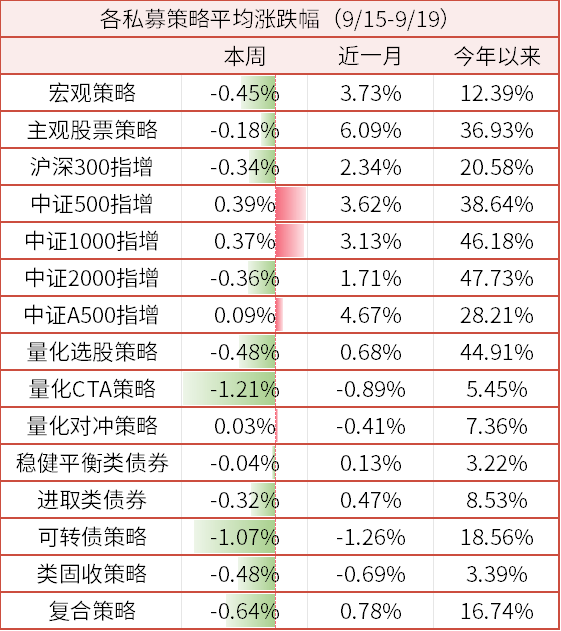
Market Overview - The market performance was weak during the week of September 15-19, with a lack of significant catalysts leading to profit-taking behavior and noticeable rotation among sectors [1] - The average daily trading volume of the entire A-share market was 2.52 trillion, up 8.23% week-on-week, indicating a relatively warming fund atmosphere as the bull market enters a consolidation phase [1] - The Federal Reserve's interest rate cut was in line with market expectations, but it did not significantly boost market sentiment due to prior price increases already factoring in the cut [1] Private Equity Strategies - The performance of various private equity strategies was generally average, with slight fluctuations in stock strategies, particularly stronger performance in mid-cap index strategies [2][3] Private Equity Strategy Performance - Macro strategy: -0.45% this week, 3.73% over the past month, and 12.39% year-to-date [3] - Subjective stock strategy: -0.18% this week, 6.09% over the past month, and 36.93% year-to-date [3] - CSI 500 index strategy: 0.39% this week, 3.62% over the past month, and 38.64% year-to-date [3] - CSI 1000 index strategy: 0.37% this week, 3.13% over the past month, and 46.18% year-to-date [3] - CSI 2000 index strategy: -0.36% this week, 1.71% over the past month, and 47.73% year-to-date [3] Sector Performance - The coal sector saw a weekly increase of 1.97%, while the power equipment sector decreased by 0.53% [6] - The electronics sector fell by 0.47%, and the automotive sector decreased by 1.94% [6] - The healthcare sector experienced a decline of 1.41%, while the food and beverage sector saw a slight decrease of 0.12% [6] Future Market Outlook - The current bull market is in a consolidation phase, which may lead to short-term corrections, increasing the demand for risk management capabilities among fund managers [4] - High-growth sectors, particularly in technology, are expected to remain market leaders, while sectors that have experienced significant declines may also present rotation opportunities [4] Bond Market - The bond market showed slight recovery, with the overall sentiment remaining weak, and long-term configurations are considered to have good value [9] - The bond market is expected to remain cautious in the short term due to strong profit-taking behavior in the equity market [9] Quantitative Strategies - The quantitative stock selection strategy showed mixed results, with the overall environment being average, and the growth-oriented sectors like the ChiNext and technology performing relatively well [8] - The quantitative CTA strategy reported an average loss of -1.21%, with trading volumes and volatility showing varied trends [12] Macro Hedge Strategy - The macro hedge strategy faced negative performance, with equity assets showing slight fluctuations and bond assets performing flat [15] - The coal and energy sectors showed strong performance, while gold prices fluctuated following the Federal Reserve's interest rate decision [15]

资金回流!外资单周净流入中资股创新高,港股科技50ETF近日吸金超2亿
Xin Lang Cai Jing· 2025-09-23 02:34
Group 1 - The core viewpoint of the article highlights that with the Federal Reserve initiating interest rate cuts, Hong Kong's technology assets are experiencing inflows from both domestic and foreign investors [1][5] - As of September 17, foreign net inflows into Chinese stocks reached $1.86 billion, marking the highest weekly inflow since November of the previous year [1][5] - Passive foreign investments shifted from a net outflow of $230 million to a net inflow of $1.9 billion, indicating a significant change in investor sentiment [1][5] Group 2 - The Hong Kong Technology Index is currently valued at 24.59 times PE, which is at the 15.36% historical percentile, suggesting potential undervaluation [3] - The Hong Kong Technology 50 ETF has seen continuous net inflows exceeding 200 million yuan over the past week, reflecting growing investor interest [2] - Historical data indicates that after the Federal Reserve's initial rate cuts, the probability of A-shares and Hong Kong stocks rising in the following three months is 100% and 75% respectively, with a 100% probability for Hong Kong stocks over the next six months [2][8] Group 3 - The article notes that the southbound capital allocation in technology remains low at 2.7%, slightly improved from 3.0% in early July, indicating a cautious approach towards technology investments [1][5] - The overall market outlook remains positive for both A-shares and Hong Kong stocks under the current easing monetary policy environment, with a focus on growth-oriented sectors [8] - The narrowing of the Hong Kong-US interest rate differential is expected to alleviate liquidity constraints, further attracting foreign investments into the Hong Kong market [8]

英伟达拟投资OpenAI带动美股科技板块,港股通科技ETF(513860)上涨0.23%,英诺赛科涨超3%
2 1 Shi Ji Jing Ji Bao Dao· 2025-09-23 02:01
Group 1 - Hong Kong stocks opened slightly higher on September 23, with the Hong Kong Stock Connect Technology ETF (513860) rising by 0.23% at the time of reporting [1] - Notable gainers among the ETF's constituent stocks included InnoCare Pharma and Crystal International, both up over 3%, along with other companies like BYD Electronics and Kingsoft [1] - The Hong Kong Stock Connect Technology ETF closely tracks the CSI Hong Kong Stock Connect Technology Index, which selects 50 large-cap, high R&D investment, and fast-growing revenue technology companies to reflect the overall performance of technology leaders in the Hong Kong Stock Connect [1] Group 2 - According to Huatai Securities, the release of DeepSeek at the beginning of the year triggered the first round of revaluation of Chinese technology assets, with a second upward trend in tech stocks occurring in the third quarter due to AI concepts [2] - The recent rapid rebound in Hong Kong technology stocks is attributed to accelerated domestic AI developments, and there is potential for further improvement in market sentiment [2] - The current focus of technology companies on growth, combined with a stable domestic economic and policy environment, has reduced the equity risk premium [2]

英伟达宣布1000亿美元投资,美股三大指数再创新高
Guan Cha Zhe Wang· 2025-09-23 00:53
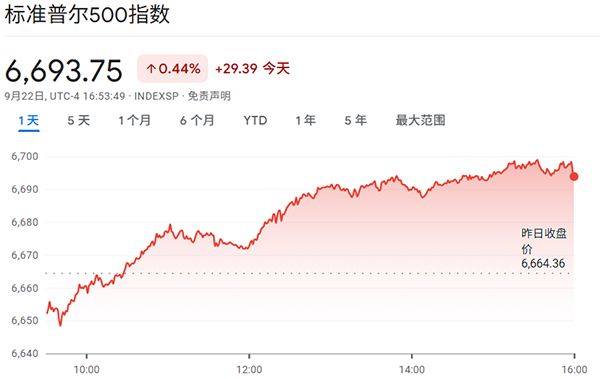
据美国财经网站消费者新闻与商业频道(CNBC)报道,当地时间9月22日,美股三大股指集体收涨, 并在盘中及收盘时双双创下历史新高。此番上涨的核心驱动来自于英伟达与甲骨文的强劲表现。 具体来看,标普500指数上涨0.44%,收于6693.75点;纳斯达克综合指数上涨0.70%,报22788.98点;道 琼斯工业平均指数上涨66.27点,涨幅0.14%,收于46381.54点。三大股指在交易日内均创下历史新高, 并最终以纪录高位收盘。 当天,英伟达宣布将向人工智能公司OpenAI投资1000亿美元,用于建设数据中心。消息公布后,CFRA 研究公司首席投资策略师萨姆·斯托瓦尔(Sam Stovall)表示,这项合作或意味着人工智能板块的交 易"将继续推动每股收益和股价增长,至少持续到2026年甚至更久"。 此外,科技板块的其它个股中,甲骨文(Oracle)表现同样亮眼。受公司首席执行官更换的消息影响, 甲骨文股价当天上涨6%,本月累计涨幅达到45%。 与此同时,苹果股价也表现突出,收盘上涨4%,主要受益于市场对新一代iPhone需求强劲的预期。 相比之下,亚马逊、Meta、博通跌超1%,谷歌小幅下跌近1%,显示科技 ...
《周末小结系列》:“保险式降息”:美元见底?美股还能嗨多久?
Sou Hu Cai Jing· 2025-09-23 00:15
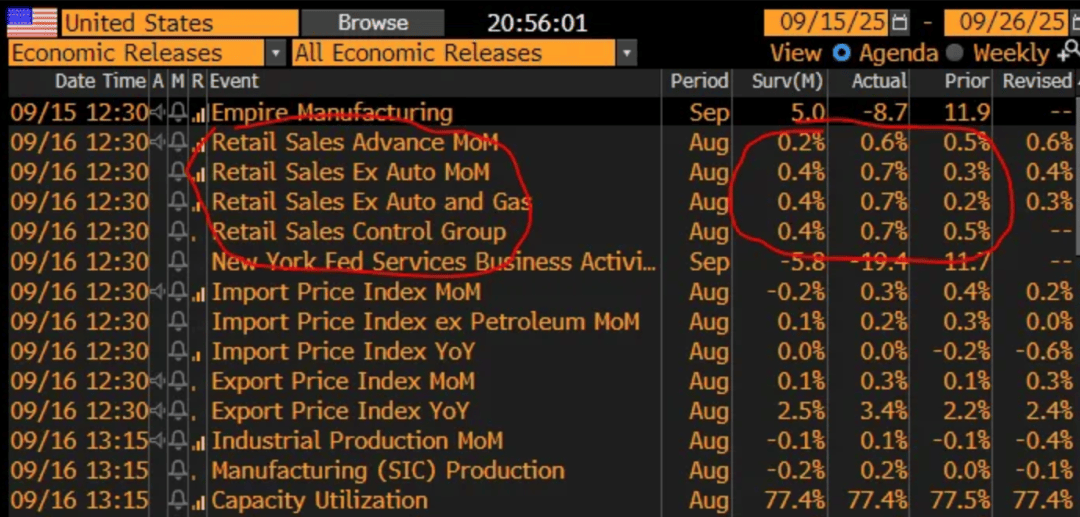
Group 1 - The core focus of the market in the past week was on the strong U.S. retail sales data and the Federal Reserve's FOMC meeting, which resulted in a significant interest rate cut described as "insurance-style" [1][5] - U.S. retail sales data exceeded expectations, particularly the retail control group, indicating that consumer spending remains robust despite signs of a cooling labor market [2][4] - The Federal Reserve's decision to cut rates was characterized as a preventive measure rather than a response to an economic downturn, suggesting that the overall economic condition is still stable [5][6] Group 2 - The market's initial reaction to the retail data was somewhat counterintuitive, with short-term interest rates falling before rebounding after the FOMC meeting [6][8] - The performance of the U.S. dollar is expected to stabilize, with potential for a rebound as the Fed enters a phase of consecutive rate cuts, which may correct market expectations of excessive easing [11][18] - U.S. equities, particularly growth and technology stocks, have been performing well, supported by the combination of a stable economy and Fed rate cuts, with small-cap stocks potentially poised for a rebound due to low positioning [13][14][16] Group 3 - The Bank of England faces a dilemma regarding the sale of long-term bonds purchased during QE, which could either exacerbate the pressure on the bond market or lead to significant losses if held [16][18] - The overall conclusion from the week's events indicates that the U.S. economy is not weakening as feared, and the Fed's "insurance-style" rate cut is favorable for risk assets, with implications for the dollar, equities, and gold [18]
“我们需要最聪明的人”,英伟达与OpenAI回应特朗普H-1B签证费调整
Hua Er Jie Jian Wen· 2025-09-22 20:59
Core Viewpoint - The proposed increase in H-1B visa fees by the Trump administration is seen positively by industry leaders like NVIDIA's Jensen Huang and OpenAI's Sam Altman, who emphasize the need to attract top global talent to support technological advancements [1][2][3]. Group 1: Impact of H-1B Visa Fee Increase - The Trump administration plans to raise the application fee for H-1B visas to $100,000, requiring employers to provide proof of payment before applying [3]. - The new policy will restrict applications for 12 months if payment is not completed, although current H-1B holders living abroad can re-enter the U.S. without paying the fee [3][6]. Group 2: Industry Implications - The immigration reform is expected to significantly impact the tech industry, which heavily relies on H-1B visas for skilled labor [4]. - Major tech companies like Amazon, Google, and Tesla are among the largest users of H-1B visas, with Amazon reportedly receiving over 10,000 approvals in 2025 [5]. - The majority of H-1B visa holders come from India, with 71% of applicants last year being from that country, primarily filling roles such as software engineers and IT project managers [5].
利好突袭!深夜,暴涨!
券商中国· 2025-09-22 15:10
Core Viewpoint - Pfizer is making a significant move to re-enter the weight loss drug market by acquiring Metsera for up to $7.3 billion, which could provide Pfizer with an established drug pipeline and clinical data, avoiding lengthy development times from scratch [2][7]. Group 1: Acquisition Details - Pfizer plans to acquire Metsera at a cash price of $47.50 per share, with potential additional payments based on performance milestones, bringing the total deal value to $7.3 billion [7]. - Metsera's leading drug candidate, MET-097i, is currently in Phase IIb trials, showing a weight reduction of 11.3% over 12 weeks with limited side effects [8]. - The acquisition fills a gap in Pfizer's portfolio for GLP-1 RA, long-acting amylin, and oral weight loss drugs, which are being developed by other companies like Novo Nordisk and Eli Lilly [8]. Group 2: Market Context - The U.S. stock market is experiencing a mixed trend, with major indices fluctuating; the Dow Jones is down 0.2%, while the Nasdaq is up 0.18% [9]. - Concerns about a potential market bubble are rising, with comparisons being made to the late 1990s tech bubble, despite ongoing improvements in corporate earnings [11][12]. - Analysts from Morgan Stanley suggest that the market may be underestimating the growth potential of U.S. corporate earnings, driven by operational leverage and suppressed demand [13].

【招银研究】海外降息重启,国内股市回调——宏观与策略周度前瞻(2025.09.22-09.26)
招商银行研究· 2025-09-22 11:05
Group 1: Monetary Policy and Market Reactions - The Federal Reserve's interest rate cut has led to a mixed market response, with initial dovish sentiments followed by hawkish tones, resulting in a rebound in U.S. Treasury yields and fluctuations in the dollar [2] - U.S. stock valuations remain high, with corporate earnings showing strong performance, suggesting that future stock market gains will primarily come from earnings growth rather than valuation increases [2][8] - The yield curve has steepened significantly due to market expectations of Fed rate cuts and concerns over U.S. fiscal outlook and Fed independence, indicating potential for further steepening before reaching a peak [2] Group 2: Currency Outlook - The dollar is expected to maintain a volatile range between 95 and 103, influenced by interest rate differentials and the resilience of the U.S. economy [3] - The Chinese yuan may exhibit a strong trend in the short term, but could face disturbances from A-share declines and adjustments in U.S. rate cut expectations [3] Group 3: Chinese Economic Indicators - High-frequency data indicates a recovery in the real estate market, with new home sales in 30 major cities up by 9.8% year-on-year, while second-hand home sales increased by 29.8% [5] - External demand remains resilient, with container throughput at Chinese ports maintaining high levels, and export container freight rates showing a slight recovery [5] Group 4: Fiscal and Monetary Developments - August fiscal revenue showed a slight slowdown, with public budget revenue growth at 2.0%, while land sale revenues turned negative [6] - The People's Bank of China has adjusted its 14-day reverse repurchase operations to better reflect market conditions, indicating a shift towards more flexible liquidity management [7] Group 5: Market Strategies - The bond market is expected to experience weak fluctuations, with short-term bonds outperforming long-term ones, and a recommendation to hold mid-duration bonds while being cautious with long-duration investments [9][10] - In the A-share market, recent adjustments are seen as healthy, with a focus on maintaining liquidity and stability in capital markets, while technology growth stocks continue to perform strongly [10][11] - For Hong Kong stocks, a similar strategy is suggested, with dividend stocks as a stable base and growth sectors as aggressive positions, while monitoring for potential market volatility [11]