
医疗健康

Search documents
AQ月活突破千万成中国头部AI应用,蚂蚁变阵成立健康事业群
Sou Hu Cai Jing· 2025-11-07 08:32
Core Insights - Ant Group is strategically enhancing its presence in the AI healthcare sector by upgrading its "Ant Digital Healthcare Division" to "Ant Health Group" to accelerate its healthcare business as a new strategic pillar [1][8] - The appointment of Zhang Junjie as the new president of the health group signifies a significant organizational restructuring aimed at strengthening Ant Group's core business matrix [1][5] Business Strategy - The restructuring is part of Ant Group's broader strategy to explore new growth avenues, completing its AI strategic layout across three key areas: lifestyle services, financial services, and healthcare services [1][2] - Ant Group's flagship product, AI Health Manager AQ, has rapidly gained traction, achieving over 10 million monthly active users within four months and ranking seventh among AI native applications in China [2][3] Technological Development - The AI Health Manager AQ is supported by a multimodal medical model system built on a trillion tokens of specialized medical data, integrating a vast medical knowledge graph [2] - Ant Group's healthcare initiatives date back to 2014, with significant advancements made in recent years, including the upgrade of the Alipay "Healthcare" channel into a comprehensive service platform [2][8] Market Positioning - Ant Group's acquisitions, such as the purchase of "Good Doctor Online" and "Whale Pharmacy," are aimed at enhancing its service capabilities and closing gaps in its healthcare ecosystem [3][4][5] - The company is transitioning from being a "connector" in the healthcare system to a "participant" with service capabilities, while other industry giants focus on more profitable segments like drug retail and insurance [5] Future Outlook - The CEO emphasizes that AI will play a crucial role in addressing societal healthcare challenges, with the Chinese healthcare market projected to exceed 20 trillion yuan by 2025 [7][9] - The recent organizational changes reflect a shift towards integrating infrastructure and intelligence as core themes in Ant Group's strategy [7]


一批国家标准批准发布!
中国能源报· 2025-11-07 07:18
Emerging Fields - A total of 167 national standards have been approved in emerging fields, including rare earth permanent magnet materials, fine ceramics, and carbon fiber composite materials, promoting the iteration and transformation of new material technologies [1] - Four national standards related to intelligent computing have been released, covering terminology, reference architecture, and testing methods, laying a foundation for AI-enabled industrial upgrades [1] - Fourteen national standards concerning semiconductor equipment and materials have been published, focusing on electronic components and integrated circuit packaging testing, supporting the healthy development of the semiconductor industry [1] Transportation and Green Low-Carbon - Three national standards have been released for urban rail transit vehicle alarm information and signal systems, enhancing public rail transit safety [2] - Thirty national standards have been published for unmanned aerial vehicle registration, road traffic signs, gas vehicles, container repairs, and urban rail transit screen doors, contributing to the safety of transportation [2] - Twenty-two national standards related to kitchen waste treatment equipment, waste incineration equipment, oilfield energy consumption testing, lighting facility economic operation, and greenhouse gas management systems have been established to improve the green low-carbon standard system [2] - A total of 199 national standards for wind power generation systems, CNC plate rolling machines, and reciprocating internal combustion engines have been released, accelerating the upgrade of high-end equipment technology and product quality in the manufacturing sector [2] Safety Production - Twenty-two national standards have been published for gas transmission and distribution equipment safety, pressure pipeline specifications, and small amusement facility safety, reinforcing the safe operation of infrastructure and public places [2] - Mandatory national standards for fireworks safety and quality have been established to enhance safety performance requirements for fireworks products [2] - Eleven mandatory national standards for key fire-fighting products, including automatic sprinkler systems and foam extinguishing agents, have been updated to improve performance and reliability [2] Economic and Trade Services - Three national standards for cross-border e-commerce and e-commerce platform transaction information have been released to guide risk prevention and independent site construction for e-commerce platforms [3] - Five national standards related to logistics documents, logistics service contracts, and multimodal transport capacity evaluation have been published to enhance the standardization of logistics and multimodal transport [3] - National standards for the Chinese translation of geographical names from Sweden, Finland, Norway, Denmark, and Thailand have been established to support economic and cultural exchanges with Nordic and ASEAN countries [3] Agriculture and Rural Areas - Thirty national standards for feed, pesticides, animal health, fertilizers, and soil conditioners have been published to ensure agricultural production safety [3] - Forty-six national standards for grain, oil, tobacco, and biomass materials have been released to support high-quality agricultural product supply [3] - Seven national standards related to water-saving irrigation and agricultural product trading have been established to enhance the standardization level of agricultural production [3] Daily Life - Ten national standards for smart home appliances, including application scenarios and lithium-ion batteries, have been published to promote the intelligence, greenness, and safety of home appliance products [4] - Thirteen national standards for textiles, clothing, and footwear products have been released to guide enterprises in standardizing production and enhancing consumer experience [4] - Six national standards related to the elimination of iodine deficiency diseases have been established to strengthen healthcare service guarantees [4]

蚂蚁集团新变阵:成立“健康事业群”
Sou Hu Cai Jing· 2025-11-07 05:25
Core Insights - Ant Group's CEO announced a significant organizational restructuring, upgrading the "Digital Healthcare Division" to the "Healthcare Group," aiming to accelerate the healthcare business as a strategic pillar for the company [1] - The restructuring marks a critical shift for Ant Group, establishing five core business segments, including the newly formed Healthcare Group, which focuses on life services, financial services, and health services [1][2] - Zhang Junjie has been appointed as the president of the Healthcare Group, bringing experience from his involvement in key healthcare initiatives at Alipay [1] Business Development - Ant Group's investment in the healthcare sector dates back 11 years, starting with the first online appointment and payment service in China in 2014 [2] - The company has launched several key products, including the first electronic medical insurance code in 2019 and the acquisition of the largest online consultation platform, Haodf, in 2024 [2] - Ant Group's healthcare platform has served nearly 900 million users, with its AI health assistant, AQ, achieving over 10 million monthly active users within four months of its independent app launch [2] Market Potential - The healthcare market in China is projected to exceed 20 trillion yuan by 2025, driven by an aging population and increasing demand for chronic disease management and health care services [2] - Analysts view the restructuring as a proactive response by a technology company to adapt to changing times and address societal issues, reflecting the transition of AI technology from experimental phases to industrial applications [2]
涉稀土永磁、集成电路等,一批国家标准发布
Shang Hai Zheng Quan Bao· 2025-11-07 05:04
Summary of Key Points Core Viewpoint - The National Market Regulation Administration has approved a series of important national standards aimed at enhancing quality of life, ensuring safety, and promoting sustainable development across various sectors. Emerging Fields - A total of 167 national standards have been released for new materials such as rare earth permanent magnet materials, fine ceramics, and carbon fiber composites, facilitating technology iteration and industry standardization [1] - Four national standards related to intelligent computing have been established, focusing on terminology, reference architecture, and testing methods to support AI-driven industrial upgrades [1] - Fourteen national standards concerning semiconductor equipment and materials have been introduced, which include electronic components and integrated circuit packaging testing, promoting healthy development in the semiconductor industry [1] Transportation and Green Low-Carbon - Three national standards for urban rail transit vehicles have been published to enhance public transportation safety [2] - Thirty national standards have been released for unmanned aerial vehicles, road traffic signs, and gas vehicles, contributing to the safety of transportation systems [2] - Twenty-two national standards related to waste treatment and greenhouse gas management have been established to improve the green low-carbon standard system [2] - A total of 199 national standards for high-end equipment technology upgrades have been introduced, promoting sustainable development in manufacturing [2] Safety Production - Twenty-two national standards for gas distribution equipment and pressure pipelines have been published to ensure the safety and stability of infrastructure [2] - Mandatory national standards for fireworks safety and quality have been established to enhance product safety requirements [2] - Eleven mandatory national standards for key fire safety products have been updated to improve performance and reliability in fire prevention [2] Economic and Trade Services - Three national standards for cross-border e-commerce and transaction information have been released to guide risk prevention and management for e-commerce platforms [3] - Five logistics and multimodal transport national standards have been introduced to enhance the standardization of logistics documentation and service contracts [3] - National standards for the Chinese translation of geographical names from Nordic and ASEAN countries have been published to support economic and cultural exchanges [3] Agriculture and Rural Development - Thirty national standards for feed, pesticides, and animal health have been established to ensure agricultural production safety [3] - Forty-six national standards for grain, tobacco, and biomass materials have been released to support high-quality agricultural product supply [3] - Seven national standards related to water conservation and agricultural trade have been introduced to enhance standardization in agriculture [3] Daily Life - Ten national standards for smart home appliances have been published to promote the intelligence, greenness, and safety of household products [3] - Thirteen national standards for textiles and footwear have been established to guide production and enhance consumer experience [3] - Six national standards related to health care, including iodine deficiency elimination, have been released to strengthen medical service guarantees [3] Additional Standards - The National Market Regulation Administration has also published standards related to smart manufacturing, semiconductor equipment, and enterprise safety management [4]
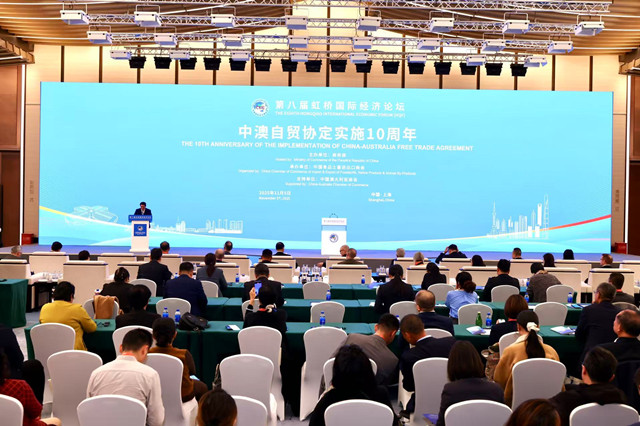
经贸合作成果丰硕,下一个10年中澳自贸协定如何“提质扩容”?
Di Yi Cai Jing· 2025-11-06 02:28
Core Viewpoint - The future of China-Australia cooperation must transition from traditional mineral and agricultural collaboration to a strategic joint development led by technology, especially as the China-Australia Free Trade Agreement (FTA) approaches its 10th anniversary in 2025 [1]. Group 1: Trade and Economic Cooperation - The China-Australia FTA is the first high-level FTA signed between China and a major developed country, serving as a significant milestone in bilateral relations [1]. - Over the past decade, the FTA has significantly boosted bilateral trade, with the trade volume reaching $211.27 billion in 2024, an increase of 85.6% compared to 2015 [5]. - China has maintained its position as Australia's largest trading partner for 16 consecutive years, with the Chinese market accounting for one-third of Australia's total exports [5]. - The FTA has facilitated a strong increase in Australian products in Chinese consumer markets, with 256 Australian companies participating in the recent China International Import Expo, marking a historical high [4]. Group 2: Future Directions and Opportunities - Future cooperation should focus on enhancing the FTA to meet evolving needs, ensuring it continues to serve both countries' enterprises and consumers effectively [7]. - There is a call for the FTA to evolve from traditional trade in agricultural and mineral products to include sectors such as digital economy, green technology, and new trade rules [8][9]. - The potential for collaboration in areas like clean energy, healthcare, and digital economy is highlighted as key opportunities for the next decade [8]. - The establishment of a robust framework for digital trade and cross-border data flow is essential, leveraging Australia's mature digital regulatory framework and China's extensive platform economy [9].
“2025投中榜·锐公司100”榜单调研启动:寻找定义未来的产业新锐
投中网· 2025-11-04 07:04
Core Insights - The narrative of China's innovation economy has shifted towards "hard technology" as a cornerstone for survival and competition, indicating a paradigm shift in global tech competition from singular technological breakthroughs to the construction and dominance of complex system ecosystems [2] - The development of hard technology has become the main theme, with advancements in generative AI, carbon neutrality, biotechnology, and advanced manufacturing driving significant changes across various sectors [2] Industry Trends - The transition from model innovation to hard-core driving and from application integration to foundational breakthroughs is evident in China's industrial upgrade path [2] - Generative AI is moving from technical exploration to industrial integration, reconstructing the entire chain from research and development to service through vertical applications [2] - The carbon neutrality sector is expanding its technological boundaries with parallel developments in green hydrogen and new energy storage, pushing the energy revolution into deeper waters [2] - Biotechnology is experiencing a paradigm shift in research and development driven by AI for Science, leading to more precise and efficient solutions [2] - Advanced manufacturing is achieving breakthroughs in key areas such as semiconductor equipment and high-end materials under the dual goals of "self-control" and "global competitiveness" [2] Company Evaluation Criteria - The "VIGOROUS 100" list will evaluate companies based on external attention, industry synergy, and industry influence, focusing on those with strong drive and potential for innovation and growth [3][5] - Eligible companies must belong to key innovation categories such as new generation information technology, healthcare, carbon neutrality, and advanced manufacturing [7] - Participating companies should have a valuation of over 1 billion RMB, be at least in Series A funding, and have financing records within the last three years [8]
热门赛道,再迎利好!
证券时报· 2025-11-04 04:54
Core Viewpoint - The article discusses the implementation of the "Artificial Intelligence + Healthcare" initiative, aiming to enhance the quality of healthcare through AI technologies by 2027 and 2030, focusing on data collection, clinical applications, and the establishment of AI application bases [2][10]. Summary by Sections Overall Requirements - The initiative is guided by Xi Jinping's thoughts, emphasizing government guidance, multi-party participation, innovation-driven approaches, and safety [31]. - By 2027, high-quality data sets and trusted data spaces will be established, with widespread application of AI in clinical decision-making and patient services [32]. Key Application Areas - **AI + Grassroots Applications**: Focus on enhancing diagnostic capabilities and chronic disease management at the grassroots level [33]. - **AI + Clinical Diagnosis**: Promotion of intelligent diagnostic services in medical imaging and clinical decision support for specialized diseases [35]. - **AI + Patient Services**: Optimization of patient service processes, including intelligent appointment systems and follow-up care [36]. - **AI + Traditional Chinese Medicine**: Development of intelligent applications in TCM diagnosis and management [37]. - **AI + Public Health**: Strengthening disease monitoring and emergency management through AI [38]. - **AI + Research and Education**: Enhancing research efficiency and health education through intelligent applications [39]. - **AI + Industry Governance**: Promoting intelligent management in healthcare institutions and regulatory frameworks [40]. - **AI + Health Industry**: Encouraging the development of new intelligent health service models and innovative medical products [41]. Application Foundation - **Infrastructure Development**: Establishment of a national health information platform to connect all healthcare institutions [43]. - **Data Supply Enhancement**: Promotion of data sharing and optimization of data collection processes [43]. - **AI Algorithm Optimization**: Support for the development of core algorithms and AI models in healthcare [43]. - **Pilot Base Construction**: Creation of AI application pilot bases focusing on various healthcare sectors [44]. Safety and Regulation - **Management and Review System**: Implementation of a comprehensive governance mechanism for AI applications in healthcare [45]. - **Innovative Regulatory Approaches**: Strengthening monitoring and evaluation of AI applications to ensure safety and privacy [45]. - **Data Security and Privacy Protection**: Establishing systems for data management and personal information protection [46].

中金 | 11月行业配置:风格更均衡
中金点睛· 2025-11-04 00:07
Core Viewpoint - The A-share market is experiencing a phase of oscillation and upward trend, with a shift towards dividend stocks and sectors with strong price increase certainty, such as non-ferrous metals, supported by recent US-China trade negotiations [2] Industry Performance Summary 1) Energy and Basic Materials - The Federal Reserve's interest rate cut has led to a continued rise in gold and industrial metal prices, with coal prices rebounding due to increased demand for the heating season and production cuts. In October, prices for thermal coal, coking coal, coking, and iron ore rose by 10%, 14%, 10%, and 3% respectively [3][10] - Coal production has seen a year-on-year decline of 3.2% in September, maintaining negative growth for three consecutive months, while coal inventory remains historically high at 710 million tons [10] 2) Industrial Products - The energy transition is supporting demand for electrical equipment, with steady growth in the photovoltaic industry. In September, excavator domestic sales grew by 22% year-on-year, and new energy vehicle sales increased by 25% [4] - The price increase pace in the photovoltaic supply chain has slowed, with polysilicon and solar cell prices decreasing by 0.6% and 3% month-on-month [4] 3) Consumer Goods - Domestic demand for home appliances continues to slow, with September sales for washing machines, refrigerators, and air conditioners down by 16%, 26%, and 21% year-on-year respectively. The liquor industry is in a supply clearing phase, with the wholesale price of Feitian Moutai down by 6% year-on-year [5] - The food sector shows mixed performance, with prices for pork, chicken, and eggs declining, while vegetable prices have risen [5] 4) Technology - The AI industry chain is experiencing high prosperity, with strong overseas demand for AI computing driving sales of Chinese communication equipment. The net profit growth rates for software and services, computer equipment, communication equipment, and semiconductors reached 161%, 45%, 25%, and 33% respectively [6] - The gaming sector remains robust, with 166 game licenses issued in October, maintaining a high level [6] 5) Financials - The banking sector's high dividend attributes are attracting medium to long-term capital allocation, with insurance premiums growing by 9% year-on-year in September. The average daily trading volume of A-shares has slightly decreased to 2.2 trillion yuan [6] - The stock market sentiment remains high, with a significant increase in margin trading balances reaching a historical high of approximately 2.5 trillion yuan [6] 6) Real Estate - The real estate market is still in a bottoming phase, with October sales area in 30 major cities down by 27% year-on-year. The price index for new and second-hand residential properties has decreased by 2.7% and 5.2% respectively [7] - The industry is under pressure, with a focus on policy support and demand improvement [7] Investment Recommendations - Focus on sectors such as AI computing, communication equipment, semiconductors, and innovative pharmaceuticals, which are expected to remain attractive until a significant change in industry prosperity occurs [7] - Non-ferrous metals are likely to benefit from the global monetary order reconstruction, while export growth remains strong, enhancing profit margins for companies in engineering machinery, electrical equipment, and white goods [7]

超2100亿港元 港股前10月IPO募资额领跑全球
Shang Hai Zheng Quan Bao· 2025-11-03 18:16
Group 1 - Minglue Technology from Sichuan Province has successfully listed on the Hong Kong stock market, becoming the second company from the province to do so this year [1] - The Hong Kong stock market has become a popular listing destination due to policy support and a recovering funding environment, with over HKD 210 billion raised in the first ten months of the year, ranking first globally [1] - The total IPO financing amount in Hong Kong has reached HKD 216.47 billion this year, representing a year-on-year increase of 203.5%, with 81 companies listed, a 50% increase compared to last year [1] Group 2 - Strategic emerging industries, particularly in healthcare and information technology, have become the mainstay of the Hong Kong IPO market this year [2] - The pharmaceutical and biotechnology sector has seen the highest number of listings, with 17 companies raising HKD 24.23 billion, including major IPOs from companies like Hengrui Medicine and Jinfang Pharmaceutical [2] - A record 58 pharmaceutical companies have submitted applications for IPOs in Hong Kong this year, with nearly 70% focusing on innovative drug development in oncology and autoimmune diseases [2] Group 3 - In the industrial engineering and software service sectors, 11 and 7 companies have gone public this year, raising HKD 77.92 billion and HKD 12.03 billion respectively [3] - The industrial engineering sector has fewer IPOs but larger individual fundraising amounts, with SANY Heavy Industry raising over HKD 10 billion [3] - In the software service sector, companies like Hesai Technology and Cambridge Technology have each raised over HKD 4 billion [3] Group 4 - Shanghai, Guangdong, Jiangsu, and Zhejiang lead in the number of companies listed on the Hong Kong stock market this year, with Shanghai having 14 listings [4] - Notable companies from Shanghai include Cambridge Technology and Hohhot Aunt, covering various sectors such as hard technology and consumer upgrades [4] - Shenzhen has also seen significant listings, with companies like Guanghetong and Xipuni focusing on high-end manufacturing and smart technology [4] Group 5 - Local governments are prioritizing support for companies going public in Hong Kong, offering services such as financial subsidies and one-stop consulting to reduce compliance and financing costs [5] - Initiatives like Chengdu's "Rongqi Outbound" program and Shenzhen's comprehensive support mechanism are designed to facilitate the listing process for companies [5]
“十四五”期间 我国研制发布数据领域国家标准超120项
Yang Shi Xin Wen· 2025-11-03 18:06
Group 1 - The core viewpoint of the article highlights the significant progress in China's data standard system construction during the "14th Five-Year Plan" period, which supports the accelerated development of the digital economy [1] - China has become the first country globally to classify data as a production factor, advancing data standardization efforts [1] - Over 120 national standards in the data field have been developed and published during the "14th Five-Year Plan," with widespread applications in key areas such as artificial intelligence, new infrastructure, and data trading [1] Group 2 - The implementation of data standards has empowered various industries, including industrial manufacturing, healthcare, and transportation [1]