
可选消费

Search documents
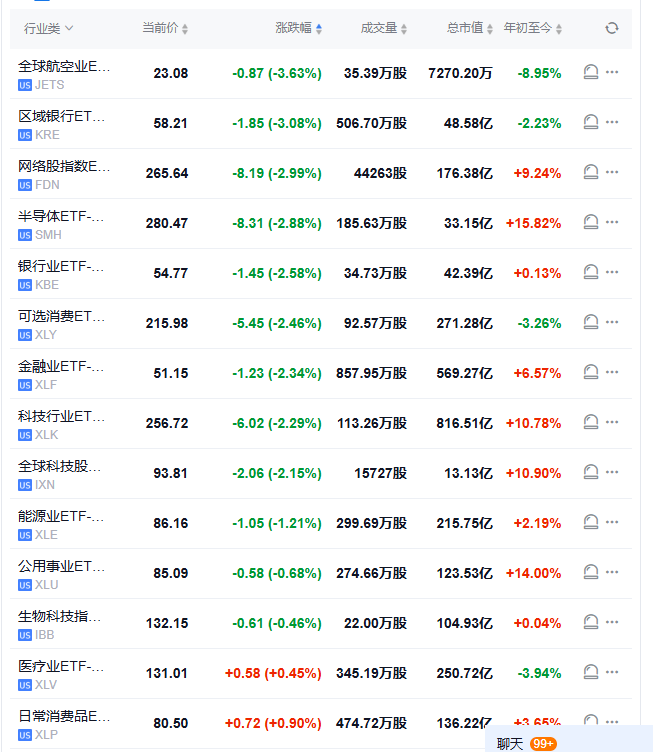
美股盘初,主要行业ETF多数下跌,全球航空业ETF跌3.6%,区域银行业ETF跌3.1%,网络股指数ETF跌3%。
news flash· 2025-08-01 13:57
Market Overview - Major industry ETFs in the US are mostly down, with the global airline industry ETF dropping by 3.6%, regional bank ETF down by 3.1%, and internet stock index ETF decreasing by 3% [1] Industry Performance - Global airline industry ETF is priced at $23.08, down by $0.87 (-3.63%) with a trading volume of 353,900 shares and a total market value of $727.02 million, reflecting a year-to-date decline of 8.95% [2] - Regional bank ETF is priced at $58.21, down by $1.85 (-3.08%) with a trading volume of 5.067 million shares and a total market value of $4.858 billion, showing a year-to-date decline of 2.23% [2] - Internet stock index ETF is priced at $265.64, down by $8.19 (-2.99%) with a trading volume of 44,263 shares and a total market value of $176.38 billion, with a year-to-date increase of 9.24% [2] - Semiconductor ETF is priced at $280.47, down by $8.31 (-2.88%) with a trading volume of 1.856 million shares and a total market value of $3.315 billion, reflecting a year-to-date increase of 15.82% [2] - Financial sector ETF is priced at $51.15, down by $1.23 (-2.34%) with a trading volume of 8.5795 million shares and a total market value of $569.27 billion, showing a year-to-date increase of 6.57% [2] - Technology sector ETF is priced at $256.72, down by $6.02 (-2.29%) with a trading volume of 1.1326 million shares and a total market value of $816.51 billion, reflecting a year-to-date increase of 10.78% [2] - Energy sector ETF is priced at $86.16, down by $1.05 (-1.21%) with a trading volume of 2.9969 million shares and a total market value of $21.575 billion, showing a year-to-date increase of 2.19% [2] - Healthcare sector ETF is priced at $131.01, up by $0.58 (+0.45%) with a trading volume of 3.4519 million shares and a total market value of $25.072 billion, reflecting a year-to-date decline of 3.94% [2] - Consumer discretionary ETF is priced at $215.98, down by $5.45 (-2.46%) with a trading volume of 925,700 shares and a total market value of $27.128 billion, showing a year-to-date decline of 3.26% [2]

中证香港科技指数下跌0.88%,前十大权重包含阿里巴巴-W等
Jin Rong Jie· 2025-08-01 13:17
Group 1 - The core viewpoint of the news is that the China Securities Hong Kong Technology Index has shown significant growth year-to-date, with a 33.07% increase, despite a slight decline in the latest trading session [1] - The index consists of 50 large-cap technology companies listed in Hong Kong, selected based on their market capitalization, R&D investment, and revenue growth [1] - The top ten holdings of the index include major companies such as Tencent Holdings (10.17%), Alibaba-W (9.81%), and Xiaomi Group-W (9.71%) [1] Group 2 - The index has a sector composition where consumer discretionary accounts for 39.87%, communication services for 26.40%, information technology for 21.52%, and healthcare for 11.75% [1] - The index is adjusted semi-annually, with changes implemented on the next trading day after the second Friday of June and December [2] - Public funds tracking the Hong Kong technology sector include the Southern China Securities Hong Kong Technology ETF and the China Merchants Securities Hong Kong Technology ETF [3]

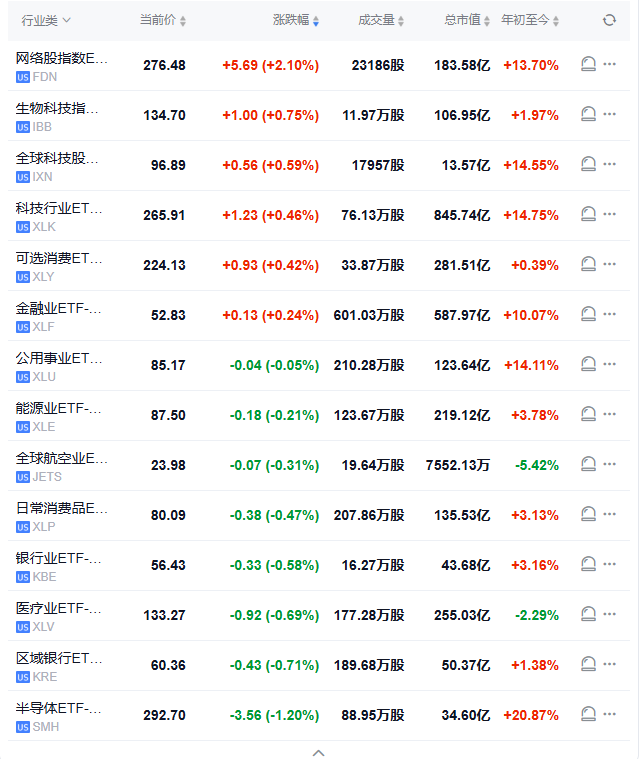
美股盘初,主要行业ETF涨跌不一,网络股指数ETF涨超2%,生物科技指数ETF涨近1%,半导体ETF跌超1%。
news flash· 2025-07-31 13:54
Market Overview - Major industry ETFs showed mixed performance, with the internet stock index ETF rising over 2% and the biotechnology index ETF increasing nearly 1%, while the semiconductor ETF fell over 1% [1] Industry Performance - Internet Stock Index ETF: Current price at 276.48, up by 5.69 (+2.10%), with a trading volume of 23,186 shares and a total market value of $18.358 billion, reflecting a year-to-date increase of 13.70% [2] - Biotechnology Index ETF: Current price at 134.70, up by 1.00 (+0.75%), with a trading volume of 119,700 shares and a total market value of $10.695 billion, showing a year-to-date increase of 1.97% [2] - Semiconductor ETF: Current price at 292.70, down by 3.56 (-1.20%), with a trading volume of 889,500 shares and a total market value of $3.460 billion, reflecting a year-to-date increase of 20.87% [2] - Financial Sector ETF: Current price at 52.83, up by 0.13 (+0.24%), with a trading volume of 6.0103 million shares and a total market value of $58.797 billion, showing a year-to-date increase of 10.07% [2] - Energy Sector ETF: Current price at 87.50, down by 0.18 (-0.21%), with a trading volume of 1.2367 million shares and a total market value of $21.912 billion, reflecting a year-to-date increase of 3.78% [2]
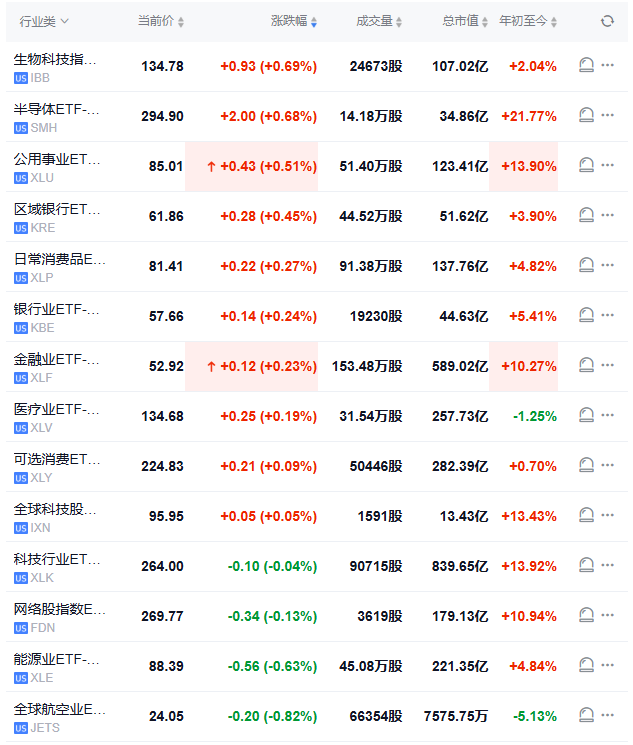
美股盘初,主要行业ETF涨跌不一,生物科技指数ETF涨0.7%,半导体ETF涨0.7%,全球航空业ETF跌0.8%。
news flash· 2025-07-30 13:41
Group 1 - Major industry ETFs showed mixed performance, with the biotechnology and semiconductor ETFs both rising by 0.7% [1] - The biotechnology index ETF is currently priced at 134.78, reflecting an increase of 0.93 (+0.69%) with a total market value of 10.702 billion and a year-to-date change of +2.04% [2] - The semiconductor ETF is priced at 294.90, up by 2.00 (+0.68%), with a total market value of 34.86 billion and a year-to-date increase of +21.77% [2] Group 2 - The global airline ETF decreased by 0.8%, currently priced at 24.05, down by 0.20 (-0.82%), with a total market value of 0.0757575 billion and a year-to-date decline of -5.13% [1][2] - The utility ETF increased by 0.51%, priced at 85.01, with a total market value of 12.341 billion and a year-to-date change of +13.90% [2] - The financial sector ETF rose by 0.23%, priced at 52.92, with a total market value of 589.02 billion and a year-to-date increase of +10.27% [2]
美国消费行业6月跟踪报告:不确定性仍在,整体继续谨慎
Haitong Securities International· 2025-07-29 13:03
Investment Rating - The report maintains a cautious investment stance on the consumer sector, particularly highlighting concerns over inflation and the impact of tariffs on low-priced consumer goods and durable imports [4]. Core Insights - The consumer confidence index in the U.S. rebounded to 61.8 in July, indicating a slight recovery in consumer sentiment, although it remains significantly lower than historical averages [6][9]. - Retail sales data for June showed a year-on-year increase of 3.9%, reaching $720.11 billion, driven by pre-tariff purchasing behavior [6][9]. - Inflationary pressures are evident, with the June CPI rising to 2.7%, primarily due to increased energy prices and the initial effects of tariffs on imported goods [9][12]. - Employment data showed a strong increase in non-farm payrolls, with 147,000 jobs added in June, although the growth was largely driven by government sectors, while the private sector showed signs of weakness [14][16]. Summary by Sections Macro Overview - Consumer confidence index increased to 61.8 in July, reflecting a two-month rebound [6]. - Retail sales for June reached $720.11 billion, up 3.9% year-on-year, exceeding expectations [6][9]. - Inflation rose to 2.7% in June, with energy prices being a significant contributor [9]. - Non-farm payrolls added 147,000 jobs in June, with a decline in the unemployment rate to 4.1% [14]. Essential Consumption - Beverage sales showed robust growth, with a 5.2% year-on-year increase in May, while tobacco sales slowed down [2][28]. - Alcohol sales in May were $6.31 billion, reflecting a modest growth of 0.8% year-on-year, but overall sales volume continues to decline [2][24]. - Dairy product shipments totaled $13.49 billion in May, with a year-on-year increase of 1.1% [28]. Optional Consumption - Restaurant sales in June reached $98.74 billion, up 6.6% year-on-year, indicating strong consumer spending in this segment [3][32]. - Department store sales were $77.25 billion in June, reflecting a year-on-year increase of 3.2% [3][34]. - Clothing retail sales in June were $26.34 billion, with a year-on-year increase of 3.9% [3][36]. Market Performance - The optional consumption sector outperformed, with a 5.6% increase, while essential consumption saw a decline of 1.5% [4]. - The consumer sector remains under pressure from high valuations and inflationary concerns, particularly affecting low-priced consumer goods [4]. Employment and Credit - The labor market showed mixed signals, with strong overall job growth but significant weakness in the private sector [14][16]. - Consumer credit saw a sharp decline in May, with a 70% drop in growth compared to April, indicating a potential slowdown in consumer spending [20]. PMI and Economic Indicators - The manufacturing PMI for June was 49.0, indicating continued contraction, while the services PMI returned to expansion at 50.8 [22][23].
港股通50ETF(159712)涨超1.2%,市场关注结构性机会与流动性变化
Mei Ri Jing Ji Xin Wen· 2025-07-28 03:13
Group 1 - The core viewpoint is that the Hong Kong stock market is expected to have a strong start in the first half of 2025, driven by AI technology revaluation and supported by sectors such as new consumption, innovative pharmaceuticals, and non-bank financials [1] - Financial and technology sectors are the most favored by the market, with southbound funds focusing on financials, particularly banks, and diversifying into information technology and communication services [1] - Foreign investment preferences lean towards financials, discretionary consumption, and information technology, indicating a structural bull market resilience in the second half of the year [1] Group 2 - The appreciation of the RMB and continuous inflow of southbound funds are crucial supports for the market, with the financial sector being attractive to insurance capital due to its low volatility and high dividend characteristics [1] - The technology growth sector benefits from reduced financing costs, suggesting a favorable environment for growth [1] - Long-term, Hong Kong stocks are seen as core assets in RMB, with significant potential for narrowing the "country risk premium" and increasing domestic pricing power, which will amplify revaluation heights [1] Group 3 - The Hong Kong Stock Connect 50 ETF (159712) tracks the Hong Kong Stock Connect 50 Index (930931), which consists of 50 large companies listed in Hong Kong that meet Stock Connect eligibility, reflecting the performance of quality Hong Kong stocks available for investment through the Stock Connect mechanism [1] - The index covers multiple industries, focusing on key areas such as finance, information technology, and consumption, demonstrating strong market representation and liquidity [1] - Investors without stock accounts can consider the Cathay CSI Hong Kong Stock Connect 50 ETF Initiated Link A (014689) and Link C (014690) [1]
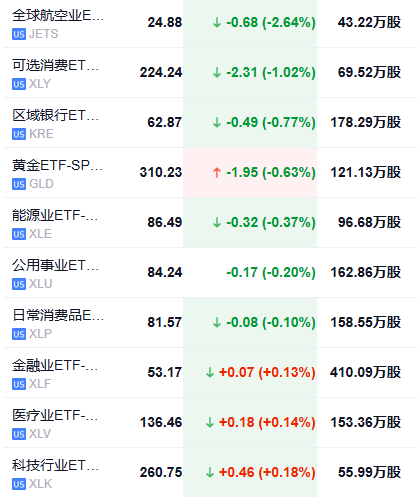
美股盘初,主要行业ETF涨跌不一,全球航空业ETF跌超2%,可选消费ETF、区域银行ETF跌幅居前。
news flash· 2025-07-24 14:00
Group 1 - Major industry ETFs showed mixed performance in early trading, with the global airline industry ETF declining over 2% [1] - The consumer discretionary ETF and regional bank ETF experienced the largest declines, with the consumer discretionary ETF down 1.02% and the regional bank ETF down 0.77% [1][2] - The gold ETF saw a slight increase of 0.63%, while the energy sector ETF and utility ETF both experienced minor declines [2] Group 2 - The global airline ETF (US JETS) closed at 24.88, down 2.64% with a trading volume of 432,200 shares [2] - The consumer discretionary ETF (US XLY) closed at 224.24, down 1.02% with a trading volume of 695,200 shares [2] - The regional bank ETF (US KRE) closed at 62.87, down 0.77% with a trading volume of 1,782,900 shares [2]
招银国际每日投资策略-20250723
Zhao Yin Guo Ji· 2025-07-23 02:49
Industry Insights - The Chinese equipment manufacturing industry is expected to benefit significantly from the rural road upgrade and renovation, which could create a market worth trillions of yuan [2][4]. - The newly implemented Rural Road Regulations emphasize improving road network quality and promoting integrated urban-rural transportation development [2]. Market Potential - As of the end of 2024, China's rural road total mileage is projected to be 4.64 million kilometers, accounting for approximately 85% of the national road total [4]. - It is estimated that 9% of rural roads (around 410,000 kilometers) may require upgrades over the next decade, with upgrade costs ranging from 30 million to 50 million yuan per kilometer, leading to potential annual expenditures of 1.2 trillion to 2 trillion yuan [4]. Beneficiaries - Companies such as SANY Heavy Industry, Zoomlion Heavy Industry, Hengli Hydraulic, Weichai Power, and China National Heavy Duty Truck are expected to benefit from the rural road upgrades, acting as catalysts for the engineering machinery and heavy truck sectors [5].
中证香港科技指数上涨0.5%,前十大权重包含腾讯控股等
Jin Rong Jie· 2025-07-22 13:12
Group 1 - The core viewpoint of the article highlights the performance of the China Securities Hong Kong Technology Index, which has shown significant growth, with a year-to-date increase of 35.11% [1] - The index consists of 50 large-cap technology companies listed in Hong Kong, selected based on their market capitalization, R&D investment, and revenue growth [1] - The top ten weighted companies in the index include Xiaomi Group-W (10.24%), Tencent Holdings (9.72%), Alibaba-W (9.62%), Meituan-W (8.32%), BYD Company (7.9%), NetEase-S (6.81%), JD Group-SW (6.59%), Baidu Group-SW (3.98%), SMIC (3.72%), and Kuaishou-W (3.49%) [1] Group 2 - The sector distribution of the index's holdings shows that consumer discretionary accounts for 41.28%, communication services for 26.09%, information technology for 21.39%, healthcare for 10.79%, and industrials for 0.45% [2] - The index samples are adjusted semi-annually, with adjustments occurring on the next trading day after the second Friday of June and December each year [2] - Public funds tracking the Hong Kong technology sector include the Southern China Securities Hong Kong Technology ETF and the China Merchants Securities Hong Kong Technology ETF [3]




2024年度A股上市公司ESG治理和信披九大盘点
Quan Jing Wang· 2025-07-17 09:37
Group 1 - In April 2024, the three major domestic stock exchanges released guidelines for sustainable development report disclosure, leading to an increase in the number of listed companies disclosing their 2024 sustainable development reports [1] - A total of 2,469 A-share listed companies published independent 2024 sustainable development reports, representing 45.6% of all A-shares, a year-on-year increase of 17% [1] - The ESG report disclosure rates vary by index, with the large-cap index at 90.3%, mid-cap at 66.6%, small-cap at 38.8%, and micro-cap at 19.4% [2] Group 2 - 62 listed companies received an AAA ESG rating, accounting for 1.1% of all A-share companies, with the financial, industrial, and healthcare sectors leading in AAA ratings [3] - Over 1,350 listed companies established ESG-related committees or working groups, indicating a significant increase in the emphasis on ESG governance [4] - The external verification of ESG reports remains low, with only about 200 companies having their reports verified by third parties, representing less than 4% of the total [5] Group 3 - 1,856 listed companies disclosed their 2024 carbon emissions data, accounting for 34.3% of all A-shares, with a year-on-year increase of over 40% [6] - The disclosure rate for Scope 3 emissions remains low at about 5%, primarily due to the lack of mandatory reporting and unified standards [7] - Approximately 270 listed companies have set long-term carbon neutrality goals, reflecting a growing commitment to low-carbon transformation [7] Group 4 - 3,759 listed companies announced or implemented cash dividend plans for 2024, with a total cash dividend amounting to 2.3 trillion yuan, an 18.3% increase year-on-year [8] - Central and state-owned enterprises have a higher disclosure rate for sustainable development reports at 75.4%, compared to 33.8% for non-state-owned enterprises [9] - The proportion of central and state-owned enterprises establishing ESG-related committees or groups is 41.8%, higher than the overall market average of 25.1% [10]