新能源车

Search documents
五年后惊呆自己?数据揭示巨变真相,结果让所有人意外!
Sou Hu Cai Jing· 2026-01-05 09:46
Group 1: Internet Industry Transformation - The internet landscape has been reshaped significantly over the past five years, with companies like Pinduoduo and ByteDance altering market boundaries and user engagement [3][5] - Pinduoduo has steadily closed the gap with Taobao by focusing on retail, while ByteDance has expanded into various fields with high success rates [3][5] - The competition in the internet sector remains fierce, with major platforms continuing to grow and integrate deeply into daily life, impacting the flow of information and goods [5] Group 2: AI Development in China - AI gained traction in China around 2025, marked by significant events such as the first major AI application acquisition for $2 billion by Meta [5][7] - Chinese AI companies face different challenges compared to their Silicon Valley counterparts, particularly in terms of computing power and user payment willingness [7] - The development strategies of Chinese AI firms are pragmatic, focusing on mature product offerings to meet local market demands [7] Group 3: New Energy Vehicle (NEV) Industry - The NEV sector in China has evolved rapidly, with the share of pure fuel vehicles expected to drop to 50% by 2025, showcasing a complete cycle from explosion to intense competition [9][11] - Major players like Geely and BYD are adjusting strategies to enhance competitiveness, while newer entrants like Xiaomi are avoiding early pitfalls [11] - The NEV industry's growth has positioned China as a global leader, demonstrating resilience and adaptability in a challenging market environment [11][13] Group 4: Market Trends and Future Outlook - The period from 2021 to 2025 has highlighted the transformative power of time, with significant advancements in internet, AI, and NEV sectors [13][14] - The investment landscape has seen indices in A-shares and Hong Kong stocks return to and exceed 2021 peaks, indicating a robust recovery [13] - The next five years are expected to bring further unexpected changes, with a focus on maintaining a proactive and innovative approach to ensure quality development in China's industries [14]


12月新能源车销量跟踪:目标兑现度分化,战略选择成关键变量
Haitong Securities International· 2026-01-05 08:42
Investment Rating - The report does not explicitly state an investment rating for the automotive industry but indicates a challenging outlook for the market moving into 2026 due to increasing volatility and structural changes [7]. Core Insights - Major automakers reported December and full-year sales results, with a notable decline in the typical year-end "pull-forward" effect, leading to double-digit month-on-month declines for most OEMs [7][8]. - The fading demand driven by subsidies is expected to put sustained pressure on the automotive market in China, with a forecast of increased volatility and market restructuring [7][8]. - The divergence in target fulfillment among automakers reflects the alignment of corporate strategies with actual market demand, with some companies exceeding targets through effective segmentation and cost efficiency [16]. Summary by Relevant Sections December Sales Performance - BYD sold 420,000 units in December, an 18% year-on-year increase but a 13% month-on-month decline, achieving a full-year target of 4.602 million units [8][9]. - Geely's December sales reached 240,000 units, a 13% year-on-year increase but a 24% month-on-month decline, with a full-year target of 3.025 million units achieved [9]. - Leapmotor delivered 60,000 units in December, a 42% year-on-year increase, surpassing its annual target of 500,000 units ahead of schedule [10]. Strategic Positioning and Market Demand - Companies that effectively matched their strategic positioning with market demand were able to meet or exceed their sales targets, while others that relied heavily on specific products or technologies underperformed [16]. - NIO achieved a record 48,000 units in December, with a full-year delivery total of 326,000 units, reflecting a 74% target achievement rate [15]. - Xiaomi Auto exceeded 50,000 units in December for the first time, achieving over 400,000 units for the full year, aligning with its revised guidance [12]. Future Outlook - The report anticipates intensified competition in the electric vehicle segment, particularly for companies like Li Auto, which aims to maintain its leading position while facing uncertainties in its battery electric vehicle strategy [13]. - The overall market dynamics suggest that companies will need to adapt to changing consumer preferences and competitive pressures as they move into 2026 [16].

港股科技ETF(513020)涨超4%,市场关注流动性改善与AI产业机遇
Mei Ri Jing Ji Xin Wen· 2026-01-05 08:29
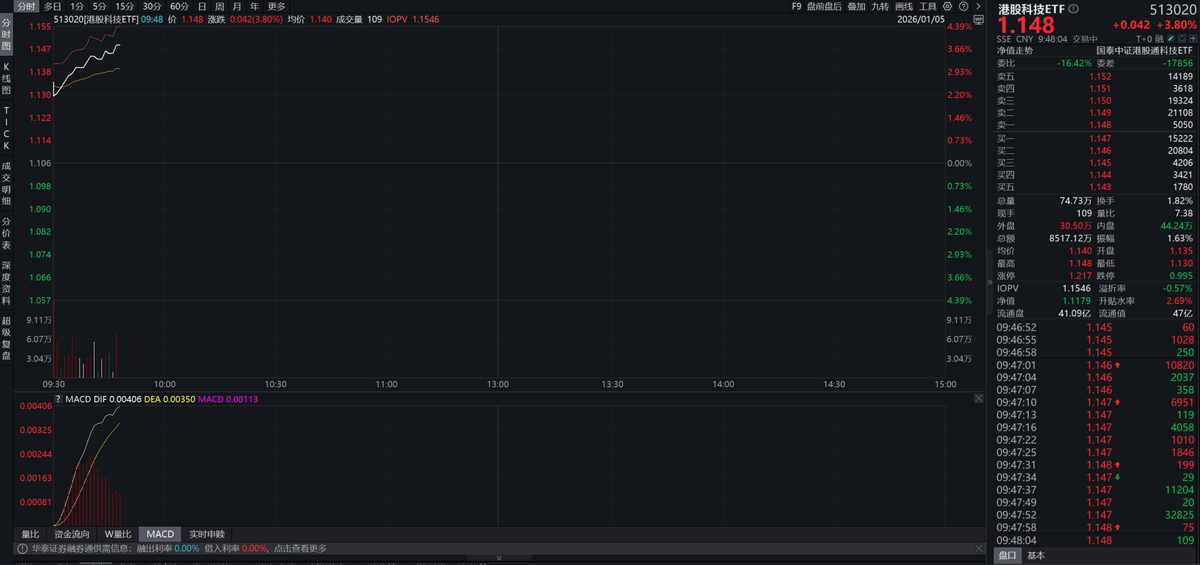
Group 1 - The core viewpoint of the article highlights the positive performance of the Hong Kong technology sector, driven by improved liquidity and opportunities in the AI industry [1] - The Hong Kong Technology ETF (513020) has risen over 4%, reflecting market optimism regarding the technology sector [1] - Baidu's Kunlun Chip has submitted a listing application in Hong Kong, and the National Integrated Circuit Industry Investment Fund has increased its stake in SMIC International to 9.25%, boosting market sentiment [1] Group 2 - The Hong Kong Technology ETF tracks the Hong Kong Stock Connect Technology Index, which includes core assets in sectors such as internet, semiconductors, innovative pharmaceuticals, and new energy vehicles [1] - The Hong Kong Stock Connect Technology Index has outperformed the Hang Seng Technology Index, with a cumulative return of 256.46% since the base date at the end of 2014, significantly exceeding the Hang Seng Technology Index's return of 96.94% [1] - Emerging technology sectors like digital economy and AI applications are expected to benefit from favorable policies and industry innovation, although geopolitical risks and global economic uncertainties remain concerns [1]

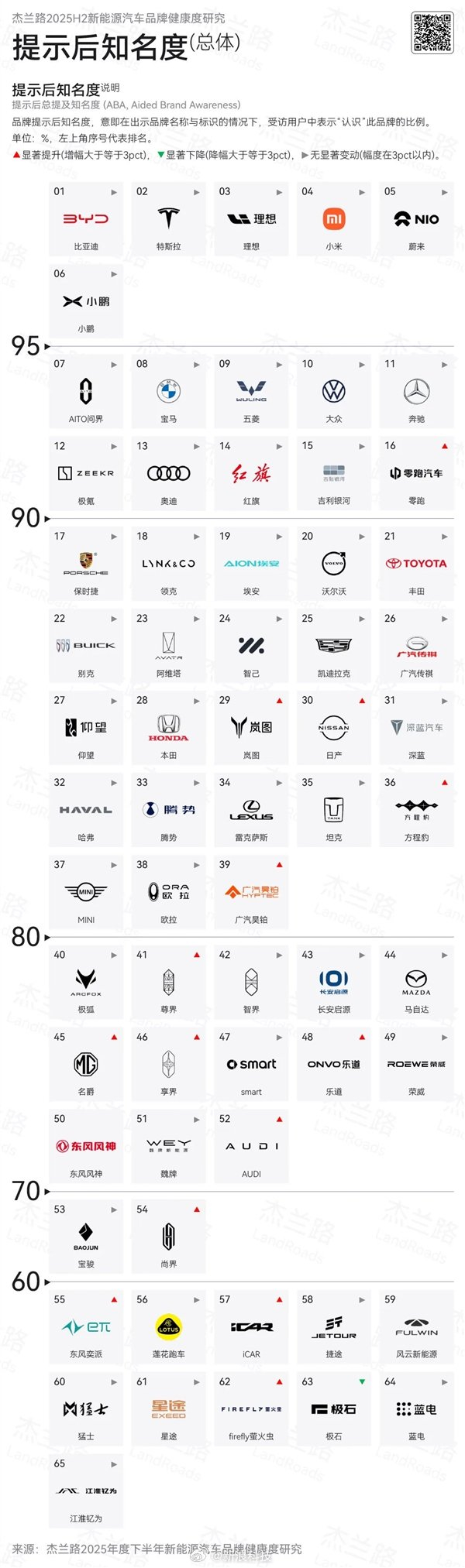
小米跻身中国新能源车知名度前四,比亚迪理想同列前五
Xin Lang Ke Ji· 2026-01-05 07:33
Core Insights - Xiaomi ranks 4th in brand awareness among Chinese electric vehicle manufacturers according to the 2025 H2 New Energy Vehicle Brand Health Research by Jielanlu [1][10] - The report highlights the sensitivity of Xiaomi and Li Auto's user base to external opinions, indicating that top brands face not only market competition but also the amplified effects of public sentiment on consumer trust [1] Brand Awareness by Price Segment - In the segment below 200,000 yuan, the top five brands are BYD, Xpeng, Volkswagen, Geely, and Wuling [1][9] - In the 200,000 to 300,000 yuan segment, the leading brands are Tesla, BYD, Li Auto, Xiaomi, and NIO [1][9] - For the segment above 300,000 yuan, the top brands are Tesla, Li Auto, Xiaomi, NIO, and AITO [1][9] Implications for Top Brands - The report emphasizes the need for leading brands to manage consumer expectations and mitigate emotional fluctuations in brand preference due to high public scrutiny [1]



港股迎2009年以来最强“开门红”,港股科技ETF(513020)大涨近4%
Mei Ri Jing Ji Xin Wen· 2026-01-05 04:53
Core Viewpoint - The Hong Kong stock market experienced a strong start in 2026, with the Hang Seng Index rising by 2.76%, marking the best opening performance since 2009, and the Hang Seng Tech Index increasing by 4% [1] Group 1: Market Performance - The Hong Kong stock market saw significant inflows, with over HKD 10 billion in southbound capital purchases, setting a new annual record [1] - The Hong Kong Technology ETF (513020) rose nearly 4% during intraday trading, with a net inflow exceeding HKD 100 million over the past 20 days [1] Group 2: Sector Highlights - The Hong Kong Technology ETF (513020) tracks the CSI Hong Kong Stock Connect Index, encompassing leading stocks in sectors such as internet, chips, innovative pharmaceuticals, and new energy, including Alibaba, Xiaomi, Tencent, Meituan, BYD, and SMIC [3] - The Hong Kong Stock Connect Technology Index has outperformed the Hang Seng Tech Index and the Hong Kong Stock Connect Internet Index, with a cumulative increase of 45.19% from 2018 to the present, while the Hong Kong Stock Connect Internet Index decreased by 13.08% and the Hang Seng Tech Index fell by 0.61% during the same period [5][6] Group 3: Future Outlook - The development of AI in North America is expected to enhance the attractiveness of Hong Kong tech stocks, with leading internet companies leveraging their data and technology advantages to gain a competitive edge in AI model training [8] - Traditional internet platform companies are anticipated to shift focus from user growth to efficiency and overseas expansion in 2026, with AI technologies expected to improve profit margins and drive growth in cross-border e-commerce and digital content [9] - AI is projected to address long-standing challenges in various sectors, including smart driving, smart manufacturing, and innovative drug development, potentially leading to significant advancements in these areas [9] Group 4: Investment Opportunities - Investors are encouraged to consider the Hong Kong Technology ETF (513020) to capitalize on investment opportunities within the Hong Kong tech sector, which reflects a diversified representation of core technology assets and the overall performance of leading tech companies in the market [10]
百万华人涌入中亚
投资界· 2026-01-04 08:15
Core Viewpoint - The article highlights the significant transformation occurring in Central Asia, particularly Kazakhstan, as it becomes a key market for Chinese enterprises looking to expand internationally. The influx of Chinese tourists and goods indicates a growing economic relationship and potential investment opportunities in various sectors, including e-commerce and consumer goods [3][4]. Group 1: Market Trends - In the first eleven months of this year, over 876,000 Chinese tourists visited Kazakhstan, with a 50% increase in flight bookings and an 80% increase in hotel reservations compared to the previous year [3]. - The flow of goods is also rising, with 13,089 trains operating between China and Central Asia, sending 1,031,695 TEUs, marking a 30.6% year-on-year increase [3]. - Kazakhstan is evolving from a "marginal market" to a "foreign trade growth pole" for Chinese companies, with sectors like infrastructure, new energy, and cross-border e-commerce leading the growth [3][4]. Group 2: E-commerce Development - Kazakhstan has the highest internet penetration rate (92.9%) and mobile connection rate (128%) in the region, with e-commerce accounting for 14.1% of retail by 2024, up from 0.5% in 2013 [10]. - The e-commerce market in Kazakhstan has grown sevenfold over the past five years, reaching approximately $6.5 billion in 2024, with a year-on-year growth of 33% [10]. - Local platforms like Kaspi.kz and Russian platforms like Wildberries are gaining traction, alongside Chinese platforms such as Taobao and AliExpress, facilitating a smooth shopping experience for consumers [9][10]. Group 3: Consumer Behavior and Preferences - The presence of Chinese brands like Mixue Ice City and WEDRINK in Kazakhstan reflects a shift in consumer preferences towards new beverage options, indicating a consumption upgrade in the region [22][24]. - Despite higher prices compared to China, local consumers are willing to pay for these products, as the average income in Kazakhstan is significantly lower than in China [25]. - The demand for electric vehicles is rising, with Chinese brands like BYD and Hongqi becoming increasingly visible on the streets of Almaty, as the local market seeks to replace aging vehicles [26][28]. Group 4: Challenges for Chinese Enterprises - Chinese businesses face challenges in establishing credibility and trust among local consumers, who often prefer to buy from local retailers due to past negative experiences with Chinese companies [29]. - The competitive landscape is intensifying, with local biases against Chinese merchants making it difficult for them to penetrate the market [30]. - The article emphasizes the importance of local partnerships and understanding cultural nuances to succeed in the Central Asian market, as well as the need for a localized approach to business operations [32][33].

糟了!海外出大事了
Sou Hu Cai Jing· 2026-01-04 02:23
Group 1: Macro News - The U.S. military successfully executed an operation to arrest Venezuelan President Maduro and his wife, who are now on a U.S. warship and will face charges in New York [1][2] - The Venezuelan government condemned the U.S. actions as a severe military invasion and declared a national emergency [1] - The Chinese government expressed strong condemnation of the U.S. military action, calling it a violation of international law and an infringement on Venezuela's sovereignty [2] - France's Foreign Minister stated that the U.S. military action against Venezuela violates the principle of non-use of force established by international law [3] - Russia's Foreign Ministry called for the immediate release of Maduro and his wife, emphasizing the need for dialogue to resolve issues between the U.S. and Venezuela [3] - The UN Secretary-General expressed shock at the escalation of the situation in Venezuela, warning of potential regional impacts from the U.S. military actions [3] Group 2: Industry Information - The global sovereign wealth fund assets reached a record high of $15 trillion, with increased investments in the technology sector, particularly in AI and digitalization [6] - The National Integrated Circuit Fund increased its stake in SMIC from 4.79% to 9.25% [10] - BYD reported December 2025 sales of 420,398 new energy vehicles, with a total annual sales of 4,602,436 units, reflecting a year-on-year growth of 7.73% [10] - Baidu plans to spin off Kunlun Chip and seek independent listing on the Hong Kong Stock Exchange [11]


2026年,物价走势会怎样?3个关键信号已出现,普通家庭这样应对
Sou Hu Cai Jing· 2026-01-04 00:06
Core Viewpoint - Experts generally predict that consumer prices in 2026 will not experience significant inflation, instead showing a trend of "low and moderate recovery" with CPI expected to rise around 0.8% year-on-year, with a possibility of reaching 2.0% in a reasonable range [1] Group 1: CPI and Consumer Behavior - The CPI year-on-year growth rate has expanded, with November CPI rising by 0.7%, the highest since March 2024, driven mainly by an increase in food prices, particularly fresh vegetables which surged by 14.5% [3] - The core CPI, excluding food and energy, rose by 1.2% year-on-year, remaining above 1% for three consecutive months, indicating a recovery in consumer spending, with prices for household appliances and clothing increasing [3] Group 2: PPI and Industrial Prices - The Producer Price Index (PPI) increased by 0.1% month-on-month in November, marking two consecutive months of growth, suggesting a gradual recovery in production material prices [4] - Prices in sectors such as coal mining, photovoltaic equipment, and lithium-ion batteries are stabilizing, with emerging industries showing significant upward price trends, which may eventually affect downstream consumer prices [4] Group 3: Policy Impact on Prices - The "anti-involution" policies implemented this year have played a crucial role in stabilizing prices, with accelerated capacity governance in key industries leading to more regulated market competition and a noticeable reduction in price declines in sectors like new energy vehicles and photovoltaic equipment [5] - Continued policy efforts to expand domestic demand and promote consumption are expected to further support price recovery, mitigating risks of deflation or uncontrolled inflation [5]

“人们常常低估了五年能有的改变”丨晚点小数据 2025
晚点LatePost· 2026-01-03 15:02
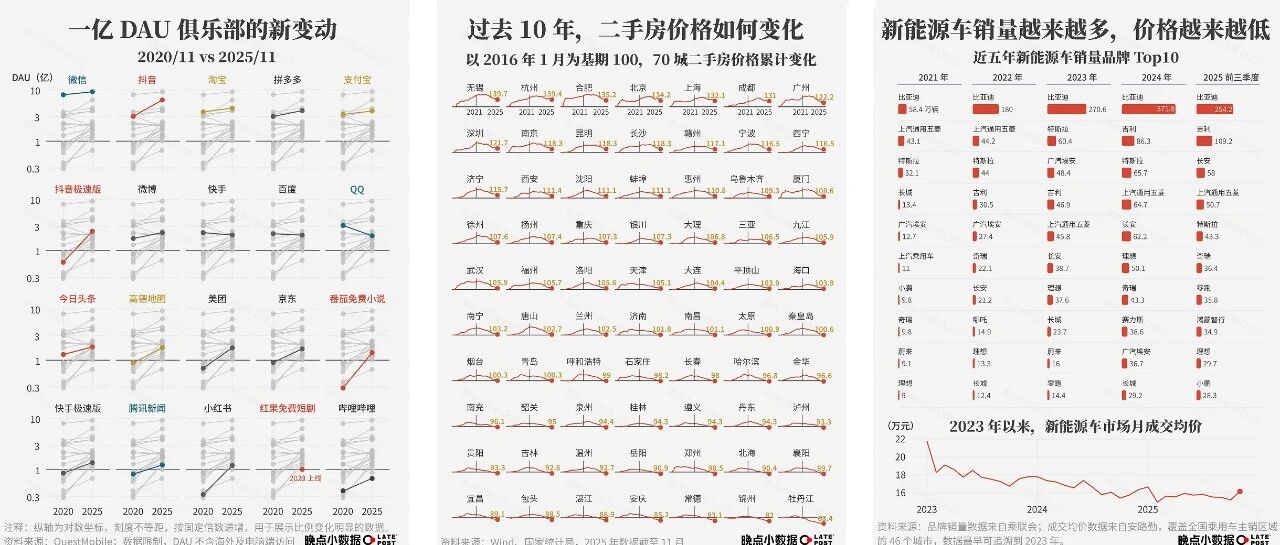
Core Viewpoint - The article emphasizes the long-term changes in consumer behavior and industry dynamics over the past five years, highlighting how events from 2021 continue to shape the current landscape [4][5]. Group 1: Industry Changes - In 2021, several industries were just beginning to emerge, such as AI and new energy vehicles, with companies like Li Auto and NIO selling cars priced at 300,000 to 500,000 yuan, while BYD set mainstream models above 200,000 yuan [5]. - The penetration of internet platforms into daily life was less pronounced five years ago, with platforms like Pinduoduo just starting to become profitable and not yet dominating the market [5]. - By 2025, ByteDance has become a significant player in various sectors, including e-commerce, with its GMV ranking third in the industry, while maintaining high growth rates [12]. Group 2: Company Performance - Alibaba's CFO stated that maintaining profits would be foolish given the competitive landscape, indicating a shift towards aggressive investment strategies among major players [9]. - Pinduoduo has significantly closed the gap with Taobao in terms of user base and shopping habits, focusing solely on retail without diversifying into AI or food delivery [11]. - ByteDance's revenue and profit levels are projected to reach those of Meta by 2025, with a strong focus on AI driving its growth [14]. Group 3: AI Development - The AI sector in China saw significant investment, with ByteDance spending 150 billion yuan in one year, while Alibaba announced a three-year investment plan of 380 billion yuan [33]. - Chinese AI companies are facing different challenges compared to their Silicon Valley counterparts, particularly in user monetization and computational resources [33]. - The user base for AI applications in China is limited, with only about 100 million daily active users across various platforms, indicating a need for more engaging and entertaining products to attract users [43]. Group 4: Consumer Behavior and Market Trends - Over the past five years, consumer spending has increased, but inflation has stagnated, leading to a trend of low-margin sales across industries [50]. - The average price of new energy vehicles in China has dropped to 169,000 yuan, reflecting intense competition and a return to traditional automotive industry dynamics [64]. - The automotive market is characterized by a price war, with companies like Geely and BYD adjusting their strategies to maintain competitiveness [75].


特斯拉2025年交付量大跌,仅为比亚迪纯电车七成!马斯克又讲新故事
新浪财经· 2026-01-03 09:17
Core Viewpoint - Tesla's fourth-quarter delivery volume decreased by 16% year-on-year to 418,227 units, falling short of both analyst expectations and the company's own targets, while BYD continues to show growth in electric vehicle sales [2][3]. Group 1: Tesla's Performance - Tesla's fourth-quarter delivery volume was 418,227 units, a 16% decline compared to the previous year, and did not meet analyst expectations or the company's goals [2][3]. - For the full year, Tesla delivered approximately 1.64 million vehicles, which is about 72.6% of BYD's delivery volume of nearly 2.26 million units, marking a decline of over 8% from the previous year's 1.79 million [3][6]. - Tesla's market share in Europe has decreased, with new car registrations dropping by 39% in the first 11 months of 2025, while BYD's registrations surged by 240% [7]. Group 2: BYD's Growth - BYD's pure electric vehicle sales grew by nearly 28% year-on-year, with total deliveries reaching close to 2.26 million units in 2025 [3][6]. - BYD has also sold over 2 million plug-in hybrid vehicles in the past two years, further widening the gap with Tesla [6]. Group 3: Market Outlook - Analysts have significantly downgraded their expectations for Tesla's 2026 delivery volume from over 3 million to approximately 1.8 million [7]. - The introduction of a cheaper version of the Model Y may help Tesla regain some market share in the coming quarters, especially in emerging markets like Thailand, Vietnam, and Brazil [7]. Group 4: Autonomous Driving Focus - Elon Musk has shifted attention from Tesla's declining sales by promoting the progress of its Robotaxi initiative, which aims for fully autonomous driving without a safety supervisor [8][10]. - Currently, the availability of autonomous vehicle services is limited, with only a few vehicles operational in select areas [10].