石化

Search documents
化工板块反弹
Nan Hua Qi Huo· 2026-01-26 03:25
Report Summary 1. Report Industry Investment Rating No relevant content provided. 2. Core Viewpoints of the Report - After the technical adjustment of non - ferrous related varieties last week, there are signs of a rebound, and silver has reached a new high. The underlying logic is the demand logic of related commodities driven by the new economy, new energy, and AI economy, and there may be a risk of short - squeeze as the market progresses. The anti - involution logic of low - valued varieties is gradually advancing. Recently, chemical varieties have shown signs of a rebound and increased trading activity, which is worthy of attention. The national policy is determined to rectify involution - style competition and adjust the dynamic adjustment ability of the supply side. It is believed that anti - involution will be an inevitable theme in 2026 [2][5]. 3. Summary by Relevant Catalog 3.1 Week - long Market Viewpoint Summary - The strength - weakness structure of the commodity market in the past week remains unchanged, with non - ferrous metals and precious metals remaining strong. Chemical varieties have also shown strong performance recently. After a recent technical adjustment, non - ferrous commodities are strengthening again, and the upward trend continues [4]. - Gold and silver have broken through new highs after a short - term technical adjustment, and there are no signs of a trend reversal from the technical form [4]. - In the context of the easing of China - Canada trade relations, rapeseed oil has weakened, but soybean oil and palm oil are unaffected. The overall downside space for oils and fats is very limited, and they can be used as long - position allocations [4]. - The chemical sector will generally operate within the anti - involution framework in 2026. The national policy emphasizes the supply - demand adjustment of the petrochemical sector. The production capacity of glass has declined significantly recently, and the valuation of chemical products has reached an extreme level [4]. - Steel in the black sector is one of the key anti - involution varieties, and the downside space for coal is also limited. The coal supply - guarantee market is nearing its end. Recently, chemical varieties are showing signs of an upward trend [4]. 3.2 Data Tables - **Plate Capital Flow**: The total capital flow is 34.115 billion yuan. Among them, precious metals have a capital inflow of 5.764 billion yuan, non - ferrous metals 3.479 billion yuan, black metals - 0.594 billion yuan, energy 0.274 billion yuan, chemicals 4.047 billion yuan, feed and breeding 0.478 billion yuan, oils and fats 2.118 billion yuan, and soft commodities 0.259 billion yuan [9]. - **Black and Non - ferrous Weekly Data**: It shows price percentile, inventory percentile, valuation percentile, position percentile, open - interest change percentile, and annualized basis for various black and non - ferrous varieties such as iron ore, rebar, gold, silver, etc. For example, the price percentile of iron ore is 21.8%, and the inventory percentile is 100% [9]. - **Energy and Chemical Weekly Data**: It details price percentile, inventory percentile, valuation percentile, position percentile, open - interest change percentile, and annualized basis for energy and chemical products such as fuel oil, low - sulfur oil, asphalt, etc. For example, the price percentile of fuel oil is 7.5%, and the inventory percentile is 44.1% [11]. - **Agricultural Product Weekly Data**: It provides price percentile, inventory percentile, valuation percentile, position percentile, open - interest change percentile, and annualized basis for agricultural products such as soybean meal, rapeseed meal, soybean oil, etc. For example, the price percentile of soybean meal is 9.9%, and the inventory percentile is 91.9% [12].
化工板块迎资金布局,北向1月净买入超35亿创半年新高;化工行业ETF易方达(516570)连续5日“吸金”
Sou Hu Cai Jing· 2026-01-26 02:53
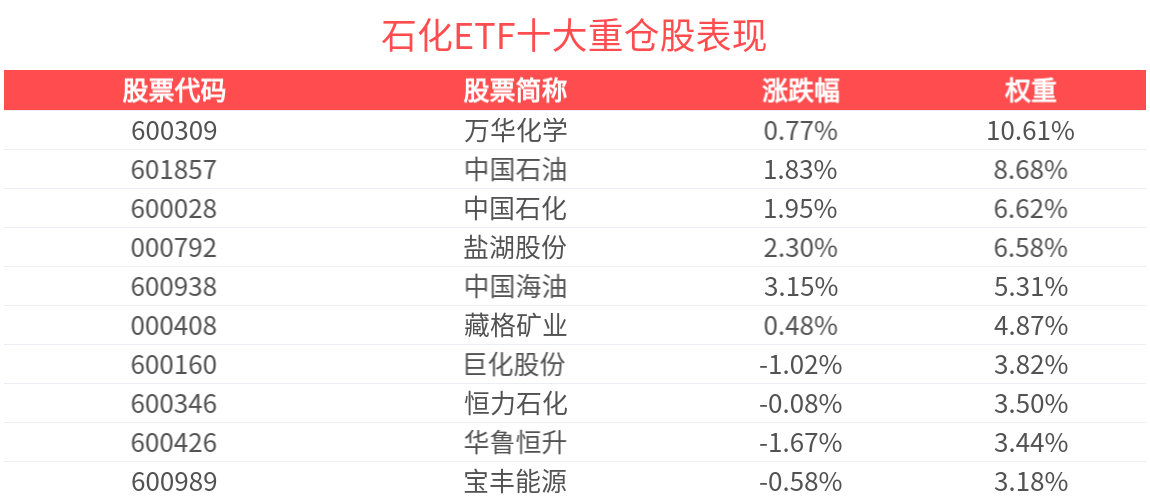
化工行业ETF易方达(516570)一键打包石化产业龙头,管理费率+托管费率合计仅0.2%/年,助力投资 者低成本布局传统能源产业机会。 截至10:03,中证石化产业指数(H11057)涨0.45%,权重股中,万华化学涨1.1%,中国石油涨 2.14%,中国石化涨2.6%,盐湖股份涨3.2%,中国海油涨3.22%,藏格矿业涨1.35%,巨化股份跌 0.41%,恒力石化涨0.73%,华鲁恒升跌0.95%,宝丰能源涨0.09%。 化工行业ETF易方达(516570)跟踪中证石化产业指数,备受资金青睐。数据显示,该基金连续5日获 资金净流入,合计超1.4亿,近20日资金净流入超2.1亿。 消息面上,2025年四季度主动偏股基金对化工板块配置比例环比提升1.2个百分点,结束连续三个季度 减仓态势,2026年1月北向资金累计净买入化工板块超35亿元,创近半年单月新高。机构重点加仓化 纤、化肥、新材料龙头企业,持仓集中度提升,为板块行情提供充足流动性支撑。 银河证券表示,需求端受益国内扩内需政策和美国降息周期,新旧动能切换叠加海外补库需求,化工品 需求增长具备确定性。 相关产品: 易方达中证石化产业ETF联接A(0201 ...

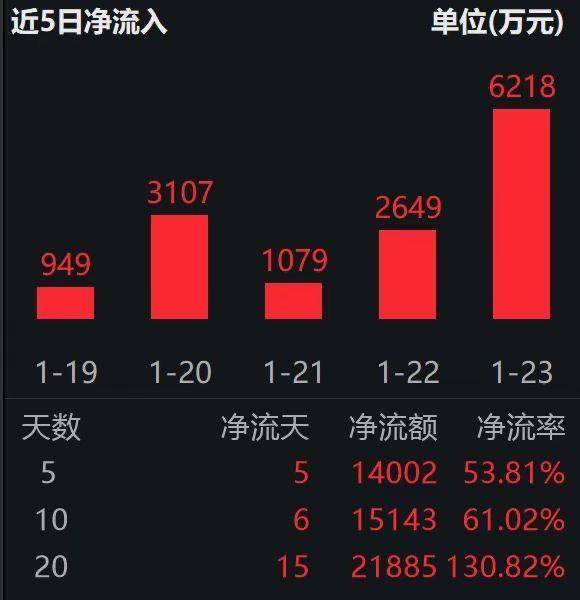
石化ETF(159731)连续13天净流入,合计“吸金”6.1亿元
Xin Lang Cai Jing· 2026-01-26 02:18
Group 1 - The core viewpoint of the news highlights the positive performance of the petrochemical sector, with the China Petrochemical Industry Index showing a slight increase and several key stocks experiencing notable gains [1][2] - The petrochemical ETF (159731) has seen a recent increase in trading volume and liquidity, with a turnover rate of 8.41% and an average daily transaction of 130 million yuan over the past week [1] - The petrochemical ETF has achieved a record high in terms of net inflow, accumulating 610 million yuan over the past 13 days, with a total share count reaching 887 million and a total scale of 910 million yuan [1] Group 2 - The cyclical sector is experiencing price increases in various sub-sectors, particularly in the lithium battery supply chain, with lithium hexafluorophosphate and lithium carbonate leading the price surge [2] - The chemical sector's allocation ratio has rebounded in Q4, indicating improved fundamentals, while the expansion cycle is nearing its end, suggesting potential investment opportunities in the large chemical sector [2] - The top ten weighted stocks in the China Petrochemical Industry Index account for 56.73% of the index, with major players including Wanhua Chemical, China Petroleum, and China Petrochemical [2][4]
光大证券晨会速递-20260126
EBSCN· 2026-01-26 01:29
2026 年 1 月 26 日 晨会速递 分析师点评 市场数据 总量研究 【策略】A 股牛市当前阶段形态特征六问六答——解密牛市系列之六 本轮牛市或已突破第二震荡段,进入上涨段 3。参考历史结构性牛市规律,本轮牛市 上涨段 3 初期或在 4200-4300 点形成阶段性高点,随后回调企稳于震荡段 2 上沿, 并重新开启新一轮上涨。后续需重点跟踪两点:一是 4200-4300 点区间压力释放与 资金承接情况;二是震荡段 2 上沿的支撑有效性及核心板块企稳信号。 【策略】保持稳健,持股过节——策略周专题(2026 年 1 月第 3 期) 保持稳健,持股过节。参考之前的市场行情,我们认为春节前市场将会保持震荡,难 以保持稳定的趋势,这主要与春节之前投资者交易热度有所下行,以及微观流动性短 期趋紧有关。从历史情况来看,春节前 20 个交易日,主要指数上涨概率不足 50%。 预计春节之后市场将会迎来新一轮上行动力,春节后 20 个交易日主要指数上行概率 与平均涨幅均较高。因此建议投资者近期以稳为主,但仍应持股过节。 【债券】如何看待近期 DR001 的上行?——2026 年 1 月 23 日利率债观察 如果一段时间内 ...
连云港打造万亿级绿色石化产业集群
Xin Lang Cai Jing· 2026-01-25 20:20
Core Insights - Lianyungang is advancing its industrial development during the 14th Five-Year Plan, achieving significant growth in industrial output and value-added production, with an annual growth rate of 11.6%, leading the province [1] Group 1: Industrial Development - The city's industrial output value has crossed three trillion yuan thresholds, with a target of exceeding 600 billion yuan in industrial output for the current year [2] - The green petrochemical industry cluster has rapidly emerged, with projects like Shenghong Refining and Satellite Chemical's comprehensive utilization of light hydrocarbons fully operational [1][2] - The bio-pharmaceutical sector has been recognized as a national advanced manufacturing cluster, contributing 16 new Class 1 drugs and ranking fifth among national bio-pharmaceutical parks [1] Group 2: Infrastructure and Energy - The construction of the Tianwan Nuclear Power Plant's Units 7 and 8 has commenced, with a total investment of 72 billion yuan for the Xuwei nuclear energy heating power plant project, which has been approved by the State Council [1] - The first industrial-use nuclear heating project in the country has been put into operation [1] Group 3: Innovation and Technology - Lianyungang aims to stimulate innovation and cultivate new productive forces, focusing on high-end manufacturing and the development of a trillion-level green petrochemical industry cluster [2] - The city plans to enhance its bio-pharmaceutical public technology service platform and accelerate the intelligent, green, and integrated transformation of industries such as steel metallurgy and shipbuilding [2] - The city is also targeting the semiconductor sector by supporting the silicon industry’s extension into this field [2]

零碳工厂迎来国家级“施工图”丨美丽中国·寻找零碳先锋
中国能源报· 2026-01-25 13:35
Core Viewpoint - The article discusses the implementation of a national-level guideline for the construction of zero-carbon factories in China, marking a significant step towards industrial green and low-carbon development, shifting focus from regional "parks" to individual "factories" [1][3]. Group 1: Zero-Carbon Factory Construction - The Ministry of Industry and Information Technology (MIIT), along with other governmental bodies, has issued guidelines to create a clear roadmap for the transition of factories to zero-carbon operations [1][3]. - Zero-carbon factories are seen as essential units that support the construction of zero-carbon parks and promote regional green and low-carbon development [3][5]. - The construction of zero-carbon factories is defined as a process that involves continuous reduction of CO2 emissions through technological innovation, structural adjustments, and management optimization [3][4]. Group 2: Implementation Strategy - The guidelines propose a phased approach to zero-carbon factory construction, prioritizing industries with urgent decarbonization needs and lower difficulty in achieving carbon reduction [7]. - By 2026, a selection of zero-carbon factories will be identified as benchmarks, with a goal to cultivate a number of such factories in sectors like automotive, lithium batteries, and photovoltaics by 2027 [7]. - The strategy emphasizes a gradual expansion to traditional high-energy industries such as steel and cement by 2030, exploring new decarbonization pathways [7]. Group 3: Comprehensive Carbon Reduction System - The construction of zero-carbon factories is viewed as a systemic transformation of manufacturing models, aiming to enhance efficiency and drive green transitions across the industry [9]. - The guidelines outline six key pathways for zero-carbon factory construction, including improving carbon accounting systems, enhancing energy efficiency, and promoting the use of renewable energy [9][10]. - A focus on energy use is highlighted, with an emphasis on increasing the share of renewable energy and optimizing production processes to achieve significant reductions in carbon emissions [11]. Group 4: Policy and Standards - The construction of zero-carbon factories is a complex system project that requires integrated innovation across energy supply, production processes, and policy standards [13]. - The guidelines stress the importance of policy guidance, standard provision, and market-driven approaches to create a collaborative ecosystem for carbon reduction [12][13]. - There is a need for a unified national standard system for zero-carbon factories to ensure consistency and reliability in implementation, with ongoing efforts to develop comprehensive standards and guidelines [14][15].
多家外资石化巨头接连落子广东
2 1 Shi Ji Jing Ji Bao Dao· 2026-01-24 23:43
Group 1 - The article highlights a revolutionary advancement in plastic waste management with the launch of the world's first continuous and large-scale chemical recycling facility for mixed plastic waste in Guangdong, China, marking a significant shift from reliance on crude oil to a circular economy [4][5] - The project, led by Dongyue Chemical, has a capacity of 200,000 tons per year and utilizes a one-step process that transforms low-value mixed plastic waste directly into new plastic, bypassing the need for complex sorting [5][9] - Guangdong's ambitious plans include a 3,000-acre green recycling base and a second-phase project worth 22.6 billion yuan aimed at achieving an annual production capacity of 3 million tons, generating over 2 million tons of green olefins to support the Greater Bay Area's appliance and automotive industries [7][11] Group 2 - The region has seen a rapid transformation of plastic waste from a problematic "white pollution" into a valuable industrial resource, achieving in one year what was initially planned for three years [9] - The Greater Bay Area's petrochemical landscape is expanding, with major players like ExxonMobil and BASF establishing operations, contributing to a robust industry with over 9,800 petrochemical companies and a revenue scale of 2 trillion yuan [11][12] - Guangdong is positioning itself as a global hub for petrochemicals, driven by innovation and openness, facilitating the shift of the global petrochemical focus eastward [14]
多家外资石化巨头接连落子广东
21世纪经济报道· 2026-01-24 23:43
Core Viewpoint - The article highlights the revolutionary advancement in waste plastic recycling technology by Guangdong Dongyue Chemical, which has developed a continuous and large-scale chemical recycling facility that transforms low-value mixed waste plastics directly into new plastics without complex sorting processes, marking a significant shift from reliance on crude oil to a circular economy model [2][3][12]. Group 1: Technological Innovation - Guangdong Dongyue Chemical's project can process 200,000 tons of mixed waste plastics annually using a "one-step" method, which is a departure from the conventional "two-step" process of pyrolysis and refining [2]. - The technology aims to convert scattered waste plastics into new plastic products, achieving a closed-loop cycle of plastic usage [3]. Group 2: Economic Impact - The project is part of a larger initiative in Jieyang, which includes a 3,000-acre green recycling base and a second phase project worth 22.6 billion yuan, targeting an annual production capacity of 3 million tons [6]. - The initiative is expected to produce over 2 million tons of green olefins annually, providing sustainable energy for the home appliance and automotive industries in the Greater Bay Area [6]. Group 3: Industry Landscape - The article notes the rapid development of the waste plastic recycling industry in Guangdong, which has transformed "white pollution" into a valuable industrial resource within three years [8]. - The region is also witnessing significant investments from foreign companies like ExxonMobil and BASF, enhancing its position in the global petrochemical landscape [10][12].
严查地方违规补贴、整顿政府采购秩序,多部委发布会为2026年“反内卷”划重点
Xin Lang Cai Jing· 2026-01-24 04:11
Core Viewpoint - The Chinese government is enhancing its procurement policies to ensure equal treatment of domestic and foreign products, aiming to eliminate discrimination and promote a unified national market by 2026 [2][3]. Group 1: Government Procurement Policy - Starting January 1, 2026, the government procurement policy will officially implement equal treatment for all types of suppliers, prohibiting discrimination based on ownership, organization form, equity structure, investor nationality, or other unreasonable conditions [3]. - The Ministry of Finance has encouraged foreign entities to report any violations of these procurement regulations, emphasizing transparency and fairness in the procurement process [2]. Group 2: Economic Development and Market Competition - The Chinese government is focusing on building a unified national market and addressing "involution" in competition as key tasks for high-quality economic development [3][4]. - Recent data indicates a positive trend in economic indicators, with the core Consumer Price Index (CPI) rising by 1.2% year-on-year in December 2025, and manufacturing profits increasing by 5.0% from the previous year [4][5]. - The government acknowledges existing issues of weak demand and insufficient supply, emphasizing the need to expand domestic demand and optimize supply to achieve a dynamic balance in the economy [5]. Group 3: Regulatory Measures and Market Order - The government plans to implement targeted measures to enhance the effectiveness of the unified market, including refining market operation rules and addressing barriers in procurement and investment [7][8]. - A comprehensive approach will be taken to regulate local government economic promotion behaviors, particularly concerning illegal subsidies and incentives in attracting investments [8]. - The establishment of a clear framework for encouraging and prohibiting local government actions in investment will be prioritized to ensure compliance and fair competition [8].

北方首个,“10万亿俱乐部”再扩容
Mei Ri Jing Ji Xin Wen· 2026-01-24 00:25
Economic Growth in Shandong - Shandong Province is projected to achieve a GDP of 10,319.7 billion yuan in 2025, marking a 5.5% increase from the previous year, making it the third province in China and the first in Northern China to surpass the 10 trillion yuan GDP milestone [1] - By 2025, the primary industry in Shandong is expected to reach an added value of 677.5 billion yuan (up 4.0%), the secondary industry 40,541 billion yuan (up 5.0%), and the tertiary industry 55,881 billion yuan (up 6.1%) [1] Industrial and Economic Indicators - Shandong's industrial added value is anticipated to grow by 7.6%, retail sales of consumer goods by 5.1%, and total foreign trade by 4.5%, all exceeding the national average [3] - The province has faced challenges due to a high reliance on traditional industries, which constituted 70% of its economy, prompting a necessary transition towards modernization and innovation [3] Transition and Development Strategy - The establishment of the Shandong New and Old Kinetic Energy Conversion Comprehensive Experimental Zone in 2018 initiated a dual approach to upgrade traditional industries while fostering new sectors [3] - During the 14th Five-Year Plan period, Shandong's industrial added value increased from 2.3 trillion yuan to 3.3 trillion yuan, reflecting a growth of over 40% [3] - By 2025, advanced production capacity in key industries like steel and petrochemicals is expected to exceed 40%, with high-tech industries accounting for 55.3% of the total output [3] Future Economic Goals - Shandong aims to become a significant economic growth pole in Northern China, with plans to elevate Qingdao to a 2 trillion yuan economy and support cities like Weifang, Linyi, and Jining in reaching the trillion yuan mark [3][4]