Workflow
能源
icon
Search documents
能源化工期权:能源化工期权策略早报-20260108
Wu Kuang Qi Huo· 2026-01-08 02:29
1. Report Industry Investment Rating - No relevant information provided in the document 2. Core Viewpoints of the Report - The energy - chemical sector is mainly divided into energy, alcohols, polyolefins, rubber, polyesters, alkalis, and others. For each sector, options strategies and suggestions are provided for selected varieties. Each option variety's strategy report includes underlying market analysis, option factor research, and option strategy suggestions [9]. - It is recommended to construct option portfolio strategies mainly based on sellers, as well as spot hedging or covered strategies to enhance returns [3]. 3. Summary According to Relevant Catalogs 3.1 Underlying Futures Market Overview - The report shows the latest prices, price changes, price change percentages, trading volumes, volume changes, open interests, and open - interest changes of various energy - chemical futures contracts, such as crude oil, liquefied petroleum gas (LPG), methanol, etc. For example, the latest price of crude oil contract SC2602 is 416, with a decrease of 9 and a decline rate of 2.19%, trading volume of 111,000 lots, and an open interest of 33,000 lots [4]. 3.2 Option Factors 3.2.1 Volume - Open Interest PCR - The report presents the trading volume, volume change, open interest, open - interest change, trading - volume PCR, volume - PCR change, open - interest PCR, and open - interest - PCR change of various energy - chemical options. For instance, the trading - volume PCR of crude oil options is 0.53, with a change of 0.03, and the open - interest PCR is 0.45, with a change of - 0.08 [5]. 3.2.2 Pressure and Support Levels - It shows the underlying contract, at - the - money strike price, pressure points, pressure - point offsets, support points, support - point offsets, maximum call - option open interest, and maximum put - option open interest of various energy - chemical options. For example, the pressure point of crude oil options (SC2602) is 450 and the support point is 400 [6]. 3.2.3 Implied Volatility - The report provides information on the at - the - money implied volatility, weighted implied volatility, weighted - implied - volatility change, annual average implied volatility, call - option implied volatility, put - option implied volatility, 20 - day historical volatility, and implied - historical - volatility difference of various energy - chemical options. For example, the at - the - money implied volatility of crude oil options is 35.09%, and the weighted implied volatility is 43.46% with a change of 11.52% [7]. 3.3 Option Strategies and Suggestions 3.3.1 Energy - Type Options (Crude Oil and LPG) - **Crude Oil**: The fundamental situation involves geopolitical events and OPEC+ production policies. The market has shown a weak - bearish trend recently. Option strategies include constructing a short - biased call + put option combination strategy for the volatility strategy and a long collar strategy for the spot long - hedging strategy [8]. - **LPG**: The supply has no significant increase, and the chemical demand supports the price. The market shows an oscillating - decline bearish trend. Option strategies are similar to those of crude oil, with a short - biased call + put option combination strategy for volatility and a long collar strategy for spot hedging [10]. 3.3.2 Alcohol - Type Options (Methanol and Ethylene Glycol) - **Methanol**: The import volume from Venezuela and domestic inventory conditions affect the price. The market shows an upward - rebound trend after a decline. Option strategies include a short - neutral call + put option combination strategy for volatility and a long collar strategy for spot hedging [10]. - **Ethylene Glycol**: The port inventory situation impacts the price. The market shows a weak - bearish trend. Option strategies include a short - volatility strategy for volatility and a long - spot + long put + short out - of - the - money call strategy for spot hedging [11]. 3.3.3 Olefin - Type Options (PVC) - PVC: The production - capacity utilization rate and the market show a bearish trend followed by a rebound. Option strategies include a bull - spread call - option combination strategy for directionality and a long - spot + long at - the - money put + short out - of - the - money call strategy for spot hedging [11]. 3.3.4 Rubber - Type Options (Rubber and Synthetic Rubber) - **Rubber**: The inventory and production data affect the price. The market shows a warming - up upward trend. Option strategies include a short - neutral call + put option combination strategy for volatility [12]. - **Synthetic Rubber**: No detailed fundamental and strategic analysis is given in the text. 3.3.5 Polyester - Type Options (PTA) - PTA: The market start - up rate and production affect the price. The market shows a short - term strong upward - rebound trend. Option strategies include a bull - spread call - option combination strategy for directionality and a short - bullish call + put option combination strategy for volatility [12]. 3.3.6 Alkali - Type Options (Caustic Soda and Soda Ash) - **Caustic Soda**: The capacity utilization rate and the market show a weak - bearish trend. Option strategies include a bear - spread combination strategy for directionality and a long collar strategy for spot hedging [13]. - **Soda Ash**: The effective production capacity and the market show a low - level weak - oscillating trend. Option strategies include a short - volatility combination strategy for volatility and a long collar strategy for spot hedging [13]. 3.3.7 Other Options (Urea) - Urea: The daily production volume and the market show a short - term weak - bearish trend. Option strategies include a short - bullish call + put option combination strategy for volatility and a long - spot + long at - the - money put + short out - of - the - money call strategy for spot hedging [14].
银河期货每日早盘观察-20260108
Yin He Qi Huo· 2026-01-08 01:53
Report Industry Investment Rating No relevant information provided. Core Viewpoints of the Report - The stock index futures market shows an upward trend despite fluctuations, with the market expected to continue to rise. The bond market is expected to be weak in the short - term, and the commodity market has different trends in various sectors [20][21][24]. - Different sectors in the agricultural market, such as protein meal, sugar, and oils, have their own supply - demand situations and price trends. For example, protein meal is under supply pressure, while sugar is affected by international and domestic supply and demand and cost factors [27][28][32]. - In the black metal market, steel prices are oscillating strongly, while double - coking coal prices are volatile, and iron ore prices are treated bearishly at high levels [56][60][62]. - The non - ferrous metal market has different trends for each metal. For instance, gold and silver are oscillating at high levels, and copper is recommended to be bought after a callback and stabilization [70][71][79]. - The shipping market shows signs of the spot price reaching the top, and the energy - chemical market has different trends for each product, such as the oil price oscillating weakly and the asphalt price being firm [118][120][124]. Summary by Related Catalogs Financial Derivatives Stock Index Futures - The stock index futures market is volatile, with the CSI 500 and CSI 1000 indexes performing strongly. The market is expected to continue to rise, and trading strategies include going long on dips, waiting for the spread of the IM/IC futures - ETF arbitrage, and using bull spreads [20][21][22]. Bond Futures - Bond futures closed down on Wednesday. The bond market is expected to be weak in the short - term due to factors such as the low probability of central bank interest rate cuts and concerns about long - term bond supply and demand. The trading strategy is to sell short for hedging [24][25]. Agricultural Products Protein Meal - The international soybean market is under cost pressure, but the decline may be limited. The domestic soybean supply may decrease, and the spot price may be supported. The trading strategy is to oscillate mainly, reduce the MRM spread, and sell a wide - straddle option [27][28]. Sugar - The international sugar price is expected to oscillate at the bottom, and the domestic sugar price is slightly strong. The trading strategy is to expect the international sugar price to oscillate at the bottom, and the Zhengzhou sugar price to be slightly strong in the short - term, and to sell put options [30][32][33]. Oils - The oils market has improved sentiment, but the fundamentals are still weak. The trading strategy is for palm oil to go short at the upper edge of the range after a rebound, and for soybean oil to follow the overall trend [35][36]. Corn/Corn Starch - The US corn is oscillating at the bottom, and the domestic corn spot price is stable in the short - term but under pressure in the long - term. The trading strategy is to go long on the 03 and 07 contracts on dips and expand the spread between the 05 corn and starch [37][40]. Live Pigs - The supply pressure of live pigs still exists, and the price is expected to be under pressure. The trading strategy is to short sell [41][42]. Peanuts - Peanut spot prices are stable, and the futures price is oscillating at the bottom. The trading strategy is to go long on the 05 contract on dips and sell the pk603 - C - 8200 option [43][44][45]. Eggs - Egg demand has improved, and prices are rising steadily. The trading strategy is to expect the near - term contract to oscillate weakly and consider going long on the far - term 5 - month contract on dips [46][48][49]. Apples - Apple prices are oscillating at a high level due to high costs and good demand during the Spring Festival. The trading strategy is to hold long positions in the May contract and short the October contract [50][51][52]. Cotton - Cotton Yarn - The new - year cotton planting area is expected to decline, and the price is oscillating strongly. The trading strategy is to expect the US cotton to oscillate in the range and the Zhengzhou cotton to be strongly oscillating in the short - term [53][54]. Black Metals Steel - Steel market sentiment has improved, and prices are oscillating strongly. The trading strategy is to hold long positions and consider shorting the coil - coal ratio and the coil - screw spread [56][57]. Double - Coking Coal - Double - coking coal prices are volatile, and long positions are recommended to be gradually closed. The trading strategy is to gradually close long positions and not to chase the market [60][61]. Iron Ore - Iron ore prices are expected to be bearish at high levels due to repeated market expectations. The trading strategy is to short at high levels [62][64][66]. Ferroalloys - Ferroalloys are expected to be strongly oscillating in the short - term due to supply - demand improvement and cost - push. The trading strategy is to be strongly oscillating in the short - term, wait and see for arbitrage, and sell out - of - the - money put options [65][66]. Non - Ferrous Metals Gold and Silver - Gold and silver are oscillating at high levels due to the adjustment of the Bloomberg index. The trading strategy is to hold long positions cautiously based on the 5 - day moving average [70][71][72]. Platinum and Palladium - Platinum and palladium are oscillating. Platinum is expected to be bullish in the long - term, and palladium is recommended to wait and see. The trading strategy is to go long on platinum on dips and consider the long - platinum and short - palladium arbitrage [74][75][76]. Copper - Copper prices have increased short - term fluctuations, and it is recommended to buy after a callback and stabilization. The trading strategy is to control the position and buy after a callback [79][80]. Alumina - Alumina price fluctuations are enlarged due to policy expectations and fundamental contradictions. The trading strategy is to wait and see [81][83]. Electrolytic Aluminum - Electrolytic aluminum prices may have a short - term callback risk due to capital rotation. The trading strategy is to be bullish after a stabilization [85][87]. Cast Aluminum Alloy - Cast aluminum alloy prices oscillate with the sector. The trading strategy is to wait and see [88][90]. Zinc - Zinc prices are affected by the capital side. The trading strategy is to pay attention to the overall trend of the non - ferrous sector and gradually close long positions [93][94]. Lead - Lead prices are recommended to be bought on dips. The trading strategy is to go long on dips and buy out - of - the - money call options [96][97][98]. Nickel - Nickel prices have returned to the financial attribute due to resource speculation. The trading strategy is to operate cautiously after an over - rise and correction [100][101][102]. Stainless Steel - Stainless steel prices follow the nickel price and are weak. The trading strategy is to follow the nickel price [104][105]. Industrial Silicon - Industrial silicon prices are strongly oscillating in the short - term and are recommended to be shorted at high levels in the medium - term. The trading strategy is to be strongly oscillating in the short - term and short at high levels in the medium - term [107][109][110]. Polysilicon - Polysilicon prices may weaken with the market sentiment. The trading strategy is to participate cautiously and sell put options [110][111]. Lithium Carbonate - Lithium carbonate prices are still at a high level after a correction. The trading strategy is to operate cautiously and control the position [112][114]. Tin - Tin prices have increased short - term fluctuations. The trading strategy is to oscillate widely at a high level in the short - term [115][116]. Shipping Container Shipping - Spot container shipping prices show signs of reaching the top, and the main contract is gradually shifting positions. The trading strategy is to close all long positions in the EC2602 contract and wait and see, and look for opportunities for the 6 - 10 positive spread arbitrage [117][118]. Energy - Chemicals Crude Oil - Crude oil supply has no risk for the time being, and prices are oscillating weakly. The trading strategy is to oscillate widely, with gasoline being strong and diesel being weak in China, and the crude oil monthly spread being strong [120][121][122]. Asphalt - Asphalt prices are firm due to raw material concerns. The trading strategy is to oscillate at a high level [123][124][125]. Fuel Oil - Fuel oil prices are volatile due to frequent geopolitical disturbances. The trading strategy is to oscillate strongly in the short - term, be vigilant about geopolitical risks, and look for opportunities for the FU59 positive spread arbitrage [127][129][130]. Natural Gas - TTF/JKM prices are oscillating at a low level, and HH is looking for support. The trading strategy is to hold short positions in the TTF third - quarter contract [131][132][133]. LPG - LPG prices are under pressure despite the geopolitical premium. The trading strategy is to be bearish on the far - term contracts in the long - term and pay attention to the follow - up of the Iranian event [134][135][137]. PX&PTA - The upward drive of PX&PTA prices is weakening. The trading strategy is to oscillate strongly and conduct the 3 - 5 contract positive spread arbitrage [138][139]. BZ&EB - Pure benzene is accumulating inventory, and the supply - demand contradiction of styrene is not significant. The trading strategy is to expect the price to oscillate strongly in the short - term and conduct the short - pure - benzene and long - styrene arbitrage [140][141][143]. Ethylene Glycol - Taiwan's ethylene glycol plants stopped at the beginning of the month, and prices are expected to oscillate widely. The trading strategy is to oscillate widely [144][145]. Short - Fiber - Short - fiber procurement sentiment is cautious, and processing fees are under pressure. The trading strategy is to expect the price to oscillate strongly [146][147]. Bottle Chips - Bottle chip prices follow the cost side and have a relatively loose supply - demand situation. The trading strategy is to expect the price to oscillate strongly [148][149][150]. Propylene - Propane prices have increased, and downstream factories are actively purchasing. The trading strategy is to expect the price to oscillate strongly in the short - term [151][152]. Plastic PP - Domestic medium - and long - term loans are increasing, which is beneficial to plastic PP. The trading strategy is to hold long positions in the L 2605 and PP 2605 contracts and sell and hold the PP2605 put 6100 contract [153][154]. Caustic Soda - The sentiment of the caustic soda market has improved, but the fundamentals are weak. The trading strategy is to wait and see and short on rallies [156]. PVC - PVC prices are mainly oscillating. The trading strategy is to wait and see and short on rallies [157][160][161]. Soda Ash - Soda ash prices are strong under the influence of sentiment. The trading strategy is to not go against the sentiment in the short - term and wait and see to short in the long - term [162][163][165]. Glass - Glass prices are strong under the influence of sentiment. The trading strategy is to not go against the sentiment in the short - term and wait and see to short in the long - term [166][167]. Methanol - Methanol prices are having a short - term correction. The trading strategy is to oscillate strongly [170][171]. Urea - Urea prices are oscillating at a high level. The trading strategy is to hold long positions, pay attention to the 59 positive spread arbitrage, and sell put options on a callback [173][174][175]. Pulp - Pulp prices are oscillating widely at a high level. The trading strategy is to wait and see, and aggressive investors can short against the previous high [177][179][180]. Logs - The price of 6 - meter radiata pine is slightly strengthening. The trading strategy is to wait and see, and aggressive investors can buy a small amount of long positions and look for opportunities for the 3 - 5 reverse spread arbitrage [182][183][184]. Offset Printing Paper - High inventory suppresses the implementation of the cultural paper price increase letter. The trading strategy is to wait and see and sell the OP2603 - C - 4300 option [185][186]. Natural Rubber and No. 20 Rubber - The real - estate market has improved, which is beneficial to natural rubber. The trading strategy is to wait and see for the RU 05 contract, hold long positions in the NR 03 contract, and conduct the RU2605 - NR2605 arbitrage [187][188][189]. Butadiene Rubber - Butadiene rubber prices are rising. The trading strategy is to hold long positions in the BR 03 contract and conduct the BR2603 - NR2603 arbitrage [190][191][192].
帮主郑重:商品市场“集体冷静”,是趋势拐点还是技术回调?
Sou Hu Cai Jing· 2026-01-08 01:11
朋友们,今天全球大宗商品市场的表现,可以说是给近期火热的气氛泼了一盆"冷水"。原油、铜、白银 等主要品种价格全线下行,尤其是伦铜从纪录高位明显回落,白银一度大跌6%。我是帮主郑重。这突 如其来的"集体冷静",是行情趋势的拐点,还是狂奔之后一次必要的技术性喘息?我们得好好拆解一 下。 这对于我们投资者有何启示?策略上需要更加细腻。 对于原油,我们需要重新评估地缘事件的持续性影响。如果"美国销售委油"成为现实,那么供应过剩的 基本面将重新主导定价,油价短期可能面临压力。交易逻辑从"事件驱动"回摆至"供需驱动"。 对于以铜为代表的工业金属,今天的回调未必是坏事。它为看好长期"绿色需求"和"全球复苏"逻辑的投 资者,提供了一个更好的观察窗口和潜在的再次入场机会。关键在于,回调的幅度和时长,是否能将不 坚定的筹码清洗出去。 对于普通投资者而言,当前市场的波动率在显著提升,这意味着短期操作的难度加大。更稳妥的策略或 许是:对于明确看好的长线逻辑(如铜的电动化需求),可以利用这种回调进行分批、耐心的布局,而 不是追涨杀跌;对于受复杂事件驱动的品种(如原油),则需要保持更多警惕,等待局势明朗。 先看领跌的两位。原油价格跌至每 ...
173 分钟对谈,马斯克只讲 3 件事:AI、能源、机器人
3 6 Ke· 2026-01-08 00:56
2026 年 1 月 7 日,马斯克的 173 分钟播客对话上线。节目录制于 2025 年 12 月底。 在节目中,他给出了明确的时间表: 2026 年实现 AGI,三年内机器人超越外科医生,2030 年 AI 智力超越全人类总和。 实现这一切的关键不是算法,而是电。 大多数人严重低估了电的重要性。电力获取、工厂建设、设备散热,这些工程问题正在成为 AI 发展的 真正制约。 为此,他正在孟菲斯建设吉瓦级 AI 工厂,特斯拉也将启动 800 万平方英尺的机器人产线。 整场对话的核心是 AI、能源、机器人三者的关系: 当外界还在讨论 AI 能否辅助医生时,马斯克已将目光投向了完全替代。 他预判,三年内机器人外科医生的专业能力将全面超越人类。在他看来,这不是实验室愿景,而是工程 路线图上的明确节点。 相较于人类,Optimus(擎天柱)机器人拥有无法比拟的物理优势:它不需要休息,没有生理震颤;它 能通过红外线和紫外线光谱获取超越肉眼的感知;最关键的是"云端学习",一台机器掌握了某种复杂手 术,全球所有机器人将即刻同步这一技能。 在他看来,真正的分水岭已经到来。接下来的 AI 竞赛不再只是算法之争,而是对物理世界的掌 ...
马斯克:中国会搞定芯片问题!中国将在发展人工智能所需的算力领域超越其他所有国家!
是说芯语· 2026-01-07 23:47
Core Viewpoint - Elon Musk predicts that China will surpass all other countries in the computing power necessary for artificial intelligence development, emphasizing that China's ability to scale up energy production will be a decisive factor in the AI race [1][3]. Group 1: Energy Supply and AI Development - Musk states that by 2026, China's power generation could reach approximately three times that of the United States, which is crucial for supporting high-energy AI data centers [3]. - The International Energy Agency reports that global data centers will consume 415 terawatt-hours of electricity by 2024, accounting for 1.5% of total global electricity consumption, with AI-driven data centers experiencing even faster growth in energy consumption [3]. - Goldman Sachs highlights that energy shortages may slow down the U.S. in the AI competition, while China is steadily increasing its energy production capacity [4]. Group 2: Chip Production and Technological Development - Musk expresses optimism regarding China's ability to overcome chip production challenges, suggesting that the impact of U.S. restrictions on advanced semiconductors may diminish over time [6]. - He believes that the diminishing marginal returns of cutting-edge chip performance provide an opportunity for latecomer countries like China to catch up in technology [6]. - The shift in global AI competition logic indicates that energy supply capabilities are becoming a hidden variable in reshaping the global AI computing power landscape, with China's investments in energy solidifying its AI industry foundation [6].
华尔街见闻早餐FM-Radio | 2026年1月8日
Sou Hu Cai Jing· 2026-01-07 23:36
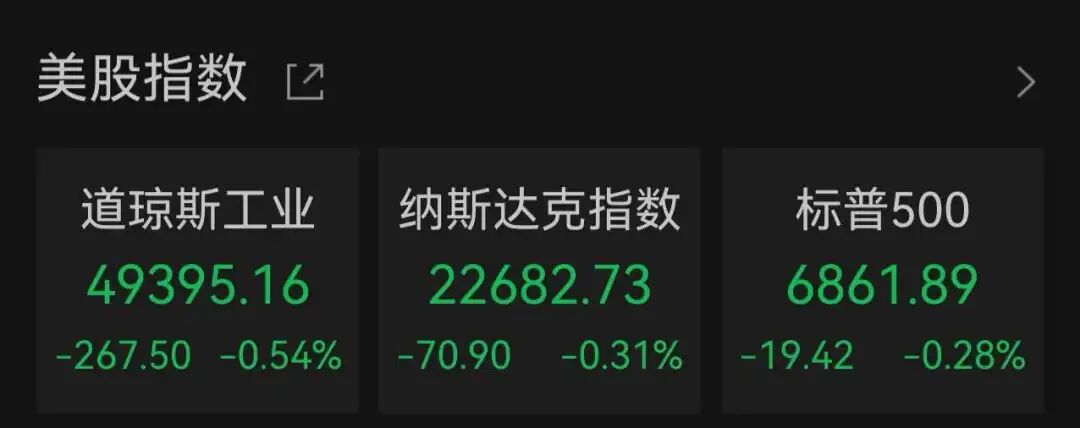
Market Overview - The US economic data presents mixed signals, with geopolitical risks affecting the stock market, leading to declines in the S&P 500 and Dow Jones, while the Nasdaq has seen three consecutive days of gains [1] - Google's parent company saw a 2.5% increase in stock price, surpassing Apple's market value for the first time since 2019, while Apple experienced a six-day decline [1] - The chip index halted a three-day rise, but Nvidia rebounded by 1% [1] - Valero Energy shares rose over 3% following Trump's announcement regarding the transfer of Venezuelan oil to the US [1] - Defense contractors fell after Trump stated he would not allow dividends and buybacks, with Northrop Grumman down 5.5% and Lockheed Martin nearly 5% [1] - Blackstone shares dropped 5.6% after Trump proposed banning institutional investors from purchasing single-family homes [1] Economic Indicators - The US ADP employment report showed a modest increase of 41,000 jobs in December, below expectations, while the JOLTS job openings fell to a one-year low [6][19] - The ISM services PMI rose to 54.4, the highest in over a year, indicating robust demand and a recovery in hiring [19] - The offshore RMB fell over 100 points, nearing the 7.0 mark, hitting a new low for the year [1] Commodities - Precious metals experienced a significant drop, with silver and platinum leading the decline, silver futures down over 6% and platinum nearly 8% [1][17] - Industrial metals also fell, with copper down over 2% and nickel down over 3% [1] - Oil prices dropped to a three-week low, with WTI crude futures down 2% [1][13] AI and Technology - The Chinese government aims to accelerate the upgrade of smart terminals, with a goal for key AI technologies to achieve reliable supply by 2027 [4][33] - The AI sector is seeing significant investment, with companies like Zhiyuan AI and MiniMax planning IPOs in Hong Kong, raising substantial capital [21][9] - The introduction of Gemini AI-powered smart TVs by Google marks a significant step in the consumer electronics sector [22] International Relations - The US is set to "resell" Venezuelan oil and has demanded Venezuela cut economic ties with China and Russia, which has drawn criticism from China [5][20] - The geopolitical landscape is tense, with the US military's recent actions against Russian-flagged oil tankers raising concerns about potential military escalation [20][26]
2025年中国并购市场交易排行榜
Wind万得· 2026-01-07 23:08
Core Insights - In 2025, China's M&A market showed strong growth driven by the recovery of the global M&A market and the high-quality development of the domestic economy, with a total transaction volume of approximately 25,894 billion RMB, an increase of 16.12% year-on-year [2][5] - The number of disclosed M&A events was 8,151, a slight decrease of 0.72% compared to 2024, indicating a robust recovery in market demand supported by policy initiatives [2][5] M&A Market Overview - The total M&A transaction volume for 2025 was approximately 25,894 billion RMB, with quarterly volumes of 4,272 billion RMB, 4,610 billion RMB, 7,410 billion RMB, and 9,602 billion RMB respectively [5] - The most active region for M&A transactions was Beijing, with a transaction volume of 10,930 billion RMB, up 48.59% year-on-year [6] - The top three industries by M&A transaction volume were Industrial (7,605 billion RMB, up 11.67%), Real Estate (4,443 billion RMB, up 549.36%), and Information Technology (2,855 billion RMB, up 35.84%) [10] M&A Transaction Methods - Agreement acquisitions accounted for the largest share of M&A transactions, totaling 10,681 billion RMB, which is 39.75% of the overall volume [12] - Issuing shares to purchase assets ranked second with 3,319 billion RMB, making up 12.35% of the total [12] - Auction-type M&A transactions totaled 2,645 billion RMB, representing 9.84% of the overall volume [12] M&A Purpose Distribution - Horizontal integration M&A transactions accounted for 5,966 billion RMB, or 22.70% of the total transaction volume [13] - Asset adjustment and strategic cooperation transactions accounted for 2,498 billion RMB and 2,059 billion RMB, respectively, making up 9.51% and 7.84% of the total [13] M&A Scale Distribution - Transactions exceeding 100 billion RMB accounted for the highest proportion, representing 42.14% of the total transaction amount [16] - Transactions in the range of 10 billion to 100 billion RMB accounted for 34.48% of the total [16] Top M&A Transactions - The largest M&A transaction was the judicial auction of 12.63% equity in Wantong Development, with a transaction volume of 2,316.10 billion RMB [17] - The second-largest was China Shenhua's acquisition of equity in 12 companies, totaling 1,335.98 billion RMB [18] - The third-largest involved CICC's merger with Dongxing Securities and Xinda Securities, with a transaction volume of 1,142.75 billion RMB [20] Financial Advisor Rankings - CICC ranked first among financial advisors with a transaction volume of 4,298.01 billion RMB [24] - CITIC Securities and Shenwan Hongyuan ranked second and third with 3,046.91 billion RMB and 1,397.09 billion RMB, respectively [24] Legal and Accounting Firm Rankings - Zhonglun Law Firm led the legal advisory sector with a transaction volume of 2,074.55 billion RMB [32] - Ernst & Young ranked first among accounting firms with a transaction volume of 2,145.38 billion RMB [35]
投资级企业掀起史上最猛年初融资潮 美元债发行规模创新冠疫情以来新高
Zhi Tong Cai Jing· 2026-01-07 22:28
Group 1 - Investment-grade corporate bonds in the U.S. are experiencing the most intense wave of dollar bond financing since the onset of the COVID-19 pandemic, with issuance reaching $88.4 billion this week, the highest weekly level since May 2020 [1] - Major Wall Street banks, including Morgan Stanley and JPMorgan, predict that the issuance of investment-grade bonds could reach a historical high by 2026, driven by lower borrowing costs and the need for long-term funding for mergers and acquisitions and data center construction related to the AI boom [1] - The strong demand from investors is a significant driving force behind this issuance wave, with some corporate bonds being oversubscribed by four times, and a bond from Orange SA being oversubscribed by 15 times, indicating a preference for long-term assets [1] Group 2 - The new bond issuance premium that companies must pay to attract investors has significantly decreased, further lowering financing costs and enhancing issuance motivation [2] - European banks, including Crédit Agricole and Société Générale, have entered the U.S. market to issue "Yankee bonds," with expectations that U.S. banks will follow suit after major earnings reports next week [2] - The energy, utilities, and automotive finance sectors are key contributors to the current bond issuance, with companies like Total, Public Service Enterprise Group, General Motors, and Ford's financing subsidiaries participating in this wave [2]
“掘金”2026年传统产业转型机遇
Zheng Quan Ri Bao· 2026-01-07 17:10
Group 1 - The core viewpoint emphasizes the importance of deep collaboration among policy guidance, clear pathways, and capital empowerment to unlock transformation opportunities in traditional industries [1] - Continuous policy support provides clear guidance for the transformation of traditional industries and establishes a reliable framework for capital market participation [1] - The transformation of traditional industries is driven by dual forces of digitalization and greening, with specific policies expected to be introduced by 2026 to support digital upgrades in key sectors [1] Group 2 - Focusing on the new quality productivity track is crucial for identifying high-potential targets in traditional industry transformation [2] - Traditional industry upgrades involve reconstructing the value chain through digitalization, greening, and high-end development rather than simple equipment replacement [2] - Capital markets are increasingly favoring companies that combine "hard technology + sustainability" as they provide long-term funding support for traditional enterprises [2] Group 3 - The strengthening of policy and regional collaboration is creating a window of opportunity for the development of industrial clusters [2] - By 2026, capital markets are expected to favor traditional industry companies with core technological breakthroughs, clear transformation paths, green financing capabilities, and high-quality information disclosure [2] - Investment and financing will focus on companies listed on the Sci-Tech Innovation Board, Growth Enterprise Market, and Beijing Stock Exchange that are undergoing transformation upgrades [2]
国新能源:公司2025年度经营业绩将出现亏损
Zhi Tong Cai Jing· 2026-01-07 14:59
国新能源(600617)(600617.SH)披露2025年年度业绩预亏的提示性公告,公司预计2025年度归属于上 市公司股东的净利润为负值,公司2025年度经营业绩将出现亏损。 ...