连锁餐饮

Search documents
云海肴创始人去世,暴露一个扎心问题
创业邦· 2025-09-20 11:09
Core Viewpoint - The article reflects on the untimely death of Zhao Han, the co-founder and chairman of the well-known restaurant chain Yunhaiyao, emphasizing the impact of his contributions to the promotion of Yunnan cuisine across China and the importance of addressing health issues among entrepreneurs [4][7][15]. Group 1: Zhao Han's Contributions - Zhao Han was instrumental in bringing Yunnan cuisine to a national audience, establishing Yunhaiyao as a leading brand in the mid-to-high-end restaurant sector [15]. - Under Zhao Han's leadership, Yunhaiyao expanded to over 200 locations across 29 cities in three countries, achieving annual revenues exceeding 1 billion yuan [15]. - The restaurant's success is attributed to its strategic positioning in bustling commercial areas, which attracted a stable and significant customer flow [14][15]. Group 2: Health Concerns for Entrepreneurs - Zhao Han's death highlights the increasing prevalence of sudden cardiac events among entrepreneurs, with acute myocardial infarction being a leading cause [17]. - Statistics indicate that approximately 1 million cases of acute myocardial infarction occur annually in China, with a mortality rate exceeding 30% [17]. - Factors contributing to heart attacks include high work intensity, irregular eating habits, emotional fluctuations, smoking, cold exposure, and constipation [18][19][20][21][22][23]. Group 3: Entrepreneurial Challenges - Entrepreneurs often face immense pressure, leading to physical and mental exhaustion, which can result in severe health issues [25][26]. - The article stresses the need for entrepreneurs to prioritize their health and well-being, as success in business should not come at the cost of personal health [26].


9点1氪|小米召回超11万辆SU7;翟欣欣案宣判:犯敲诈勒索罪,判刑12年;云海肴创始人去世,年仅40岁
3 6 Ke· 2025-09-20 00:54
Group 1 - Xiaomi recalls 116,887 units of SU7 standard version electric vehicles due to safety concerns, implementing free software upgrades via OTA technology [2] - The founder of Yunhai Yao, Zhao Han, passed away at the age of 40 due to a heart attack, impacting the well-known restaurant brand [3] - Chasing Technology announced its first smartphone, Dreame Space, has secured over 100 million yuan in pre-orders before its official launch, targeting the high-end market [4] Group 2 - The Paris Notre-Dame Cathedral's towers will reopen to visitors on September 20, 2024, after extensive repairs following a fire in 2019 [5][6] - Jaguar Land Rover has extended the production halt for 33,000 employees due to ongoing network security issues [10] - GE Healthcare is exploring options for selling its China division, potentially valued at several billion dollars, amidst market speculation [10] Group 3 - Major internet companies are increasing bond financing to support AI investments, with Tencent, Baidu, and Alibaba leading the charge [11] - A major gold theft in Hong Kong resulted in the loss of approximately 59 million HKD, with the mastermind arrested [11] - The Nanjing Wahaha Hongzhen Drinking Water Company, controlled by Zong Fuli, is set to be deregistered [12] Group 4 - iOS 26 introduces over 20 new AI features without increasing storage requirements, indicating improved efficiency [13][14] - Meta's CEO Mark Zuckerberg emphasizes the importance of investing heavily in AI to avoid falling behind in the competitive landscape [14] - Xiaomi has open-sourced its first native end-to-end voice model, Xiaomi-MiMo-Audio, showcasing advancements in voice technology [15] Group 5 - FedEx reported better-than-expected Q1 earnings with an adjusted EPS of $3.83, exceeding analyst expectations [16] - Nvidia plans to invest $500 million in the UK autonomous driving startup Wayve [16] - Zhanxin Electronics completed a C-round financing exceeding 1 billion yuan, aimed at expanding its silicon carbide production capacity [17]

云海肴联合创始人赵晗去世,前员工:我心中TOP 1的好老板
第一财经· 2025-09-19 16:04
Core Viewpoint - The article reports the passing of Zhao Han, co-founder of Yunhaiyao, highlighting his contributions to the restaurant industry and the emotional impact of his loss on employees and partners [3][6][7]. Company Overview - Zhao Han, born in July 1985 in Kunming, was a graduate of Renmin University of China and served as the chairman of Yunhaiyao [6]. - In 2009, Zhao Han and three partners founded the first Yunhaiyao restaurant in Beijing, leading to the establishment of a chain that became a leader in Yunnan cuisine [6]. - As of now, Yunhaiyao operates 138 stores nationwide, with 47% located in first-tier cities [6]. Employee Sentiments - Former employees expressed shock and sorrow over Zhao Han's death, describing him as a kind and approachable leader who fostered a strong team spirit [7]. - Zhao Han was remembered for his personal touch, including maintaining connections with former employees and celebrating occasions with them [7]. Business Operations - The four partners of Yunhaiyao, all born in the 1980s, actively engage in daily operations, discussing strategies such as discounts and promotions [7]. - Zhao Han's entrepreneurial journey began with a student organization, which led him to explore the restaurant business and eventually invest his family's savings into opening a restaurant [7].

云海肴联合创始人赵晗去世,前员工:他永远亲切待人
Di Yi Cai Jing· 2025-09-19 14:16
Core Viewpoint - The news reports the passing of Zhao Han, co-founder of Yunhaiyao, highlighting his significant contributions to the restaurant industry and the emotional impact of his loss on employees and partners [1][2]. Company Overview - Yunhaiyao was co-founded by Zhao Han in 2009 in Beijing, focusing on Yunnan cuisine and has grown to become a leading chain in this segment with 138 locations nationwide, 47% of which are in first-tier cities [2]. - Zhao Han was instrumental in establishing the brand alongside three partners, and they actively participated in daily operations and strategic discussions [2]. Employee Sentiments - Former employees expressed shock and sorrow at Zhao Han's passing, describing him as a kind and approachable leader who fostered a positive work environment [1][2]. - Employees fondly recalled his leadership style, including team-building activities and personal gestures like sending red envelopes during holidays [2]. Personal Background - Zhao Han was born in July 1985 in Kunming and was a graduate of Renmin University of China, where he studied history [2]. - His entrepreneurial journey began with a student organization that led him to explore the restaurant business, ultimately convincing his parents to invest in his first restaurant venture [2].
云海肴创始人赵晗突发心梗去世,年仅40岁
Sou Hu Cai Jing· 2025-09-19 07:18
Group 1 - Zhao Han, co-founder of the well-known restaurant chain Yunhaiyao, passed away due to a sudden heart attack at the age of 40 on September 18 [1][5] - The farewell ceremony for Zhao Han is scheduled for September 20 at 11 AM at the Kunming City Funeral Home [3] - Zhao Han was born in 1985 in Kunming, Yunnan, and co-founded the first Yunhaiyao restaurant in Beijing in 2009 with three partners, quickly establishing the brand as a leader in Yunnan cuisine [5] Group 2 - In February 2025, Zhao Han will no longer serve as chairman or hold other positions in the board of Yunhaiyao, with Zhu Haiqin taking over as chairman and CEO [5] - The company has expanded to include another brand, "Dao Xiaoman," and has rapidly developed into a leading chain for Yunnan cuisine [5]

云海肴创始人突发心梗去世,年仅40岁!
Zhong Guo Ji Jin Bao· 2025-09-19 07:16
Core Points - Zhao Han, the founder and chairman of the well-known restaurant chain Yunhaiyao, passed away due to a sudden heart attack at the age of 40 [1][4] - The official statement from Yunhaiyao confirmed the news, expressing deep sorrow and highlighting the pressures Zhao faced in the restaurant industry [1] - Zhao Han was instrumental in establishing Yunhaiyao and expanding its brand presence, including international ventures [5] Company Overview - Yunhaiyao was co-founded by Zhao Han and three other individuals in October 2009, with the first restaurant opening in Beijing [5] - The brand focuses on Yunnan cuisine, with the name reflecting its origins and culinary aspirations [5] - Under Zhao's leadership, Yunhaiyao became a leading chain in Yunnan cuisine, launching several sub-brands [5] Investment and Growth - In 2014, Yunhaiyao received significant investment from Sequoia Capital and Julin Capital, marking a pivotal moment in its growth [5] - The company relocated its registration back to Kunming in the same year and opened its first restaurant in Kunming in November 2017 [5] - Zhao Han expanded the brand internationally, opening a restaurant in Singapore in 2019, with a third location established in September 2020 [5] Leadership Transition - Zhao Han was set to fully exit management of Yunhaiyao by the end of 2024, with Zhu Haiqin appointed as the new chairman and CEO in February 2025 [5]
云海肴联合创始人、CEO朱海琴发文悼念赵晗
Sou Hu Cai Jing· 2025-09-19 07:03
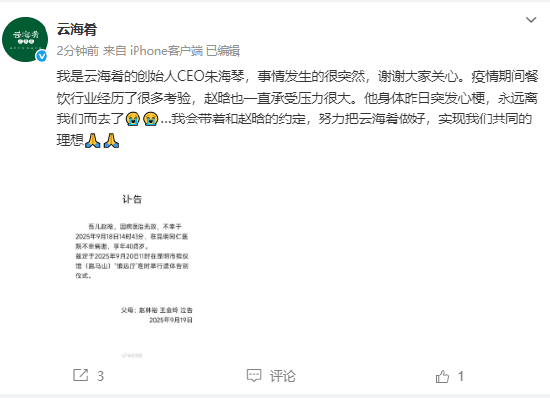
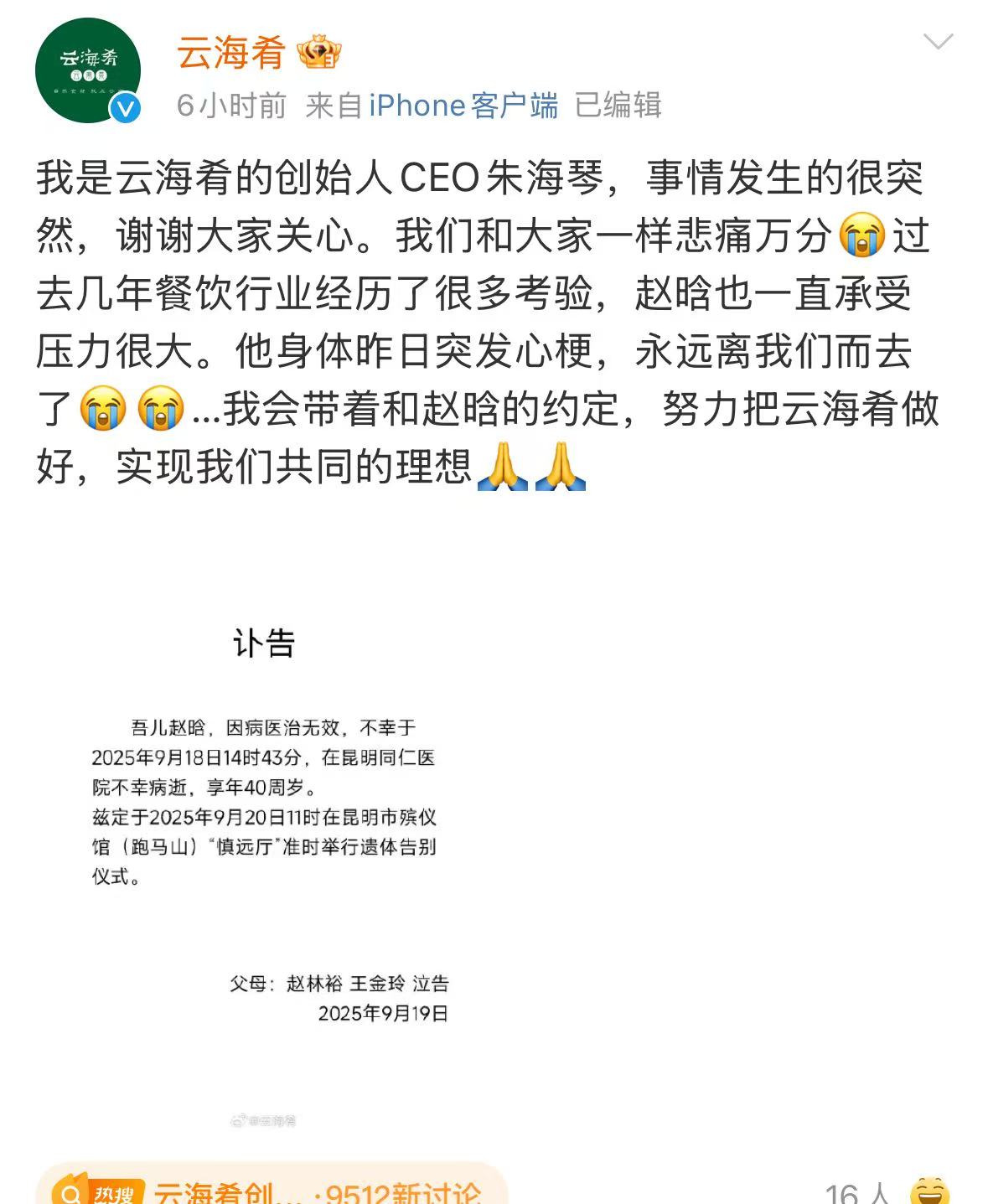
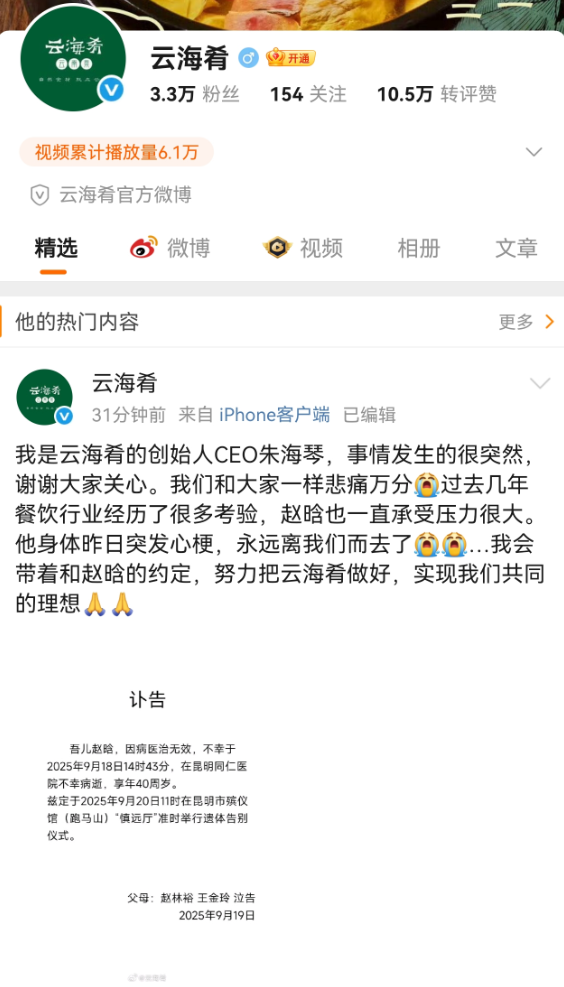
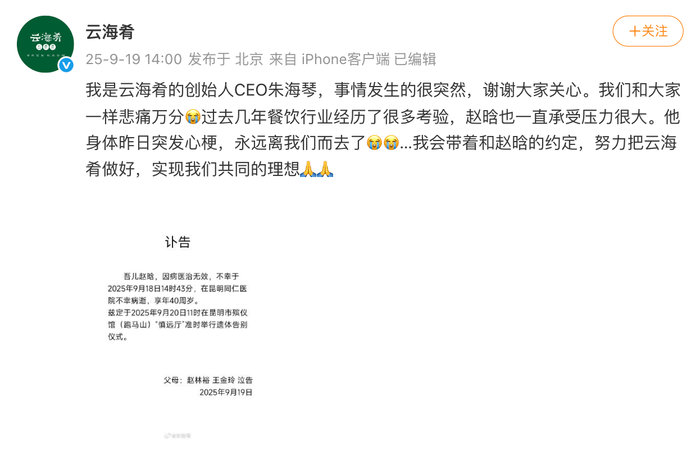
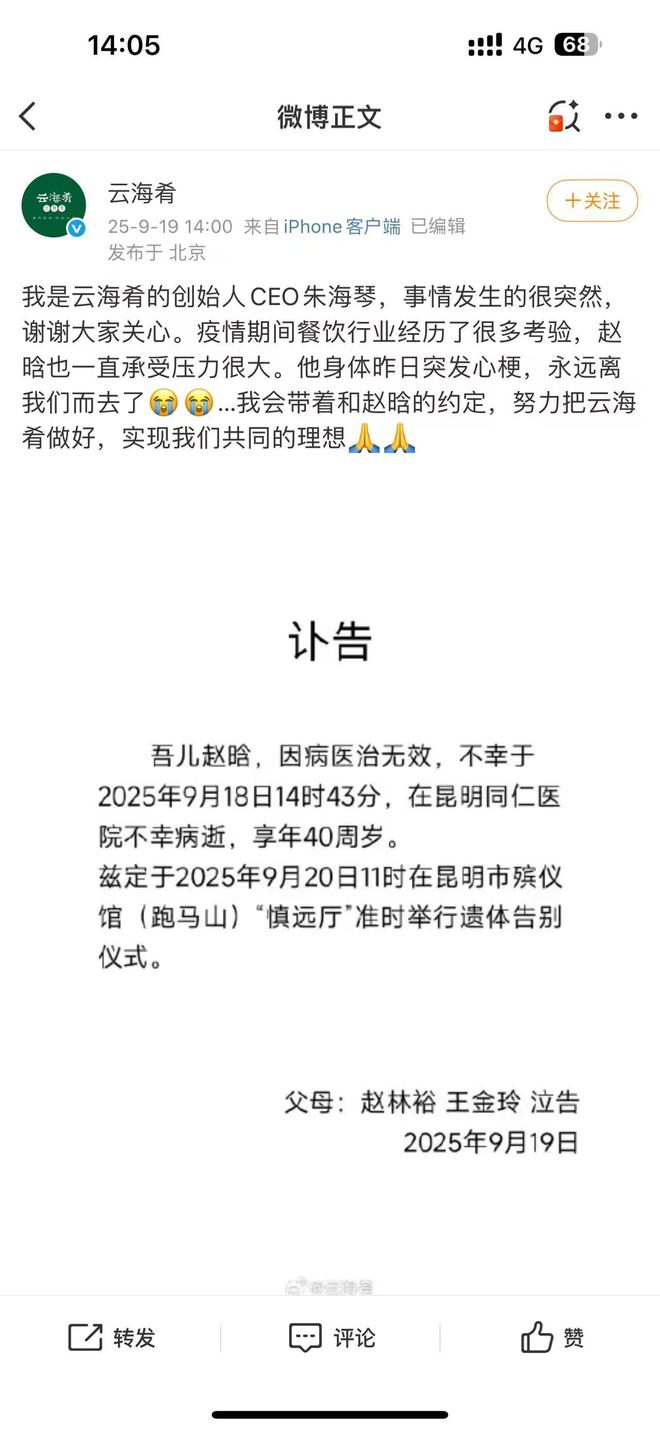
9月19日午间,云海肴联合创始人、CEO朱海琴通过@云海肴 微博账号发文悼念赵晗,"我会带着和赵 晗的约定,努力把云海肴做好,实现我们共同的理想。"朱海琴称,"过去几年餐饮行业经历了很多考 验,赵晗也一直承受压力很大。" 知名连锁餐饮品牌云海肴联合创始人、董事长赵晗因突发心梗,经医治无效在9月18日于昆明同仁医院 病逝,年仅40岁。据赵晗家属发布的讣告显示,遗体告别仪式定于9月20日11时在昆明市殡仪馆"慎远 厅"举行。 ...
云海肴联合创始人赵晗因突发心梗病逝,年仅40岁
Nan Fang Du Shi Bao· 2025-09-19 06:40
Group 1 - Zhao Han, co-founder and chairman of the well-known restaurant chain Yunhaiyao, passed away suddenly at the age of 40 due to a heart attack [1] - The official statement from Yunhaiyao confirmed the news, with CEO Zhu Haiqin expressing gratitude for the support and acknowledging the pressures faced during the pandemic [1] - Zhao Han's death occurred on September 18, 2025, and a memorial service is scheduled for September 20, 2025, in Kunming [1] Group 2 - Zhao Han was born on July 1, 1985, in Kunming, Yunnan, and was a graduate of Renmin University of China [6] - He founded the Yunnan cuisine chain "Yunhaiyao" in 2009 and later expanded with sub-brands like "Dao Xiaoman" [6] - Yunhaiyao received funding from Sequoia Capital China and Longbai Capital in 2012, with the main entity, Yunnan Yunhaiyao Catering Management Co., Ltd., established in 2014 [6] - In December 2024, Zhao Han stepped down from his positions as legal representative and chairman, with Zhu Haiqin taking over [6]
又一个“西贝”暴雷!3亿中产天塌了
创业邦· 2025-09-19 06:27
Core Viewpoint - The article discusses the challenges faced by the hotpot restaurant chain "Tai Er" amid controversies surrounding the use of pre-prepared dishes, particularly in the context of the recent "Xi Bei" incident, which has heightened consumer scrutiny on food quality and preparation methods [5][10]. Group 1: Company Overview - Tai Er has gained popularity for its unique dining experience, including long wait times and strict dining rules, but is now facing allegations of using pre-prepared ingredients, which contradicts its branding as serving "live fish" [6][10]. - The company has seen a significant decline, closing 65 stores in the past year and experiencing a sharp drop in revenue, with a reported income of 1.949 billion yuan, down 13.3% year-on-year [8][21]. Group 2: Market Context - The pre-prepared dish controversy has become a nightmare for many restaurant brands, as consumer perception can quickly turn negative, impacting sales and brand reputation [10][14]. - The Chinese sauerkraut fish market is projected to grow at a compound annual growth rate of 33.7% from 2018 to 2024, with the market size expected to exceed 80 billion yuan by 2025, indicating significant consumer potential [17]. Group 3: Strategic Responses - In response to the controversies, Tai Er has initiated a transformation strategy, including the introduction of "fresh live concept stores" and expanding its menu to include other core items like fresh chicken and beef, aiming to diversify its offerings and reduce reliance on sauerkraut fish [22]. - The company is also adapting its dining policies to attract family customers by allowing larger groups and introducing new cooking styles, which marks a shift from its previous strict dining rules [22]. Group 4: Future Outlook - The ongoing pre-prepared dish debate presents both a challenge and an opportunity for Tai Er to redefine its brand narrative and potentially regain consumer trust through genuine quality improvements [22][24]. - As competition intensifies and consumer interest wanes, the company must focus on building long-term brand loyalty and differentiating itself in a crowded market to avoid stagnation [24].
云海肴创始人赵晗去世,云海肴CEO发声
Xin Lang Ke Ji· 2025-09-19 06:12
9月19日,知名连锁餐饮品牌云海肴联合创始人、董事长赵晗因突发心梗,经医治无效在9月18日于昆明 同仁医院病逝,年仅40岁。 云海肴创始人、CEO朱海琴在云海肴官方微博发文确认了这一消息,并贴出了赵晗家属发布的讣告。讣 告显示,赵晗于9月18日病逝,遗体告别仪式定于9月20日11时在昆明市殡仪馆"慎远厅"举行。 公开资料显示,赵晗毕业于中国人民大学国学院,2009年与堂哥吕志韬、好友朱海琴等共同创立云海 肴,将云南菜带出云南,发展为全国知名的餐饮品牌。他致力于传承云南美食文化,推动云南食材产业 发展,曾获"兴滇人才奖"等荣誉。 责任编辑:王翔 ...