
铁矿石

Search documents
山金期货黑色板块日报-20260115
Shan Jin Qi Huo· 2026-01-15 01:28
Report Summary 1. Report Investment Rating for the Industry - No investment rating information is provided in the report. 2. Core Viewpoints - The steel market is in the off - season of consumption, showing a situation of weak supply and demand. The arrival of winter storage still needs time. The strong rise of the stock market and optimistic policy expectations boost confidence, but the market supervision's interview with the photovoltaic association and related enterprises has affected market sentiment. For both steel and iron ore, it is recommended to hold long positions for mid - term trading and avoid chasing up or selling down [2][3]. 3. Summary by Directory 3.1 Threaded Rods and Hot - Rolled Coils - **Supply and Demand**: Last week, the production of threaded rods increased, the overall inventory continued to decline, the apparent demand for threaded rods decreased, the overall apparent demand for the five major steel products declined, the inventory increased, and production slightly rebounded. In the off - season, the steel mill production may continue to decline [2]. - **Operation Suggestion**: Hold long positions for mid - term trading, and avoid chasing up or selling down [2]. - **Data Highlights**: - The closing price of the threaded rod main contract is 3162 yuan/ton, up 4 yuan (0.13%) from the previous day and down 25 yuan (- 0.78%) from last week. - The 247 steel - mill blast furnace operating rate is 78.94%, up 0.62 percentage points; the daily average molten iron output of 247 steel mills is 229.5 million tons, up 2.07 million tons (0.91%) [2]. 3.2 Iron Ore - **Supply and Demand**: The overall production of the five major steel products increased last week, but the apparent demand decreased month - on - month. The market is in the off - season, and the molten iron output is likely to decline seasonally. Although the molten iron output of 247 sample steel mills rebounded by about 2.1 million tons last week, it is expected to be a short - term phenomenon. The arrival of pre - festival restocking demand will be later than usual this year due to the late Spring Festival. Global shipments have declined, and the rising port inventory suppresses the futures price. The sharp rebound of coking coal and coke supports the price of iron ore [3]. - **Operation Suggestion**: Hold long positions for mid - term trading [3]. - **Data Highlights**: - The settlement price of the DCE iron ore main contract is 821 yuan/dry ton, up 1.5 yuan (0.18%) from the previous day and down 7 yuan (- 0.85%) from last week. - The Australian iron ore shipments are 1659.5 million tons, down 39 million tons (- 2.30%) [4]. 3.3 Industry News - In December 2025, Mongolia's coal exports were 10.9291 million tons, a month - on - month increase of 16.83% and a year - on - year increase of 71.31%. From January to December 2025, Mongolia's cumulative coal exports were 90.0182 million tons, a year - on - year increase of 7.48% [6]. - HeSteel obtained the first steel export license order in Hebei Province for 2026, which will be shipped to Chittagong, Bangladesh [6]. - As of the week ending January 14, according to Zhaogang.com, the national building materials production was 4.4952 million tons, an increase of 0.042 million tons from last week; the factory inventory was 3.8945 million tons, a decrease of 0.0565 million tons from last week; the social inventory was 3.5609 million tons, an increase of 0.121 million tons from last week [6]. - In December, China imported 119.647 million tons of iron ore and its concentrates and 58.597 million tons of coal and lignite [6].
铁矿石早报-20260115
Yong An Qi Huo· 2026-01-15 00:46
Group 1: Report Industry Investment Rating - No information provided Group 2: Report's Core View - No clear core view presented in the given content Group 3: Summary by Relevant Catalogs Spot Market - Newman powder price is 818, with daily change of 0 and weekly change of -6. Its discounted futures price is 875.9, with daily change of -0.30 and weekly change of -1.00, and import profit is 16.98 [1] - PB powder price is 827, with daily change of 1 and weekly change of -5. Its discounted futures price is 881.9 [1] - Mac powder price is 820, with daily change of -8 and weekly change of -14. Its discounted futures price is 895.5, with daily change of -0.30 and weekly change of -1.00, and import profit is 43.45 [1] - Jinbuba powder price is 780, with daily change of 1 and weekly change of -5. Its discounted futures price is 875.3, with daily change of -0.35 and weekly change of -1.40, and import profit is 53.71 [1] - Mainstream mixed powder price is 757, with daily change of 0 and weekly change of -1. Its discounted futures price is 897.4, with daily change of -0.30 and weekly change of -0.65, and import profit is 5.79 [1] - Super special powder price is 702, with daily change of -1 and weekly change of -8. Its discounted futures price is 924.9, with daily change of -0.20 and weekly change of -0.60, and import profit is 5.76 [1] - Carajás powder price is 909, with daily change of 1 and weekly change of -10. Its discounted futures price is 845.0, with daily change of -0.35 and weekly change of -1.20, and import profit is -11.83 [1] - Brazilian mixed powder price is 858, with daily change of -5 and weekly change of -15. Its discounted futures price is 867.8, with daily change of -0.15 and weekly change of -1.15, and import profit is 8.79 [1] - Brazilian coarse IOC6 price is 787, with daily change of -3 and weekly change of -9. Its discounted futures price is 863.3 [1] - Brazilian coarse SSFG price is 792, with daily change of -3 and weekly change of -9 [1] - Ukrainian iron concentrate price is 901, with daily change of -8 and weekly change of -14. Its discounted futures price is 998.3 [1] - 61% Indian powder price is 769, with daily change of 1 and weekly change of -5 [1] - Karara iron concentrate price is 905, with daily change of -4 and weekly change of -10. Its discounted futures price is 928.3 [1] - Roy Hill powder price is 814, with daily change of 1 and weekly change of -5. Its discounted futures price is 895.9, with daily change of -0.35 and weekly change of -0.95, and import profit is 65.00 [1] - KUMBA powder price is 886, with daily change of 1 and weekly change of -5. Its discounted futures price is 866.5 [1] - 57% Indian powder price is 637, with daily change of -1 and weekly change of -8 [1] - Atlas powder price is 752, with daily change of 0 and weekly change of -1 [1] - Tangshan iron concentrate price is 982, with daily change of 0 and weekly change of -6. Its discounted futures price is 869.0 [1] Futures Market - i2601 contract price is 832.5, with daily change of 2.5 and weekly change of -6.5. The monthly spread is -33.5, with daily change of 12.5, weekly change of -1.4, and weekly change of -4.3 [1] - i2605 contract price is 821.0, with daily change of 1.5 and weekly change of -7.0. The monthly spread is 11.5, with daily change of 24.0, weekly change of -0.4, and weekly change of -3.8 [1] - i2609 contract price is 799.0, with daily change of 1.0 and weekly change of -5.5. The monthly spread is 22.0, with daily change of 46.0, weekly change of 0.1, and weekly change of -5.3 [1] - FE01 price is 108.19, with daily change of -0.70 and weekly change of 1.55. The monthly spread is -2.55, with daily change of -22.7, weekly change of -28.7, and weekly change of -7.2 [1] - FE05 price is 107.41, with daily change of -0.83 and weekly change of 1.86. The monthly spread is 0.78, with daily change of -27.0, weekly change of 3.4, and weekly change of 4.9 [1] - FE09 price is 105.64, with daily change of -0.76 and weekly change of 1.99. The monthly spread is 1.77, with daily change of -34.6, weekly change of 1.8, and weekly change of 3.3 [1]
国投期货2026年铁矿石年度策略:过剩压力加剧,重心继续下移
Guo Tou Qi Huo· 2026-01-14 11:07
1. Report Industry Investment Rating No relevant information provided. 2. Core Viewpoints - In 2026, the overseas iron ore demand is expected to have a mild recovery, with overseas pig iron production increasing by 0.5% and iron ore demand increasing by about 3.5 million tons. However, the domestic demand remains under pressure, with domestic hot metal production expected to decline slightly by 0.5% and iron ore demand potentially decreasing by about 8 million tons. The overall supply of iron ore is gradually becoming looser, and the pressure of inventory accumulation in domestic ports will intensify [9][13]. 3. Summary by Relevant Catalogs 3.1. 2025 Iron Ore Price Trend Review - In early 2025, affected by the Australian hurricane, the supply was temporarily tight, and the price maintained a high - level shock. Then, due to the steady release of global major mine capacities, the weak recovery of domestic terminal demand, and external trade frictions, the iron ore price entered a downward channel. In the second half of the year, driven by the increasing expectation of the "anti - involution" policy, the iron ore price rebounded with the black - series as a whole, but was suppressed by the supply growth and supported by high hot metal production. After the rebound, the iron ore price entered a narrow - range shock [5]. 3.2. Overseas Demand - In 2025, overseas pig iron production declined slightly. Except for India, the production in other major pig - iron - producing countries such as Japan and South Korea was relatively sluggish. In 2026, the Federal Reserve is still in the interest - rate - cut channel, but the number and amplitude of interest - rate cuts will be restricted. China's steel exports are expected to maintain a certain resilience. It is estimated that overseas pig iron production will increase by 0.5% in 2026, equivalent to an increase of about 3.5 million tons in iron ore demand [9]. 3.3. Domestic Demand - In 2025, domestic terminal demand was under pressure, steel and billet exports maintained a high growth rate, and hot metal production remained high for a long time. In 2026, although the domestic macro - policy tone is warm, due to the uncertainty of trade frictions and the downward pressure on traditional demand, the total demand will face a slight contraction. It is estimated that domestic hot metal production will decline slightly by 0.5%, equivalent to a potential decrease of about 8 million tons in iron ore demand [13]. 3.4. Scrap Steel Market - In 2025, the scrap steel price fluctuated at a low level, following the trend of finished products. Short - process steel mills faced great production pressure, while long - process steel mills had high production enthusiasm, driving the consumption of scrap steel. The supply of scrap steel increased due to the "two new" policies, which offset the decline in the real - estate industry. In 2026, it is expected that the national support for consumption will still be strong, and the "two new" policies will continue to be promoted. However, considering the downward trend of the real - estate industry and the low - profit pattern, the supply and demand of scrap steel are expected to increase slightly, and the price will continue to fluctuate within a range, following the trend of steel [24]. 3.5. Overseas Iron Ore Supply - In 2025, global iron ore shipments continued to grow, with the annual cumulative shipment volume increasing by 51.63 million tons year - on - year, a growth rate of 3.3%. The overseas shipment growth rate was low in the first half and high in the second half. The overall supply of iron ore was gradually becoming looser but not in a large - scale surplus. There was a differentiation in mine shipments, with the shipment growth rates of Australia and Brazil being relatively fast, while the shipments from non - mainstream countries declined slightly due to the weak ore price and the lack of new production capacities [25]. 3.6. China's Iron Ore Import and Domestic Production - In 2025, from January to November, China's iron ore imports continued to grow rapidly, with a cumulative import of 1.139 billion tons, a year - on - year growth rate of 1.4%. In 2026, with the continued expansion of overseas mines, the annual import increment is expected to be about 20 million tons, a year - on - year growth rate of 1.5%. In 2025, the domestic iron ore production was lower than expected and is expected to decline slightly. In 2026, although the "Cornerstone Plan" continues to be promoted, considering the increase in Australian and Brazilian production capacities and the commissioning of China's overseas equity mines, the urgency of increasing domestic iron ore production may decrease, and the domestic iron concentrate production is expected to remain basically flat [38]. 3.7. Iron Ore Inventory - In the first half of 2025, due to the lower - than - expected overseas shipments and strong hot metal production, the port inventory decreased. In the second half of the year, the port inventory continued to accumulate under high supply. In 2026, the further release of overseas production capacities is expected to intensify the pressure of inventory accumulation in domestic ports, and the proportion of Australian and Brazilian ores in the inventory structure will further increase. In 2025, the steel mills' imported ore inventory remained at a low level, resulting in continuous rigid procurement demand. In 2026, with the further loosening of iron ore supply and weak demand, the steel mills' inventory will continue to be low, and they will mainly conduct rigid procurement except for obvious restocking actions around long holidays [44].
银河期货铁矿石日报-20260114
Yin He Qi Huo· 2026-01-14 09:57
研究所 黑色研发报告 | | 今日 | 昨日 | 涨跌 | | 今日 | 昨日 | 涨跌 | | --- | --- | --- | --- | --- | --- | --- | --- | | DCE01 | 832.5 | 830.0 | 2.5 | I01-I05 | 11.5 | 10.5 | 1.0 | | DCE05 | 821.0 | 819.5 | 1.5 | I05-I09 | 22.0 | 21.5 | 0.5 | | DCE09 | 799.0 | 798.0 | 1.0 | I09-I01 | -33.5 | -32.0 | -1.5 | | 现货 | 昨天 | 前天 | 涨跌 | 折标准品 | 01厂库基差 | 05厂库基差 | 09厂库基差 | | P B粉(60.8%) | 822 | 825 | -3 | 893 | 55 | 65 | 87 | | 纽曼粉 | 824 | 827 | -3 | 901 | 63 | 74 | 95 | | 麦克粉 | 828 | 830 | -2 | 914 | 76 | 86 | 108 | | 金布巴粉(60.5%) | 779 | 7 ...
钢材&铁矿石日报2026年1月14日:现实矛盾有限,钢矿震荡运行-20260114
Bao Cheng Qi Huo· 2026-01-14 09:48
Report Industry Investment Rating No relevant content provided. Core Viewpoints - The main contract price of rebar oscillated with a daily increase of 0.03%, showing a pattern of decreasing volume and increasing open interest. Currently, rebar supply is rising while demand is weak, with the fundamentals operating weakly. Steel prices in the off - season continue to face pressure. The relatively positive factor is the warm commodity sentiment. Subsequently, rebar prices are expected to continue to oscillate, and the production situation of steel mills should be monitored [5]. - The main contract price of hot - rolled coil oscillated with a daily decrease of 0.09%, also showing decreasing volume and increasing open interest. At present, hot - rolled coil supply is continuously increasing while demand has slightly declined. Both supply and demand are at high levels, and the supply - increasing and demand - weakening fundamentals are operating weakly, putting pressure on prices. The relatively positive factor is the warm commodity sentiment. It is expected that the price trend will maintain an oscillating pattern, and attention should be paid to the demand performance [5]. - The main contract price of iron ore oscillated at a high level with a daily increase of 0.06%, with decreasing volume and increasing open interest. Currently, iron ore supply remains at a high level, and the improvement in demand is limited. The fundamentals of the iron ore market have not improved, and inventories are rising at a high level, with weak upward drivers. The relatively positive factor is the pre - holiday restocking. Under the game of long and short factors, iron ore prices are expected to maintain a high - level oscillating pattern, and the restocking situation of steel mills should be monitored [5]. Summary by Directory Industry Dynamics - In 2025, China's foreign trade imports and exports reached 45.47 trillion yuan, a year - on - year increase of 3.8%. Exports were 26.99 trillion yuan, up 6.1%, and imports were 18.48 trillion yuan, up 0.5%. The total value of imports and exports reached a new high, and China will continue to maintain its position as the world's largest goods trading country [7]. - In 2025, China's automobile production and sales reached new historical highs, with production at 34.531 million vehicles and sales at 34.4 million vehicles, a year - on - year increase of 10.4% and 9.4% respectively. It has ranked first in the world for 17 consecutive years. New energy vehicle production and sales exceeded 16 million vehicles, accounting for over 50% of domestic new vehicle sales. Automobile exports exceeded 7 million vehicles, and exports of new energy vehicles reached 2.615 million vehicles, doubling year - on - year [8]. - In 2025, China exported 119.019 million tons of steel, a year - on - year increase of 7.5%. In December, China exported 11.301 million tons of steel, a month - on - month increase of 13.2%, and imported 517,000 tons of steel, a month - on - month increase of 4.2%. From January to December, China imported 6.059 million tons of steel, a year - on - year decrease of 11.1%. In December, China imported 119.647 million tons of iron ore and its concentrates, a month - on - month increase of 8.2%. From January to December, the cumulative import of iron ore and its concentrates was 1.258709 billion tons, a year - on - year increase of 1.8% [9]. Spot Market - Rebar: The spot price in Shanghai was 3,270 yuan, in Tianjin was 3,210 yuan, and the national average price was 3,341 yuan. - Hot - rolled coil: The spot price in Shanghai was 3,290 yuan, in Tianjin was 3,190 yuan, and the national average price was 3,308 yuan. - Tangshan billet: The spot price was 2,970 yuan. - Zhangjiagang heavy scrap: The spot price was 2,110 yuan. - PB powder (Shandong port): The price was 821 yuan. - Tangshan iron concentrate (wet basis): The price was 782 yuan. - Ocean freight: Australia was 7.56 yuan, and Brazil was 20.83 yuan. - SGX swap (current month): The price was 108.19 yuan. - Iron ore price index (61% FE, CFR): The price was 108.20 yuan [10]. Futures Market - Rebar: The closing price of the active contract was 3,162 yuan, with a daily increase of 0.03%. The trading volume was 764,719 contracts, a decrease of 73,160 contracts compared with the previous day, and the open interest was 1,691,461 contracts, an increase of 3,518 contracts [14]. - Hot - rolled coil: The closing price of the active contract was 3,306 yuan, with a daily decrease of 0.09%. The trading volume was 309,018 contracts, a decrease of 95,043 contracts compared with the previous day, and the open interest was 1,448,875 contracts, an increase of 8,625 contracts [14]. - Iron ore: The closing price of the active contract was 821.0 yuan, with a daily increase of 0.06%. The trading volume was 238,116 contracts, a decrease of 73,505 contracts compared with the previous day, and the open interest was 662,688 contracts, an increase of 9,381 contracts [14]. Related Charts - Steel inventories: Included charts of rebar inventory (weekly change, total inventory of steel mills and social inventory), hot - rolled coil inventory (weekly change, total inventory of steel mills and social inventory) [16]. - Iron ore inventories: Included charts of 45 - port iron ore inventory (inventory and its monthly change, seasonal inventory), 247 steel mills' iron ore inventory, and domestic mine iron concentrate inventory [24]. - Steel mill production: Included charts of the blast furnace operating rate and capacity utilization rate of 247 sample steel mills, the profitability ratio of 247 steel mills, the operating rate of 87 independent electric furnaces, and the profit - loss situation of 75 independent electric arc furnace steel mills for building materials [31]. 后市研判 - Rebar: The supply - demand pattern has weakened, with a significant increase in inventory. Building steel mills are continuously resuming production, and the weekly output of rebar has increased by 28,200 tons month - on - month. Supply continues to rise and has room for further increase. Meanwhile, rebar demand continues to weaken seasonally, with the weekly apparent demand decreasing by 254,800 tons month - on - month. High - frequency transactions have rebounded due to holiday factors, but both are still at low levels in recent years. The weak demand pattern remains unchanged, continuing to put pressure on steel prices. Subsequently, rebar prices are expected to continue to oscillate, and the production situation of steel mills should be monitored [41]. - Hot - rolled coil: The supply - demand pattern has not changed much. Plate steel mills' production is stabilizing, and the weekly output of hot - rolled coil has increased by 10,000 tons month - on - month. Supply continues to rise and is at a relatively high level, and the high inventory level has not alleviated the supply pressure, continuing to put pressure on prices. Meanwhile, the demand for hot - rolled coil has weakened, with the weekly apparent demand decreasing by 24,300 tons month - on - month, and high - frequency daily transactions are at a low level. The relatively positive factor is that the production of downstream cold - rolled products remains at a high level, providing support for hot - rolled coil demand, but industrial contradictions are accumulating, and export performance is average, so there are concerns about demand. It is expected that the price trend will maintain an oscillating pattern, and attention should be paid to the demand performance [42]. - Iron ore: The supply - demand pattern is operating weakly, and inventories are continuously rising. Steel mills are starting to resume production, and the terminal consumption of iron ore has rebounded from a low level. Last week, the average daily hot metal output and the daily consumption of imported ore of sample steel mills increased month - on - month, but the overall increase was not large. The profitability of steel mills has not improved, and the off - season steel market can hardly accommodate a large - scale increase in production, so the room for improvement in iron ore demand is limited and the positive effect is weak. Meanwhile, port arrivals are continuously increasing, and the shipments of miners are weakly stable, both at relatively high levels. Overseas iron ore supply is active, and domestic ore supply is also rebounding, so iron ore supply remains at a relatively high level. Under the game of long and short factors, iron ore prices are expected to maintain a high - level oscillating pattern, and the restocking situation of steel mills should be monitored [43].
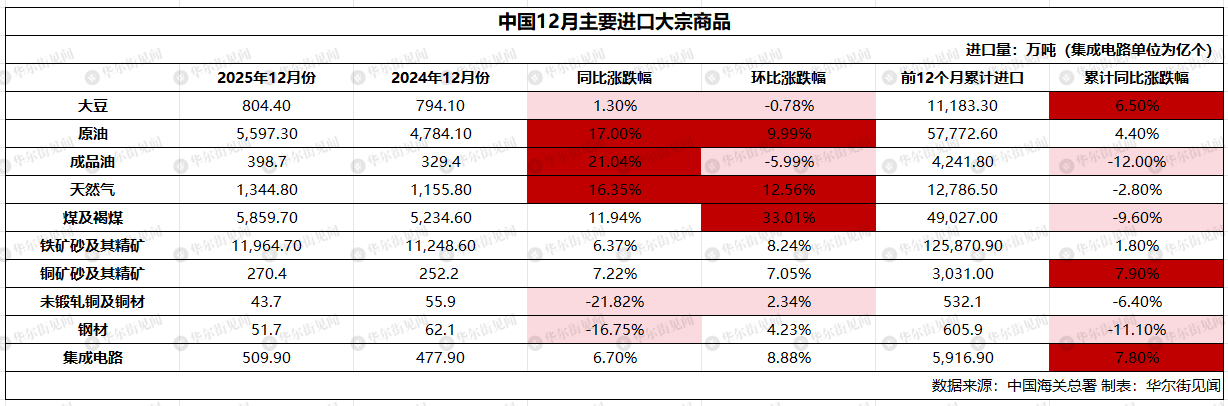
中国12月钢铁出口创新高、稀土同比大增32%,全年大豆、铁矿石、原油进口齐破纪录
Hua Er Jie Jian Wen· 2026-01-14 07:58
Core Insights - In 2025, China's soybean imports reached a record high of 111.8 million tons, marking the third consecutive year of growth, with a 6.5% increase from 2024 [1][3] - Iron ore imports also hit a historical peak, growing by 1.8% to 1.26 billion tons, continuing a three-year growth trend [6] - Coal imports saw the largest decline in a decade, dropping by 9.6% to 49 million tons [6][13] - December exports of rare earths surged by 32% year-on-year to 4,392 tons, while steel product exports exceeded the previous peak in 2015, reaching 11.3 million tons [2][1] Import and Export Data - December soybean imports were 8 million tons, a 1.3% increase year-on-year, while the total for the year was 111.83 million tons [3][13] - December iron ore imports were 11.96 million tons, a 6.37% increase from the previous year [9] - December crude oil imports reached 55.97 million tons, a 17% increase year-on-year, with an annual total of 57.77 million tons [4][12] - December natural gas imports rose by 16.35% to 1.34 million tons, but the total for the year fell by 2.8% to 12.79 million tons [7][13] Market Analysis - The increase in crude oil imports is attributed to stronger refining activity and robust stockpiling demand, with processing volumes expected to reach 15.38 million barrels per day in 2025 [5] - The decline in coal imports is linked to rising domestic production and the rapid adoption of clean energy, which is reducing coal demand [7] - The surge in rare earth exports indicates a solid demand foundation, despite a 20% month-on-month decline in December due to pre-holiday stockpiling by overseas buyers [2]

黑色建材日报 2026-01-14-20260114
Wu Kuang Qi Huo· 2026-01-14 01:47
Report Industry Investment Rating No relevant content provided. Core Viewpoints - The black series is still in a bottom - range oscillation pattern, sensitive to news changes. The actual terminal demand for steel is weak, and the short - term macro level is in a policy vacuum period. Attention should be paid to the de - stocking of hot - rolled coils, the "dual - carbon" policy, and its impact on the supply - demand pattern of the steel industry [2]. - For iron ore, the supply is expected to enter the off - season, and after the resumption of iron - making, the supply - demand margin is expected to improve. The price is expected to oscillate at a relatively high level in the short term, and attention should be paid to the rhythm of steel mill restocking and iron - making production [5]. - For manganese silicon and ferrosilicon, the future market is mainly affected by the overall market sentiment and the cost - push problem of manganese ore for manganese silicon and the supply - contraction issue for ferrosilicon [9][10]. - For coking coal and coke, the commodity bullish sentiment may continue, but there is a risk of short - term high volatility. The supply - demand structure is relatively balanced, and the price is expected to oscillate in the current range in the short term [16]. - For industrial silicon, it is expected to face inventory accumulation pressure, and the price is expected to be under pressure. Attention should be paid to new supply disturbances in the northwest [19]. - For polysilicon, the price is expected to be weak in the short term. Attention should be paid to actual spot transactions and official policies [22]. - For glass, the price is boosted by production line cold - repair and fuel - cost increase, but the high inventory restricts the upward space. It is recommended to wait and see [24]. - For soda ash, the supply pressure persists, the demand is weak, and the overall pattern remains weak [26]. Summary by Related Catalogs Steel Market Quotes - The closing price of the rebar main contract was 3158 yuan/ton, down 7 yuan/ton (- 0.22%) from the previous trading day. The registered warehouse receipts were 55933 tons, a net increase of 1512 tons. The main contract positions were 1.6879 million lots, a net decrease of 38760 lots. The Tianjin aggregated price of rebar was 3210 yuan/ton, up 10 yuan/ton, and the Shanghai aggregated price was 3300 yuan/ton, down 10 yuan/ton [1]. - The closing price of the hot - rolled coil main contract was 3303 yuan/ton, down 8 yuan/ton (- 0.24%) from the previous trading day. The registered warehouse receipts were 173103 tons, a net increase of 60866 tons. The main contract positions were 1.4403 million lots, a net increase of 12752 lots. The Lecong aggregated price of hot - rolled coils was 3280 yuan/ton, down 10 yuan/ton, and the Shanghai aggregated price was 3280 yuan/ton, unchanged [1]. Strategy Views - The output of hot - rolled coils increased slightly, demand continued to weaken, and inventory continued to decline slightly. The output of rebar increased against the season, demand declined, and inventory increased slightly. The black series is in a bottom - range oscillation pattern, and attention should be paid to market rumors and information screening [2]. Iron Ore Market Quotes - The main contract of iron ore (I2605) closed at 819.50 yuan/ton, with a change of - 0.36% (- 3.00), and the positions changed by - 1527 lots to 653300 lots. The weighted positions were 989800 lots. The spot price of PB fines at Qingdao Port was 826 yuan/wet ton, with a basis of 58.83 yuan/ton and a basis ratio of 6.70% [4]. Strategy Views - Supply: The overseas iron - ore shipment volume continued to decline. The shipment from Brazil decreased significantly, and the shipments of Rio Tinto and BHP decreased. The shipment from non - mainstream countries increased, and the near - end arrival volume continued to increase [5]. - Demand: The daily average pig - iron output was 229.5 tons, continuing to rise. The blast - furnace utilization rate in some areas recovered, and the steel - mill profitability decreased slightly [5]. - Inventory: Port inventory continued to accumulate, and steel - mill imported - ore inventory increased but remained at a low level [5]. - Outlook: The supply - demand margin is expected to improve. The price is expected to oscillate at a relatively high level in the short term, and attention should be paid to steel - mill restocking and iron - making production [5]. Manganese Silicon and Ferrosilicon Market Quotes - On January 13, the main contract of manganese silicon (SM603) closed down 0.24% at 5916 yuan/ton. The spot price of 6517 manganese silicon in Tianjin was 5750 yuan/ton, with a basis of 24 yuan/ton [8]. - The main contract of ferrosilicon (SF603) closed down 0.28% at 5682 yuan/ton. The spot price of 72 ferrosilicon in Tianjin was 5850 yuan/ton, with a basis of 168 yuan/ton [8]. Strategy Views - Market sentiment: The bullish sentiment in the commodity market may continue, but there is a risk of short - term high volatility. The ferrosilicon showed relative strength due to rumors but then gave up the gains [9]. - Fundamental analysis: The supply - demand structure of manganese silicon is loose, with high inventory and weak downstream demand, but these factors are mostly priced in. The supply - demand structure of ferrosilicon is basically balanced, with marginal improvement [10]. - Future drivers: The market direction of the black sector and the overall market sentiment, as well as the cost - push problem of manganese ore for manganese silicon and the supply - contraction issue for ferrosilicon [10]. Coking Coal and Coke Market Quotes - On January 13, the main contract of coking coal (JM2605) closed down 3.80% at 1191.0 yuan/ton. The spot price of low - sulfur main - coking coal in Shanxi was 1525.3 yuan/ton, with a basis of 143 yuan/ton [12]. - The main contract of coke (J2605) closed down 1.41% at 1745.0 yuan/ton. The spot price of quasi - first - grade wet - quenched coke at Rizhao Port was 1490 yuan/ton, with a basis of 108 yuan/ton [12]. Strategy Views - Previous drivers: The bullish commodity - market atmosphere and the news of coking - coal production - capacity reduction [15]. - Outlook: The commodity bullish sentiment may continue, but there is a risk of short - term high volatility. The supply - demand structure is relatively balanced, and the price is expected to oscillate in the current range in the short term [16]. Industrial Silicon Market Quotes - The main contract of industrial silicon (SI2605) closed at 8635 yuan/ton, with a change of - 1.37% (- 120). The weighted positions changed by + 3755 lots to 378736 lots. The spot price of 553 in East China was 9200 yuan/ton, with a basis of 565 yuan/ton [18]. Strategy Views - Supply: The production in December was stable, the furnace - opening number in the southwest decreased to a low level, and the supply improvement was limited [19]. - Demand: The polysilicon production in January continued to decline, and the demand for industrial silicon was weak. The demand from the organic - silicon industry was relatively stable [19]. - Outlook: It is expected to face inventory accumulation pressure, and the price is expected to be under pressure. Attention should be paid to new supply disturbances in the northwest [19]. Polysilicon Market Quotes - The main contract of polysilicon (PS2605) closed at 49005 yuan/ton, with a change of - 1.98% (- 990). The weighted positions changed by - 2302 lots to 88766 lots. The average spot price of N - type granular silicon was 54.25 yuan/kg, and the basis was 5745 yuan/ton [20]. Strategy Views - Market sentiment: The anti - monopoly meeting minutes and market adjustment led to price weakness [21]. - Fundamental analysis: The spot price increased, but downstream hesitation persisted. The supply pressure may ease if the production - cut plan of a leading enterprise is implemented [22]. - Outlook: The price is expected to be weak in the short term. Attention should be paid to actual spot transactions and official policies [22]. Glass and Soda Ash Glass - Market Quotes: The main contract of glass closed at 1096 yuan/ton, down 4.11% (- 47). The inventory of float - glass sample enterprises decreased by 134.80 million cases (- 2.37%) [24]. - Strategy Views: The glass daily melting volume decreased, and the fuel - cost increase boosted the price. However, the terminal demand was weak, and the high inventory restricted the upward space. It is recommended to wait and see [24]. Soda Ash - Market Quotes: The main contract of soda ash closed at 1212 yuan/ton, down 2.18% (- 27). The inventory of sample enterprises increased by 16.44 million tons [25]. - Strategy Views: The supply was stable, the demand was weak, and the inventory continued to accumulate. The overall pattern remained weak [26].
山金期货黑色板块日报-20260114
Shan Jin Qi Huo· 2026-01-14 01:38
1. Report Industry Investment Rating No information provided. 2. Core Viewpoints - The steel market is in the off - season with weak supply and demand. The winter storage is yet to come. The strong stock market and optimistic policy expectations boost confidence, but the "anti - involution" expectation decline has an impact on market sentiment. For both steel products and iron ore, it is recommended to hold long positions for mid - term trading and avoid chasing up or selling down [2][3]. 3. Summary by Directory 3.1 Threaded Rods and Hot - Rolled Coils - **Supply and demand**: Last week, the output of threaded rods increased, the overall inventory continued to decline, the apparent demand for threaded rods decreased, the overall apparent demand for five major steel products declined, the inventory increased, and the output increased slightly. In the off - season, steel mill output may continue to decline [2]. - **Operation suggestions**: Hold long positions for mid - term trading and avoid chasing up or selling down [2]. - **Data details**: The closing prices of the main contracts of threaded rods and hot - rolled coils decreased slightly compared to the previous day but increased compared to the previous week. The prices of steel billets and scrap steel increased. The blast - furnace operating rate and daily pig - iron output of 247 steel mills increased, while the proportion of profitable steel mills decreased. The output of independent electric - arc furnace steel mills increased significantly. The social and steel - mill inventories of five major products and threaded rods increased, while the steel - mill inventory of hot - rolled coils decreased. The apparent demand for five major products and threaded rods decreased [2]. 3.2 Iron Ore - **Supply and demand**: The overall output of five major steel products increased last week, but the apparent demand decreased. In the off - season, pig - iron output is likely to decline seasonally. The short - term increase in the pig - iron output of 247 sample steel mills last week is expected to be temporary. The global shipment of iron ore has decreased, and the rising port inventory suppresses the futures price. The sharp rebound of coking coal and coke supports the iron ore price [3]. - **Operation suggestions**: Hold long positions for mid - term trading [3]. - **Data details**: The settlement prices of iron ore futures and spot decreased slightly compared to the previous day but increased compared to the previous week. The shipment of Australian and Brazilian iron ore decreased. The port inventory increased, while the inventory of imported sinter powder in 64 sample steel mills decreased. The domestic iron ore output of some mines increased [4]. 3.3 Industry News - From January 5th to January 11th, 2026, the total iron ore inventory of seven major ports in Australia and Brazil was 1.2552 billion tons, a month - on - month increase of 969,000 tons, and the inventory is slightly lower than the average level of the fourth quarter [6]. - Hebei Iron and Steel Group's silicon - manganese procurement volume in January 2026 was 17,000 tons, higher than that in December 2025 (14,700 tons) [7]. - In early January, the social inventory of five major steel products in 21 cities was 7.11 million tons, a month - on - month decrease of 100,000 tons (1.4%), and the decline rate narrowed. It was 480,000 tons (7.2%) higher than the same period last year [8].
《黑色》日报-20260114
Guang Fa Qi Huo· 2026-01-14 01:30
1. Report Industry Investment Ratings - There is no information about industry investment ratings in the provided reports. 2. Core Views of the Reports Steel Industry - Yesterday, the steel futures market weakened with market sentiment, while the spot market remained stable. The industry showed little change, with a significant seasonal decline in apparent demand, mainly in rebar. Inventory is about to enter the off - season accumulation phase. Rebar's inventory pressure will increase in the future, while hot - rolled coil's inventory is decreasing. Before the Spring Festival, real - world demand is weak, but prices have already factored in the weak demand. The price of steel is pushed up by the strengthening of raw material prices recently, and it is expected to maintain a range - bound trend in January. The reference range for rebar May contract is 3050 - 3250 yuan, and for hot - rolled coil is 3200 - 3350 yuan [1]. Iron Ore Industry - The iron ore futures market was in high - level oscillation yesterday with a slight increase in positions. The spot market was relatively strong, but downstream steel mills still purchased on demand. In terms of fundamentals, the global iron ore shipment volume declined this period, and the shipment center will gradually decline after the end of the peak shipment season. The impact of weather on shipments is expected to be limited. On the demand side, the influence of steel mill maintenance on SMM increased slightly, and there is still room for the resumption of hot - metal production. The average hot - metal production in January is expected to be around 2.3 million tons. The export orders of finished products increased significantly, and demand is still supported. The port inventory increased significantly. In the future, iron ore will gradually transition to a situation of weak supply and demand. The price is suppressed by high inventory above and supported by steel mill restocking expectations and hot - metal production resumption below. It is expected to maintain high - level oscillation. The short - term price is expected to fluctuate in a wide range, and the trading strategy is mainly range - bound operation, with a reference range of 770 - 830 [4]. Coke Industry - Yesterday, both coke and coking coal futures showed a trend of rising and then falling. In the spot market, the fourth round of coke price cuts was implemented on January 1st, and the port price rebounded with the futures. The coke market is currently weakly stable. On the supply side, the adjustment of coke prices lags behind coking coal, and the coking profit is under pressure, but the start - up rate is increasing. On the demand side, the steel mill's losses and maintenance decreased, the hot - metal production increased steadily, and the steel price rebounded at a low level. In terms of inventory, the overall inventory of coke and coking coal increased slightly at a medium level. In terms of policy, ensuring the long - term coal supply for power plants is still the main tone. The trading strategy is to go long on dips unilaterally and consider the arbitrage strategy of going long on coking coal and short on coke [6]. Ferrosilicon and Ferromanganese Industry - Yesterday, the ferrosilicon futures contract was in oscillation with a slight decline, and the 03 contract continued to reduce positions. The spot price fluctuated within a limited range, and downstream buyers remained on the sidelines. In terms of fundamentals, the ferrosilicon production was basically flat, reaching a historically low level. The hot - metal production continued to resume, and there is still some support for demand. The factory inventory decreased, and the cost was supported by the strong price of manganese ore. It is recommended to go long on dips, with a support level of around 5500. The ferromanganese futures contract was also in oscillation, with supply at a historically neutral - low level. The hot - metal production continued to resume, and there is support for demand. The manganese ore price is expected to be supported by factors such as port inventory and shipping issues. It is expected that the price will fluctuate widely, and it is advisable to go long on dips, with a support level of around 5800 [7]. 3. Summary by Relevant Catalogs Steel Industry Steel Prices and Spreads - Rebar spot prices in East China, North China, and South China were 3300, 3210, and 3280 respectively, with changes of - 10, 10, and - 10 compared to the previous day. The 05, 10, and 01 contracts of rebar were 3158, 3202, and 3134 respectively, with changes of 14, 6, and 45. - Hot - rolled coil spot prices in East China, North China, and South China were 3280, 3190, and 3280 respectively, with changes of 0, 0, and - 10. The 05, 10, and 01 contracts of hot - rolled coil were 3303, 3321, and 3280 respectively, with changes of 9, 3, and 25 [1]. Cost and Profit - The billet price was 2970 with no change, and the slab price was 3730 with no change. The cost of Jiangsu electric - arc furnace rebar was 3232, up 16; the cost of Jiangsu converter rebar was 3223, up 2. The profit of East China hot - rolled coil was - 27, up 13; the profit of North China rebar was - 107, up 3; the profit of South China rebar was 193, up 3 [1]. Supply - The daily average hot - metal production was 229.0, up 1.6 (0.7%) from the previous day. The production of five major steel products was 818.6, up 3.4 (0.4%); rebar production was 191.0, up 2.8 (1.5%); hot - rolled coil production was 305.5, up 1.0 (0.3%) [1]. Inventory - The inventory of five major steel products was 1253.9, up 21.8 (1.8%); rebar inventory was 438.1, up 16.1 (3.8%); hot - rolled coil inventory was 368.1, down 2.8 (- 0.8%) [1]. Transaction and Demand - The building materials trading volume was 8.4, down 2.2 (- 20.9%); the apparent consumption of five major steel products was 796.8, down 44.2 (- 5.3%); the apparent consumption of rebar was 175.0, down 25.5 (- 12.7%); the apparent consumption of hot - rolled coil was 308.3, down 2.4 (- 0.8%) [1]. Iron Ore Industry Iron Ore - Related Prices and Spreads - The warehouse - receipt costs of Karara fines, PB fines, Brazilian mix fines, and Jinbuba fines were 878.4, 885.3, 884.1, and 922.0 respectively, with changes of - 13.1 (- 1.5%), - 2.2 (- 0.2%), - 2.2 (- 0.2%), and - 2.2 (- 0.2%) compared to the previous day. The 05 - contract basis of Karara fines, PB fines, Brazilian mix fines, and Jinbuba fines were 58.9, 0.8, 62.5, and 102.5 respectively, with changes of - 10.1 (- 14.6%), 65.0 (1.2%), 0.8 (1.4%), and 0.8 (0.8%). The 5 - 9 spread was 21.5, up 1.0 (4.9%); the 1 - 5 spread was - 74.7, down 31.0 [4]. Supply - The 45 - port arrival volume (weekly) was 2920.4, up 164.0 (5.9%); the global shipment volume (weekly) was 3213.7, down 32.8 (- 1.0%); the national monthly import volume was 11054.0, down 76.9 (- 0.7%) [4]. Demand - The daily average hot - metal production of 247 steel mills (weekly) was 227.4, up 2.1 (0.9%); the 45 - port daily average ore - removal volume (weekly) was 325.2, down 1.9 (- 0.6%); the national monthly pig - iron production was 6234.3, down 320.6 (- 4.9%); the national monthly crude - steel production was 6987.1, down 212.6 (- 3.0%) [4]. Inventory Change - The 45 - port inventory (weekly) was 16275.26, up 304.4 (1.9%); the imported ore inventory of 247 steel mills (weekly) was 8989.6, up 43.0 (0.5%); the inventory - available days of 64 steel mills (weekly) was 19.0, down 1.0 (- 5.0%) [4]. Coke Industry Coke - Related Prices and Spreads - The price of Shanxi quasi - first - grade wet - quenched coke (warehouse - receipt) was 2224, up 13; the price of Rizhao Port quasi - first - grade wet - quenched coke (warehouse - receipt) was 1745, up 22. The coke 05, 09 contracts were 1745, 1824 respectively, with changes of - 25 (- 1.4%) and - 20 (- 1.1%). The 05 - 09 spread was - 79, down 5 [6]. Coking Coal - Related Prices and Spreads - The price of Shanxi medium - sulfur primary coking coal (warehouse - receipt) was 1260 with no change; the price of Mongolian No. 5 raw coal (warehouse - receipt) was 1259, up 24 (1.9%). The coking coal 05, 09 contracts were 1191, 1268 respectively, with changes of - 47 (- 3.8%) and - 43 (- 3.2%). The JM05 - JM09 spread was - 77, down 5 [6]. Supply - The daily average production of all - sample coking plants (weekly) was 62.7, up 0.9 (1.4%); the daily average production of 247 steel mills was 46.9, up 0.1 (0.1%); the raw - coal production was 853.4, down 2.7 (- 0.3%); the clean - coal production was 438.2, down 0.6 (- 0.1%) [6]. Demand - The hot - metal production of 247 steel mills (weekly) was 229.5, up 2.1 (0.9%); the daily average production of all - sample coking plants was 63.6, up 0.9 (1.4%); the daily average production of 247 steel mills was 46.9, up 0.1 (0.1%) [6]. Inventory Change - The total coke inventory was 915.7, up 0.2 (0.0%); the coke inventory of all - sample coking plants was 86.1, down 5.5 (- 6.0%); the coke inventory of 247 steel mills was 645.7, up 1.7 (0.3%); the coking - coal inventory of all - sample coking plants was 1071.7, up 12.0 (1.2%); the coking - coal inventory of 247 steel mills was 797.7, down 4.5 (- 0.6%); the port inventory was 299.8, down 1.5 (- 0.5%) [6]. Ferrosilicon and Ferromanganese Industry Spot Prices and Spreads - The closing price of the ferrosilicon main contract was 5682.0, down 16.0 (- 0.3%); the closing price of the ferromanganese main contract was 5916.0, down 14.0 (- 0.2%). The spot prices of 72% FeSi in Inner Mongolia, Qinghai, Ningxia, and Gansu were 5350.0, 5300.0, 5320.0, and 5300.0 respectively, with no changes. The spot prices of FeMn65Si17 in Inner Mongolia, Guangxi, Ningxia, and Guizhou were 5750.0, 5850.0, 5650.0, and 5800.0 respectively, with increases of 50.0 (0.9%), 50.0 (0.9%), 0.0 (0.0%), and 50.0 (0.9%) [7]. Cost and Profit - The production cost of ferrosilicon in Inner Mongolia was 5882.9, up 38.1 (0.7%); the production cost in Guangxi was 6236.3 with no change; the production cost in Qinghai was 5831.0 with no change; the production cost in Ningxia was 5433.0 with no change. The production profit of ferrosilicon in Inner Mongolia was - 132.9, up 11.9; the production profit in Ningxia was - 113.0 with no change [7]. Supply - The weekly production of ferrosilicon was 0.0, up 0.2 (0.2%); the weekly production of ferromanganese was 19.1, down 0.3 (- 1.4%). The operating rate of ferrosilicon production enterprises (weekly) was 29.6, up 0.1 (0.3%); the operating rate of ferromanganese was 36.8, down 0.1 (- 0.2%) [7]. Demand - The weekly demand for ferrosilicon (estimated by Steel Union) was 1.9, up 0.0 (0.1%); the weekly demand for ferromanganese (estimated by Steel Union) was 11.6, up 0.1 (0.7%). The daily average hot - metal production of 247 steel mills (weekly) was 229.5, up 2.1 (0.9%); the blast - furnace operating rate (weekly) was 79.3, up 0.4 (0.5%); the production of five major steel products (weekly) was 818.6, up 3.4 (0.4%) [7]. Inventory Change - The inventory of 60 sample ferrosilicon enterprises (weekly) was 6.9, up 0.5 (7.1%); the inventory of 63 sample ferromanganese enterprises (weekly) was 38.3, down 1.1 (- 2.8%). The average available days of ferrosilicon for downstream users (monthly) was 15.4, down 0.4 (- 2.5%); the average available days of ferromanganese inventory (monthly) was 16, up 0.1 (0.9%) [7].
铁矿石早报-20260114
Yong An Qi Huo· 2026-01-14 00:40
Group 1 - Investment Rating: Not provided Group 2 - Core View: Not provided Group 3 Spot Market - Newman powder price is 818, with a daily change of -2 and a weekly change of 16, and the import profit is 15.26 [1] - PB powder price is 826, with a daily change of -2 and a weekly change of 16 [1] - Macarthur powder price is 828, with a daily change of -2 and a weekly change of 16, and the import profit is 49.79 [1] - Jinbuba powder price is 779, with a daily change of -2 and a weekly change of 16, and the import profit is 50.63 [1] - Mixed powder price is 757, with a daily change of -8 and a weekly change of 10, and the import profit is 4.11 [1] - Super Special powder price is 703, with a daily change of -2 and a weekly change of 15, and the import profit is 5.78 [1] - Carajás powder price is 908, with a daily change of -12 and a weekly change of 7, and the import profit is -14.76 [1] - Brazilian blended powder price is 863, with a daily change of -2 and a weekly change of 12, and the import profit is 13.27 [1] - Brazilian coarse IOC6 price is 790, with a daily change of -2 and a weekly change of 16 [1] - Brazilian coarse SSFG price is 795, with a daily change of -2 and a weekly change of 16 [1] - Ukrainian iron concentrate price is 909, with a daily change of -2 and a weekly change of 20 [1] - 61% Indian powder price is 768, with a daily change of -2 and a weekly change of 16 [1] - Karara iron concentrate price is 909, with a daily change of -2 and a weekly change of 19 [1] - Roy Hill powder price is 813, with a daily change of -2 and a weekly change of 16, and the import profit is 61.98 [1] - KUMBA powder price is 885, with a daily change of -2 and a weekly change of 16 [1] - 57% Indian powder price is 638, with a daily change of -2 and a weekly change of 15 [1] - Atlas powder price is 752, with a daily change of -8 and a weekly change of 10 [1] - Tangshan iron concentrate price is 982, with no daily change and a weekly change of 6 [1] Futures Market - i2601 contract price is 830.0, with a daily change of -34.0 and a weekly change of 4.0, and the monthly spread is -32.0 [1] - i2605 contract price is 819.5, with a daily change of -3.0 and a weekly change of 18.5, and the monthly spread is 10.5 [1] - i2609 contract price is 798.0, with a daily change of -4.0 and a weekly change of 18.0, and the monthly spread is 21.5 [1] - FE01 contract price is 108.89, with a daily change of 0.55 and a weekly change of 2.92, and the monthly spread is -2.49 [1] - FE05 contract price is 108.24, with a daily change of 1.10 and a weekly change of 3.51, and the monthly spread is 0.65 [1] - FE09 contract price is 106.40, with a daily change of 1.21 and a weekly change of 3.60, and the monthly spread is 1.84 [1]