
债券

Search documents
国债等利息收入恢复征收增值税 中、外资机构如何调整投资策略?
Sou Hu Cai Jing· 2025-08-06 16:59
Core Viewpoint - The announcement of the restoration of value-added tax (VAT) on interest income from newly issued government bonds, local government bonds, and financial bonds starting from August 8, 2025, has caused significant market reactions, leading to a surge in demand for existing bonds that remain exempt from this tax [1][2]. Group 1: Market Reactions - The new tax policy is expected to create a "buy old bonds" trend, as investors prefer existing bonds that are exempt from the new tax [2][5]. - Following the announcement, the yield on 10-year government bonds initially rose but then fell, indicating a preference for holding existing tax-exempt bonds [2][5]. - The yield on 10-year and 30-year government bonds decreased by 1 basis point, with current yields reported at 1.6975% and 1.919% respectively [2][5]. Group 2: Impact on Investment Strategies - The new tax policy is anticipated to enhance the predictability of the bond market, potentially leading to a shift in investment towards credit bonds and public funds that are not affected by the new tax [2][3][4]. - Institutions believe that the new regulations may lead to a widening yield spread between new and old bonds, with estimates suggesting a 5 to 10 basis point difference [2][3]. - Public funds are expected to benefit from the tax advantages compared to self-managed accounts, as they remain exempt from both income tax and VAT [3][4]. Group 3: Long-term Implications - The restoration of VAT is seen as a move to guide funds from the interest rate market to the stock and credit markets, aligning with broader economic goals [5][6]. - The policy aims to reduce the distortions in the yield curve and interest rate risks that have accumulated due to the previous tax exemptions [6][7]. - The estimated tax revenue from the restoration of VAT is projected to be approximately 4 billion RMB in 2025 and 25 billion RMB in 2026, although this is considered limited compared to the overall tax revenue [6][7].
美债交易员提高今年降息预期,部分头寸押注9月份可能会一次性降息50基点
Sou Hu Cai Jing· 2025-08-06 16:43
鉴于美国经济走弱迹象,债券交易员正在加大对美联储今年降息的押注。与有担保隔夜融资利率 (SOFR)挂钩的期权仓位显示,投资者正在为今年剩下三次美联储会议每次都可能降息做准备,预计 2025年累计降息幅度达75个基点。其他与SOFR相关的交易押注美联储将在9月会议上一次性降息50个基 点。 ...
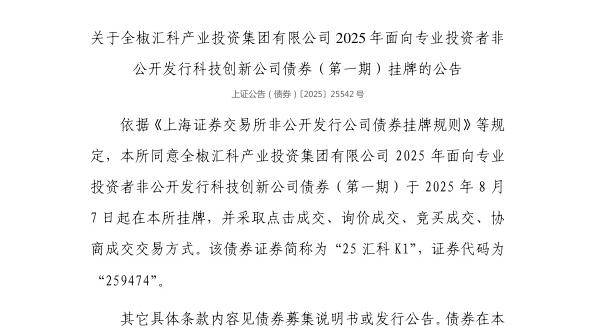
上交所:全椒汇科产业投资集团有限公司债券8月7日挂牌,代码259474
Sou Hu Cai Jing· 2025-08-06 16:28
依据《上海证券交易所非公开发行公司债券挂牌规则》等规定,上交所同意全椒汇科产业投资集团有限 公司2025年面向专业投资者非公开发行科技创新公司债券(第一期)于2025年8月7日起在上交所挂牌, 并采取点击成交、询价成交、竞买成交、协商成交交易方式。该债券证券简称为"25汇科K1",证券代 码为"259474"。 8月6日,上交所发布关于全椒汇科产业投资集团有限公司2025年面向专业投资者非公开发行科技创新公 司债券(第一期)挂牌的公告。 来源:金融界 ...

债市日报:8月6日
Xin Hua Cai Jing· 2025-08-06 14:54
Core Viewpoint - The bond market is experiencing a strong consolidation phase, with fluctuations in yields and a net withdrawal of liquidity from the market, influenced by the recent news on VAT collection and profit-taking by investors [1][5]. Market Performance - The majority of government bond futures closed higher, with the 30-year main contract down 0.04% at 119.330, while the 10-year main contract remained flat at 108.555 [2]. - The interbank yield on the 10-year government bond increased by 0.25 basis points to 1.797%, while the yield on the 10-year treasury bond decreased by 0.5 basis points to 1.6975% [2]. Overseas Bond Market - In North America, most U.S. Treasury yields rose, with the 2-year yield up 4.9 basis points to 3.720% and the 10-year yield up 1.17 basis points to 4.208% [3]. - In Asia, Japanese bond yields increased across the board, with the 10-year yield rising by 2.9 basis points to 1.503% [3]. - In the Eurozone, the 10-year French bond yield rose by 0.1 basis points to 3.283%, while the 10-year German bond yield fell by 0.1 basis points to 2.621% [3]. Primary Market - The Ministry of Finance reported weighted average winning yields for 91-day, 182-day, and 1-year government bonds at 1.2110%, 1.3019%, and 1.3277%, respectively, with bid-to-cover ratios of 3.31, 2.7, and 2.7 [4]. - Agricultural Development Bank's financial bonds had winning yields below market estimates, with 1.074-year, 3-year, 5-year, and 10-year yields at 1.39%, 1.61%, 1.69%, and 1.82%, respectively [4]. Liquidity Conditions - The central bank conducted a 7-day reverse repurchase operation of 1385 billion yuan at a rate of 1.40%, resulting in a net withdrawal of 1705 billion yuan for the day [5]. - Short-term Shibor rates mostly increased, with the overnight rate rising by 0.1 basis points to 1.316% [5]. Institutional Perspectives - Industry analysts suggest that the current convertible bond valuations are nearing historical highs, indicating limited downside potential and possible breakout opportunities [6]. - The outlook for August indicates that central bank liquidity is expected to remain reasonably ample, with funding rates likely to stay low, although regulatory goals may prevent further declines [6]. - Analysts anticipate that the market's trading focus may shift as the impact of anti-involution policies is validated by data, with interest rates expected to stabilize [6].
【西街观察】债市“零容忍”治乱
Bei Jing Shang Bao· 2025-08-06 14:33
此前,债券承销领域低价中标、"拼价格"等频频发生,扰乱了市场秩序。以某股份行350亿元二级资本 债项目为例,中标报价中还有低至700元和1050元的极端低价,个别报价对应的承销费率竟低至 0.000002%,暴露了市场竞争的无序与混乱。 市场对于债市的关注不仅是行情的震荡,还有监管的信号。 近日,中国银行间市场交易商协会新规剑指债市发行"价格战"乱象,无疑是其中最为引人瞩目的一环, 释放出债市治乱"零容忍"的态度。 可以看到,即将于8月11日起执行的《关于规范银行间债券市场簿记建档发行及承销有关工作的通 知》,从承销报价、簿记建档到分销全流程进行严格把控,剑指当前债券市场存在的发行定价扭曲、非 市场化发行以及人为干预簿记发行过程等现象。 北京商报评论员 岳品瑜 交易商协会及时亮剑,对该项目中的承销商与发行人展开自律调查,同时发布新规,从源头上遏制此类 乱象的滋生。 近年来,我国债券市场发展迅速,总体平稳规范,但也出现了一些违法违规行为,监管部门对此保持着 高度警惕,秉持"零容忍"的工作方针,依托债券市场统一执法工作机制,坚决打击各类违法违规行为。 2024年,央行对上海东亚期货有限公司、天津信唐货币经纪有限责 ...
美国短期国债供应洪流来袭,赤字恐慌下市场能否顺利承接成焦点
Bei Ke Cai Jing· 2025-08-06 14:10
Core Viewpoint - The U.S. Treasury is set to auction a record $100 billion in short-term bonds on August 7, 2023, as part of a strategy to manage its growing debt burden and refinance maturing obligations [1][2]. Group 1: Debt Levels and Market Impact - The total U.S. federal debt has reached $36.21 trillion, accounting for 123% of GDP, significantly exceeding the International Monetary Fund's warning threshold [3]. - The issuance of short-term bonds is intended to fill a $500 billion funding gap in the Treasury General Account (TGA), but excessive reliance on short-term debt may lead to a vicious cycle of increased borrowing costs and interest rate volatility [4][5]. Group 2: Market Demand and Supply Dynamics - There is a structural weakening in demand for U.S. Treasuries, exacerbating liquidity pressures in the market. The ability of commercial banks to increase short-term bond holdings is limited due to regulatory constraints [6]. - Major holders of U.S. debt, such as Japan and China, continue to reduce their holdings, creating a fragile support system for U.S. Treasuries amid supply-demand imbalances [7]. Group 3: Fiscal Sustainability Concerns - The current trajectory of U.S. federal finances is unsustainable, with warnings from top economists about the potential for a fiscal crisis if corrective measures are not taken [10][11]. - The structural deterioration of the U.S. government's fiscal situation is characterized by uncontrolled debt levels, surging short-term bond supply, and diminishing market absorption capacity [11].
国债等利息收入恢复征收增值税,中外资机构如何调整投资策略?
Di Yi Cai Jing· 2025-08-06 12:53
Core Insights - The new tax regulation on interest income from newly issued government bonds, effective from August 8, 2025, has triggered a surge in demand for existing bonds, leading to a strong performance in both the stock and bond markets [1][5] - The policy is expected to have a limited short-term impact on the overall bond market direction, with institutions believing that it will not alter the long-term trends [5][6] Group 1: Market Reactions - The announcement of the tax on new bond issuances led to a "rush for old bonds," with institutions favoring existing tax-exempt bonds [2][5] - Following the policy announcement, the yield on 10-year government bonds initially rose but then fell, indicating a preference for holding existing bonds [2][5] - The yield on 10-year and 30-year government bonds decreased by 1 basis point, reflecting market adjustments to the new tax expectations [2] Group 2: Investment Opportunities - The new tax regulation is seen as beneficial for credit bonds and money market instruments, with institutions likely to increase allocations to these areas [3][4] - Public funds are expected to benefit from the tax advantages compared to proprietary trading accounts, as public funds remain exempt from the new tax [3][4] - The potential for increased investment in the "southbound bond connect" is noted, as it remains unaffected by the new tax [4] Group 3: Long-term Outlook - Institutions believe that the new tax policy will not significantly alter the long-term trajectory of the bond market, with expectations of a bifurcation between new and old bonds [5][6] - The policy aims to guide funds from the bond market to the stock market and credit markets, aligning with broader economic goals [5][6] - The restoration of the tax is projected to contribute approximately 4 billion RMB to fiscal revenue in 2025 and around 25 billion RMB by 2026, although this is considered limited compared to the overall tax revenue [6][7]
一图看懂沪AAA科创债指数
Zhong Guo Ji Jin Bao· 2025-08-06 10:46
Core Viewpoint - The rapid development of the index system in China has led to an increasing acceptance of index-based investment, with a significant rise in the issuance of technology innovation bonds (科创债) and the establishment of related indices to facilitate investment opportunities in this sector [5][8][11]. Group 1: Technology Innovation Bonds - As of now, a total of 356 entities have issued 1,360 technology innovation bonds, with a total scale of CNY 1.95 trillion. The Shanghai and Shenzhen stock exchanges have issued 935 bonds, amounting to CNY 1.23 trillion, representing an increase of approximately 14.7 times and 13 times compared to the end of 2022, respectively [8]. - The supportive policies for technology innovation bond issuance have been frequent since 2025, enhancing long-term capital investment in hard technology sectors [10][11]. - The Shanghai Stock Exchange and China Securities Index Co. launched the Shanghai AAA Technology Innovation Company Bond Index in August 2023, which reflects the overall performance of technology innovation company bonds listed on the exchange [13]. Group 2: Investment Capacity and Quality - Currently, there are 795 technology innovation bonds with a total scale of CNY 1.1 trillion on the Shanghai Stock Exchange. The AAA technology innovation bond index includes 785 bonds, with a total scale of CNY 1.0943 trillion, accounting for 88% of the total market scale of technology innovation bonds [14]. - The issuers of the bonds in the index are all rated AAA, ensuring high credit quality, with implied ratings of AA+ and above [16]. - The index covers a wide range of issuers, including central and local enterprises as well as technology innovation private enterprises, addressing the challenges investors face in identifying risks and meeting investment thresholds [17]. Group 3: Investment Performance - In the current low-interest-rate environment, technology innovation bonds offer higher annualized returns compared to government bonds and money market funds, providing investors with a new asset allocation option that combines stable returns and policy benefits [18]. - Since the base date of June 30, 2022, the Shanghai AAA technology innovation bond index has outperformed the Shanghai market benchmark corporate bonds and the 5-year government bond index, with a cumulative increase of 14.4% and an annualized return of 4.3% as of July 31, 2025 [19][21]. Group 4: Market Recognition - There are currently three domestic ETFs tracking the Shanghai AAA technology innovation bond index, which have quickly reached their fundraising limits of CNY 3 billion since their public offering on July 7. The total scale of these products has now reached CNY 28.6 billion, indicating growing market recognition of the investment value of technology innovation bonds [24].

一图看懂沪AAA科创债指数
中国基金报· 2025-08-06 10:37
Core Viewpoint - The article emphasizes the rapid development and increasing acceptance of index investment in China, particularly focusing on the growth of technology innovation bonds (科创债) and the introduction of related indices to facilitate investment opportunities [7][11]. Group 1: Index Investment Trends - The index system has been rapidly improved, leading to a growing recognition in the market and accelerating the trend of index-based investment [7]. - The Shanghai Stock Exchange, together with China Fund News and China Securities Index Company, launched an educational series titled "Understanding Index Investment at a Glance" to provide comprehensive insights into index investment [7]. Group 2: Technology Innovation Bonds (科创债) - As of now, there are 356 issuers of technology innovation bonds in the market, with a total issuance of 1,360 bonds amounting to 1.95 trillion yuan. The Shanghai and Shenzhen stock exchanges have issued 935 bonds, totaling 1.23 trillion yuan, representing a growth of approximately 14.7 times and 13 times compared to the end of 2022, respectively [8][10]. - Since 2025, policies supporting the issuance of technology innovation bonds have been frequently introduced, enhancing long-term capital investment in hard technology [11]. Group 3: Index Development and Performance - In August 2023, the Shanghai Stock Exchange and China Securities Index Company launched the Shanghai AAA Technology Innovation Company Bond Index, which reflects the overall performance of technology innovation company bonds on the exchange [13]. - The current outstanding technology innovation bonds on the Shanghai Stock Exchange total 795, with a combined scale of 1,100.4 billion yuan, and the AAA technology innovation bond index includes 785 bonds, accounting for 88% of the total market scale [14][15]. Group 4: Investment Opportunities - The bonds included in the index are all rated AAA, ensuring high credit quality, and the index covers a wide range of issuers, including central and local enterprises as well as technology innovation private enterprises [17][18]. - In the current low-interest-rate environment, technology innovation bonds offer higher annualized returns compared to government bonds and money market funds, providing investors with a new asset allocation option that combines stable returns and policy benefits [19][20]. - Since the base date of June 30, 2022, the Shanghai AAA Technology Innovation Bond Index has outperformed the benchmark corporate bond index and the 5-year government bond index, with a cumulative increase of 14.4% and an annualized return of 4.3% as of July 31, 2025 [20]. Group 5: ETF Products - As of July 31, 2025, there are three domestic ETFs tracking the Shanghai AAA Technology Innovation Bond Index, which have quickly reached their fundraising limits since their public offering on July 7, with a total scale of 28.6 billion yuan [23].

债市“褪色”之后
ZHONGTAI SECURITIES· 2025-08-06 10:18
Report Industry Investment Rating - Not provided in the content Core Viewpoints of the Report - The bond market lacks its own driving factors this year, with its fluctuations mainly influenced by external factors. The "endogenous" fluctuations of the bond market are converging, and it's difficult to change the "meager fluctuations" of this year's bond market. In the second half of the year, the bond market is expected to have narrow - range oscillations each month, and neither excessive short - nor long - positions are advisable [5][10][35] Summary by Relevant Catalogs 1. 6 - month Bond Market's Expected "Old Script" - Since June, interest rates have been consolidating and oscillating, and fund durations have gradually increased, anticipating a downward trend in interest rates in July. The market was skeptical about the economic outlook despite good Q2 GDP data, expecting a neutral tone from the July Politburo meeting. As a result, in early July, the overall fund duration increased, and there was an expansion of credit - bond ETFs. In June, the net inflow of market - making credit - bond ETFs was 6.3314 billion yuan, a 146% increase from May. In mid - July, the Sci - tech Innovation Bond ETF took over the market, with an average duration of about 4.3 years and 3.9 years for the tracked indices [13] 2. New Developments in the Equity and Commodity Markets - Starting from June, the commodity and equity markets showed a completely opposite trend to the bond market, entering a trading mode with rapidly increasing risk appetite. Commodity prices rebounded from lows and then rose across the board, fully recovering the gap caused by the April tariff shock by July 22. The equity market reached new highs and continued to rise, spreading from bank dividends to low - valuation sectors in the technology sector and then to the cyclical sector. The bond market's expected scenario did not occur, and it started to adjust rapidly on July 21 [4] 3. Bond Market's Rise and Fall Driven by External Factors - The bond market has been in a narrow - range technical oscillation, with interest rates fluctuating around the central level by about 10 BP. Two major factors causing significant adjustments in the bond market are external: the unexpected escalation of trade frictions in April led to a sharp decline in bond interest rates, with the 10Y Treasury bond rate dropping from over 1.8% to 1.61% on April 7; the resonance of the equity and commodity markets in late July led to an accelerated upward movement of the 10Y interest rate, breaking through 1.70% [5][21] 4. The "Positive and Negative" Sides of the Convergence of Bond Market's Endogenous Fluctuations - On one hand, the yields of bond - based funds have declined, and the expected returns of bond - related assets need adjustment. As of August 1, the performance of pure - bond funds this year has been weaker than in 2024. On the other hand, the market's attention to bonds has significantly decreased. The trading volume of Treasury bond futures has not changed significantly, while the trading volume of coking coal contracts has increased. The "asset shortage" narrative in the bond market is also weakening, as insurance premium growth has slowed, rural commercial banks' trading volume has decreased, and the buying power of wealth management products for long - term bonds has weakened [24][25][26] 5. Main Themes in the Second Half of the Year - The market needs to find factors beyond the "stock - bond seesaw" effect. When the equity market stabilizes above 3500 points, it's necessary to consider the factors jointly influencing the stock and bond markets. The expectations, verifications, and adjustments of "anti - involution" will continue, and the market's understanding will change. The underestimated overseas and tariff factors may resurface. The most important factor for the bond market may be its own asset - liability changes. If the average annualized returns of bond funds and wealth management products are less than 1.5% by the end of the year, there may be a shift of deposits to riskier assets [8][30][33]