
稀土

Search documents
美股全线暴跌,发生了什么?
Jing Ji Wang· 2025-10-11 02:47
Group 1 - The U.S. stock market experienced a significant decline, with major indices falling sharply, including the Nasdaq dropping over 3%, marking its largest single-day decline since April [1][2] - Large-cap tech stocks were heavily impacted, with notable declines in companies such as TSMC ADR down over 6%, and Tesla, Nvidia, and Amazon all falling more than 4% [4] - Chinese concept stocks also suffered, with the Nasdaq Golden Dragon China Index dropping over 6%, and companies like Futu Holdings and NIO seeing declines exceeding 10% [5] Group 2 - The global financial markets faced widespread sell-offs, with the Dow Jones Industrial Average plunging over 880 points at one point, closing down 1.9% [2] - European markets also experienced declines, with the Euro Stoxx 50 Index falling 1.75% and major indices in Germany, France, and Italy dropping over 1% [5] - Commodities such as oil and cryptocurrencies were severely affected, with WTI crude oil falling over 4% and Bitcoin experiencing a drop of over 13% [5] Group 3 - The uncertainty in the market has led to increased demand for protective derivatives, with investors shifting towards safe-haven assets like gold and U.S. Treasuries [6] - Gold prices rose over 1%, surpassing $4000 per ounce, while the yield on the 10-year U.S. Treasury fell to 4.034% [6] Group 4 - Analysts noted that the market had built up significant profit-taking potential due to a strong performance since April, leading to expectations of a correction [7] - The U.S. government shutdown has escalated, with the Trump administration implementing large-scale permanent layoffs of federal employees, affecting thousands across multiple departments [7][8] - The Michigan Consumer Sentiment Index for October was reported at 55, the lowest since May, indicating stagnant consumer confidence amid expectations of rising unemployment and inflation [9]

中国出台稀土新规,德国跳出来:极度担忧
Guan Cha Zhe Wang· 2025-10-11 02:00
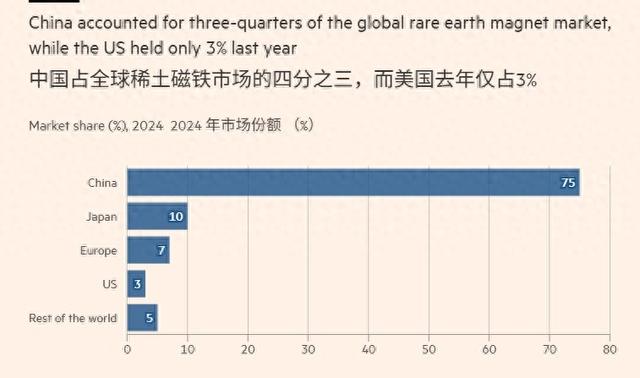
Core Points - China has implemented new export regulations on rare earth materials, causing concern in both the US and Europe [1][2] - The new regulations require foreign companies to obtain approval from China for exporting rare earth magnets and certain semiconductor materials that contain Chinese components [5][6] - The timing of these regulations coincides with upcoming negotiations between the US and China, highlighting China's strategic leverage in trade discussions [8] Group 1: Regulatory Impact - The new regulations cover rare earth magnets and semiconductor materials containing 0.1% or more of Chinese rare earth components, effective from December 1 [5][6] - China controls approximately 70% of global rare earth mining, 90% of separation and processing, and 93% of magnet manufacturing, underscoring its dominance in the sector [4][5] Group 2: International Reactions - Germany's government is in discussions with affected companies and EU partners regarding the implications of China's new regulations [2] - The EU has expressed concerns over China's export restrictions, emphasizing the need for reliable supply chains for critical raw materials [2] Group 3: Strategic Considerations - Analysts suggest that China's export controls are a strategic move to enhance its bargaining position in trade negotiations with the US [8] - The regulations are seen as a response to previous US tariffs and efforts to reduce reliance on Chinese supply chains, further complicating the geopolitical landscape [6][8]
技术出口人员服务设备维修三管齐下,中国打造稀土技术明牌
Sou Hu Cai Jing· 2025-10-11 01:01
Core Insights - China has shifted its focus from merely discussing the export of rare earth minerals to emphasizing the importance of core technologies in the rare earth industry, signaling a transformative change in the global rare earth landscape [4][14] - The new regulations create a "technical Great Wall," restricting not only the export of equipment but also the entire knowledge system of the rare earth industry, including mining, refining, and application processes [5][7] - This strategic move comes at a time when the U.S. government is facing internal chaos, thereby weakening its ability to exert external pressure, making it an opportune moment for China to assert its technological dominance [9][11] Industry Implications - The regulations effectively prevent foreign entities from accessing critical technologies, making it difficult for other countries to replicate China's rare earth industry, thus locking in China's competitive advantage [7][12] - The announcement challenges the U.S. strategy of diversifying rare earth supply chains through partnerships, particularly with countries like Pakistan, by highlighting that possessing raw materials alone is insufficient without the necessary processing technologies [13][14] - This move serves as a wake-up call for countries reliant on single-source technology solutions, urging them to reassess their vulnerabilities in critical technology sectors [15] Strategic Shift - China's proactive approach in defining new competitive rules marks a significant strategic upgrade, moving from a reactive stance to one that shapes the global narrative around technology sovereignty [18] - The emphasis on controlling core technologies over merely possessing natural resources indicates a profound shift in the balance of power in global trade and technology [18]
稀土出口管制升级:技术主权再强化
Tai Mei Ti A P P· 2025-10-11 00:30
Group 1 - The core viewpoint of the articles highlights China's recent upgrade in rare earth export controls, emphasizing the reinforcement of technological sovereignty through stricter regulations on the entire rare earth industry chain [1][2] - The Ministry of Commerce issued announcements that include both item and technology controls, requiring approval for all aspects of rare earth technology exports, from mining processes to the manufacturing of magnetic materials [1] - The tightening of rare earth controls is not solely due to bilateral trade frictions but is also a strategic move to safeguard China's technological sovereignty in a competitive global landscape [2] Group 2 - Rare earths have become a focal point of international attention since the 21st century, with multiple rounds of US-China trade negotiations addressing rare earth issues [1] - The technological barriers in the rare earth industry are significant, particularly in processing, which includes steps from ore selection to the separation of rare earth oxides and the refining of individual metals [2] - The purity of rare earth products is crucial for the performance of downstream materials, such as permanent magnets used in electric vehicles and robotics, highlighting the strategic importance of rare earths in emerging technologies [2]
突然变盘!全线大跳水
Zhong Guo Ji Jin Bao· 2025-10-11 00:08
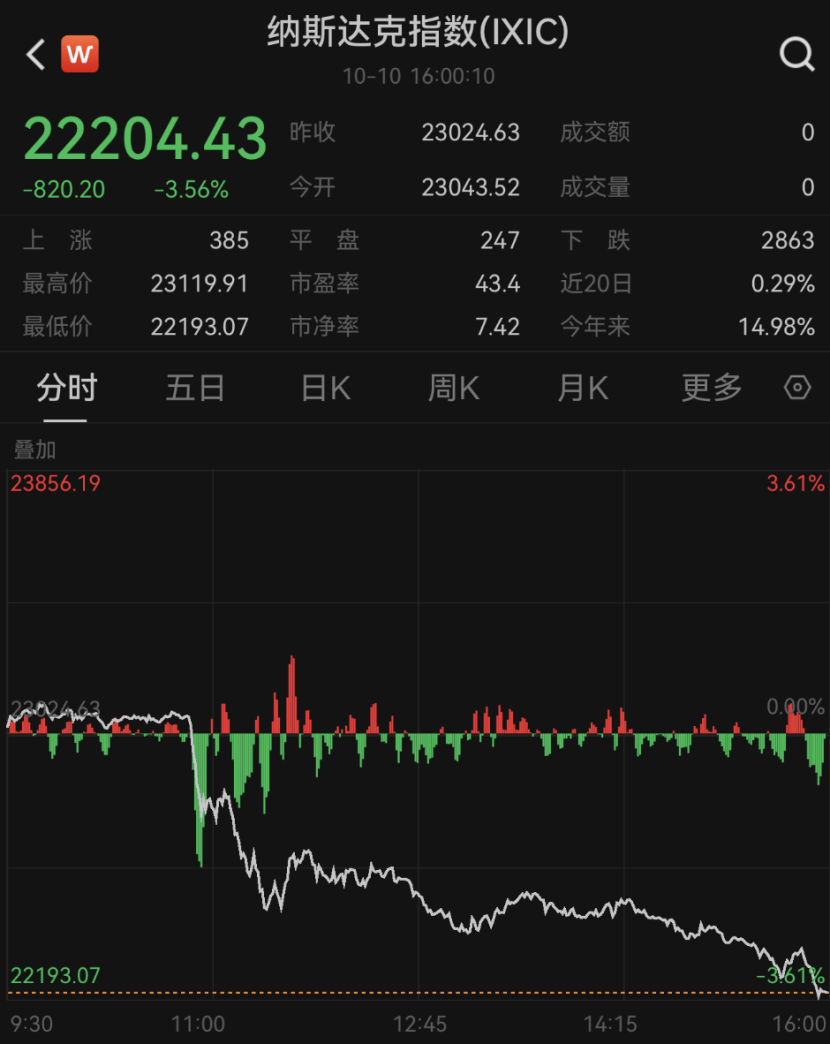
Market Overview - The U.S. stock market experienced a significant decline, with the Nasdaq and S&P 500 indices recording their largest single-day drops since April 10, 2023 [1][2] - The Nasdaq index fell by 3.56% to 22,204.43 points, while the S&P 500 dropped by 2.71% to 6,552.51 points, marking a weekly decline of 2.43% for the S&P 500 and 2.53% for the Nasdaq [2] Technology Sector - Major technology stocks saw substantial losses, with the "Big Seven" tech index down by 3.65% [3] - Individual stocks such as Tesla, Amazon, and Nvidia each fell over 5%, while Facebook and Apple dropped more than 3% [3] Chinese Stocks - Chinese stocks also faced significant declines, with the Nasdaq Golden Dragon China Index down by 6.1% [4] - Alibaba's stock fell by 8.45%, and other companies like Bilibili and Baidu saw declines exceeding 8% [4] Commodity Prices - International oil prices dropped sharply, with U.S. crude futures down 4.24% to $58.90 per barrel, and Brent crude futures falling nearly 3.82% to $62.73 per barrel [5] - In contrast, spot gold prices increased by over 1%, reaching a high of $4,022.901 per ounce [5] Federal Employment and Economic Outlook - The Trump administration confirmed the initiation of large-scale federal employee layoffs, with 200,000 federal employees already reduced this year and an additional 100,000 expected by year-end [6] - The likelihood of the U.S. government shutdown extending beyond 30 days has increased, with predictions now at 37% [6] Federal Reserve Insights - Federal Reserve officials expressed a willingness to consider further interest rate cuts as a precaution against a weakening labor market, with inflation significantly above target levels [7] - The labor market is perceived to be in a negative growth phase, prompting discussions on the need for cautious policy adjustments [7]


突然变盘!全线大跳水
中国基金报· 2025-10-10 23:58
Core Viewpoint - The U.S. stock market experienced a significant decline, with the Nasdaq and S&P 500 indices recording their largest single-day drops since April 10, driven by a provocative statement from former President Trump [1][3]. Market Performance - The Nasdaq Composite Index fell by 3.56%, closing at 22,204.43 points, while the S&P 500 Index dropped by 2.71%, ending at 6,552.51 points, marking their largest single-day declines since April 10 [3][4]. - For the week, the S&P 500 Index decreased by 2.43%, the largest weekly drop since June, and the Nasdaq Index fell by 2.53%, the largest weekly decline since April [3][4]. Major Stock Movements - Major technology stocks saw significant declines, with the Wande American Technology Seven Giants Index dropping by 3.65%. Notable individual stock performances included: - Tesla down over 5% - Amazon down over 5% - Nvidia down nearly 5% - Apple and Facebook down over 3% - Microsoft down over 2% - Google down nearly 2% [11][12]. Chinese Stocks Performance - Chinese stocks also faced substantial losses, with the Nasdaq Golden Dragon China Index falling by 6.1%. Key declines included: - Alibaba down 8.45% - Bilibili down over 9% - Baidu and Xpeng down over 8% - JD.com down over 6% [13][14]. Commodity Market - International oil prices saw a notable decline, with U.S. crude futures dropping by 4.24% to $58.90 per barrel, and Brent crude futures falling by nearly 3.82% to $62.73 per barrel. Gold prices, however, increased by over 1% [16][15].





有他国撑腰也没用,稀土管制落地,中国不给美国留活路
Sou Hu Cai Jing· 2025-10-10 19:29
Group 1 - The U.S. has recently intensified actions against Chinese companies in trade, including placing multiple Chinese entities on an export control "blacklist" [1][3] - The U.S. Department of Commerce added 29 organizations from China, Turkey, and the UAE to the export control list, with 26 being Chinese companies, due to violations of U.S. national security and foreign policy, particularly related to supplying drone components to Iran [3][4] - This move creates trade barriers, requiring U.S. companies to obtain special licenses to transact with these entities, which complicates the approval process [3][4] Group 2 - The U.S. is motivated by strategic considerations regarding rare earth resources, with China controlling approximately 90% of global rare earth processing capacity, essential for defense and high-tech industries [4][10] - A significant cooperation agreement was signed between the U.S. and Pakistan for mineral resources, valued at $500 million, focusing on exploring and developing rare earths and other strategic minerals [5][7] - The first phase of this agreement has commenced, with nearly 2 tons of minerals being shipped from Pakistan to the U.S. [7] Group 3 - In response to U.S. actions, China announced stringent export controls on rare earth-related items and technologies, deemed the "strictest ever," requiring licenses for any related exports [8][9] - These controls encompass the entire technology chain of rare earth production, impacting not only mining but also processing and manufacturing [9][10] - The new regulations create significant challenges for U.S. companies and allies, as they must navigate complex approval processes for using Chinese technology in rare earth production [10][11] Group 4 - The U.S. faces a critical situation where shortages of rare earths could directly impact its defense industry and major tech companies, leading to production delays and increased costs [12] - While the cooperation with Pakistan offers some hope, China's export controls effectively close this loophole, making it difficult for the U.S. to reduce reliance on Chinese technology [12] - The situation highlights the need for the U.S. to invest in domestic mining and supply chain development, which will take years to yield results [12]

中国北方稀土(集团)高科技股份有限公司2025年前三季度业绩预增公告
Shang Hai Zheng Quan Bao· 2025-10-10 18:54
Core Viewpoint - China Northern Rare Earth (Group) High-Tech Co., Ltd. expects a significant increase in net profit for the first three quarters of 2025, projecting a rise of over 272% compared to the same period last year [2][3]. Performance Forecast - The company anticipates a net profit attributable to shareholders of the parent company between 1.51 billion yuan and 1.57 billion yuan, an increase of 1.105 billion yuan to 1.165 billion yuan year-on-year, representing a growth of 272.54% to 287.34% [2][3]. - The expected net profit after deducting non-recurring gains and losses is projected to be between 1.33 billion yuan and 1.39 billion yuan, an increase of 1.064 billion yuan to 1.124 billion yuan year-on-year, reflecting a growth of 399.90% to 422.46% [2][3]. Previous Year’s Performance - In the same period last year, the total profit was 1.0039735 billion yuan, with a net profit attributable to shareholders of 0.4053247 billion yuan and a net profit after deducting non-recurring gains and losses of 0.2660514 billion yuan [5]. Reasons for Performance Increase - The company has effectively adapted to market changes, focusing on strategic planning and enhancing operational efficiency, which has contributed to the substantial growth in performance [6]. - The company has implemented a green development philosophy and a user-first quality approach, optimizing production and marketing strategies to meet high-value product demands [7]. - Significant advancements in research and development have been made, with numerous national and regional projects undertaken, enhancing the company's technological capabilities [7].

内蒙古包钢钢联股份有限公司关于股份回购进展情况的公告
Shang Hai Zheng Quan Bao· 2025-10-10 18:48
登录新浪财经APP 搜索【信披】查看更多考评等级 股票代码:600010 股票简称:包钢股份编号:(临)2025-066 债券代码:175793 债券简称:GC钢联01 内蒙古包钢钢联股份有限公司 关于股份回购进展情况的公告 本公司董事会及全体董事保证本公告内容不存在任何虚假记载、误导性陈述或者重大遗漏,并对其内容 的真实性、准确性和完整性承担个别及连带责任。 重要内容提示: ■ 一、回购股份的基本情况 内蒙古包钢钢联股份有限公司(以下简称"公司")分别于2025年4月17日、2025年5月22日召开第七届董 事会第二十八次会议和2024年年度股东大会,审议通过了《关于以集中竞价方式回购公司股份的方 案》,同意公司自股东大会审议通过本次回购股份方案之日起12个月内,使用自有资金及股票回购专项 贷款以集中竞价交易方式回购公司股份,回购资金总额不低于人民币1亿元(含),不超过人民币2亿元 (含),回购股份价格上限为2.73元/股,本次回购股份将全部予以注销并减少公司注册资本。 具体内容详见公司于2025年4月19日在上海证券交易所网站(www.sse.com.cn)披露的《关于以集中竞 价方式回购公司股份方案的公 ...

闪崩!今夜,无眠
Zhong Guo Ji Jin Bao· 2025-10-10 16:53
Core Viewpoint - A significant global market downturn occurred on October 10, triggered by a strong statement from Trump that heightened trade tensions, leading to a sell-off across various markets [1] Market Reaction - Major U.S. stock indices experienced sharp declines, with the Dow Jones dropping approximately 500 points, the Nasdaq falling nearly 2%, and the S&P 500 index decreasing over 1% [1] - Chinese concept stocks saw a decline of 4%, while the FTSE China A50 futures index fell more than 3% [1] - Global markets reacted similarly, with oil prices experiencing increased declines and European stock markets also dropping sharply towards the end of the trading session [1] Safe-Haven Assets - Gold, as a safe-haven asset, reached a new high during the trading session, indicating a flight to safety among investors [1] Sector Performance - U.S. rare earth concept stocks surged against the market trend, suggesting a specific sector benefiting from the overall market turmoil [1]