证券

Search documents
2月5日晚间重要公告 | 江丰电子:拟收购凯德石英控制权 6日起复牌
Shang Hai Zheng Quan Bao· 2026-02-05 15:57
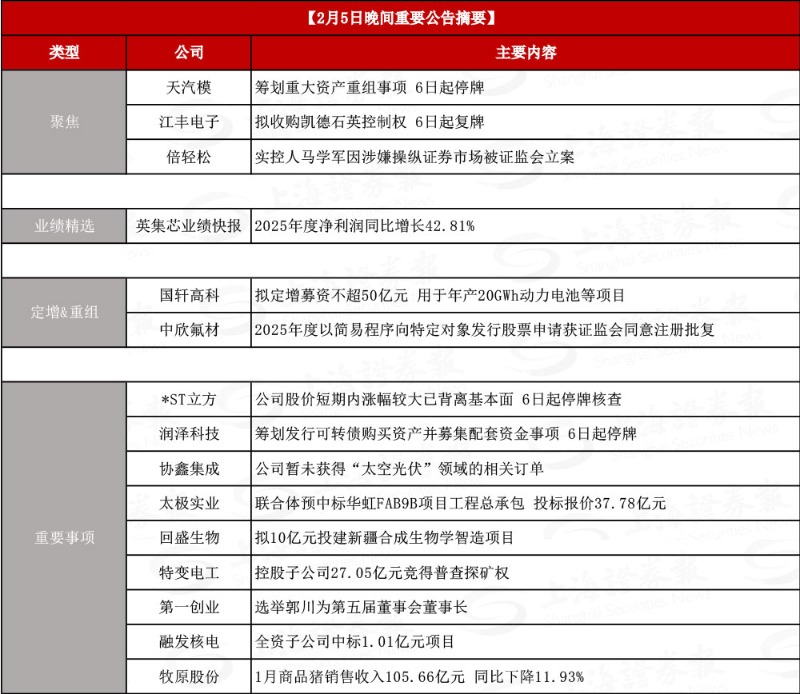
Company Announcements - Tianqi Mould is planning a major asset restructuring and will be suspended from trading starting February 6 [1] - Jiangfeng Electronics intends to acquire control of Kaide Quartz for 591 million yuan, with trading resuming on February 6 [2][3] - Beikong Leisure's actual controller, Ma Xuejun, is under investigation by the China Securities Regulatory Commission for alleged market manipulation [4][5] Performance Highlights - In 2025, Yingjixin reported a total revenue of 1.611 billion yuan, a year-on-year increase of 12.65%, and a net profit of 177.44 million yuan, up 42.81% from the previous year [6] Capital Increase & Restructuring - Guoxuan High-Tech plans to raise no more than 5 billion yuan through a private placement to fund a 20GWh power battery project and other initiatives [7] - Zhongxin Fluorine Materials received approval from the CSRC for a simplified procedure to issue shares to specific investors in 2025 [7] Important Matters - Runze Technology is planning to issue convertible bonds to purchase assets and raise supporting funds, with trading suspended from February 6 [8] - ST Cube's stock price increased by 314.93% from January 20 to February 5, leading to a suspension for verification due to a significant deviation from its fundamentals [8] - Muyuan Foods reported a January sales revenue of 10.566 billion yuan from commodity pigs, a year-on-year decrease of 11.93% [8] Other Developments - GCL-Poly has not yet received any orders in the "space photovoltaic" sector, which remains in the exploratory stage [9] - Huizhou Energy achieved a power generation of 4.264 billion kWh in January, a year-on-year increase of 26.38% [10] - Taiji Industry's subsidiary is part of a consortium that has pre-qualified for a semiconductor project with a bid of 3.778 billion yuan [10][11]


中国银河(601881)披露2025年度第二十四期短期融资券兑付完成公告,2月5日股价上涨0.33%
Sou Hu Cai Jing· 2026-02-05 15:07
《中国银河:2025年度第二十四期短期融资券兑付完成的公告》 最新公告列表 截至2026年2月5日收盘,中国银河(601881)报收于15.37元,较前一交易日上涨0.33%,最新总市值为 1680.62亿元。该股当日开盘15.3元,最高15.46元,最低15.24元,成交额达5.97亿元,换手率为0.54%。 近日,中国银河证券股份有限公司发布《2025年度第二十四期短期融资券兑付完成的公告》。公告显 示,公司于2025年10月15日发行了2025年度第二十四期短期融资券,发行额为人民币40亿元,票面利率 为1.66%,期限为112天,兑付日期为2026年2月4日。2026年2月4日,公司已兑付本期短期融资券本息 共计人民币4,020,374,794.52元。 以上内容为证券之星据公开信息整理,由AI算法生成(网信算备310104345710301240019号),不构成 投资建议。 ...

华泰证券2026年面向专业投资者公开发行公司债券(第一期)票面利率为1.85%
Zhi Tong Cai Jing· 2026-02-05 15:04
2026年2月5日,发行人和主承销商在网下向专业机构投资者进行了票面利率询价。根据网下专业机构投 资者询价结果,经发行人和主承销商协商一致,最终确定本期债券品种一的票面利率为1.85%,品种二 未实际发行。 华泰证券(06886)发布公告,根据《华泰证券股份有限公司2026年面向专业投资者公开发行公司债券(第 一期)发行公告》,华泰证券股份有限公司2026年面向专业投资者公开发行公司债券(第一期)(以下简 称"本期债券")分为两个品种,其中品种一期限为3年,票面利率询价区间为1.3%-2.3%;品种二期限为5 年,票面利率询价区间为1.5%-2.5%。本期债券票面利率由发行人和主承销商根据网下利率询价结果在 利率询价区间内协商确定。 ...

华泰证券(06886)2026年面向专业投资者公开发行公司债券(第一期)票面利率为1.85%
智通财经网· 2026-02-05 15:04
智通财经APP讯,华泰证券(06886)发布公告,根据《华泰证券股份有限公司2026年面向专业投资者公开 发行公司债券(第一期)发行公告》,华泰证券股份有限公司2026年面向专业投资者公开发行公司债券(第 一期)(以下简称"本期债券")分为两个品种,其中品种一期限为3 年,票面利率询价区间为1.3%-2.3%;品 种二期限为5年,票面利率询价区间为 1.5%-2.5%。本期债券票面利率由发行人和主承销商根据网下利 率询价结果在利率询价区间内协商确定。 2026年2月5日,发行人和主承销商在网下向专业机构投资者进行了票面利率询价。根据网下专业机构投 资者询价结果,经发行人和主承销商协商一致,最终确定本期债券品种一的票面利率为1.85%,品种二 未实际发行。 ...
中信建投(601066)披露境外中期票据发行及担保公告,2月5日股价上涨1.03%
Sou Hu Cai Jing· 2026-02-05 14:32
截至2026年2月5日收盘,中信建投(601066)报收于24.58元,较前一交易日上涨1.03%,最新总市值为 1906.6亿元。该股当日开盘24.35元,最高24.78元,最低24.33元,成交额达5.36亿元,换手率为0.34%。 近日,中信建投证券股份有限公司发布《关于间接全资附属公司根据中期票据计划进行发行并由全资子 公司提供担保的公告》。公告显示,公司全资子公司中信建投(国际)金融控股有限公司的间接全资附 属公司CSCIF Hong Kong Limited在境外中期票据计划下发行一笔本金为人民币3.50亿元、期限358天的 票据;中信建投国际为该票据提供无条件及不可撤销的连带责任保证担保,担保金额为人民币3.57亿 元,无反担保。本次担保用于补充境外业务营运资金,被担保人资产负债率超过70%,但公司对其持股 100%。截至公告日,公司及控股子公司对外担保总额为人民币473.38亿元,占最近一期经审计净资产 的44.46%,无逾期担保。 最新公告列表 《关于间接全资附属公司根据中期票据计划进行发行并由全资子公司提供担保的公告》 以上内容为证券之星据公开信息整理,由AI算法生成(网信算备310104 ...

三大指数午后跌幅收窄,关注A500ETF易方达(159361)、沪深300ETF易方达(510310)等产品后续表现
Mei Ri Jing Ji Xin Wen· 2026-02-05 14:08
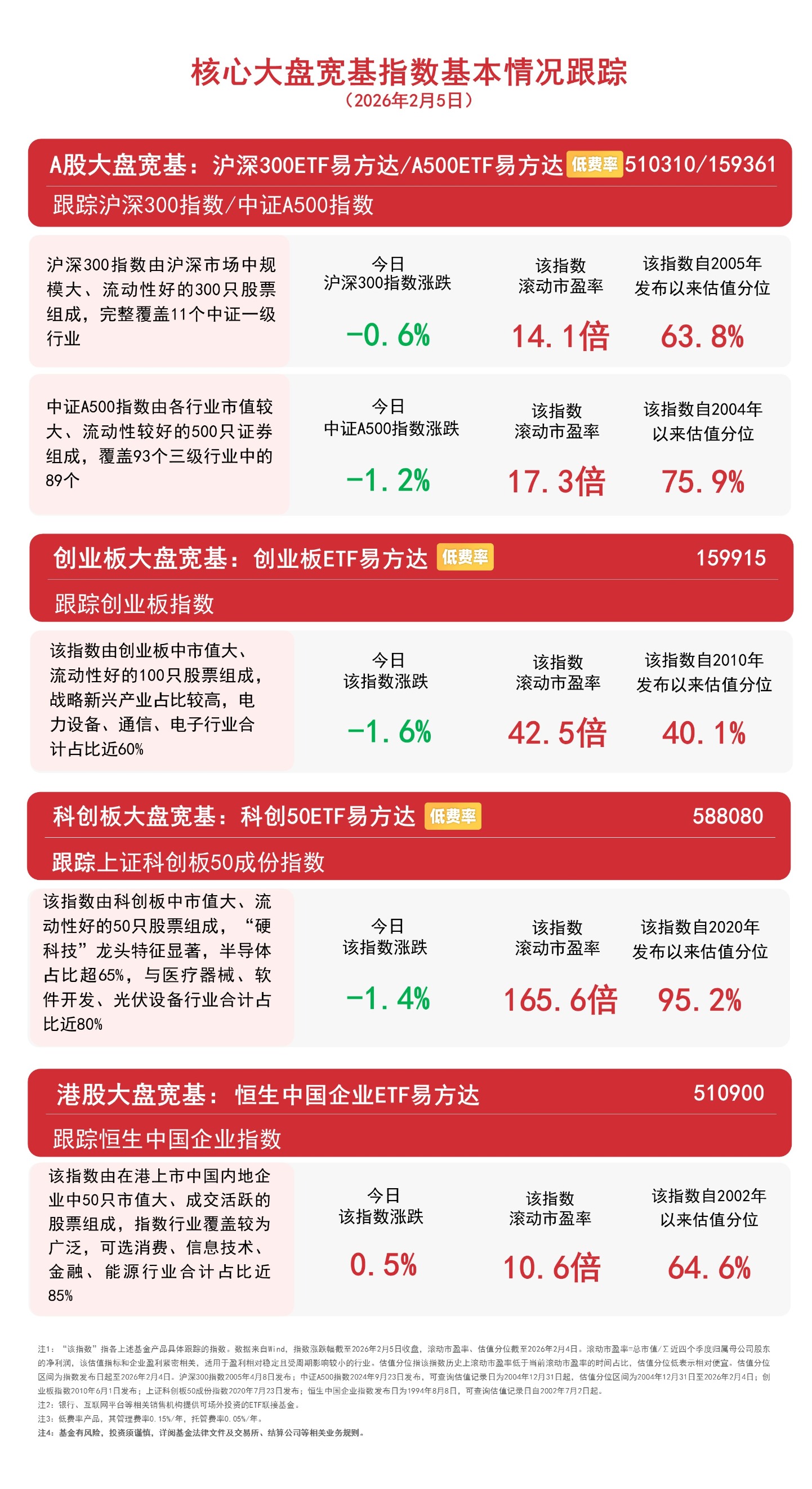
Market Performance - On February 5, A-shares experienced a collective adjustment, with the major indices showing declines. The CSI A500 index fell by 1.2%, the CSI 300 index decreased by 0.6%, the ChiNext index dropped by 1.6%, and the STAR Market 50 index declined by 1.4% [1] - In contrast, the Hang Seng China Enterprises Index rose by 0.5% [1] Sector Performance - The sectors that saw gains included film and television, beauty care, tourism and hotels, retail, food processing and manufacturing, banking, cultural media, securities, and local stocks from Fujian [1] - Conversely, sectors that experienced declines included oil and gas, precious metals, photovoltaic equipment, non-ferrous metals, cultivated diamonds, power grid equipment, coal mining and processing, and phosphorus chemical industries [1] Index Composition - The STAR Market 50 index consists of 50 stocks with large market capitalization and good liquidity, prominently featuring "hard technology" leaders, with over 65% in semiconductors and a combined 80% in medical devices, software development, and photovoltaic equipment [6] - The Hang Seng China Enterprises Index includes 50 large-cap, actively traded stocks from mainland China listed in Hong Kong, covering a wide range of industries, with nearly 85% in consumer discretionary, information technology, finance, and energy sectors [6]
[2月5日]指数估值数据(红利、港股上涨;存款会入市吗;投顾四周年成绩单来了)
银行螺丝钉· 2026-02-05 13:56
Core Viewpoint - The article discusses the current market conditions, focusing on the performance of A-shares and Hong Kong stocks, the impact of deposit maturities on the stock market, and the valuation of dividend indices. Market Performance - The overall market experienced a decline, with small and mid-cap stocks falling more than large-cap stocks. The ChiNext and STAR Market indices dropped around 1.5%. However, Hong Kong stocks showed resilience, rebounding in the afternoon and closing higher [2][3]. - The A-share market has seen a 3.4% correction from its peak in this bull market, while the Hong Kong Hang Seng Index has corrected by 4.2%. Since September 2024, both markets have risen by 50-60% [2][3][4]. Deposit Maturities and Market Impact - A significant amount of deposits, approximately 50 trillion yuan, is set to mature between late 2025 and early 2026, with most maturing in the first two quarters of 2026 [4][5][6]. - The current interest rates on deposits are lower than in previous years, leading to speculation about whether these funds will flow into the stock market. However, only a small portion is expected to enter equity assets due to the low-risk appetite of depositors [7][8][9]. Investment Strategies - It is suggested that only 5-10% of the maturing deposit funds may flow into stock markets, translating to several hundred billion to a trillion yuan potentially entering the market, which is seen as a positive but not overwhelmingly large impact [14][15]. - The article emphasizes that new funds and profits taken from the market should consider stable fixed-income strategies rather than aggressive stock investments, especially when the market is rated around 3 stars [21][22][23]. Dividend Indices Valuation - The article provides a valuation table for various dividend indices, highlighting their earnings yield, price-to-earnings ratio, price-to-book ratio, and dividend yield. For instance, the Shanghai Dividend Index has an earnings yield of 9.79% and a P/E ratio of 10.21 [24][25]. - The valuation of dividend indices is crucial as they have been among the fastest-growing index funds in recent years, and the article encourages investors to explore these options [28][30].
MINIMAX-WP:稳定价格行动及稳定价格期间结束
Zhi Tong Cai Jing· 2026-02-05 13:46
Core Viewpoint - MINIMAX-WP (00100) announced the end of the stabilization period for its global offering on February 5, 2026, which is 30 days after the deadline for submitting the Hong Kong public offering application [1] Group 1 - The stabilization agent, China International Capital Hong Kong Securities Limited, or its affiliates, conducted stabilization actions during the stabilization period, including the allocation of a total of 4.3796 million shares, representing 15% of the total shares available for subscription under the global offering [1] - The overall coordinator exercised the over-allotment option on January 9, 2026, at an offering price of HKD 165.00 per share, which excludes a 1% brokerage commission and other fees, involving a total of 4.3796 million shares to cover the over-allocation under the international offering [1] - During the stabilization period, the stabilization agent did not purchase or sell any Class A ordinary shares in the market for stabilization purposes [1]
2026年黄金长期看涨逻辑解析——从机构预测到投资实操全指南
Sou Hu Cai Jing· 2026-02-05 13:43
Core Viewpoint - The core conclusion is that gold prices are expected to show a "high-level fluctuation, long-term bullish" trend by 2026, supported by multiple structural factors, despite potential short-term volatility influenced by market sentiment and policy expectations [2][3]. Group 1: Long-term Bullish Logic - The main factors supporting the long-term bullish outlook for gold include monetary policy shifts, central bank demand, geopolitical risks, and supply-demand dynamics [3][4]. - The Federal Reserve is expected to shift to a rate-cutting cycle, with predictions of a 50-100 basis point cut, which will lower the opportunity cost of holding gold and weaken the dollar, positively impacting gold prices [3][5]. - Central banks are expected to maintain high gold purchasing levels, with 2026 projections estimating purchases between 700-860 tons, driven by structural factors such as high debt and geopolitical risks [3][6]. - Geopolitical uncertainties, including the U.S. elections and ongoing conflicts, are likely to sustain demand for gold as a safe-haven asset [4]. - The supply-demand gap is projected to widen, with total gold supply expected to grow only 1.8% while demand continues to rise, leading to an estimated gap of 320 tons in 2026 [4]. Group 2: Institutional Perspectives - Global institutions show differing predictions for gold prices in 2026, with optimistic forecasts from firms like Goldman Sachs (targeting $5400/oz) and Bank of America (potentially reaching $6000/oz) based on rising private investment and central bank purchases [7][8]. - Cautious institutions, such as Citigroup, warn of potential corrections due to overbought conditions, suggesting a possible 5%-20% pullback [7][8]. - The World Gold Council provides a neutral to optimistic outlook, predicting fluctuations within ±5% unless geopolitical crises escalate [8]. Group 3: Investment Strategies - Investors are advised to consider various gold investment products based on their risk tolerance and investment horizon, including physical gold, gold ETFs, gold T+D, and gold futures [12][13]. - Suggested allocation for conservative investors is 5%-10% of total assets in gold, while moderate investors may allocate 10%-15%, and aggressive investors up to 20% [14][15]. - Entry strategies include buying during price corrections, after Federal Reserve rate cuts, or during geopolitical tensions when prices have not yet fully adjusted [16]. Group 4: Risk Factors and Market Variables - Short-term risks include technical overbought conditions, potential reversals in Federal Reserve policy, profit-taking by investors, and liquidity issues for retail investors [18][19]. - Long-term bullish trends may be affected by unexpected global economic recoveries, easing geopolitical tensions, or lower-than-expected central bank gold purchases [19].
25元批发造股神,有财经大V一年赚2000万
21世纪经济报道· 2026-02-05 13:34
Core Viewpoint - The article discusses the booming yet chaotic landscape of financial knowledge payment platforms, highlighting the rise of financial "KOLs" (Key Opinion Leaders) who monetize their expertise through membership fees, while also addressing the regulatory challenges and the prevalence of unqualified individuals in the space [4][28]. Group 1: Financial KOLs and Their Revenue Models - Financial "KOLs" can achieve significant annual revenues, with some generating over 20 million yuan from membership fees alone [4]. - Many KOLs attract followers by claiming professional backgrounds and sharing market insights on social media platforms before directing them to paid knowledge-sharing platforms [7][11]. Group 2: Regulatory Challenges and Market Integrity - The recent announcement by Knowledge Planet to initiate a crackdown on illegal financial content indicates a growing concern over the integrity of financial advice being offered [4][28]. - Despite regulatory efforts, some KOLs continue to engage in dubious practices, such as using simulated trading software to fabricate impressive investment results [12][25]. Group 3: Content Strategies and User Engagement - Successful KOLs maintain high content update frequencies and often employ straightforward communication styles to engage their audience [16]. - KOLs utilize various tactics to circumvent platform regulations, such as hiding stock recommendations in non-detectable formats or using coded language [17][20]. Group 4: Emotional Value and Community Building - KOLs not only provide investment knowledge but also emotional support to their followers, especially during market volatility, which enhances user retention [22]. - The community aspect of KOLs' platforms fosters a sense of belonging among followers, which can lead to increased loyalty and engagement [22]. Group 5: Ethical Concerns and Misleading Practices - Some KOLs have been implicated in promoting private equity products with misleading performance claims, raising ethical questions about their influence and accountability [25][27]. - The blurred lines between personal branding and product promotion create challenges for investors in discerning the credibility of financial advice [25][28].