免税

Search documents
【十大券商一周策略】短期热度有望延续,A股估值有望继续提升
券商中国· 2026-01-11 14:55
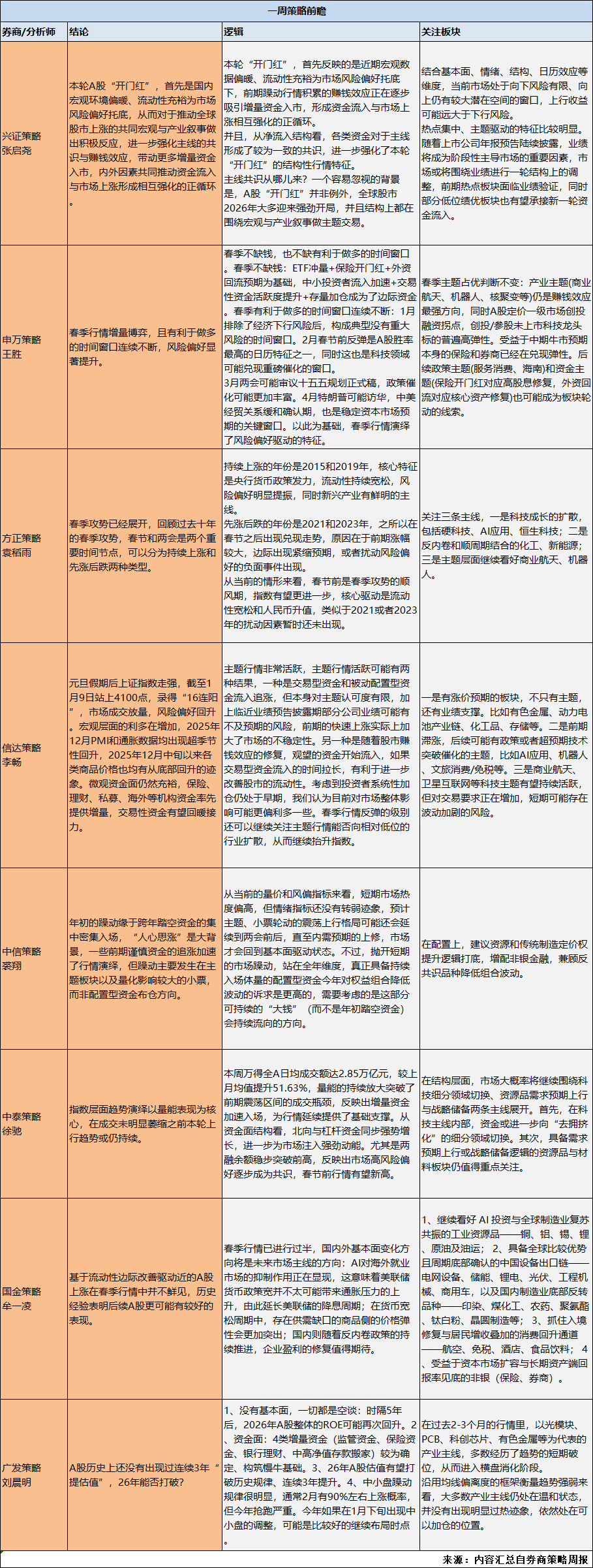
Group 1 - The market is currently experiencing a high level of enthusiasm, with a focus on theme stocks and small-cap stocks, while traditional investment funds are more cautious [2] - The expectation is that the market will continue to show a pattern of oscillation and upward movement until the National People's Congress, driven by improved domestic demand expectations [2] - There is a recommendation to focus on resources and traditional manufacturing sectors, as well as to increase allocation in non-bank financials to reduce portfolio volatility [2] Group 2 - A-share valuations are expected to continue to rise, with a potential rebound in overall ROE by 2026, influenced by factors such as increased profits from emerging industries and a slowdown in PPI [3] - The influx of certain types of funds, including regulatory, insurance, and bank wealth management funds, is seen as a solid foundation for the A-share market [3] - The market is likely to see a continuation of the spring rally, with a focus on small-cap stocks and potential adjustments providing good entry points for investors [3] Group 3 - The current market environment suggests limited downside risk and significant potential for upward movement, particularly in the commercial aerospace sector, which is experiencing positive changes [5] - The market is characterized by a concentration of themes and strong trading sentiment, with upcoming earnings reports expected to drive structural adjustments [5] - There is a focus on sectors such as AI, semiconductor, and resource price increases as key areas for investment [9] Group 4 - The spring rally is supported by improved liquidity and a favorable economic environment, with expectations of continued strong performance in the A-share market [6] - The focus on technology and growth sectors is expected to provide significant investment opportunities, particularly in AI applications and commercial aerospace [11] - The market is likely to remain strong leading up to the Spring Festival, with a focus on sectors benefiting from policy support and economic recovery [14]


A股策略周报20260111:趋势仍在,结构再平衡-20260111
SINOLINK SECURITIES· 2026-01-11 13:41
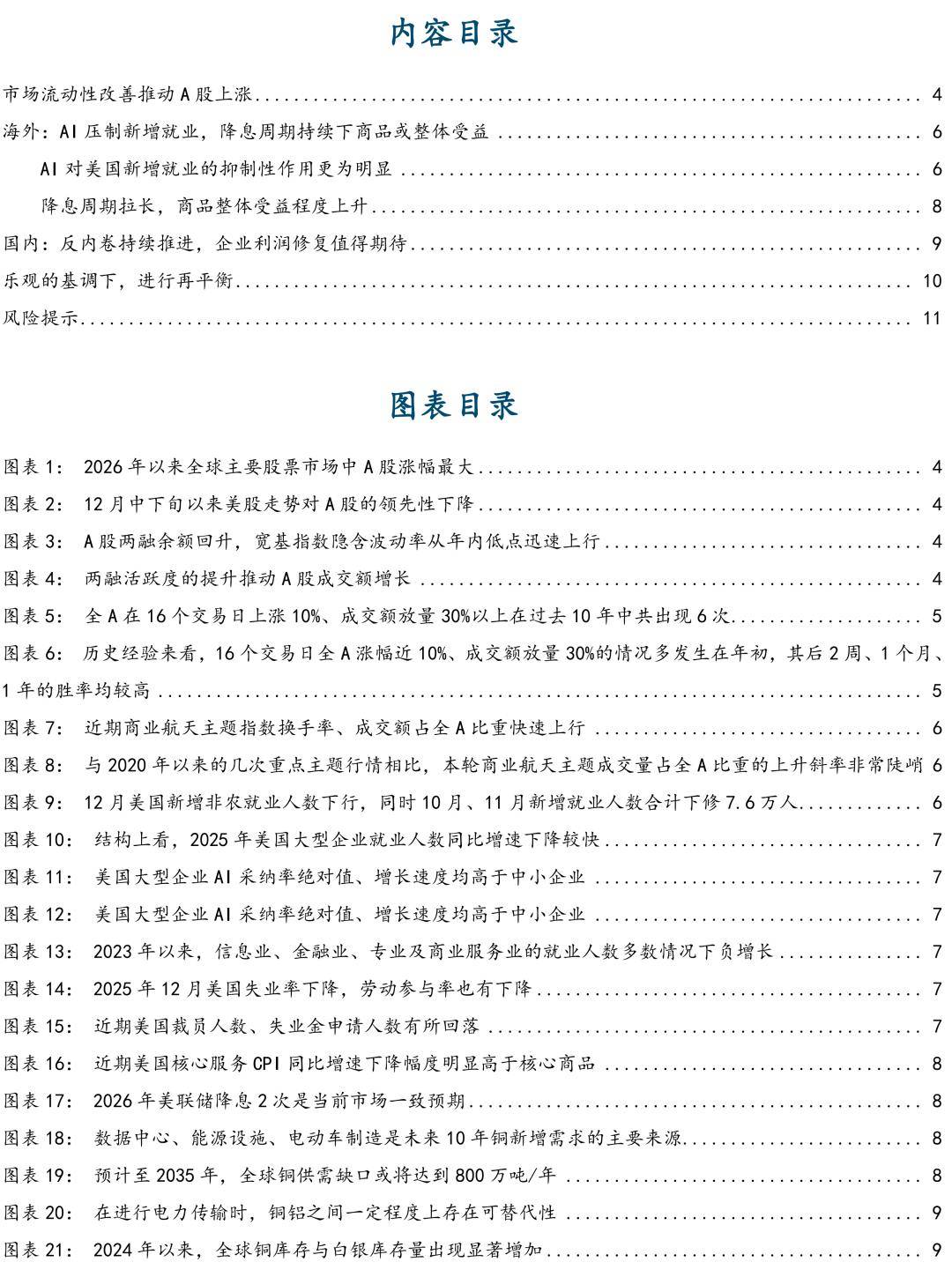
Group 1: Market Liquidity and A-Share Performance - The improvement in market liquidity has been a direct catalyst for the recent rise in A-shares, with margin trading balances increasing by over 125 billion yuan in just half a month, leading to a more than 35% increase in trading volume across the A-share market [3][13][22] - Historical data shows that similar situations, where the A-share market rose by nearly 10% over 16 trading days with trading volume expanding by over 30%, have occurred six times in the past decade, predominantly at the beginning of the year [3][18][22] - The recent surge in the commercial aerospace index has led to a significant increase in turnover rates and trading volume proportions, indicating a potential structural overheating in the market [3][22] Group 2: AI Impact on Employment and Economic Policy - The U.S. job market continues to face pressure, with December's non-farm payrolls adding only 50,000 jobs, below expectations, and a downward revision of 76,000 jobs for October and November [4][26][33] - The adoption of AI by large U.S. companies has significantly suppressed employment growth, particularly in the information, finance, and professional services sectors, which have collectively lost 344,000 jobs over the past three years [4][26][33] - The Federal Reserve's extended rate-cutting cycle is expected to benefit commodity markets, as inflation concerns related to AI investments are easing [4][40][41] Group 3: Domestic Economic Recovery and Policy Optimization - The Producer Price Index (PPI) for industrial enterprises in December showed a year-on-year increase, indicating a shift from price drag to price support for corporate revenues [5][56] - The Consumer Price Index (CPI) has also risen, with the core CPI maintaining its highest level in five years, reflecting a smoother transmission of prices from enterprises to consumers [5][56] - The ongoing anti-involution policies are expected to enhance corporate profitability, with regulatory measures aimed at preventing monopolistic practices and promoting fair competition [5][62] Group 4: Rebalancing and Investment Recommendations - The report suggests a positive outlook for A-shares, driven by improved liquidity and favorable domestic and international economic conditions [6][63] - Recommended investment areas include industrial resource products like copper, aluminum, and lithium, as well as sectors benefiting from the recovery of domestic manufacturing and consumer spending [6][63] - The report emphasizes the importance of capturing opportunities in sectors such as aviation, duty-free, and food and beverage, which are expected to benefit from increased consumer income and tourism recovery [6][63]
A股分析师前瞻:增量资金入市,春季做多的时间窗口连续不断
Xuan Gu Bao· 2026-01-11 13:37
Group 1 - The core viewpoint is that the spring season presents a favorable environment for investment, characterized by ample liquidity and positive macroeconomic indicators, which are expected to drive market performance [1][2] - The analysis indicates that the current market is experiencing a "spring rally," supported by increased inflows from various types of investors, including ETFs, insurance funds, and foreign capital, which collectively enhance market risk appetite [1][2] - The upcoming political events, such as the Two Sessions and potential visits from foreign leaders, are anticipated to provide additional policy catalysts that could further stimulate market activity [1][2] Group 2 - The short-term market sentiment is currently high, with indicators suggesting that the upward trend may continue until the Two Sessions, driven by improved domestic demand expectations [2][3] - Historical data suggests that A-shares have not experienced three consecutive years of valuation increases, but 2026 may break this trend, with a potential recovery in overall ROE [2][4] - Various sectors, particularly those related to technology and materials, have shown signs of short-term consolidation after previous upward trends, indicating a potential for further investment opportunities [2][4] Group 3 - The analysis highlights that the current market dynamics are influenced by a combination of macroeconomic factors and investor sentiment, creating a positive feedback loop that encourages further capital inflow [1][2] - The spring season is marked by a series of favorable time windows for investment, with specific months identified as having historically high success rates for market performance [1][2] - The focus on thematic investments, particularly in sectors like commercial aerospace and robotics, is expected to remain strong, with potential for significant returns as these industries continue to develop [3][4]
国金策略:趋势仍在,结构再平衡
Sou Hu Cai Jing· 2026-01-11 10:59
Group 1 - The recent improvement in market liquidity has driven the A-share market's rise, with historical patterns suggesting a strong performance in the upcoming period [1][5] - The A-share market has seen a significant increase in trading volume, with a 35% growth in total trading volume and a 10% rise in the overall A-share index over the past 16 trading days [2][14] - There is a notable structural overheating in the market, particularly in the commercial aerospace index, which has seen a sharp increase in turnover and trading volume [2][14] Group 2 - AI's negative impact on the U.S. employment market is becoming evident, with December's non-farm payrolls falling short of expectations and a downward revision of previous months' data [3][20] - The prolonged interest rate cut cycle by the Federal Reserve is expected to benefit commodity markets, as the demand for resources related to AI and new energy industries is increasing [3][33] - Geopolitical tensions are altering inventory behaviors among market participants, leading to increased stockpiling and a rise in copper and silver inventories [3][35] Group 3 - Domestic policies aimed at reducing "involution" are being implemented, with industrial prices showing signs of recovery, leading to improved corporate profitability [4][43] - The recent regulatory focus on the photovoltaic industry has raised concerns about the commitment to anti-involution policies, but the overall direction remains focused on improving corporate fundamentals [4][49] - The government is actively working on regulatory frameworks to support innovation while preventing monopolistic practices, which is expected to enhance corporate profitability in the long run [4][51] Group 4 - The report maintains an optimistic outlook for the A-share market, suggesting that the combination of improved liquidity, AI investments, and domestic policy support will lead to a favorable investment environment [5][52] - Recommended sectors include industrial resource products like copper, aluminum, and lithium, as well as equipment exports and consumer sectors benefiting from recovery trends [5][52]
消费“升温”场景“上新” 各地节前市场热气升腾迎来“开门红”
Yang Shi Wang· 2026-01-11 02:53
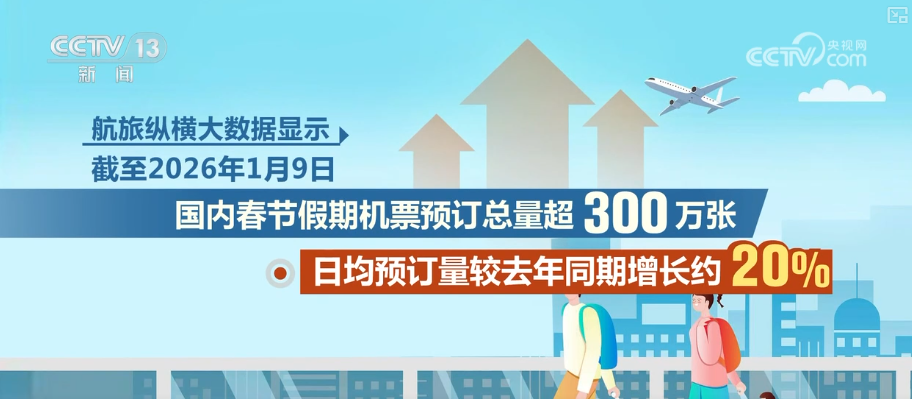
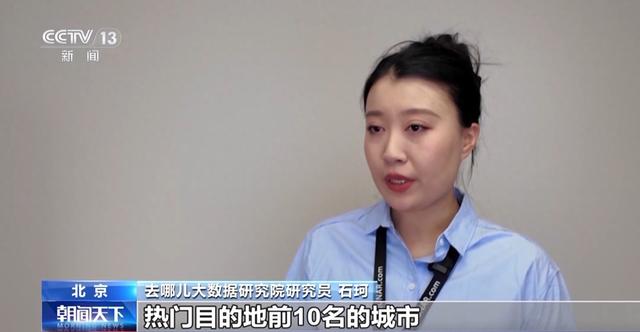
Group 1: Travel and Flight Booking Trends - The domestic flight bookings for the Spring Festival have exceeded 3 million, with a daily booking increase of approximately 20% compared to the same period in 2025 [3] - Major cities and popular provincial capitals have seen a significant increase in flight bookings, with an average growth of about 30% compared to the previous week [3] - Top 10 popular destinations have experienced substantial growth in flight bookings, with Haikou leading at a 120% year-on-year increase, followed by Sanya at 90%, and other cities like Chengdu, Hangzhou, and Chongqing showing increases between 50% and 80% [5] Group 2: Duty-Free Shopping in Hainan - The duty-free shopping market in Hainan has seen a strong start to the new year, with total shopping amounts reaching 1.21 billion yuan, a year-on-year increase of 88% [8] - The number of shoppers and items purchased during the New Year period also saw significant increases of 38.3% and 30.3%, respectively [8] - The expansion of the duty-free product range to 47 categories since November 2025 has effectively boosted consumption in this sector [10] Group 3: Culinary Events in Shanghai - Shanghai has launched the "Global Food Festival" for the entire year, featuring multiple themes and city tasting routes [11] - The Huangpu District is creating a European-style food market to offer diverse culinary experiences, including various international foods [13] - The Shanghai Municipal Commission of Commerce aims to enhance the influence of global cuisine through nine initiatives, promoting high-quality development in the restaurant industry [15][17]
各地消费活动升温,热门目的地机票预订量增长明显
Xin Lang Cai Jing· 2026-01-11 00:39
Group 1: Travel and Flight Bookings - The domestic flight bookings for the upcoming Spring Festival have significantly increased, with over 3 million tickets booked as of January 9, 2026, representing a 20% year-on-year growth in daily bookings [1] - Major cities such as Haikou and Sanya have seen remarkable growth in flight bookings, with Haikou leading the top 10 cities with a 120% increase, and Sanya experiencing a 90% increase [3] - Popular routes are shifting, with new routes to cities rich in traditional New Year activities gaining traction alongside traditional routes like Beijing-Guangzhou and Beijing-Shanghai [3] Group 2: Duty-Free Shopping in Hainan - Hainan's duty-free shopping market has seen a strong start to the year, with total sales reaching 1.21 billion yuan from January 1 to 7, 2026, marking an 88% increase year-on-year [4] - The number of transactions and visitors also increased, with 824,000 items sold and 149,000 visitors, reflecting a 30.3% and 38.3% growth respectively [4] - Sanya's duty-free stores experienced a peak in customer traffic, with sales nearing 800 million yuan in the first week of the year [5] Group 3: Culinary Events in Shanghai - Shanghai launched the "Global Food Festival" on January 9, 2026, featuring various themed culinary events throughout the year [7] - The initiative includes the creation of ten city tasting routes and a European-style market showcasing diverse food products, enhancing the city's culinary culture [7] - The Shanghai Municipal Commission of Commerce aims to encourage more projects and businesses to participate in this initiative to promote high-quality development in the restaurant industry [9]
各地消费活动升温 热门目的地机票预订量增长明显
Yang Shi Xin Wen Ke Hu Duan· 2026-01-11 00:08
Group 1: Travel and Tourism - The domestic flight bookings for the upcoming Spring Festival have significantly increased, with over 3 million tickets booked as of January 9, 2026, representing a 20% year-on-year growth in daily bookings [2] - Popular destinations such as Haikou and Sanya have seen remarkable growth in flight bookings, with Haikou leading at a 120% increase and Sanya at 90% [2] - New travel routes to cities with rich cultural activities, such as Shanghai to Jieyang and Beijing to Foshan, are gaining popularity alongside traditional routes [2] Group 2: Duty-Free Shopping - The duty-free shopping market in Hainan has experienced a strong start to the year, with total sales reaching 1.21 billion yuan from January 1 to 7, 2026, marking an 88% increase year-on-year [3] - Sanya's duty-free stores reported nearly 800 million yuan in sales during the first week of the year, indicating a peak in customer traffic [4] - The expansion of the duty-free product range to 47 categories since November has effectively boosted consumer spending in Hainan [5] Group 3: Culinary Events - Shanghai has launched the "Global Food Festival" initiative, featuring diverse culinary themes throughout the year and introducing ten city tasting routes [6] - The initiative aims to enhance Shanghai's global food influence through various promotional measures and the establishment of food landmarks [6] - The Shanghai Municipal Commission of Commerce emphasizes the goal of high-quality development in the catering industry through increased participation and policy guidance [6]
2026年度策略-看好内需顺周期主线-出海关注龙头Alpha
2026-01-08 02:07
Summary of Conference Call Notes Industry and Company Focus - **Industry**: Various sectors including travel, high-end consumption, education, and export markets - **Companies Mentioned**: China Duty Free Group, Lao Pu Gold, Chao Hong Ji, Huatu Shanding, China Oriental Education, Anker Innovations, Star Technology, Small Commodity City, and others Key Points and Arguments Domestic Demand Strategy - **Focus Areas**: - **Cyclical Beta**: Prioritize travel-related sectors such as aviation, hotels, and tourism due to significant demand improvement driven by policy catalysts [1][3] - **High-End Consumption**: Strong recommendations for duty-free and high-end gold jewelry sectors, with expectations of price increases driving both valuation and performance [1][6] - **Value Consumption**: Marginal improvement in demand is unclear; sectors depend on income growth or improvements in PPI and CPI data [1][7] - **Counter-Cyclical Industries**: Education sector shows strong demand resilience, particularly in vocational education and public examination training, with AI technology enhancing efficiency [1][8] Service Consumption - **Characteristics**: Service-oriented consumption is elastic, quick to respond, and has no inventory issues, significantly aiding employment and economic recovery [4][11] - **Current Proportion**: Service consumption accounts for approximately 55% of personal consumption expenditure in China, compared to 70% in the US, indicating room for growth [12] High-End Retail and Luxury Market - **Market Recovery**: High-end retail and luxury markets began to recover in Q2 and Q3 of 2025, driven by a stable high-net-worth population and wealth effect [4][16] - **Consumer Sentiment**: The recovery of middle-class confidence is crucial, as they contribute 60% of luxury sales [16] Export Market Opportunities - **Outlook for 2026**: Anticipation of more opportunities in the second half of 2026, with resilient exports and better-than-expected US demand [9][23] - **Key Companies**: Focus on leading companies with alpha attributes such as Anker Innovations and Star Technology for performance-driven growth [9][23] Education Sector - **Demand Characteristics**: The education sector, particularly vocational training and public examination preparation, is expected to perform well despite overall employment pressures [8][26] - **Key Players**: Companies like Huatu Education and China Oriental Education are highlighted for their strong market positions [8][26] Risks and Challenges - **Currency Fluctuations**: Current RMB exchange rates are stable, with limited risk of significant appreciation that could impact export companies negatively [24] - **Raw Material Prices**: Fluctuations in raw material prices are not seen as a major concern for leading companies due to supply chain dynamics [25] Investment Recommendations - **Cyclical Sectors**: Focus on travel-related industries for potential valuation uplift due to demand recovery [5] - **High-End Consumption**: Investment in duty-free and high-end jewelry sectors is recommended due to positive market sentiment [6] - **Education**: Strong prospects for companies in vocational education and public examination training [26] Additional Insights - **Tea and Restaurant Industries**: Opportunities in the tea industry due to competitive landscape improvements and in the restaurant sector with companies like Xiao Cai Yuan and Guo Quan showing potential for scalable growth [18][20] This summary encapsulates the key insights and recommendations from the conference call, providing a comprehensive overview of the current market landscape and future opportunities across various sectors.
人气旺 活力足
Xin Lang Cai Jing· 2026-01-07 21:21
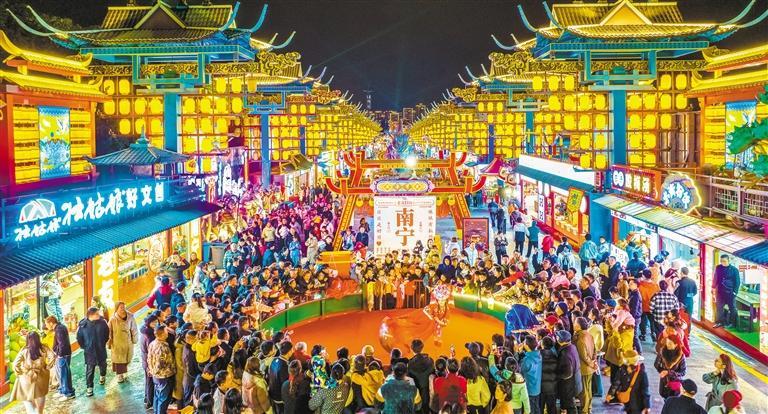
Group 1 - The "Nanning Night" cultural tourism district in Nanning, Guangxi, attracted citizens and tourists, showcasing vibrant activities such as markets, food tasting, and performances during the holiday season [2] - A new round of consumer goods replacement policy has been implemented with the first batch of 625 billion yuan in national subsidies being allocated, aimed at boosting consumer spending [4] - The duty-free shopping trend has surged since the Hainan Free Trade Port initiated its full island closure, with tourists actively purchasing duty-free items at the CDF Haikou Sun Moon Plaza [7] Group 2 - The Beijing Wangfujing WellTown project, a key cultural tourism initiative, is demonstrating strong consumer momentum through its "commercial + cultural tourism" integration model [9] - Consumers in Leshan, Sichuan, are actively selecting new mobile phones in a large shopping center, indicating a positive retail environment [10] - In Nanjing, Jiangsu, citizens are enjoying local cuisine at a restaurant in the historical cultural district of Laomendong, reflecting a growing interest in culinary experiences [10]
帮主郑重核心标的组合:3-5只必配+精准建仓方案
Sou Hu Cai Jing· 2026-01-07 09:49
Group 1: Investment Opportunities - Company 1: Contemporary Amperex Technology Co., Limited (CATL) is a global leader in power batteries, with a storage business growing over 60%. The target price set by CICC is 445 yuan, with significant overseas production capacity expected to be released by 2026, ensuring stable demand in both new energy vehicles and energy storage [3][4] - Company 2: Zijin Mining Group Co., Ltd. focuses on copper and gold, essential for AI computing and new energy. The net profit is projected to increase by 55% in the first three quarters of 2025, with valuations below the industry median [5][6] - Company 3: China Duty Free Group Co., Ltd. benefits from the Hainan duty-free sales surge, with a 128.9% year-on-year increase in sales during the New Year. As the industry leader with an 82% market share, growth potential is significant with the recovery of outbound tourism and expansion of local duty-free stores [7] - Company 4: East Money Information Co., Ltd. is a leading internet brokerage benefiting from a recent surge in new A-share accounts, with market activity increasing. The company stands to gain from commission and fund distribution services, with a high equity risk premium compared to historical averages [8] - Company 5: Northern Rare Earth Group High-Tech Co., Ltd. holds 83.7% of China's light rare earth reserves. With tightening export controls on medium and heavy rare earths, the strategic value of the entire rare earth sector is being reassessed, with long-term demand growth expected in electric vehicle motors and wind power [9][10] Group 2: Investment Strategy - The investment strategy emphasizes a gradual entry into positions rather than full allocation at once, focusing on "phased entry and using time to gain space" [11] - Key signals to monitor include whether the Shanghai Composite Index can maintain the critical support level of 3974 points and whether individual stocks remain above their core moving averages. As long as there is no deterioration in fundamentals, short-term fluctuations should not cause panic [11]