
农业

Search documents
广发早知道:汇总版-20250918
Guang Fa Qi Huo· 2025-09-18 00:47
Report Industry Investment Rating No relevant information provided. Core Viewpoints of the Report - The A-share market showed a mixed performance on September 17, with the main indexes rising, but individual stocks had a mixed trend. The export chain was active, while the consumer goods sector adjusted. The four major stock index futures contracts all rose, and the Fed's interest rate cut had a certain impact on the market [2][3]. - The bond market sentiment improved, and the central bank's expected bond - buying supported the bond market. However, there were still uncertainties in the market, and the 10 - year Treasury bond yield was expected to fluctuate within a certain range [6]. - The Fed's interest rate cut of 25BP was in line with market expectations, and the precious metals market showed a correction after the market digested the news. Gold was expected to enter a high - level shock, and silver was expected to fluctuate within a certain range [7][9]. - For non - ferrous metals, copper, aluminum, and other metals had different market performances and outlooks. The supply and demand fundamentals and macro - environment affected their prices [12][19]. - In the black metal sector, steel prices were affected by coal supply expectations and demand, and iron ore prices were supported by supply - demand and inventory factors. Coke and coking coal also had their own supply - demand and price trends [40][46][52]. - In the agricultural products sector, the outlook for soybean meal and rapeseed meal was affected by US soybean export expectations, and the pig and corn markets also had their own supply - demand and price characteristics [60][63][65]. Summary by Directory Financial Derivatives - Financial Futures Stock Index Futures - Market situation: On September 17, the A - share market opened lower and closed higher. The Shanghai Composite Index rose 0.37%, the Shenzhen Component Index rose 1.16%, and the ChiNext Index rose 1.95%. The four major stock index futures contracts all rose, with IF2509 and IH2509 rising 0.80% and 0.20% respectively, and IC2509 and IM2509 rising 1.26% and 1.25% respectively [2][3]. - News: The State Council Information Office introduced policies to expand service consumption, and the Fed cut interest rates by 25 basis points [3]. - Capital: The A - share trading volume increased slightly, with a total turnover of 2.38 trillion yuan. The central bank conducted 4185 billion yuan of 7 - day reverse repurchase operations, with a net investment of 1145 billion yuan [4]. - Operation suggestion: It is recommended to take profit on relevant option call positions after the macro - event is settled [4]. Treasury Futures - Market performance: Treasury futures closed up across the board, with the 30 - year, 10 - year, 5 - year, and 2 - year main contracts rising 0.31%, 0.13%, 0.10%, and 0.04% respectively [5]. - Capital: The central bank conducted 4185 billion yuan of 7 - day reverse repurchase operations, and the tax - payment period was approaching its end, and the capital situation was expected to ease [5][6]. - Operation suggestion: It is recommended to conduct range - based operations and be cautious about chasing up in the short term [6]. Financial Derivatives - Precious Metals - Market review: The Fed cut interest rates by 25 basis points, and the market's interpretation was neutral. Gold and silver prices showed corrections, with gold closing at $3659.55 per ounce, down 0.82%, and silver closing at $41.63 per ounce, down 2.09% [7][9]. - Outlook: Gold was expected to enter a high - level shock, and it was recommended to take profit on the option straddle double - buying strategy. Silver was expected to fluctuate between $40.5 - 42.5, and it was recommended to sell out - of - the - money put options at high prices [9][10]. Financial Derivatives - Container Shipping to Europe No relevant information provided. Commodity Futures - Non - Ferrous Metals Copper - Spot: As of September 18, the average price of SMM electrolytic copper decreased. The consumption was still weak [12]. - Macro: The Fed cut interest rates by 25bp, and the previous easing trading might be basically over [15]. - Supply: The copper concentrate TC was at a low level, and the domestic electrolytic copper production was expected to decline in September [13]. - Demand: The copper rod operating rate was weak in the peak season, and the downstream demand was suppressed [14]. - Inventory: LME copper inventory decreased, while domestic social inventory increased [14]. - Logic: The previous easing trading might end, and the copper price was expected to be affected by the macro - market style shift and US economic data [15]. - Operation suggestion: The main contract was expected to fluctuate between 79000 - 81500 [15]. Alumina - Spot: On September 17, the spot prices of alumina in various regions decreased [16]. - Supply: The domestic alumina production increased in August, and the operating capacity was expected to continue to increase slightly in September [17]. - Inventory: The port inventory decreased, while the warehouse receipt registration increased [17]. - Logic: The market was in a situation of "high supply, high inventory, and weak demand". The supply - side disturbances in Guinea provided short - term support, but the overall supply was still excessive [18]. - Operation suggestion: The main contract was expected to fluctuate between 2900 - 3200, and it was recommended to pay attention to supply - side factors [18]. Aluminum - Spot: On September 17, the average price of SMM A00 aluminum decreased [19]. - Supply: The domestic electrolytic aluminum production increased in August, and the aluminum - water ratio increased [19]. - Demand: The downstream operating rate improved during the peak season [19]. - Inventory: The domestic electrolytic aluminum inventory showed a mixed trend, and the LME inventory remained unchanged [20]. - Logic: The macro - level interest rate cut had a marginal weakening effect on the aluminum price. The supply was high, and the cost support weakened. The inventory reduction was still uncertain [21]. - Operation suggestion: The main contract was expected to fluctuate between 20600 - 21000 [21]. Aluminum Alloy - Spot: On September 17, the spot price of SMM aluminum alloy ADC12 remained unchanged [22]. - Supply: The domestic recycled aluminum alloy ingot production decreased in August, and the operating rate was expected to increase slightly in September [22]. - Demand: The terminal orders improved slightly, but the inventory was still accumulating [22][23]. - Logic: The cost was strongly supported, and the demand was expected to improve during the peak season. The price was expected to remain firm [23]. - Operation suggestion: The main contract was expected to fluctuate between 20200 - 20600, and it was recommended to consider the arbitrage strategy [23]. Zinc - Spot: On September 17, the average price of SMM 0 zinc ingot decreased, and the downstream orders were general [24]. - Supply: The zinc concentrate processing fee was stable, and the global zinc mine production increased. The domestic refined zinc production was expected to decline in September [24]. - Demand: The primary processing industry's operating rate increased during the peak season, but the market was still in a wait - and - see mood [25]. - Inventory: The domestic social inventory increased, while the LME inventory decreased [26]. - Logic: The domestic zinc price was suppressed by the supply expectation, while the LME zinc price was strong. The zinc price was expected to fluctuate [27]. - Operation suggestion: The main contract was expected to fluctuate between 21800 - 22800 [28]. Tin - Spot: On September 17, the price of SMM 1 tin decreased slightly, and the spot market trading was cold [28]. - Supply: The domestic tin ore and tin ingot imports had different trends, and the supply was still tight [28]. - Demand: The solder operating rate increased in August, but the overall demand was still weak [29]. - Inventory: The LME inventory remained unchanged, the SHFE warehouse receipt decreased, and the social inventory increased [29]. - Logic: The supply was tight, and the tin price was expected to remain high and fluctuate. It was recommended to pay attention to the supply recovery [30]. - Operation suggestion: The main contract was expected to fluctuate between 265000 - 285000 [30]. Nickel - Spot: As of September 17, the average price of SMM1 electrolytic nickel decreased [30]. - Supply: The refined nickel production was at a high level, and the monthly production was expected to increase slightly [31]. - Demand: The demand from electroplating and stainless steel was general, while the demand from ternary materials for nickel sulfate improved [31]. - Inventory: The overseas inventory was high, the domestic social inventory increased, and the bonded area inventory decreased [31]. - Logic: The macro - environment was positive, but the supply was expected to be loose in the medium - term. The nickel price was expected to fluctuate within a range [32]. - Operation suggestion: The main contract was expected to fluctuate between 120000 - 125000 [32]. Stainless Steel - Spot: As of September 17, the price of 304 cold - rolled stainless steel decreased slightly [33]. - Raw materials: The nickel ore price was firm, the nickel - iron price was strong, and the chromium - iron price increased [33]. - Supply: The domestic stainless steel production was expected to increase in September [34]. - Inventory: The social inventory decreased slowly, and the warehouse receipt decreased [34]. - Logic: The macro - environment improved, but the downstream demand in the peak season was not as expected. The price was expected to fluctuate within a range [36]. - Operation suggestion: The main contract was expected to fluctuate between 12800 - 13400 [36]. Lithium Carbonate - Spot: As of September 17, the price of battery - grade lithium carbonate increased slightly, while the price of lithium hydroxide decreased slightly [36]. - Supply: The lithium carbonate production increased in August, and the supply was affected by previous production cuts and imports [37]. - Demand: The demand was optimistic, and the orders in September were expected to increase [37]. - Inventory: The overall inventory decreased, with the upstream inventory decreasing and the downstream inventory increasing [38]. - Logic: The policy was favorable, and the supply - demand was in a tight balance. The price was expected to be strong and fluctuate [39]. - Operation suggestion: The main contract was expected to fluctuate around 70000 - 75000 [40]. Commodity Futures - Black Metals Steel - Spot: The steel price decreased slightly, and the basis of rebar was 48 yuan [40]. - Cost and profit: The cost was affected by production restrictions, and the steel profit decreased [40][41]. - Supply: The iron element production increased in the first 8 months, and the steel production showed different trends this week [42]. - Demand: The five - major steel products' apparent demand was basically flat year - on - year, and the export growth was limited [43]. - Inventory: The five - major steel products' inventory increased, mainly due to rebar [44]. - Viewpoint: The steel price was expected to fluctuate within a range, affected by weak demand and coal supply expectations [45]. Iron Ore - Spot: As of September 17, the prices of mainstream iron ore powders were mixed [46]. - Futures: The iron ore 2601 contract rose slightly [46]. - Basis: The basis of different iron ore varieties was different [47]. - Demand: The steel mill's iron - making capacity utilization rate increased, and the profit margin decreased slightly [48]. - Supply: The global iron ore shipment increased, and the port arrival decreased [49]. - Inventory: The port inventory decreased slightly, and the steel mill's inventory increased [50]. - Viewpoint: The iron ore market was in a tight - balance situation, and the price was expected to be bullish. It was recommended to go long on the 2601 contract [51]. Coking Coal - Spot and futures: The coking coal futures fluctuated and fell, and the spot price showed signs of stabilization [52]. - Supply: The coal mine production increased, and the import coal price fluctuated with the futures [56]. - Demand: The iron - making and coking production increased, and the demand was supported [54]. - Inventory: The overall inventory decreased slightly [55]. - Viewpoint: The coking coal market was expected to rebound, and it was recommended to go long on the 2601 contract [56]. Coke - Spot and futures: The coke futures fluctuated and fell, and the second - round price cut by steel mills was implemented [57]. - Supply: The coking production increased due to previous profit increases [59]. - Demand: The steel mill's production increased, and the demand for coke was supported [58]. - Inventory: The overall inventory increased slightly [59]. - Viewpoint: The coke market was expected to bottom out and rebound, and it was recommended to go long on the 2601 contract [59]. Commodity Futures - Agricultural Products Meal - Spot market: The prices of soybean meal and rapeseed meal decreased, and the trading volume was mixed [60]. - Fundamental news: Brazil's soybean production and export forecasts were adjusted, and the US soybean production was uncertain [61]. - Market outlook: The domestic soybean meal market was under pressure, and the support at 3000 for the 01 contract should be noted [62]. Live Pigs - Spot situation: The live pig price decreased slightly [63]. - Market data: The profit of live pig breeding decreased, and the average slaughter weight increased [63][64]. - Market outlook: The supply pressure was high, and the near - month contract was expected to be weak. The 1 - 5 spread arbitrage opportunity should be noted [64]. Corn - Spot price: The corn price in Northeast China was stable, while that in North China decreased [65]. - Fundamental news: The grain inventory in Guangzhou Port changed, with corn inventory decreasing [66]. - Market outlook: The short - term corn market was in a loose supply - demand situation, and the price was expected to be weak. The support at 2150 should be noted [67].
中保商务论坛在保加利亚举办 百余家企业共商合作
Xin Hua She· 2025-09-18 00:31
作为中保政府间经济联委会新一届例会重要配套活动,本次论坛吸引了中保两国百余家企业参与,涵盖 农业、能源、物流、汽车制造、信息技术、金融等多个领域。 论坛还包括专题推介和企业对接会等环节,为两国企业提供了高效的交流平台。与会企业代表表示,通 过本次论坛不仅了解了对方市场需求和政策环境,还建立了直接联系,为后续合作奠定了良好基础。 新华社索非亚9月17日电 "中国—保加利亚商务论坛"日前在保加利亚首都索非亚举行,来自中保两国的 100多家企业参加了本次论坛并进行对接交流。 保加利亚经济和工业部长迪洛夫在开幕致辞中表示,保加利亚高度重视发展对华经贸关系,愿为中国企 业到保投资提供更多便利和支持。他说,保加利亚拥有良好的投资环境和区位优势,正在积极推进基础 设施建设,期待更多中国企业参与保加利亚经济发展。 中国商务部副部长凌激在致辞中说,中保两国传统友谊深厚,经贸合作成果显著。2020年至2024年,双 边贸易额从29亿美元增至41亿美元;中国对保投资累计达1.7亿美元,涵盖农业、制造业、新能源等多 个领域。 ...
【ETF观察】9月17日行业主题ETF净流入39.78亿元
Sou Hu Cai Jing· 2025-09-17 23:58
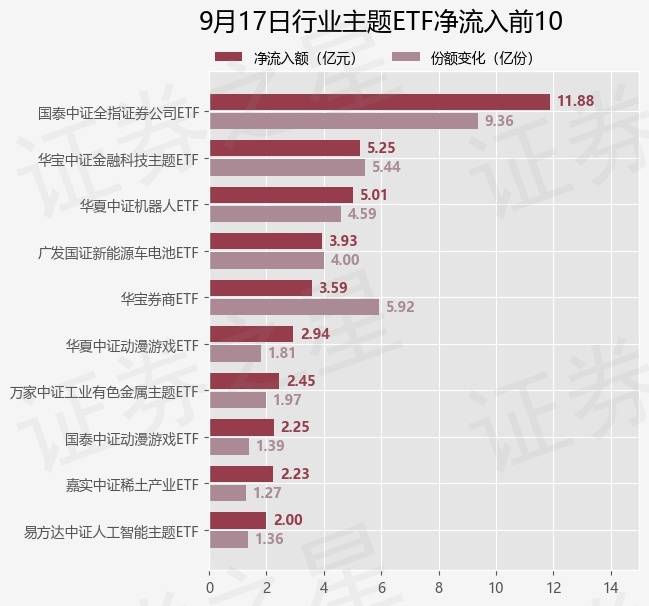
Summary of Key Points Core Viewpoint - On September 17, a total of 39.78 billion yuan net inflow was recorded for industry-themed ETF funds, with a cumulative net inflow of 124.46 billion yuan over the past five trading days, indicating strong investor interest in these funds [1]. Fund Inflows - A total of 123 industry-themed ETF funds experienced net inflows on September 17, with the leading fund being the Guotai CSI All-Share Securities Company ETF (512880), which saw an increase of 9.36 million shares and a net inflow of 11.88 billion yuan [1][3]. - Other notable funds with significant net inflows include: - Huabao CSI Financial Technology Theme ETF (159851) with a net inflow of 5.25 billion yuan [3]. - Huaxia CSI Robotics ETF (562500) with a net inflow of 5.01 billion yuan [3]. - Guotai Securities ETF (512000) with a net inflow of 3.59 billion yuan [3]. Fund Outflows - On the same day, 164 industry-themed ETF funds experienced net outflows, with the Guotai CSI Coal ETF (515220) leading the outflows, which saw a reduction of 4.21 million shares and a net outflow of 4.6 billion yuan [4][5]. - Other funds with significant net outflows include: - Huabao CSI Medical ETF (512170) with a net outflow of 1.50 billion yuan [5]. - Penghua CSI Sub-Segment Chemical Industry ETF (159870) with a net outflow of 1.49 billion yuan [5]. - Huatai-PineBridge CSI Rare Earth Industry ETF (516780) with a net outflow of 1.36 billion yuan [5].

泰国贫困人口增至343万人
Zhong Guo Xin Wen Wang· 2025-09-17 20:29
中新社曼谷9月17日电(记者李映民)泰国国家经济和社会发展委员会17日公布了2024年泰国贫困与不平 等状况报告。报告显示,贫困人口已增加至343万人,占全国人口的4.89%,高于2023年的3.41%;贫困 线也于2024年上调,从原来的月收入3043泰铢提高到3078泰铢。 报告称,尽管过去几年泰国贫困状况整体上有持续改善的趋势,但2024年贫困人口的增加,已为泰国敲 响警钟,尤其是在全球与国内经济因多重因素而面临高度不确定性的时期,这一情况更值得重视。 与此同时,贫困具有流动性,民众可能因经济、社会结构性因素或自然灾害等影响,在"贫困"与"非贫 困"状态之间转换。2024年,泰国易受贫人群数量在各个层级都出现上升。其中,"极贫群体"(消费支出 低于贫困线20%以上者)达到87.9万人,"轻度贫群体"增加至255万人。 报告还指出,农业劳动力依然是最易陷入贫困的群体,占贫困人口总数的45.49%。这反映出农业部门 的结构性脆弱性,因为农民主要依赖生产收入,而收入极易受天气和农产品价格波动影响。气候变化导 致大量农户在农业经济下行时再次陷入贫困。(完) (文章来源:中国新闻网) ...
转债市场日度跟踪20250917-20250917
Huachuang Securities· 2025-09-17 14:41
Report Industry Investment Rating The document does not provide the industry investment rating. Core Viewpoints - On September 17, 2025, most sectors in the convertible bond market rose, and the valuation increased compared to the previous day. The CSI Convertible Bond Index rose 0.57%, and the trading sentiment in the convertible bond market heated up [1]. - The convertible bond price center increased, with the proportion of high - price bonds rising. The valuation also increased, with the conversion premium rate and overall weighted parity showing certain changes [2]. - In the stock market, more than half of the underlying stock sectors rose. The top three rising sectors in the A - share market were power equipment, automobiles, and household appliances, while the top three falling sectors were agriculture, forestry, animal husbandry and fishery, commercial and retail, and social services. In the convertible bond market, the top three rising sectors were light manufacturing, power equipment, and electronics, and the top three falling sectors were transportation, beauty care, and household appliances [3]. Summaries by Directory Market Main Index Performance - The CSI Convertible Bond Index closed at 479.44, up 0.57% daily, 0.42% weekly, 1.79% monthly, and 15.65% since the beginning of 2025. The Shanghai Composite Index closed at 3876.34, up 0.37% daily, 1.81% weekly, 5.72% monthly, and 15.65% since the beginning of 2025. The Shenzhen Component Index closed at 13215.46, up 1.16% daily, 5.63% weekly, 15.40% monthly, and 26.89% since the beginning of 2025. The ChiNext Index closed at 3147.35, up 1.95% daily, 9.74% weekly, 27.44% monthly, and 46.96% since the beginning of 2025 [7]. - In terms of market style, large - cap growth stocks were relatively dominant. Large - cap growth stocks rose 1.15%, large - cap value stocks fell 0.03%, mid - cap growth stocks rose 0.98%, mid - cap value stocks rose 1.02%, small - cap growth stocks rose 1.07%, and small - cap value stocks rose 1.15% [1][8]. Market Fund Performance - The trading volume in the convertible bond market was 80.992 billion yuan, a 3.63% increase compared to the previous day, and the total trading volume of the Wind All - A Index was 2402.924 billion yuan, a 1.51% increase compared to the previous day. The net out - flow of the main funds in the Shanghai and Shenzhen stock markets was 32.839 billion yuan, and the yield of the 10 - year Treasury bond decreased by 1.78bp to 1.83% [1]. Convertible Bond Valuation - The weighted average closing price of convertible bonds was 131.07 yuan, a 0.69% increase compared to the previous day. The closing price of equity - biased convertible bonds was 183.62 yuan, up 7.66%; the closing price of bond - biased convertible bonds was 118.21 yuan, up 0.24%; and the closing price of balanced convertible bonds was 126.68 yuan, up 0.73% [2]. - The conversion premium rate of the 100 - yuan parity fitting was 29.21%, a 0.38pct increase compared to the previous day. The overall weighted parity was 102.13 yuan, a 0.38% increase compared to the previous day. The conversion premium rate of equity - biased convertible bonds was 11.14%, up 2.39pct; the conversion premium rate of bond - biased convertible bonds was 83.79%, up 0.43pct; and the conversion premium rate of balanced convertible bonds was 21.80%, down 0.47pct [2]. Industry Rotation - In the A - share market, the top three rising sectors were power equipment (+2.55%), automobiles (+2.05%), and household appliances (+1.64%); the top three falling sectors were agriculture, forestry, animal husbandry and fishery (-1.02%), commercial and retail (-0.98%), and social services (-0.86%). In the convertible bond market, the top three rising sectors were light manufacturing (+2.70%), power equipment (+2.05%), and electronics (+1.83%); the top three falling sectors were transportation (-0.28%), beauty care (-0.19%), and household appliances (-0.12%) [3]. - In terms of different sectors: - Closing price: The large - cycle sector rose 0.66%, the manufacturing sector rose 1.91%, the technology sector rose 1.36%, the large - consumption sector rose 0.18%, and the large - finance sector rose 0.55% [3]. - Conversion premium rate: The large - cycle sector rose 0.5pct, the manufacturing sector rose 0.034pct, the technology sector rose 0.49pct, the large - consumption sector fell 0.1pct, and the large - finance sector rose 0.32pct [3]. - Conversion value: The large - cycle sector rose 0.44%, the manufacturing sector rose 1.72%, the technology sector rose 1.01%, the large - consumption sector fell 0.46%, and the large - finance sector rose 0.31% [3]. - Pure bond premium rate: The large - cycle sector rose 0.8pct, the manufacturing sector rose 2.7pct, the technology sector rose 2.0pct, the large - consumption sector rose 0.19pct, and the large - finance sector rose 0.63pct [4].
现货成交清淡,豆粕窄幅震荡
Hua Tai Qi Huo· 2025-09-17 03:05
Report Industry Investment Ratings - The investment rating for the粕类 is neutral [3] - The investment rating for the玉米 is cautiously bearish [6] Core Views - The adjustment in this report is slightly higher than market expectations, leading to a decline in US soybean prices. Future attention should focus on changes in the new - season US soybeans. In China, the strengthening of Brazilian premiums has supported domestic soybean prices to some extent, but the domestic soybean supply remains sufficient with high downstream inventories. Attention should be paid to changes in China - US policies [2] - For corn, the supply of old grain from traders is limited and its price is firm. New grain is gradually coming onto the market, and traders are mainly buying at lower prices. The overall supply is loose. Feed enterprises are using their inventories, and deep - processing enterprises also want to buy at lower prices. Future attention should be on the listing and purchase of new - season corn [5] Summary by Related Catalogs 粕类 Market News and Important Data - Futures: The closing price of the soybean meal 2601 contract was 3041 yuan/ton, a change of - 1 yuan/ton (- 0.03%) from the previous day; the rapeseed meal 2601 contract was 2518 yuan/ton, a change of + 14 yuan/ton (+ 0.56%) [1] - Spot: In Tianjin, the soybean meal spot price was 3030 yuan/ton, up 10 yuan/ton; in Jiangsu and Guangdong, it was 2950 yuan/ton, unchanged. In Fujian, the rapeseed meal spot price was 2670 yuan/ton, up 20 yuan/ton [1] - US market: As of September 14, the US soybean good - to - excellent rate was 63%, the defoliation rate was 41%, and the harvest progress was 5% [1] Market Analysis - The report adjustment was slightly higher than expected, causing a decline in US soybean prices. In China, the strengthening of Brazilian premiums supported domestic soybean prices, but supply was sufficient and downstream inventories were high. Policy changes between China and the US should be watched [2] Strategy - Neutral [3] Corn Market News and Important Data - Futures: The closing price of the corn 2511 contract was 2166 yuan/ton, a change of - 1 yuan/ton (- 0.05%); the corn starch 2511 contract was 2443 yuan/ton, unchanged [3] - Spot: In Liaoning, the corn spot price was 2150 yuan/ton, unchanged; in Jilin, the corn starch spot price was 2600 yuan/ton, unchanged [3] - US market: As of September 11, the US corn export inspection volume was 1.5117 million tons, a week - on - week increase of 4.7% and a year - on - year increase of 165.7%. As of September 14, the good - to - excellent rate was 67%, and the harvest progress was 7% [3] Market Analysis - The supply of old grain from traders was limited and its price was firm. New grain was gradually coming onto the market. Feed enterprises were using inventories, and deep - processing enterprises wanted to buy at lower prices. The overall supply was loose [5] Strategy - Cautiously bearish [6]
“真金白银”支持“工具箱”帮扶 强农惠农富农让亿万农民得实惠
Yang Shi Wang· 2025-09-17 03:03
Core Viewpoint - The Chinese government has made significant progress in consolidating and expanding the achievements of poverty alleviation during the "14th Five-Year Plan" period, ensuring that large-scale poverty does not reoccur [1][3]. Group 1: Poverty Alleviation Measures - A comprehensive monitoring and support mechanism to prevent poverty has been established, with an average of 3-5 support measures provided to at-risk individuals [3]. - The Ministry of Agriculture and Rural Affairs has implemented various measures such as industry subsidies, employment support, and medical insurance subsidies to ensure early detection and intervention [5]. - The scale of migrant workers from poverty alleviated areas has remained above 30 million annually, supported by collaboration from eastern provinces, central units, enterprises, and social organizations [8]. Group 2: Financial Support and Investment - The central government has allocated a total of 850.5 billion yuan in support for rural revitalization during the "14th Five-Year Plan" period [12]. - National fiscal spending on agriculture, forestry, and water affairs has reached 10.8 trillion yuan, focusing on food security and implementing various subsidies for staple crops [15]. - Financial resources have been directed towards rural infrastructure projects, including sanitation, water supply, and educational facilities [18]. Group 3: Agricultural Development - The government supports the establishment of 210 characteristic industrial clusters, 250 modern agricultural parks, and 1,098 strong agricultural towns during the "14th Five-Year Plan" [21]. - The projected revenue from leisure agriculture is expected to reach approximately 900 billion yuan in 2024, with a significant increase in the number of agricultural leading enterprises [23]. - A pilot program for extending land contracts for an additional 30 years has been initiated in several provinces to ensure stability for farmers [24].
金融期货早评-20250917
Nan Hua Qi Huo· 2025-09-17 02:26
Report Industry Investment Ratings - Not provided in the given content Core Views - Domestically, policies in the consumption field will continue to be introduced due to income distribution imbalance. The economy needs government support, with the production side remaining strong. Overseas, US inflation is resilient, and the market is concerned about the US job market. Focus on Fed Chair Powell's speech and the dot - plot [2] - For the US dollar index, there is a risk of downward break - out. The RMB exchange rate may form a "three - price convergence" pattern. It is advisable to short the US dollar index and use appropriate hedging strategies for enterprises [3][4] - The stock index is expected to be mainly volatile. Wait for the Fed's interest - rate cut to land and hold positions for observation [5] - The sentiment of treasury bonds has recovered. Consider holding long positions at low prices [6] - The container shipping market has insufficient cargo volume. Near - month contracts may fall, and short - selling opportunities can be focused on [8] - Precious metals may be bullish in the medium - to - long - term. Be cautious of profit - taking after the interest - rate cut expectation is fulfilled [11] - Copper is expected to be in high - level consolidation [12] - The fundamentals of the aluminum industry chain vary. Aluminum may be bullish, alumina may be bearish, and cast aluminum alloy may be bullish [13][15][16] - Zinc is expected to be mainly volatile [16] - Nickel and stainless steel are affected by the macro level, and the fundamentals are relatively stable [17] - Tin is in high - level oscillation [18] - Lithium carbonate is supported by the peak - season demand [19] - Industrial silicon and polysilicon are in a pattern of rising and then falling. Be cautious about polysilicon investment [20][21] - Lead is in high - level oscillation [21] - The trading logic of steel products is switching. Pay attention to policy implementation and demand [22] - Iron ore has limited upside and downside space [24][25] - Coal and coke are not recommended as short - selling targets in the black series. Pay attention to downstream restocking and policies [27] - Ferrosilicon and ferromanganese are supported by cost. Focus on the impact of coking coal prices [28] - Crude oil is mainly driven by supply. It is recommended to short at high prices [32] - LPG is mainly volatile. Pay attention to PDH enterprise start - up [34] - PX - TA is in oscillation. PTA processing fees may be repaired [37] - MEG - bottle chips have a heavy inventory - building expectation. Do not short blindly [38] - PP is supported by the cost side. It is recommended to go long at low prices [41] - PE has a slow demand recovery and a weak pattern [44] - Pure benzene and styrene are in a strong - side oscillation. Observe the downstream restocking intention [46][47] - Fuel oil is waiting for an opportunity to short the cracking profit [47] - Low - sulfur fuel oil focuses on shorting the high - low sulfur spread in the far - month [48] - Asphalt follows the cost and waits for a long - position opportunity [48] - Rubber and 20 - number rubber continue to be in wide - range oscillation. Pay attention to weather and demand [51] - Urea is in a pattern of support below and suppression above, with the 01 contract expected to oscillate between 1650 - 1850 [53] - For glass, soda ash, and caustic soda, the soda ash market is affected by supply and demand expectations, with a pattern of strong supply and weak demand [53] Summary by Directory Financial Futures Macro - China's Ministry of Commerce explores setting spring and autumn holidays for primary and secondary schools and promotes the opening of Internet and cultural fields. The US Treasury Secretary believes the Fed has been slow to respond, and the market expects a 75 - basis - point interest - rate cut by the end of the year. The Fed's interest - rate meeting is highly anticipated [1][4] RMB Exchange Rate - The on - shore RMB against the US dollar rose. The US inflation is resilient, and the market is concerned about the US job market. The RMB exchange rate may form a "three - price convergence" pattern [2][3][4] Stock Index - The stock index was volatile, with small - cap stocks relatively strong. Wait for the Fed's interest - rate cut to land and hold positions for observation [4][5] Treasury Bonds - Treasury bonds opened low and went high. The policy on expanding service consumption was released, and its impact on the market is limited. Consider holding long positions at low prices [6] Container Shipping - The container shipping index (European line) futures had a mixed performance. The new - week Maersk European line spot - cabin quotes continued to decline, and the cargo volume was insufficient. Focus on short - selling opportunities for near - month contracts [6][8] Commodities Precious Metals - Gold and silver prices were strong. Gold reached a new high. Focus on the Fed's September FOMC meeting, including interest - rate cuts, dot - plots, and Powell's speech. The medium - to - long - term may be bullish, and be cautious of profit - taking [9][11] Copper - The copper price冲高回落. It is expected to be in high - level consolidation due to the conflict between macro and micro factors [11][12] Aluminum Industry Chain - Aluminum prices rose due to interest - rate cut expectations and improved fundamentals, but the downstream receiving sentiment was poor. Alumina supply is in surplus, and prices may be weak. Cast aluminum alloy is supported by scrap aluminum shortages and may be bullish [13][15][16] Zinc - Zinc prices were mainly volatile. Supply is in surplus, and demand is average. Observe macro and consumption, and the short - term is in bottom - side strong - side oscillation [16] Nickel and Stainless Steel - Nickel and stainless steel were affected by the macro level and mine - end disturbances. The fundamentals were relatively stable. Focus on subsequent macro - level positive news [16][17][18] Tin - Tin prices were in high - level oscillation. They were supported by the Fed's interest - rate cut expectations, and the short - term supply is tight [18] Lithium Carbonate - Lithium carbonate futures rose. Supported by the peak - season demand, the reasonable price range is 72000 - 76000 yuan/ton [18][19] Industrial Silicon and Polysilicon - Industrial silicon and polysilicon futures had a pattern of rising and then falling. Industrial silicon has short - term positive sentiment support and long - term structural pressure. Polysilicon is affected by news and policies, and investment should be cautious [19][20][21] Lead - Lead prices were in high - level oscillation. The supply is weak relative to demand, and the short - term is in high - level oscillation [21] Black Metals Steel Products - The trading logic of steel products is switching. There is a high - supply and over - seasonal inventory - building pressure, but there is also support from the hot - rolled coil inventory decline and pre - holiday restocking expectations. Pay attention to policy implementation and demand [22][23] Iron Ore - Iron ore prices were oscillating. The fundamentals have slightly declined, and the upside and downside space are limited [24][25] Coal and Coke - Coal and coke prices were in high - level oscillation. The supply is frequently disturbed, and they are not recommended as short - selling targets in the black series. Pay attention to downstream restocking and policies [26][27] Ferrosilicon and Ferromanganese - Ferrosilicon and ferromanganese prices冲高回落. They are supported by cost, and the trading logic is the game between strong expectations and weak reality. Focus on the impact of coking coal prices [28] Energy and Chemicals Crude Oil - Crude oil prices rose. Geopolitical disturbances dominate the price trend. Supply pressure is the core driving force, and it is recommended to short at high prices [30][31][32] LPG - LPG prices were mainly volatile. The supply is loose, and the demand has little change. Pay attention to PDH enterprise start - up [33][34] PX - TA - PX - TA prices were in oscillation. PX supply may increase in September, and PTA supply and demand are in a complex situation. PTA processing fees may be repaired [35][36][37] MEG - Bottle Chips - MEG - bottle chips have a heavy inventory - building expectation. Do not short blindly as the supply lacks elasticity and the downward space is limited [37][38] PP - PP prices were slightly up. The supply pressure is relieved, and the demand is in the recovery stage but the peak season is not obvious. The cost side provides support, and it is recommended to go long at low prices [38][40][41] PE - PE prices were slightly up. The supply is expected to decrease, and the demand is in the process of recovery but the speed is slow. It is in a weak pattern and is expected to be in oscillation [42][43][44] Pure Benzene and Styrene - Pure benzene and styrene prices were in a strong - side oscillation. Pure benzene has an increase in supply and a decrease in demand. Styrene supply may increase after September, and the demand has limited growth. Observe the downstream restocking intention [46][47] Fuel Oil - Fuel oil prices were in a certain situation. The supply is expected to rise slowly, and the demand is stable. Wait for an opportunity to short the cracking profit [47] Low - Sulfur Fuel Oil - Low - sulfur fuel oil prices were in a certain situation. The supply is relatively abundant, and the demand is weak. Focus on shorting the high - low sulfur spread in the far - month [48] Asphalt - Asphalt prices were in a certain situation. The supply is increasing, and the demand is affected by rain and funds. The inventory is improving. Try long - position after the cost stabilizes [48] Rubber and 20 - Number Rubber - Rubber and 20 - number rubber prices were in wide - range oscillation. Affected by weather, supply, and demand, the short - term cost is supported, and the long - term needs to pay attention to policies and trade [50][51] Urea - Urea prices were in a certain situation. The market has sufficient supply and increasing inventory. There is support from exports, and the 01 contract is expected to oscillate between 1650 - 1850 [51][52][53] Glass, Soda Ash, and Caustic Soda - Soda ash prices were up. The inventory is decreasing, and the supply is expected to remain high. The demand is stable, and it is in a pattern of strong supply and weak demand [53]
累计投入8505亿元 国家“真金白银”支持脱贫地区发展
Yang Shi Xin Wen· 2025-09-17 01:13
Group 1 - The core viewpoint of the news is that during the "14th Five-Year Plan" period, China has made significant progress in consolidating and expanding the achievements of poverty alleviation, ensuring that large-scale poverty does not reoccur [1] - The Ministry of Agriculture and Rural Affairs has established a monitoring and support mechanism to prevent poverty, providing an average of 3 to 5 types of support to those at risk of falling back into poverty [1] - The scale of migrant workers from poverty alleviation has remained above 30 million annually, with strong support from various sectors including eastern provinces, central units, enterprises, and social organizations [1] Group 2 - The coverage of policies aimed at strengthening agriculture and benefiting farmers has expanded significantly, with national fiscal spending on agriculture, forestry, and water affairs reaching 10.8 trillion yuan [2] - Key agricultural subsidies have been implemented, including cost and income insurance for major grain crops, ensuring comprehensive coverage [2] - The government has supported the construction of rural infrastructure, including sanitation, water supply, and educational facilities, addressing critical areas of public welfare [2] Group 3 - A pilot program for extending land contracts for an additional 30 years has been initiated in seven provinces, ensuring stability for most farmers' original contracted land [3]
“十四五”以来我国农业农村发展稳中有进、稳中向好
Yang Guang Wang· 2025-09-17 01:04
Core Insights - The Chinese government has maintained a positive momentum in agricultural and rural development during the "14th Five-Year Plan" period, with significant increases in grain production and improvements in rural living conditions [1][2] Group 1: Agricultural Production - Grain production in China has reached a new level, with a record output of 1.4 trillion jin (approximately 700 million tons) last year, an increase of 74 billion jin compared to 2020 [1] - The per capita grain availability has reached 500 kg, ensuring basic self-sufficiency in grains and absolute safety in staple food supply [1] - The summer grain production is stable, early rice has increased, and the area for autumn grain is also on the rise, with a target of maintaining an annual grain output of around 1.4 trillion jin [1] Group 2: Rural Development Initiatives - The implementation of the "Ten Million Project" has led to the establishment of a rural construction task list and project management system, improving rural living environments [1] - Over 90% of administrative villages have access to 5G, and the express delivery network has accelerated, allowing more farmers to access delivery services conveniently [1] - More than 95% of village clinics are included in the medical insurance system, making healthcare more accessible for rural residents [1] Group 3: Poverty Alleviation Efforts - The government has successfully prevented large-scale poverty and has provided targeted assistance to over 6 million individuals at risk of falling back into poverty as of July this year [2] - The scale of employed labor from poverty alleviation efforts has remained above 30 million annually during the "14th Five-Year Plan" period [2]