债券

Search documents
日本5年期国债收益率下行8个基点至1%。
news flash· 2025-08-04 00:06
Core Viewpoint - The yield on Japan's 5-year government bonds has decreased by 8 basis points to 1% [1] Group 1 - The decline in the yield indicates a potential shift in investor sentiment towards safer assets amid economic uncertainties [1] - The current yield level reflects ongoing monetary policy adjustments by the Bank of Japan [1] - This movement in bond yields may influence broader market trends and investment strategies in the region [1]
日本5年期国债收益率下跌8个基点至1%。
news flash· 2025-08-04 00:06
Core Points - The yield on Japan's 5-year government bonds has decreased by 8 basis points to 1% [1] Group 1 - The decline in the yield indicates a potential shift in investor sentiment towards safer assets [1] - The current yield level may reflect market expectations regarding future monetary policy adjustments by the Bank of Japan [1]
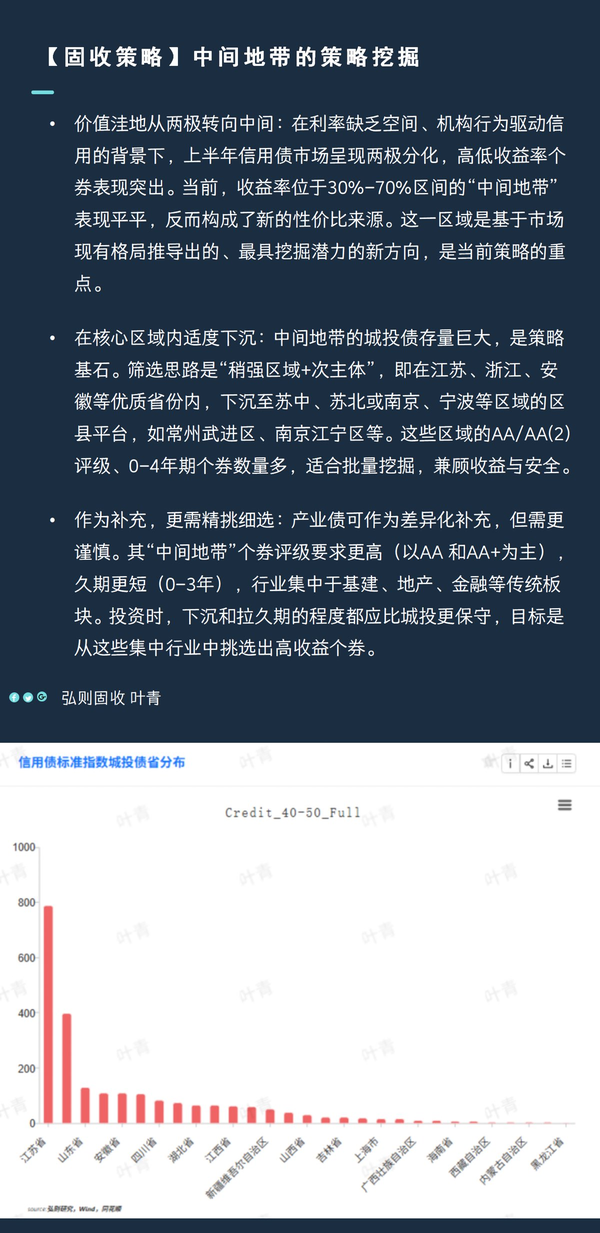
弘则固收叶青:中间地带的策略挖掘
news flash· 2025-08-03 23:38
Core Insights - The credit bond market is experiencing polarization, with the value gap shifting towards the "middle ground" of 30%-70% yield range, which is now seen as a new source of value [1] - The strategy focuses on investing in AA/AA(2) rated municipal bonds in strong provinces like Jiangsu and Zhejiang, particularly in county-level platforms [1] - There is a significant amount of municipal bond inventory in the middle ground, making it a key area for investment [1] Investment Strategy - The investment approach involves selectively moving down to county-level platforms in high-quality provinces, targeting AA/AA(2) rated bonds with maturities of 0-4 years [1] - The focus is on regions such as Suzhong, Subei, and cities like Nanjing and Ningbo, where there are numerous suitable bonds available for bulk investment [1] - For supplementary investments, industry bonds should be chosen carefully, with a focus on higher-rated (AA and AA+) and shorter-duration (0-3 years) bonds concentrated in traditional sectors like infrastructure, real estate, and finance [2]

恢复征收国债等利息收入增值税
Sou Hu Cai Jing· 2025-08-03 23:14
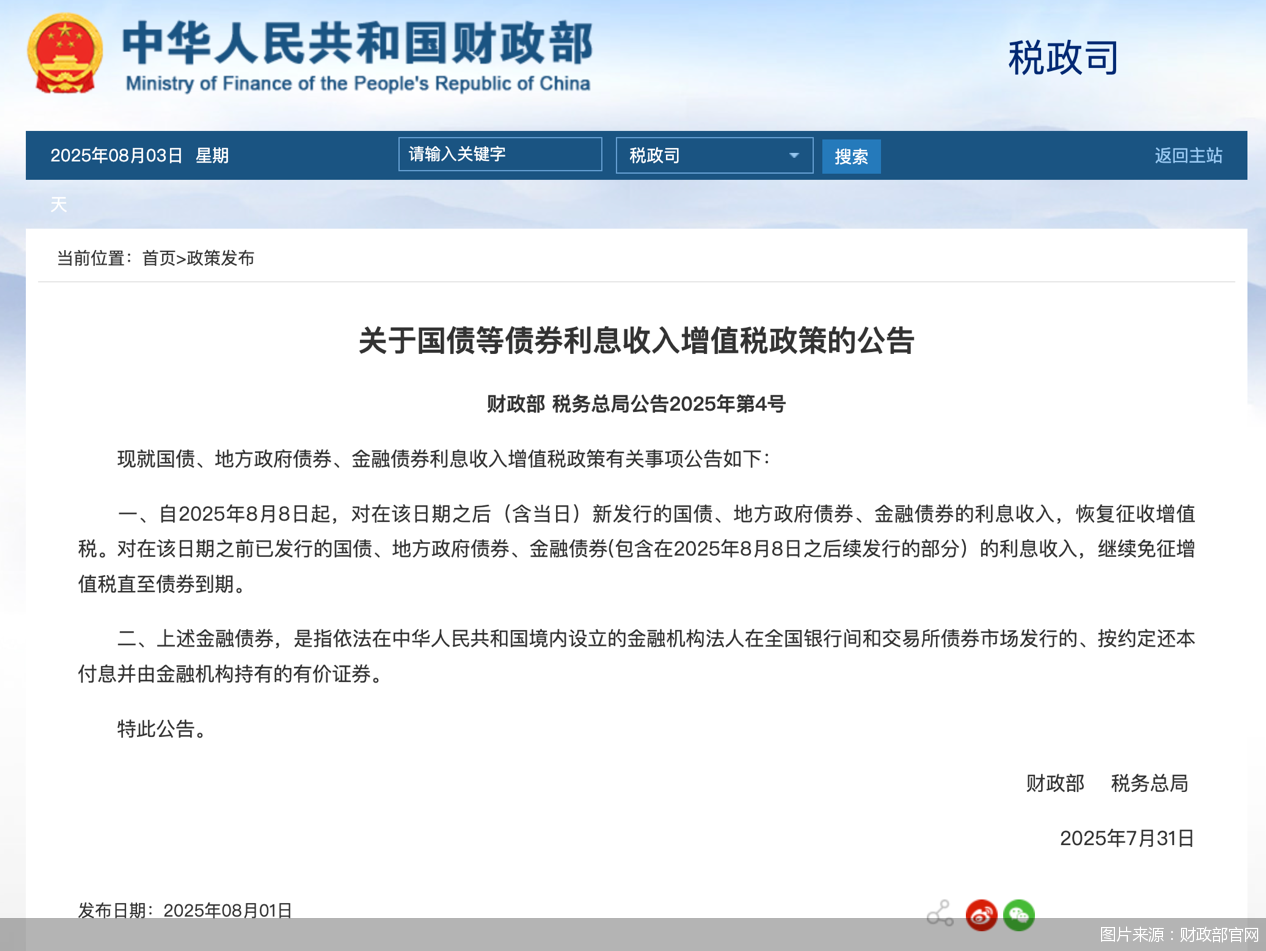
Core Viewpoint - The Ministry of Finance and the State Taxation Administration announced the resumption of value-added tax (VAT) on interest income from newly issued government bonds, local government bonds, and financial bonds starting from August 8, 2025 [1] Summary by Relevant Sections - The announcement specifies that interest income from government bonds, local government bonds, and financial bonds issued after August 8, 2025, will be subject to VAT [1] - Bonds issued before August 8, 2025, will continue to be exempt from VAT until maturity, including any portions issued after this date [1] - Financial bonds are defined as securities issued by financial institutions legally established in the People's Republic of China, which are held by these institutions and repay principal and interest as agreed [1] - Experts indicate that the policy adjustment reflects the maturity of the bond market in China, where the goal of exempting VAT on interest income has been achieved [1] - The "new and old segmentation" approach allows existing bonds to continue enjoying preferential policies until maturity, facilitating a smooth implementation of the policy adjustment and supporting the healthy development of the bond market [1]
累计发行规模突破1万亿元 熊猫债市场空间持续拓展
Zhong Guo Zheng Quan Bao· 2025-08-03 21:08
Core Insights - The Panda bond market has seen significant growth, with issuance reaching 1,166.50 billion yuan as of August 3, 2023, and cumulative issuance surpassing 1 trillion yuan [1] Group 1: Market Dynamics - The Panda bond market has experienced a surge in issuance since July, with 11 issuers collectively issuing 16 bonds worth 219.50 billion yuan [2] - The Asian Infrastructure Investment Bank issued a 20 billion yuan Panda bond with a record subscription ratio, attracting over 30 institutions [2] - Morgan Stanley also entered the market with a 20 billion yuan Panda bond, marking the first issuance by a US-based company [2] Group 2: Factors Driving Growth - The cost advantage of Panda bonds is a key factor for their increased issuance, as their interest rates are significantly lower than those of concurrent US dollar bonds, encouraging issuers to refinance [2] - The ongoing opening of China's bond market has attracted foreign issuers, with government and international organizations accounting for 50% of Panda bond issuance, a 27 percentage point increase from 2024 [2] - Systematic reforms in China's bond market, including simplified access rules and improved cross-border fund usage, have enhanced the financing efficiency for foreign issuers [2] Group 3: Demand and Internationalization - The deepening of the RMB internationalization process has boosted demand for Panda bonds, with RMB cross-border payments ranking fourth globally [3] - Issuance of Panda bonds by emerging market sovereign entities reflects a strategic choice to hedge against US dollar exchange rate risks [3] Group 4: Future Outlook - The Panda bond market is expected to continue expanding, with 2023 issuance projected to reach 1,544.50 billion yuan and a record 1,948.00 billion yuan anticipated for 2024 [4] - The registration scale for Panda bonds in the first half of 2025 reached 1,535 billion yuan, indicating a 165% year-on-year growth [4] - Recent policy measures from the National Development and Reform Commission aim to streamline the management process for foreign investment enterprises seeking to issue Panda bonds [4] Group 5: Investment Perspective - Panda bonds are viewed as a favorable "safe-haven asset" for foreign investors, with no significant default events reported and manageable overall credit risk [5] - The relative independence of China's monetary policy results in lower correlation between RMB bond yields and those of major global bonds, enhancing the appeal of Panda bonds for international investors [5]
国债等债券利息收入恢复征收增值税
Bei Jing Shang Bao· 2025-08-03 15:43
Core Viewpoint - The Ministry of Finance and the State Taxation Administration announced a policy change regarding the value-added tax (VAT) on interest income from newly issued government bonds, local government bonds, and financial bonds, effective from August 8, 2025, which will end the previous tax exemption for these interest incomes [1][2][3]. Group 1: Policy Changes - The new policy will restore VAT on interest income from newly issued government bonds, local government bonds, and financial bonds starting from August 8, 2025 [1][2]. - Historically, interest income from these bonds was exempt from taxes to attract investment and expand the bond market [2][3]. - The policy change aims to prevent excessive capital from being trapped in interest-bearing bonds and to increase fiscal revenue [3][4]. Group 2: Market Impact - Following the announcement, there was an initial increase in medium to long-term government bond yields, with the 10-year government bond yield rising from approximately 1.7040% to 1.7175% before retreating [4]. - The policy is expected to lead to a higher cost of issuing new bonds, while existing bonds may trade at a premium due to tax advantages [5]. - The removal of tax exemptions is anticipated to shift investor focus towards credit bonds or dividend assets, potentially leading to a bearish outlook for interest rate bonds [5][6]. Group 3: Investor Considerations - Individual investors will continue to be exempt from personal income tax on interest income from government bonds, despite the VAT restoration [6]. - The People's Bank of China has indicated that tax policies can influence bond market rates and investor behavior, which may lead to increased volatility in bond yields [6][7]. - The ongoing "asset shortage" scenario is expected to persist, with a downward trend in interest rates likely, although market conditions may remain volatile due to external economic influences [7].
固定收益策略报告:税负调整会打断债市修复吗?-20250803
SINOLINK SECURITIES· 2025-08-03 14:06
Group 1 - The report indicates that despite multiple events intertwining, the bond market sentiment has shown signs of recovery amidst volatility, with a focus returning to fundamentals and liquidity after a period of policy uncertainty [2][12][22] - The recent tax adjustment on interest income from newly issued government bonds is expected to lead to a one-time and structural price reassessment rather than a trend change, with potential central bank support to smooth the market response [3][11][21] - The report identifies four relatively certain impacts of the tax adjustment, including an estimated widening of the new and old bond yield spread by 6-11 basis points, benefits for certain bond types, enhanced advantages for asset management products, and increased attractiveness of credit assets for banks [3][8][9] Group 2 - The report suggests that the current recovery in bond market sentiment may have continuity, particularly as three core variables show marginal changes, including an increasing probability of a peak in social financing growth and signs of economic pressure in the second half of the year [4][15][18] - The basic economic indicators have begun to reflect a scenario of marginal pressure, with PMI data showing declines in production and demand orders, supporting the view of weakening economic momentum [15][22] - The likelihood of a significant tightening of liquidity is low, as the central bank is expected to maintain a supportive stance in light of the economic conditions, potentially leading to a continuation of a relatively loose liquidity environment [5][18][22]
修复行情能走到什么位置?
GOLDEN SUN SECURITIES· 2025-08-03 13:53
Report Industry Investment Rating No relevant content provided. Core Viewpoints of the Report - The bond market's repair period will continue. In the first stage, interest rates will return to the pre - adjustment level. Whether they can break through new lows depends on the performance of other markets and fundamental pressures. It is expected that the 10 - year and 30 - year treasury bonds may return to around 1.65% and 1.85% in the short term. If other markets have moderate growth and demand continues to slow, interest rates may hit new lows [7][22]. Summary by Relevant Catalogs Bond Market Repair Situation - This week, the bond market started a repair rally as expected, with yields across all tenors generally declining. The yields of 10 - year and 30 - year treasury bonds dropped by 2.7bps and 2.3bps to 1.71% and 1.95% respectively. The repair of credit bonds was more significant, with the yields of 3 - year and 5 - year secondary capital bonds falling by 7.8bps and 6.4bps to 1.85% and 1.95% respectively. The yield of 1 - year AAA certificates of deposit also dropped by 3.6bps to 1.64% [1][9]. - The direct trigger for the bond market repair was the cooling of supply contraction expectations and the correction in commodities and the stock market. The Politburo meeting's mild stance on over - capacity governance led to a 3.8% decline in the Nanhua Industrial Products Index this week, and the stock market also adjusted, reducing risk appetite [1][9]. Fundamental Factors Affecting the Bond Market - Fundamentally, there is an increasing downward pressure. The manufacturing PMI in July was 49.3%, down 0.4 percentage points from the previous month, with a larger seasonal decline than in previous years. The new orders index dropped 0.8 percentage points to 49.4%. The service and construction PMIs also weakened, falling 0.1 and 2.2 percentage points to 50.0% and 50.6% respectively [2][10]. - Without sufficient demand, price increases are mostly structural, and terminal prices are unlikely to rise significantly. Rising upstream prices cannot be effectively transmitted to the mid - and downstream sectors, and the cost is often passed on to the mid - and downstream industries, compressing their profits. Supply contraction also reduces investment and financing demand, not directly pushing up interest rates [2][15]. Bond Market's Own Conditions - The overall asset shortage situation persists. In terms of capital demand, there is a slowdown pressure. The bill rate has weakened significantly, with the 6 - month state - owned bill re - discount rate reaching a new low of 0.4% this week, indicating weak credit demand. Government bond supply will also decrease, with the remaining net financing of government bonds in the next five months expected to be 4.26 trillion yuan, a year - on - year decrease [3][16]. - In terms of capital supply, it remains abundant. The scales of bank deposits, insurance assets, wealth management products, and bond funds are all steadily increasing. The central bank has stated that it will maintain ample liquidity, and the current loose money situation is expected to continue [3][16]. Impact of Treasury Tax Rate Adjustment - The adjustment of the treasury tax rate is mostly a one - time impact, increasing the tax burden on financial institutions such as banks. It benefits old bonds and is negative for financial bonds and new bonds. The new - old bond yield spread may widen by 5.6 - 10.8bps, and the estimated total tax increase is 31.55 billion yuan, mainly borne by banks. Public funds may gain a 3.08% tax advantage in interest income in the short term, but future tax adjustments for public funds need further observation [4][18]. Market Volatility and Fragility - Although the overall situation is favorable for the bond market, market volatility and fragility are increasing. As coupon rates decline, the proportion of trading positions is rising, and market institutions are extending durations to increase capital gains. In the second quarter, the average durations of medium - and long - term interest - rate bond funds and medium - and long - term credit - bond funds increased significantly by 0.81 years and 0.94 years respectively, the largest single - quarter increase on record [5][19].
宏观量化经济指数周报:债券增值税或推动资金增配实体经济资产-20250803
Soochow Securities· 2025-08-03 13:34
Economic Indicators - The weekly ECI supply index is at 50.07%, down 0.03 percentage points from last week, while the demand index is at 49.92%, down 0.01 percentage points[1] - In July, the ECI supply index averaged 50.11%, down 0.05 percentage points from June, and the demand index averaged 49.92%, down 0.01 percentage points[1] - The real estate market saw a 18.6% year-on-year decline in sales area for new homes in 30 major cities, totaling 6.49 million square meters in July[1] Bond Market and Tax Adjustments - The ELI index is at -0.72%, up 0.09 percentage points from last week, indicating a slight recovery in liquidity for the real economy[1] - The adjustment of the bond value-added tax may lead to increased allocation of funds to non-financial corporate bonds and other real economy assets[1] - The People's Bank of China plans to expand the issuance of technology innovation bonds in the third quarter, focusing on structural monetary policy tools[1] Market Trends and Risks - The export index remains resilient, with port cargo throughput maintaining high levels, although there are concerns about the impact of new tariffs on re-export trade[1] - The report highlights risks including uncertainties in U.S. tariff policies and the sustainability of improvements in the real estate market[1]
国债等债券利息收入需征收增值税,影响几何?个人投资者需缴税吗?
Bei Jing Shang Bao· 2025-08-03 12:51
Core Viewpoint - The Ministry of Finance and the State Taxation Administration announced a policy change regarding the value-added tax (VAT) on interest income from newly issued government bonds, local government bonds, and financial bonds, effective from August 8, 2025, which will end the previous tax exemption for these interest incomes [1][4][5]. Group 1: Policy Changes - The new policy will restore VAT on interest income from newly issued government bonds, local government bonds, and financial bonds starting from August 8, 2025 [1][4]. - Previously, interest income from these bonds was exempt from taxes to attract investment and expand the bond market [4][5]. - The policy will adopt a "new and old distinction" approach, meaning that bonds issued before August 8, 2025, will continue to be exempt from VAT until maturity [5][6]. Group 2: Market Impact - Analysts suggest that the policy change will lead to a short-term decline in interest rates and create a pricing disparity between new and old bonds [1][6]. - The restoration of VAT is expected to increase the cost of new bond issuances, while existing bonds will retain a tax advantage, potentially leading to a preference for older bonds among investors [7][8]. - The change aims to prevent excessive capital accumulation in interest rate bonds and enhance fiscal revenue, thereby alleviating fiscal pressure [5][6]. Group 3: Investor Considerations - Individual investors will remain exempt from personal income tax on interest income from government bonds, despite the VAT restoration [8][9]. - The overall market environment remains challenging, with ongoing asset scarcity and potential disruptions to the previous bull market trend due to policy shifts and external economic influences [9].