新能源汽车等

Search documents
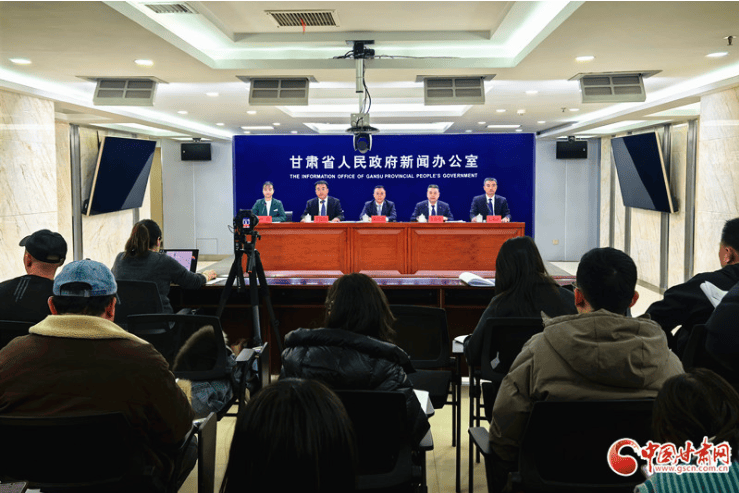
钱花哪里了?甘肃人2025年消费账单出炉
Sou Hu Cai Jing· 2026-01-20 22:22
Core Insights - The total retail sales of consumer goods in the province reached 423.76 billion yuan in 2025, representing a growth of 2.5% compared to the previous year [2] Group 1: Consumer Goods Performance - Basic living and upgraded goods showed strong growth, with retail sales of daily necessities, gold and silver jewelry, and grain and oil food increasing by 17.9%, 10.2%, and 9.7% respectively [2] - The policy promoting the replacement of old consumer goods has led to continued double-digit growth in retail sales of communication equipment, building decoration materials, home appliances, and audio-visual equipment [2] Group 2: Green and Smart Consumption - The demand for green and smart consumption is increasingly being released, with retail sales of new energy vehicles, smartphones, wearable smart devices, and high-efficiency appliances all experiencing double-digit growth [2] Group 3: E-commerce Growth - The retail sales of the wholesale and retail catering industry through public networks increased by 29.0% compared to the previous year [2]

未来的机会在这里!任泽平带你看前沿科技
泽平宏观· 2026-01-20 16:06
以下文章来源于泽平宏观商学 ,作者泽平宏观商学 泽平宏观商学 . 前沿科技企业实战研学 读万卷书行万里路 2025 年 12 月 用心打造最有品质的实战研学。读万卷书,行万里路。把教室搬到世界上最优秀的企业, 请最优秀的企业家和科学家讲课。顺势而为,把握机遇。正心正念,坚持做长期正确的 事! 我们期待与更多的企业家朋友们携手同行,共赴 2026 实战研学之旅! 泽 ZEP 平 INGM 宏 ACR 观 O RE 商 SEAR 学 CH 1-6月日程安排 · 2月27日 北京 国内头部智驾科技企业 人形机器人 年研学安 型成 11月4日-11日 洛杉矶、拉斯维加斯、旧金山 CES、英伟达、特斯拉 谷歌、罗宾汉、playground 斯坦福大学、伯克利大学 3月27日-28日 苏州 追觅科技、魔法原子、灵猴机器人 闭门投研会-2026 Al 的中国力量(一) 3月29日 上海 长三角校友会 4月20日-21日 香港 2026 香港 Web3 嘉年华 复星财富、HashKey、港交所 5月22日-23日 1151 11:47:50 深圳 华为、新凯来、江波龙、莫界科技 闭门投研会—2026 Al 的中国力量(二) ...

2025年主要发展目标任务顺利实现 来之不易成绩单彰显经济韧性活力
Ren Min Ri Bao· 2026-01-20 00:57
Economic Resilience and Growth - China's economy is expected to achieve significant progress in innovation, industrial quality improvement, digital empowerment, and green transformation by 2025, marking a successful conclusion to the "14th Five-Year Plan" [1][2] - The total value of industrial output reached 41.7 trillion yuan, with a year-on-year growth of 5.8%, contributing 35% to economic growth, an increase of 1.8 percentage points from 2024 [3] Innovation and Technology - China has become the first country to possess over 5 million valid domestic invention patents, with R&D expenditure reaching 39,262 billion yuan, maintaining the second position globally [2] - The manufacturing value added in high-tech sectors accounted for 17.1% of total industrial output, with significant growth in smart manufacturing and green energy sectors [2] Consumer Market Dynamics - The total retail sales of consumer goods exceeded 50 trillion yuan, growing by 3.7% compared to 2024, with final consumption contributing 52% to economic growth, an increase of 5 percentage points [4] - Service consumption is gaining momentum, with service retail sales growing by 5.5%, outpacing goods retail sales [4] Policy Impact - Macro policies are being implemented to support economic stability and high-quality development, including measures to boost employment and investment [7] - The policy of replacing old products with new ones has led to a 4.1% increase in retail sales of related goods, contributing to overall retail growth [7] Green Energy and Sustainability - The construction of a clean, low-carbon, and efficient energy system is accelerating, with renewable energy generation increasing by 8.8% [3] - Non-fossil energy sources accounted for a larger share of total energy consumption, rising by approximately 2 percentage points from 2024 [3] Future Outlook - The economic foundation is solid, with significant growth in economic strength and technological capabilities during the "14th Five-Year Plan" period [9] - Positive trends in economic indicators, such as the manufacturing purchasing managers' index returning to expansion territory, suggest a favorable economic outlook for 2026 [9][10]
德邦量化优选股票A:2025年第四季度利润20.84万元 净值增长率2.14%
Sou Hu Cai Jing· 2026-01-16 08:03
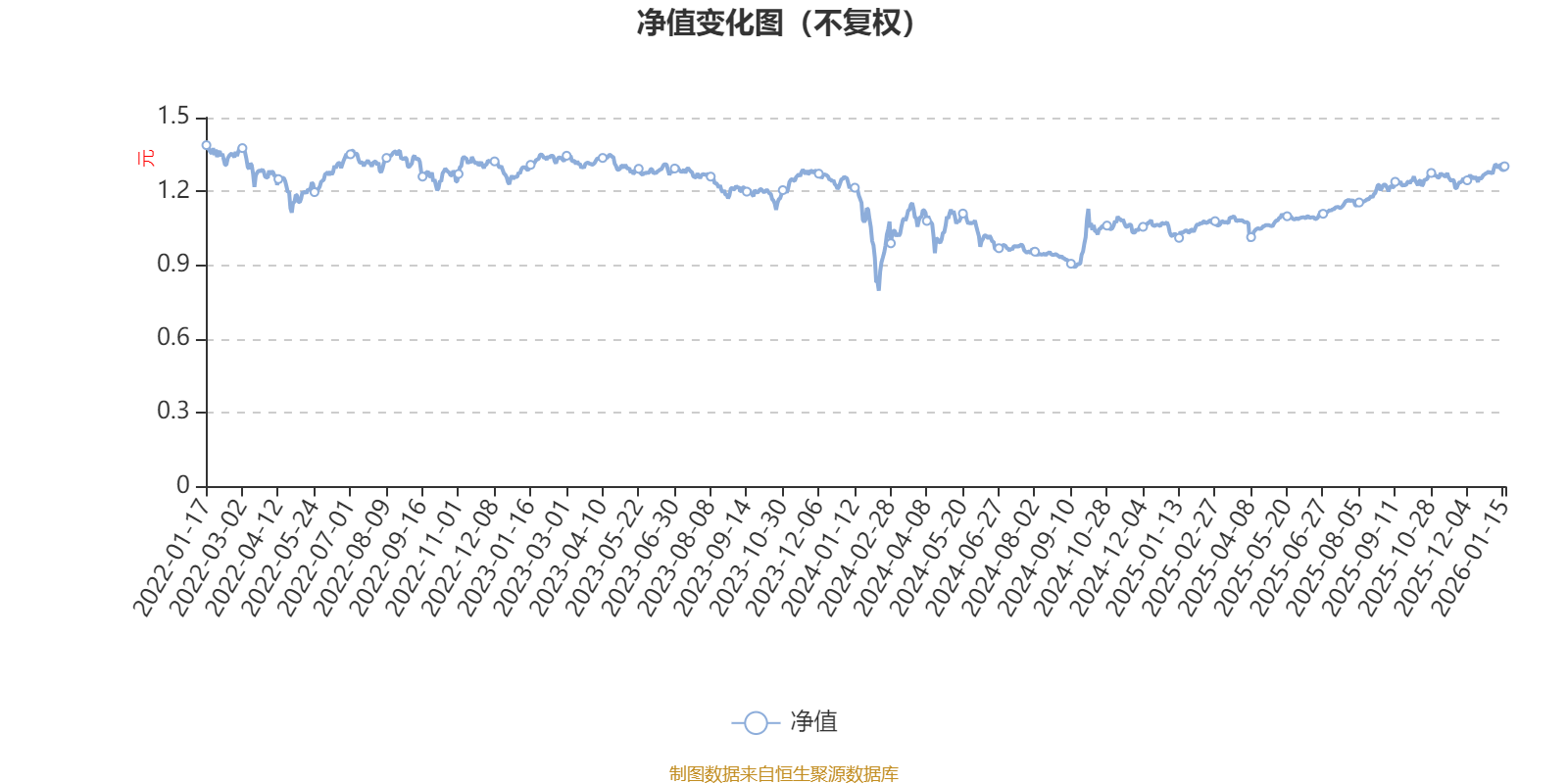
Core Viewpoint - The AI Fund Debang Quantitative Optimal Stock A (167702) reported a profit of 20.84 thousand yuan for Q4 2025, with a weighted average profit per fund share of 0.0271 yuan, and a net value growth rate of 2.14% during the reporting period [2]. Fund Performance - As of January 15, the fund's unit net value was 1.302 yuan, with a one-year cumulative growth rate of 26.43%, the highest among its peers [2]. - The fund's performance over different time frames includes a three-month growth rate of 4.89% (79/121 among comparable funds), a six-month growth rate of 14.80% (85/121), and a three-year growth rate of 0.65% (69/89) [3]. - The fund's Sharpe ratio over the past three years is 0.313, ranking 67 out of 86 comparable funds [9]. - The maximum drawdown over the past three years is 41.09%, with the largest quarterly drawdown occurring in Q1 2024 at 36.83% [11]. Investment Strategy - The fund employs a combination of AI-driven factor models and fundamental multi-factor stock selection models to identify quality investment opportunities and achieve excess returns [2]. Market Outlook - The fund manager indicates that global economic threats include trade protectionism and geopolitical conflicts, while China's economy is expected to show resilience supported by policy measures and innovation [2]. - The A-share market is anticipated to enter a profit upturn cycle due to policy support, with expectations for a slow bull market driven by resilience in the Chinese economy [2]. Fund Holdings - As of December 31, the fund's top ten holdings include Ningde Times, China Ping An, Kweichow Moutai, Zhongji Xuchuang, Zijin Mining, China Merchants Bank, Midea Group, Industrial and Commercial Bank of China, Luxshare Precision, and BYD [18]. Fund Size - The fund's total size as of Q4 2025 was 908.57 thousand yuan [15]. Stock Positioning - The average stock position over the past three years was 88.12%, slightly below the peer average of 88.3% [14]. - The fund reached its highest stock position of 93.94% at the end of Q1 2020 and its lowest of 69.22% in the first half of 2019 [14].
广货行天下,不只卖产品
Xin Lang Cai Jing· 2026-01-16 00:33
Core Viewpoint - The "Guangdong Goods Going Global" spring campaign represents a collaborative effort among the government, platforms, and enterprises to transform the industrial ecosystem, moving beyond mere product sales to showcase Guangdong's manufacturing innovation and competitiveness [1][2][3] Government Role - The event is supported by six government departments, indicating a shift from merely promoting products to acting as industrial planners, aiming to elevate Guangdong manufacturing through coordinated promotional activities [1] - The campaign will span an entire season, featuring weekly promotional events and 18 series of activities around key consumption periods, demonstrating the government's proactive role in enhancing the industrial landscape [1] Platform Support - The campaign introduces an innovative "live demonstration zone," utilizing major e-commerce platforms like Taobao, JD.com, Douyin, and Pinduoduo to showcase Guangdong products and provide targeted promotional information [2] - This model combines live presentations, immediate experiences, and online sales, creating a synergistic effect that boosts short-term sales and establishes long-term consumer recognition of Guangdong products [2] Enterprise Participation - Over 6,000 enterprises are participating, driven by the desire to expand market reach and revenue, while showcasing innovative products such as AI appliances and energy-efficient devices [2] - The transition from "Guangdong manufacturing" to "Guangdong intelligent manufacturing" is highlighted, with products gaining global recognition due to their technological advancements and superior user experiences [2] Overall Significance - The "Guangdong Goods Going Global" initiative is a comprehensive system involving collaboration among government, platforms, and enterprises, aimed at promoting Guangdong products as intelligent, green, and open to the world [3] - This initiative is positioned as a crucial pathway for Guangdong manufacturing to achieve high-quality development and establish itself as a global leader in intelligent manufacturing [3]
万亿级“国家队”投资方向,明确了
3 6 Ke· 2026-01-13 08:27
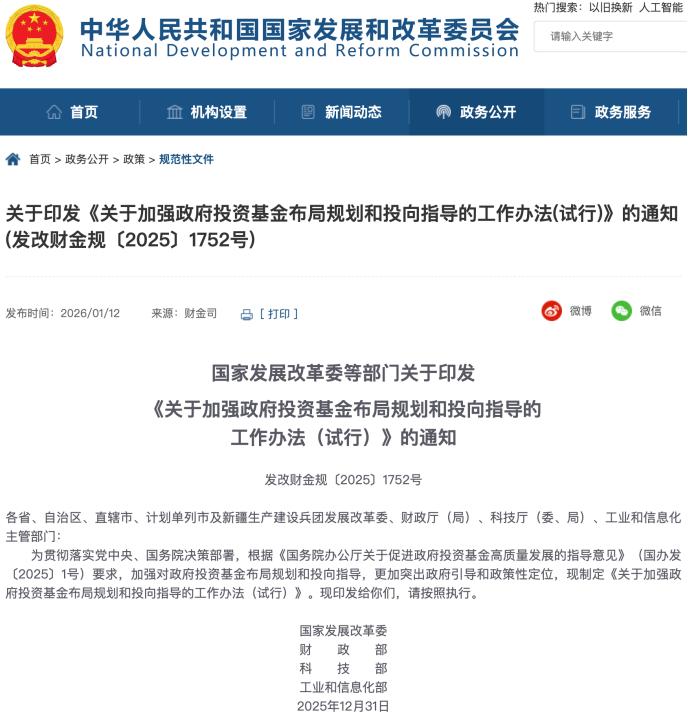
Core Viewpoint - The article discusses the newly released "Work Method" which systematically regulates the layout and investment direction of government investment funds for the first time at the national level, aiming to guide the development of trillion-level government investment funds in China [1][7]. Group 1: Policy Measures - The "Work Method" proposes 14 policy measures focusing on three aspects: where to invest, how to invest, and who manages the funds [2][3]. - It emphasizes optimizing fund allocation to support major strategies, key areas, and weak links in resource allocation, promoting deep integration of technological and industrial innovation, and nurturing emerging pillar industries [2]. Group 2: Investment Guidance - Funds must align with national major plans and encourage industries listed in the national industrial directory, avoiding investments in restricted, eliminated, or prohibited sectors [3]. - Provincial development and reform departments are tasked with creating local priority investment lists to optimize fund allocation and direction [3]. Group 3: Evaluation Indicators - The "Management Method" establishes three primary and thirteen secondary indicators for evaluating fund performance, with a focus on policy compliance (60% weight), optimization of productivity layout (30% weight), and policy execution capability (10% weight) [4][6]. - The evaluation will consider whether fund investments support the development of new productive forces, including emerging and future industries such as AI, quantum information, and advanced manufacturing [4][5]. Group 4: Regional Strategy Alignment - The evaluation also assesses the alignment of fund investments with national regional strategies, including support for various regional development initiatives like the Western Development and Northeast Revitalization [6]. - Funds that meet these regional strategy requirements will receive higher evaluation scores [6]. Group 5: Differentiated Development - The National Development and Reform Commission highlights the need for differentiated development of government investment funds, addressing issues like mismatched local resources and homogeneous investment directions [7][8]. - National funds are to focus on supporting the construction of a modern industrial system and overcoming key technological challenges, while local funds should align with local industry foundations and development realities [8].
任泽平:重启中国经济复苏,关键在于“债务大挪移”
Sou Hu Cai Jing· 2026-01-13 00:02
Group 1 - The core viewpoint emphasizes the need for a "debt transfer" strategy to revitalize the economy, drawing lessons from Japan's prolonged stagnation and the successful responses of the U.S. during the 2008 financial crisis and the COVID-19 pandemic [1][2][4] - Japan's experience post-1990 highlights the consequences of a real estate bubble burst leading to prolonged deflation, balance sheet recession, and a low-desire society characterized by reduced consumption and investment [1][4] - The U.S. managed to recover from its debt pressures through government and central bank interventions, which restored consumer and business confidence, leading to robust economic activity [2][4] Group 2 - The proposed macroeconomic policies for China include three main strategies: aggressive economic stimulation, establishment of a housing reserve bank, and investment in new infrastructure [3][4] - The housing reserve bank aims to alleviate financial pressures on developers and local governments by acquiring land and housing inventory, thereby addressing issues related to unfinished projects and housing security for new citizens [3][4] - New infrastructure initiatives are intended to support long-term economic growth by investing in advanced technologies and industries, which will stabilize growth and employment in the short term while fostering new economic engines for the future [3][4]
首批24家省级制造业中试平台名单发布
Xin Hua Ri Bao· 2026-01-10 21:14
Core Viewpoint - The establishment of 24 provincial-level manufacturing pilot platforms marks a significant advancement in the systematic construction of pilot platforms in the province, covering key industries such as semiconductors, biomedicine, new materials, high-end equipment, and new energy vehicles [1] Group 1: Manufacturing Pilot Platforms - The manufacturing pilot platforms focus on the provincial "1650" industrial system, providing services and solutions for new products in the trial production stage, acting as a crucial link between laboratory innovations and industrialization [1] - Starting in 2024, the Ministry of Industry and Information Technology and Jiangsu Province will initiate the cultivation and application process for manufacturing pilot platforms [1] - A guideline for the construction of manufacturing pilot platforms has been established, with over 400 platforms currently in cultivation, and 21 of them receiving key support from the Ministry of Industry and Information Technology [1] Group 2: Distribution of Platforms - The first batch of provincial-level manufacturing pilot platforms includes 6 cities, with Suzhou having the highest number at 8, followed by Changzhou with 5, Wuxi with 4, Nanjing with 3, Zhenjiang with 3, and Huai'an with 1 [1] - During the official operation of the provincial manufacturing pilot platforms, any significant changes such as name changes or structural adjustments must be reported to the local municipal industry and information bureau [1]
上海重磅发布!事关商业航天等热门赛道!
Zheng Quan Shi Bao Wang· 2026-01-10 10:55
Core Viewpoint - The Shanghai Municipal Government has released a three-year action plan (2026-2028) to support the transformation and upgrading of advanced manufacturing, focusing on structural optimization, innovation, quality improvement, and resource support, with specific measures to boost emerging industries like commercial aerospace and humanoid robotics [1][2]. Group 1: Action Plan Overview - The action plan aims to add 100 manufacturing enterprises with an annual output value exceeding 1 billion yuan by 2028, totaling over 600, and to drive the addition of 500 large-scale industrial enterprises in the supply chain [2]. - It emphasizes the development of new-generation electronic information, smart connected vehicles, high-end equipment, advanced materials, and green low-carbon industries [2][3]. Group 2: Innovation and Technology Focus - The plan encourages enterprises to increase investment in basic research, with financial subsidies for those achieving certain research expenditure thresholds [4]. - It supports the development of core technologies in fields such as laser manufacturing, quantum technology, and new energy [4]. Group 3: Quality and Efficiency Enhancement - The action plan includes initiatives for "AI + manufacturing" to enhance digital intelligence levels in manufacturing processes, aiming for full coverage of smart factory applications by 2028 [5]. - It promotes the creation of green factories, targeting the establishment of over 100 national-level green factories by 2028 [5]. Group 4: Financial Support Measures - The plan outlines financial support for key industries, including lower interest rates and longer loan terms for manufacturing loans, along with interest subsidies for key components and raw materials [6].
利好来了!上海,重磅发布!事关商业航天、机器人……
证券时报· 2026-01-10 08:15
Core Viewpoint - The Shanghai Municipal Government has released a three-year action plan (2026-2028) to support the transformation and upgrading of advanced manufacturing, focusing on structural optimization, innovation, quality improvement, and resource support [1][3]. Group 1: Action Plan Overview - The action plan aims to add 100 manufacturing enterprises with an annual output value exceeding 1 billion yuan by 2028, totaling over 600, and to drive the addition of 500 large-scale industrial enterprises in the supply chain [3]. - It emphasizes the development of new-generation electronic information, smart connected vehicles, high-end equipment, advanced materials, green low-carbon products, and fashion consumer goods [3][4]. Group 2: Investment in Emerging Fields - The plan encourages investment in emerging sectors such as low-altitude economy, commercial aerospace, embodied intelligence, biomanufacturing, and smart terminals, aiming to accelerate the development of innovative products like eVTOLs, commercial rockets, and humanoid robots [1][4]. Group 3: Innovation and Research Support - The action plan proposes financial incentives for companies increasing their basic research investments, with one-time subsidies ranging from 200,000 to 1 million yuan based on the level of investment [6]. - It focuses on core technology breakthroughs in areas like laser manufacturing, quantum technology, and new functional materials, supporting key industries such as integrated circuits and high-end equipment [6]. Group 4: Quality and Efficiency Enhancement - The plan includes an "AI + manufacturing" initiative to enhance digitalization in manufacturing, aiming for full coverage of smart factory applications by 2028 and increasing robot density to 600 units per 10,000 people [7]. - It promotes green transformation by encouraging the development of low-carbon products and supporting energy-saving upgrades with financial rewards [7]. Group 5: Financial Support Mechanisms - The action plan outlines financial support for key industrial chains, including lower interest rates and higher loan limits for manufacturing loans, with interest subsidies ranging from 0.8% to 1.3% [8]. - It also encourages the issuance of technology innovation bonds and customized insurance services for major technological equipment [8].