日常消费

Search documents
港股通标的即将调整!多只新经济与科技股有望被纳入
券商中国· 2026-01-08 03:33
Core Viewpoint - The Hang Seng Index Company announced that the results of the fourth quarter review of the Hang Seng Index series will be announced on February 13, 2025, with changes to the constituent stocks effective from March 9, 2025 [1]. Group 1: Stock Adjustments - Multiple institutions and big data platforms predict that over 40 stocks will be included in the Hong Kong Stock Connect, while more than 20 stocks may be removed due to insufficient market capitalization [2][5]. - The market capitalization threshold for stocks to enter the Hang Seng Composite Index and Hong Kong Stock Connect is approximately HKD 93.07 billion, while the threshold for removal is HKD 61.15 billion [6]. - A total of 43 companies meet the inclusion criteria for Hong Kong Stock Connect, with leading stocks including JD Industrial, Innovation Industry, and Dipo Technology [7]. Group 2: Industry Focus - The potential inclusion list highlights a strong focus on new economy and technology stocks, with significant representation from the information technology and healthcare sectors [10]. - The information technology sector leads with 15 potential inclusions, followed closely by healthcare with 14, while traditional financial sectors see only 4 new potential stocks [10]. Group 3: Market Dynamics - The dynamic adjustment mechanism of Hong Kong Stock Connect enhances liquidity premiums for related industries and improves the overall representativeness and attractiveness of the Hong Kong market [12]. - Continuous expansion and precise adjustments of Hong Kong Stock Connect deepen the interconnection between mainland and Hong Kong capital markets, reinforcing Hong Kong's position as an international financial hub [12]. - The market is expected to experience fluctuations and structural differentiation by 2026, driven by factors such as global liquidity easing and sustained inflow of southbound funds [12].


中国银河证券:料港股交投活跃度有望续升 关注科技及消费板块
智通财经网· 2026-01-05 06:53
Core Viewpoint - The Hong Kong stock market is expected to remain active and experience an upward trend due to multiple positive factors, with a focus on the technology and consumer sectors for medium to long-term investment opportunities [1] Group 1: Market Performance - The Hong Kong stock market rose by 2.01% last week, with the Hang Seng Technology Index increasing by 4.31% [2] - Among the primary sectors, 7 sectors saw gains while 4 sectors declined, with notable increases in Information Technology (4.54%), Energy (3.97%), and Materials (2.98%) [2] - In the secondary sectors, Semiconductor, Defense, Oil & Petrochemicals, Software Services, and Paper & Packaging led the gains, while Household Products, Durable Goods, Consumer Services, Daily Consumer Retail, and Textiles & Apparel faced declines [2] Group 2: Market Liquidity - The average daily trading volume on the Hong Kong Stock Exchange was HKD 171.19 billion, an increase of HKD 31.26 billion from the previous week [3] - The average daily short-selling amount was HKD 19.93 billion, up by HKD 2.96 billion from the previous week, with short-selling accounting for 11.78% of the trading volume, a decrease of 0.22 percentage points [3] - There was a net outflow of HKD 3.81 billion from southbound funds, a decrease of HKD 6.37 billion compared to the previous week [3] Group 3: Valuation and Risk Appetite - As of January 2, 2026, the Hang Seng Index had a price-to-earnings ratio of 12.09 and a price-to-book ratio of 1.23, both up by 2.36% from the previous week, positioned at the 79% and 56% percentiles since 2010 [4] - The Hang Seng Technology Index had a price-to-earnings ratio of 23.8 and a price-to-book ratio of 3.15, at the 36% and 66% percentiles since 2010 [4] - The risk premium for the Hang Seng Index was 4.08%, which is 1.82 standard deviations below the 3-year rolling mean, placing it at the 4% percentile since 2010 [4]

基金研究周报:白银再创新高,债基企稳(12.15-12.19)
Wind万得· 2025-12-20 22:19
Market Overview - The A-share market exhibited a structurally differentiated pattern last week, with the Shanghai Composite Index slightly up by 0.03%. However, growth sectors faced significant pullbacks, with the ChiNext Index, STAR Market 50, and ChiNext 50 down by 2.26%, 2.99%, and 2.66% respectively, indicating pressure on high-growth tracks [2][10] - The market style continued to shift towards value, as evidenced by the CSI Dividend Index rising by 1.04%, while broad indices like CSI 300 and CSI 1000 also experienced slight declines [2] - The Wande Micro-Pan Index surged by 2.99%, reflecting a temporary preference for small-cap stocks [2] Industry Performance - The A-share market's primary sectors showed a split performance, with Consumer and Financial sectors leading gains, while Technology and Industrial sectors faced declines. Daily Consumer stocks rose by 2.26% and Financials by 2.06%, benefiting from policy expectations and high dividend attractiveness. Conversely, Information Technology fell by 2.08% and Industrial by 1.22%, impacted by valuation adjustments and overseas tech stock correlations [2][10] Fund Issuance - A total of 34 funds were issued last week, including 14 equity funds, 11 mixed funds, 6 bond funds, and 3 FOFs, with a total issuance volume of 18.321 billion units [15] Fund Performance - The Wande All-Fund Index decreased by 0.25% last week. The Wande Ordinary Equity Fund Index and the Wande Equity Mixed Fund Index both fell by 0.61%, while the Wande Bond Fund Index saw a slight increase of 0.09% [2]

港股市场估值周报:2025.12.08-2025.12.14-20251216
Zhe Shang Guo Ji Jin Rong Kong Gu· 2025-12-16 05:59
Valuation of Hong Kong Stock Market - The Hang Seng Composite Index (HSCI) and Hang Seng Index (HSI) are key indicators of market valuation[8][12] - The Hang Seng Technology Index (HSTECH) reflects the valuation trends in the tech sector[16][18] Industry Valuation Levels - The PE (TTM) valuation shows that the utilities sector is undervalued, with a percentile below 20%[23] - Consumer discretionary, consumer staples, healthcare, information technology, and utilities are below the 50th percentile in PE valuation[23] - High valuation sectors (above 50%) include energy, materials, industrials, financials, and telecommunications[23] - No sectors are currently undervalued based on PB (LF) valuation, with consumer staples, information technology, utilities, and real estate below the 50th percentile[27] - Energy, materials, industrials, consumer discretionary, healthcare, financials, and telecommunications are above the 50th percentile in PB valuation[27] AH Share Premium/Discount Levels - The Hang Seng AH Share Premium Index shows fluctuations in premium levels over time, with historical averages and standard deviations noted[33]
港股市场回购统计周报2025.11.17-2025.11.23-20251125
Zhe Shang Guo Ji Jin Rong Kong Gu· 2025-11-25 06:01
Group 1: Market Overview - The total number of companies repurchasing shares this week is 73, an increase of 17 from the previous week[10] - The total repurchase amount for the week is HKD 4.87 billion, up from HKD 3.96 billion last week[10] - Tencent Holdings (0700.HK) leads with a repurchase of HKD 2.54 billion, followed by Xiaomi Group (1810.HK) with HKD 811 million[10] Group 2: Industry Insights - The majority of repurchase amounts are concentrated in the Information Technology, Industrial, Consumer Discretionary, Consumer Staples, and Energy sectors[13] - The Information Technology sector has the highest number of repurchasing companies, with 21 firms participating[13] - The Healthcare sector ranks second with 18 companies engaging in share buybacks[13] Group 3: Individual Company Data - China Feihe (6186.HK) repurchased shares worth HKD 185 million, accounting for 0.48% of its total share capital[14] - Yum China (9987.HK) repurchased shares worth HKD 233 million, representing 0.17% of its total share capital[14] - Kuaishou Technology (1024.HK) repurchased shares worth HKD 105.98 million, which is 0.04% of its total share capital[14]
A股策略周报20251116:投资与消费,电力与算力-20251116
SINOLINK SECURITIES· 2025-11-16 11:42
Group 1: Overseas Fundamental Contradictions: Investment vs. Consumption, Power vs. Computing Power - Current concerns in overseas markets focus on two main aspects: doubts about the value of AI investments and the disparity between AI-related investments and actual returns [3][4][22] - The recent divergence between U.S. consumer stocks and the S&P 500 reflects market fears of an economic recession, indicating a K-shaped recovery where low-end consumption is weakening [4][24] - The AI industry is driving investment resilience in the U.S., with AI-related investments contributing approximately 1.4 percentage points to GDP growth, surpassing the contribution from private consumption [4][24][29] Group 2: Domestic Demand: A Stabilizing Factor in the Portfolio - Domestic economic data shows weak total consumption, but structural improvements are emerging, particularly in "non-subsidized" sectors, which are showing marginal improvements [5][42] - Two potential scenarios for future domestic demand: one where exporters convert foreign exchange earnings into RMB assets, supporting domestic consumption; the other where financial capital returns in response to global economic risks, enhancing domestic demand resilience [5][47][48] - Key sectors benefiting from domestic demand recovery include food and beverage, textiles, and jewelry, which are showing signs of improvement [5][45][46] Group 3: Style Rebalancing in the Context of U.S.-China Mirror Period - The U.S. economy is transitioning to a "strong investment, weak consumption" model, similar to China's experience from 2022 to 2024, highlighting the importance of power-related assets as a key investment theme [6][56] - Recommendations include focusing on undervalued cyclical assets in the consumer sector, particularly textiles and apparel, which are experiencing improved demand dynamics [6][58] - The ongoing recovery in domestic consumption and the potential return of capital flows are expected to provide continued investment value in domestic assets [6][59]
基金研究周报:偏弱整理,微盘与红利板块显韧性(11.10-11.14)
Wind万得· 2025-11-15 22:23
Market Overview - The A-share market experienced a downward trend from November 10 to November 14, with the Shanghai Composite Index closing at 3990.49 points, a slight decline of 0.18% for the week [2] - Growth sectors faced significant pullbacks, with the ChiNext and STAR Market indices dropping over 5%, indicating pressure on high-valuation sectors [2] - Structural differentiation continued, with the CSI Dividend Index rising 0.25%, showcasing the resilience of value styles, while the Wind Micro-Cap Index surged 4.11%, becoming one of the few market highlights [2] Industry Performance - The average performance of Wind's primary industry indices increased by 0.48%, with over half of the sectors achieving positive returns [9] - The healthcare sector rose by 3.27%, consumer staples by 2.72%, and real estate by 2.62%, marking the strongest performances [9] - Conversely, the information technology sector fell by 4.27%, industrials by 1.28%, and telecommunications services by 1.09%, indicating significant pressure on technology and manufacturing sectors [9] Fund Issuance - A total of 24 funds were issued last week, including 14 equity funds, 4 mixed funds, 2 bond funds, and 4 fund of funds (FOFs), with a total issuance of 14.173 billion units [13] Fund Performance - The Wind All-Fund Index decreased by 0.37% last week, with the ordinary equity fund index down by 0.40% and the mixed equity fund index down by 0.71% [3] - The bond fund index saw a slight increase of 0.06%, indicating a mixed performance across different fund types [3] Global Market Context - Global equity markets showed a mixed performance, with the US market stable and the Dow Jones rising by 0.34%, while European markets performed strongly, with France's CAC40 up by 2.77% and Germany's DAX up by 1.30% [4] - In the commodity market, natural gas rose by 4.47%, silver by 4.69%, and gold by 1.86%, while coking coal plummeted by 6.77% [4] - The US dollar index weakened amid strong expectations for a Federal Reserve rate cut in December, which diminished the dollar's attractiveness [4]

中金 | 11月行业配置:风格更均衡
中金点睛· 2025-11-04 00:07
Core Viewpoint - The A-share market is experiencing a phase of oscillation and upward trend, with a shift towards dividend stocks and sectors with strong price increase certainty, such as non-ferrous metals, supported by recent US-China trade negotiations [2] Industry Performance Summary 1) Energy and Basic Materials - The Federal Reserve's interest rate cut has led to a continued rise in gold and industrial metal prices, with coal prices rebounding due to increased demand for the heating season and production cuts. In October, prices for thermal coal, coking coal, coking, and iron ore rose by 10%, 14%, 10%, and 3% respectively [3][10] - Coal production has seen a year-on-year decline of 3.2% in September, maintaining negative growth for three consecutive months, while coal inventory remains historically high at 710 million tons [10] 2) Industrial Products - The energy transition is supporting demand for electrical equipment, with steady growth in the photovoltaic industry. In September, excavator domestic sales grew by 22% year-on-year, and new energy vehicle sales increased by 25% [4] - The price increase pace in the photovoltaic supply chain has slowed, with polysilicon and solar cell prices decreasing by 0.6% and 3% month-on-month [4] 3) Consumer Goods - Domestic demand for home appliances continues to slow, with September sales for washing machines, refrigerators, and air conditioners down by 16%, 26%, and 21% year-on-year respectively. The liquor industry is in a supply clearing phase, with the wholesale price of Feitian Moutai down by 6% year-on-year [5] - The food sector shows mixed performance, with prices for pork, chicken, and eggs declining, while vegetable prices have risen [5] 4) Technology - The AI industry chain is experiencing high prosperity, with strong overseas demand for AI computing driving sales of Chinese communication equipment. The net profit growth rates for software and services, computer equipment, communication equipment, and semiconductors reached 161%, 45%, 25%, and 33% respectively [6] - The gaming sector remains robust, with 166 game licenses issued in October, maintaining a high level [6] 5) Financials - The banking sector's high dividend attributes are attracting medium to long-term capital allocation, with insurance premiums growing by 9% year-on-year in September. The average daily trading volume of A-shares has slightly decreased to 2.2 trillion yuan [6] - The stock market sentiment remains high, with a significant increase in margin trading balances reaching a historical high of approximately 2.5 trillion yuan [6] 6) Real Estate - The real estate market is still in a bottoming phase, with October sales area in 30 major cities down by 27% year-on-year. The price index for new and second-hand residential properties has decreased by 2.7% and 5.2% respectively [7] - The industry is under pressure, with a focus on policy support and demand improvement [7] Investment Recommendations - Focus on sectors such as AI computing, communication equipment, semiconductors, and innovative pharmaceuticals, which are expected to remain attractive until a significant change in industry prosperity occurs [7] - Non-ferrous metals are likely to benefit from the global monetary order reconstruction, while export growth remains strong, enhancing profit margins for companies in engineering machinery, electrical equipment, and white goods [7]

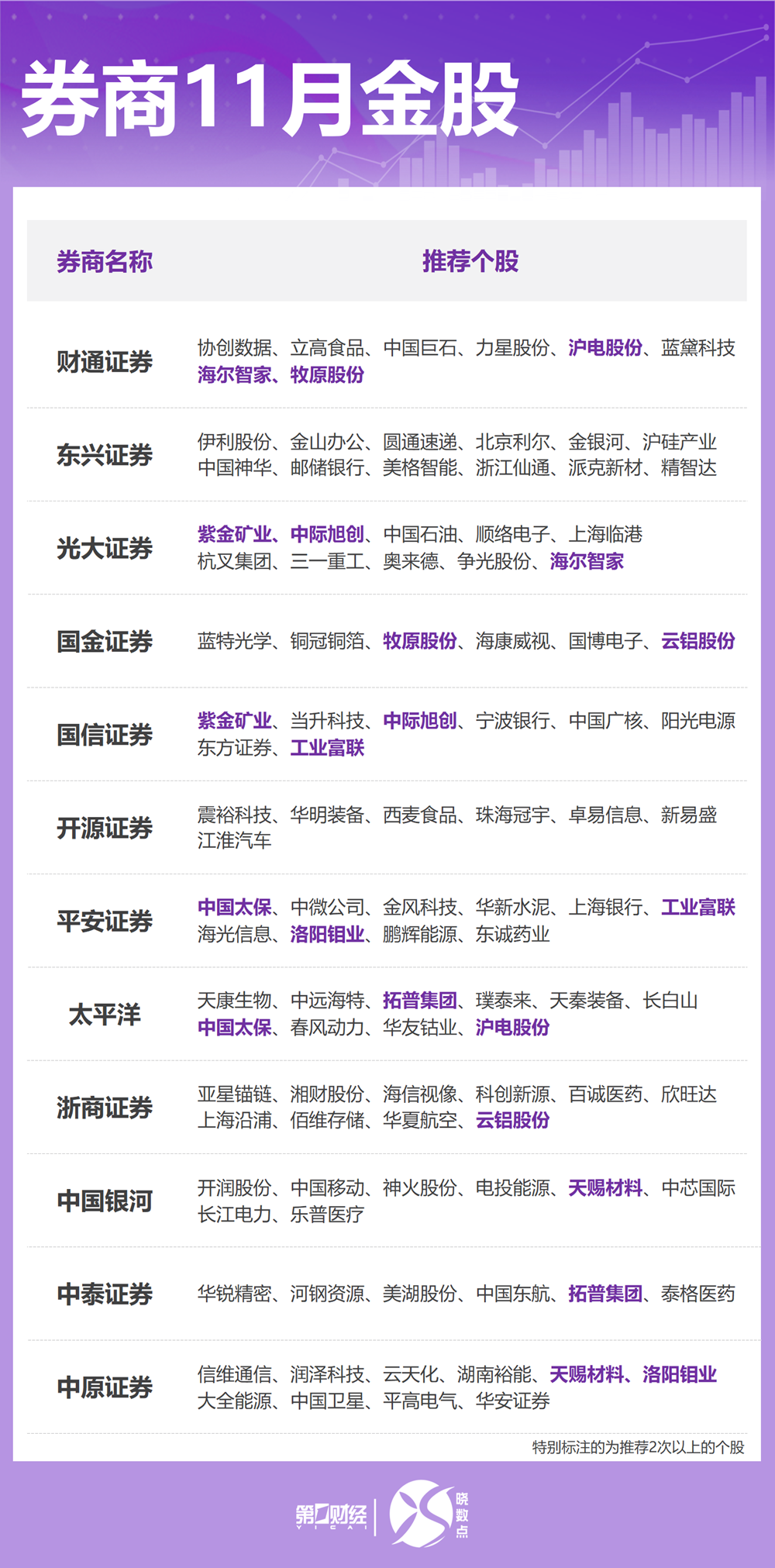
晓数点丨券商11月金股出炉:这些股获力挺,看好有色、医药等方向
Di Yi Cai Jing· 2025-11-02 03:23
Core Viewpoint - The A-share market in October showed a mixed performance, with the Shanghai Composite Index rising by 1.85%, while the Shenzhen Component Index and the ChiNext Index fell by 1.1% and 1.56% respectively. Brokerages suggest a balanced allocation strategy to navigate short-term volatility [1] Group 1: Stock Recommendations - Multiple brokerages have released their investment portfolios for November, covering sectors such as materials, information technology, and consumer goods [1] - Notable stocks recommended by various brokerages include Huadian Technology, Industrial Fulian, Yun Aluminum, and others, with some stocks receiving multiple recommendations [2][4] - Among the stocks, Zhongji Xuchuang had the highest increase in October, rising over 17%, while Top Group experienced the largest decline, dropping over 8.9% [4] Group 2: Industry Preferences - Brokerages recommend focusing on sectors such as non-ferrous metals, brokerage firms, and pharmaceuticals, anticipating increased market volatility [6] - Suggestions include prioritizing low-volatility assets and considering investments in sectors like coal, telecommunications, and electricity, which are seen as having dividend attributes [6] - East China Securities highlights three main investment lines: technology, strategic emerging industries, and opportunities arising from increased investment expectations in the fourth quarter [7]
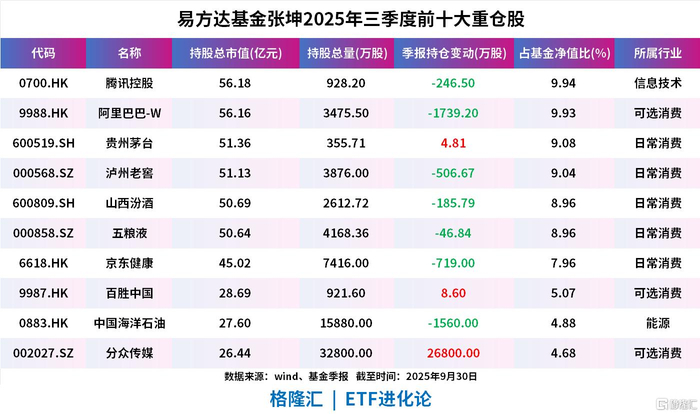
张坤三季度调仓动态出炉!或被动减持腾讯、阿里巴巴,顺丰跌出前十大重仓股名单,大手笔加仓分众传媒
Ge Long Hui A P P· 2025-10-28 08:23
Core Viewpoint - Zhang Kun, a prominent fund manager at E Fund, has disclosed the top ten holdings of four funds as of Q3 2025, indicating a strategic shift in investment focus towards consumer and technology sectors, while also reflecting on the long-term growth potential of China's consumption market [1][9]. Fund Holdings Summary - The combined top ten holdings of Zhang Kun's four funds include Tencent Holdings, Alibaba-W, Kweichow Moutai, Luzhou Laojiao, Shanxi Fenjiu, Wuliangye, JD Health, Yum China, CNOOC, and Focus Media [1]. - The total market value of the top holdings is as follows: - Tencent Holdings: 56.18 billion - Alibaba-W: 56.16 billion - Kweichow Moutai: 51.36 billion - Luzhou Laojiao: 51.13 billion - Shanxi Fenjiu: 50.69 billion - Wuliangye: 50.64 billion - JD Health: 45.02 billion - Yum China: 28.69 billion - CNOOC: 27.60 billion - Focus Media: 26.44 billion [2]. Changes in Holdings - Compared to Q2 2025, the only change in the top ten holdings was the exit of SF Express, replaced by Focus Media [2]. - In Q3, Zhang Kun reduced his holdings in Tencent and Alibaba by 2.465 million shares and 17.392 million shares, respectively, likely due to price increases of 31% and 61% during the quarter [5]. - In the liquor sector, there was an increase in Kweichow Moutai by 48,100 shares, while reductions were made in Luzhou Laojiao, Shanxi Fenjiu, and Wuliangye [6]. Sector Analysis - In the consumer sector, there were reductions in Luzhou Laojiao and Shanxi Fenjiu, but increases in Kweichow Moutai and Wuliangye, indicating a positive outlook on premium liquor [7]. - The new investments in Yum China and Focus Media reflect expectations of recovery in the restaurant and advertising sectors [7]. - In the technology sector, there were reductions in Tencent and Alibaba across all funds, while new positions were taken in Google-A and reductions in ASML and TSMC, indicating a shift towards more globally competitive tech giants [8]. Long-term Outlook - The team believes that China's consumption growth is likely to outpace GDP growth, supported by a low consumer spending ratio relative to GDP compared to other major economies [9]. - The potential for a unified market of 1.4 billion people offers significant scale advantages for product development and sales [9]. - The current low valuation levels provide a safety margin for investments in the domestic consumption market, which is expected to remain fertile ground for long-term investment [9].