消费品制造业

Search documents
数据点评 | 1月PMI:春节效应前置(申万宏观·赵伟团队)
申万宏源宏观· 2026-01-31 14:49
Core Viewpoint - The significant decline in January PMI is primarily attributed to the early return of workers for the 2026 Spring Festival and weak domestic demand, with manufacturing PMI dropping to 49.3% from 50.1% and non-manufacturing PMI falling to 49.4% from 50.2% [2][7][61] Group 1: Manufacturing PMI Analysis - The manufacturing PMI fell below the neutral line, decreasing by 0.8 percentage points to 49.3%, influenced by statistical factors and the early return of workers [2][8][61] - The manufacturing production index declined by 1.1 percentage points to 50.6%, while the new orders index decreased by 1.6 percentage points to 49.2% [5][41][64] - The purchasing index for manufacturing dropped significantly by 2.4 percentage points to 48.7%, indicating a notable contraction in supply [3][15][62] Group 2: Sector-Specific Insights - Labor-intensive sectors such as consumer goods and high-energy industries experienced a more pronounced decline in PMI, with consumer goods PMI falling by 2.1 percentage points to 48.3% and high-energy PMI down by 1 percentage point to 47.9% [3][22][62] - In contrast, capital-intensive sectors like high-tech and equipment manufacturing saw smaller declines, with PMIs of 52% and 50.1%, respectively [3][22][62] Group 3: Non-Manufacturing PMI Insights - The non-manufacturing sector showed asymmetric effects from the early return of workers, with the construction PMI dropping to 48.8%, a decline of 4 percentage points, while the service sector PMI only slightly decreased by 0.2 percentage points to 49.5% [4][25][62] - The construction sector's decline is more significant than the average historical drop of 1.4 percentage points for January since 2017 [4][25][62] Group 4: Economic Outlook - The early Spring Festival may disrupt PMI readings for January and February, but the overall economic recovery trend is expected to continue, supported by travel and consumption during the holiday [4][34][63] - Recent policies aimed at boosting service consumption are anticipated to support the service sector's recovery, with a focus on changes in consumer demand [4][34][63]

固定收益点评报告:2025年工业企业利润:中游利润占比持续提升
Huaxin Securities· 2026-01-28 14:50
Group 1: Report Industry Investment Rating - Not provided in the content Group 2: Core Viewpoints of the Report - In 2025, the year - on - year growth rate of the cumulative revenue of national industrial enterprises above designated size was 1.1% (2.1% in 2024), and the year - on - year growth rate of the total annual profit was 0.6% (-3.3% in 2024). Price improvement was the dominant factor, while the growth rate of industrial added value and operating profit margin remained basically stable. In December 2025, the profit growth rate turned positive, rising from -13% to 5.3%, driven by both volume and price increases [2]. - The stabilization of prices was the core of the annual profit growth. The growth rate of industrial added value of enterprises above designated size remained basically stable compared with 2024, and the policy of "anti - involution" led to an upward trend in PPIRM and PPI year - on - year growth rates since the second half of 2025, with CPI returning to the level of early 2023 by the end of the year. The operating profit margin of industrial enterprises above designated size in 2025 was 5.31% (5.39% at the end of 2024) [3]. - The proportion of mid - stream profits continued to increase, and the equipment manufacturing industry was the core engine. The profit structure of industrial enterprises was further optimized, with the profit share of upstream, mid - stream, and downstream industries being 16:48:36 in 2025 (21:44:36 in 2024). The equipment manufacturing industry's profit increased by 7.7% in 2025, driving the growth of all industrial enterprises' profits by 2.8 percentage points [4]. - The willingness of enterprises to expand their operations was weak. The year - on - year growth rate of finished product inventory of industrial enterprises above designated size in 2025 was 3.9%, 0.6 percentage points higher than in 2024. At the end of December, the asset - liability ratio of industrial enterprises was 57.6%, a slight increase of 0.1 percentage points year - on - year, and the liability growth rate was 4.2%, a decrease of 0.6 percentage points year - on - year. Inventory turned to passive destocking at the end of the year [7]. - Overall, the continuous recovery of industrial enterprises' profits in 2025 was the result of the effectiveness of "anti - involution" and industry policies, price stabilization, and industrial upgrading. High - tech manufacturing provided the core growth impetus. The market's core driver may gradually shift from "risk preference repair" and "policy expectation" to "profit verification" and "industry trend" [8]. Group 3: Summary by Related Catalogs Price Stabilization as the Core of Annual Profit Growth - Volume: The year - on - year growth rate of industrial added value of enterprises above designated size was 5.9% in 2025, basically the same as in 2024, indicating stable expansion of industrial production [3]. - Price: The policy of "anti - involution" led to an upward trend in PPIRM and PPI year - on - year growth rates since the second half of 2025, and CPI had recovered to the level of early 2023 by the end of the year [3]. - Profit Margin: The operating profit margin of industrial enterprises above designated size in 2025 was 5.31%, compared with 5.39% at the end of 2024 [3]. Mid - stream Profit Proportion Continued to Increase, with Equipment Manufacturing as the Core Engine - Industry Profit Structure: The profit share of upstream, mid - stream, and downstream industries was 16:48:36 in 2025 (21:44:36 in 2024), showing an optimization of the profit structure of industrial enterprises [4]. - Equipment Manufacturing Industry: In 2025, the profit of the equipment manufacturing industry increased by 7.7% compared with the previous year, driving the growth of all industrial enterprises' profits by 2.8 percentage points. Seven out of the eight major industries in the equipment manufacturing industry saw profit growth, with double - digit growth in the railway, ship, aerospace, and electronics industries [4]. - Upstream Raw Material Industry: Supported by the "anti - involution" policy and the recovery of some commodity prices, the profit decline of industries such as coal mining and non - ferrous metal smelting continued to narrow or the growth rate turned positive [4][6]. - Consumer Goods Manufacturing Industry: Affected by the relatively slow recovery of terminal demand, the year - on - year profit growth rates of consumer goods industries such as food manufacturing and textiles were still negative or at a low level, showing obvious structural weakness [6]. Weak Willingness of Enterprises to Expand Operations - Inventory: The year - on - year growth rate of finished product inventory of industrial enterprises above designated size in 2025 was 3.9%, 0.6 percentage points higher than in 2024. At the end of the year, inventory turned to passive destocking under the background of profit improvement and rising upstream raw material prices [7]. - Asset - Liability Ratio and Liability Growth Rate: At the end of December, the asset - liability ratio of industrial enterprises was 57.6%, a slight increase of 0.1 percentage points year - on - year, and the liability growth rate was 4.2%, a decrease of 0.6 percentage points year - on - year [7]. Asset Allocation Viewpoint - The continuous recovery of industrial enterprises' profits in 2025 was the result of the effectiveness of "anti - involution" and industry policies, price stabilization, and industrial upgrading. High - tech manufacturing provided the core growth impetus. The market's core driver may gradually shift from "risk preference repair" and "policy expectation" to "profit verification" and "industry trend" [8].
工业利润超季节性反弹
CAITONG SECURITIES· 2026-01-28 05:45
Profit Growth Insights - In December, the profit of industrial enterprises increased by 5.3% year-on-year, a significant recovery from the previous value of -13.1%[9] - The total profit in December reached 771.3 billion yuan, an increase of 94.8 billion yuan from November, marking the highest level for the same period since 2021[16] Production and Price Dynamics - The industrial added value in December grew by 5.2% year-on-year, up from 4.8% in November[12] - The Producer Price Index (PPI) showed a year-on-year decline of 1.9%, a slight improvement from the previous month's decline of 2.2%[13] Profit Margin Recovery - The profit margin for industrial enterprises turned positive in December, reaching 4.1%, compared to -11.5% in November[14] - The increase in profit margin was supported by non-operating income, contributing 0.76% to the profit margin change[20] Inventory and Production Signals - As of the end of December, the inventory of finished products for industrial enterprises increased by 3.9% year-on-year, with a slight decline in growth rate from November[39] - The manufacturing inventory index in December showed a seasonal increase, indicating potential overproduction concerns[39] Sector Performance Variations - The upstream mining sector experienced a significant decline in profit and revenue, with profit growth dropping to -11.2% and revenue growth to -1.8% in December[34] - The equipment manufacturing sector maintained strong performance, with revenue growth of 3.8% and profit growth of 17.0% in December[38]
2025年12月工业企业利润数据点评:利润结构向中游转移
Ping An Securities· 2026-01-28 01:09
宏观 2026 年 1 月 28 日 2025 年 12 月工业企业利润数据点评 利润结构向中游转移 证券分析师 事项: 2025 年,全国规模以上工业企业实现利润总额 73982.0 亿元,比上年增 长 0.6%。 平安观点: 风险提示:稳增长政策落地效果不及预期,海外经济衰退,地缘政治冲突升级等。 宏 观 点 评 证 券 研 究 报 告 宏 观 报 告 钟正生 投资咨询资格编号 S1060520090001 ZHONGZHENGSHENG93 4@pingan.com.cn 张璐 投资咨询资格编号 S1060522100001 ZHANGLU150@pingan.com.cn 常艺馨 投资咨询资格编号 S1060522080003 CHANGYIXIN050@pingan.com.cn 2025 年 12 月工业企业利润增长加快,量、价、利润率同步改善。2025 年 12 月,工业企业利润同比由 11 月下降 13.1%转为增长 5.3%,回升 18.4 个百分点,恢复较快。拆分量、价和利润率:2025 年 12 月工业增 加值增速较上月抬升 0.4 个百分点至 5.2%,PPI 同比增速较上月提升 0. ...
利润修复来自何处?——12月工业企业利润数据解读【陈兴团队·华福宏观】
陈兴宏观研究· 2026-01-27 09:45
Core Viewpoint - December saw a decline in revenue for industrial enterprises, with a year-on-year decrease of 3.2%, while profits improved with a year-on-year growth of 5.3%, marking a significant turnaround from the previous month's -13.1% [2][11] Group 1: Profit and Revenue Analysis - The profit margin growth in December was a key support for the overall profit improvement, with a notable recovery in profit rates [11][16] - The revenue decline was slightly offset by a narrowing of price drag, but overall revenue contraction still impacted profitability [11][16] - The year-on-year profit growth of 5.3% in December was a significant increase of 18.4 percentage points from the previous month, marking the first year-end profit increase since 2018 [11][14] Group 2: Currency Impact - The appreciation of the RMB since late 2025 has led to a return of overseas profits, with the bank's foreign exchange settlement and sales differences indicating a trend towards repatriating profits [5][11] - The expectation of RMB appreciation has historically been associated with an increase in the ratio of bank foreign exchange settlement differences to trade balances, reaching 25.9% in 2025, the second-highest since 2015 [5] Group 3: Industry Performance - The equipment manufacturing and high-tech manufacturing sectors showed strong profit growth, significantly outpacing the overall profit growth of large-scale industrial enterprises [6][14] - In December, the mining, raw materials, and processing assembly industries saw improvements in profit, while the consumer goods manufacturing sector continued to face pressure [14][16] - The high-tech manufacturing sector reported a profit growth of 13.3% year-on-year, exceeding the average growth rate of large-scale industrial enterprises by 12.7 percentage points [14] Group 4: Inventory and Demand - The nominal inventory growth rate declined to 3.9% in December, with actual inventory growth also falling, indicating weak domestic demand [9][17] - The consumer goods manufacturing sector is actively reducing inventory, while the equipment manufacturing sector is primarily focused on replenishing stock, reflecting the contrasting performance of these industries [9][17] - The production turnover days for industrial enterprises decreased to 19.9 days, suggesting ongoing operational pressures despite seasonal improvements in sales rates [17]

——12月工业企业利润数据解读:利润修复来自何处?
Huafu Securities· 2026-01-27 09:29
Group 1: Profit and Revenue Trends - In December, the revenue of industrial enterprises above designated size decreased by 3.2% year-on-year, with the decline expanding by 3.0 percentage points compared to the previous month[3] - Industrial enterprise profits increased by 5.3% year-on-year in December, reversing from a -13.1% decline in the previous month, marking the first year-end profit increase since 2018[3] - The profit margin growth in December was a significant support for profit improvement, while the price drag slightly narrowed, contributing to the overall profit recovery[3] Group 2: Currency and Economic Factors - The appreciation of the RMB since late November has led to a repatriation of overseas profits, with the bank's foreign exchange settlement and sales difference reaching 25.9% of the trade surplus for the year, the second-highest since 2015[4] - Weak domestic demand continues to constrain revenue and profit improvements for enterprises, although the RMB appreciation may temporarily support profit growth by encouraging the repatriation of overseas profits[3][4] - In the long term, the RMB appreciation could help curb excessive reliance on price competition among export enterprises, promoting a shift towards quality development driven by technology upgrades and brand building[3] Group 3: Industry Performance - The equipment manufacturing and high-tech manufacturing sectors showed strong profit growth, significantly outpacing the overall profit growth of industrial enterprises[4][5] - For the year 2025, the profit of the equipment manufacturing sector increased by 7.7%, contributing 2.8 percentage points to the overall profit growth of industrial enterprises[5] - High-tech manufacturing profits grew by 13.3% year-on-year, exceeding the average growth rate of all industrial enterprises by 12.7 percentage points, with notable performance in smart consumer devices, semiconductors, and medical-related manufacturing[5]
中经评论:“两新”激发中国制造新动能
Jing Ji Ri Bao· 2026-01-09 00:03
Group 1 - The "Two New" policy aims to optimize support for the manufacturing sector, enhancing investment growth in equipment manufacturing, consumer goods, and information technology, while promoting the transformation of Chinese manufacturing towards high-end, intelligent, and green development [1] - The demand for equipment updates is significant, with a 12.2% year-on-year increase in investment in equipment and tools from January to November 2025, contributing 1.8 percentage points to overall investment growth [1] - The first batch of 625 billion yuan in special bonds for consumer goods replacement has been allocated ahead of schedule, indicating strong governmental support for the initiative [1] Group 2 - The old-for-new consumption policy has opened new market opportunities for Chinese manufacturing, with sales of related products expected to exceed 2.6 trillion yuan in 2025, including over 11.5 million vehicles and 129 million home appliances [2] - The "Two New" policy not only stimulates investment and consumption but also drives quality upgrades in Chinese manufacturing, leading to improved production efficiency and profitability [2] - The shift towards smart and green products is evident, with nearly 60% of replaced vehicles being new energy vehicles and over 90% of replaced home appliances being energy-efficient [3] Group 3 - The optimization of the "Two New" policy is expected to invigorate small and medium-sized enterprises (SMEs) by lowering investment thresholds and streamlining application processes, thus enhancing their competitiveness [3] - The policy encourages a collaborative upgrade across the supply chain, fostering a virtuous cycle of demand and supply, which is essential for the sustainable growth of the manufacturing sector [3] - The dual focus on investment and consumption through the "Two New" policy is set to accelerate China's transition from a manufacturing power to a manufacturing stronghold [4]
“两新”激发中国制造新动能
Jing Ji Ri Bao· 2026-01-08 21:43
Core Viewpoint - The "Two New" policy aims to inject new momentum into Chinese manufacturing by driving investment and consumption, facilitating a transition from a manufacturing power to a manufacturing stronghold [1][4]. Investment and Consumption - The National Development and Reform Commission and the Ministry of Finance have optimized the support scope, subsidy standards, and implementation mechanisms of the "Two New" policy [1]. - A total of 625 billion yuan in special long-term bonds for the first batch of the consumption upgrade plan has been allocated ahead of schedule for 2026 [1]. - From January to November 2025, investment in equipment and tools increased by 12.2% year-on-year, contributing 1.8 percentage points to overall investment growth [1]. Market Opportunities - The "old-for-new" consumption policy has opened new market spaces for durable consumer goods, with sales expected to exceed 2.6 trillion yuan in 2025 [2]. - Specific figures include over 11.5 million vehicles, 129 million home appliances, 9.1 million digital products, and 12 million home renovation items being replaced [2]. Upgrading Manufacturing - The "Two New" policy not only stimulates investment and consumption but also drives quality upgrades in Chinese manufacturing [2]. - Companies are replacing outdated equipment with new technology, improving production efficiency and product competitiveness, which encourages further R&D investment [2]. Transition to High-End Manufacturing - There is a growing preference for smart and green products, with nearly 60% of replaced vehicles being new energy vehicles and over 90% of replaced home appliances being energy-efficient [3]. - The policy optimization is expected to invigorate more small and medium-sized enterprises (SMEs) by lowering investment thresholds and streamlining application processes [3].
2025年12月制造业采购经理指数升至扩张区间
Ren Min Ri Bao· 2026-01-02 22:09
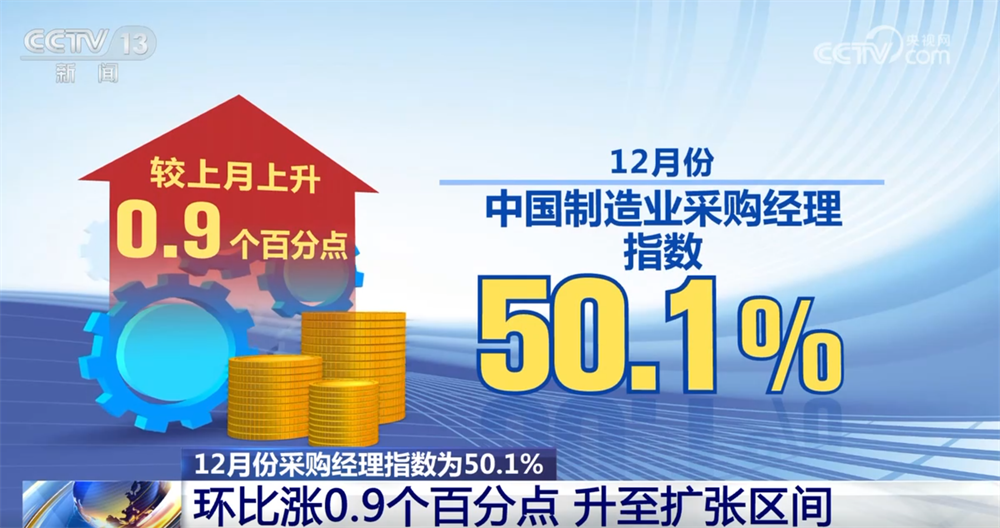
Group 1 - The manufacturing Purchasing Managers' Index (PMI) for December 2025 is reported at 50.1%, an increase of 0.9 percentage points from the previous month, marking a return to the expansion zone after eight consecutive months below 50% [1] - The production and business activity expectation index for December is at 55.5%, up 2.4 percentage points, the highest since April 2024 [1] - The new orders index for December is at 50.8%, rising 1.6 percentage points, indicating a return to the expansion zone after five months below 50% [1] Group 2 - The new export orders index for December is at 49%, an increase of 1.4 percentage points, indicating stable development in manufacturing exports [1] - The production index for December is at 51.7%, up 1.7 percentage points, showing significant growth in manufacturing activity [1] - The high-tech manufacturing PMI is reported at 52.5%, an increase of 2.4 percentage points, indicating a notable acceleration in expansion [1] Group 3 - The consumer goods industry PMI is at 50.4%, up 1 percentage point, with the production index exceeding 52% and the new orders index exceeding 51%, reflecting good expansion in the consumer goods manufacturing market [1] - The non-manufacturing business activity index for December is at 50.2%, an increase of 0.7 percentage points from the previous month [2] - The composite PMI output index for December is at 50.7%, up 1 percentage point from the previous month [2]
50.1%、升至扩张区间!从12月份采购经理指数看制造业回升向好
Yang Shi Wang· 2025-12-31 05:21
Core Viewpoint - The manufacturing sector in China shows signs of recovery with the Purchasing Managers' Index (PMI) rising to 50.1 in December, indicating expansion in the manufacturing market [1]. Group 1: Manufacturing PMI - The December manufacturing PMI is reported at 50.1, an increase of 0.9 percentage points from the previous month, indicating a shift into the expansion zone [1]. - The new orders index for manufacturing reached 50.8 in December, up by 1.6 percentage points from the previous month, reflecting stable expansion in the sector [3]. Group 2: Sector Performance - High-tech manufacturing PMI stands at 52.5, increasing by 2.4 percentage points, showing a significant acceleration in expansion [3]. - The consumer goods manufacturing PMI is at 50.4, which is an increase of 1 percentage point from the previous month, indicating positive structural changes in the sector [3]. Group 3: Future Outlook - According to the Vice President of the China Logistics and Purchasing Federation, there is a general trend of recovery across industries [6]. - The overall economic situation is expected to remain stable in 2025, with the annual average PMI for manufacturing projected at 49.6, similar to the average for 2024 [6]. - In 2026, multiple positive factors are anticipated to contribute to steady growth in the manufacturing sector [6].