
财富管理

Search documents
黑色星期四:AI没崩,但“卖AI的”先崩了
Sou Hu Cai Jing· 2026-02-14 20:03
Core Viewpoint - The recent market turmoil is driven by fears surrounding AI's potential to replace jobs, leading to significant declines in stock prices across various sectors, particularly in software, financial services, logistics, and commercial real estate [1][3][4][5][6]. Group 1: Market Reactions - The Dow Jones Industrial Average dropped over 660 points, and the Nasdaq fell by 2%, with Apple losing nearly 1.4 trillion RMB in market value [1]. - CBRE experienced a 26% decline in stock price, reminiscent of the 2008 financial crisis [1]. - The S&P 500 consumer staples sector reached a historical closing high, indicating a shift in investor sentiment towards stable companies like Coca-Cola and Walmart [9]. Group 2: Sector-Specific Impacts - **Software Sector**: The S&P 500 software and services index fell by 15% as companies that previously benefited from AI hype faced valuation corrections [4]. - **Financial Services and Logistics**: The introduction of AI tools led to significant stock drops for companies like Willis Towers Watson and C.H. Robinson, with declines of 7.4% and 14.5% respectively [5]. - **Commercial Real Estate**: Concerns about reduced office space demand due to AI's efficiency led to fears about the viability of high-rent office spaces in Manhattan [6]. Group 3: Investor Sentiment and Future Outlook - There is a notable shift in investment strategy from "buying the future" to "buying stability," as evidenced by the performance of consumer staples [9]. - Major tech companies are investing heavily in AI infrastructure, with combined capital expenditures reaching $650 billion, raising concerns about the return on these investments [10][11]. - The current market environment reflects a mix of anxiety and excitement about AI, with some companies experiencing significant funding and valuation increases despite broader market declines [12]. Group 4: Historical Context and Comparisons - The current situation is compared to the late 1990s tech bubble, where initial excitement about the internet led to market volatility when profitability questions arose [13]. - The narrative surrounding AI is shifting from grand promises to practical applications, causing investor panic as the technology matures [13][16]. - The survival of companies post-crisis will depend on their ability to adapt and effectively leverage AI, similar to how internet companies evolved after the 1999 downturn [19][20].


“我们正在目睹一场AI创造性破坏席卷全球各行各业”!高盛合伙人:本质上,这是一次“护城河检查”
华尔街见闻· 2026-02-14 13:46
Core Viewpoint - A wave of "creative destruction" driven by artificial intelligence (AI) is testing the competitive advantages of companies across various industries, leading to a reassessment of their business models and resilience against technological disruptions [1][2]. Group 1: Market Dynamics - The sentiment of "sell first, ask questions later" is spreading in the market, with accelerated sell-offs primarily driven by AI concerns, lacking clear catalysts [2]. - High volatility in the software sector is observed, with valuations under pressure as AI raises questions about the terminal value of software and technology stocks [6][7]. - The current market environment is characterized by a potential growth shock, with a flattening yield curve and rising bond prices [18]. Group 2: Valuation Concerns - Valuation multiples for public companies have decreased from over 30 times earnings to just above 20 times, while private equity valuations remain significantly higher [7]. - The market is witnessing a chain reaction from public markets to private equity and private credit, particularly affecting the leveraged loan market [8]. Group 3: Investment Recommendations - Investors are advised to focus on companies with genuine competitive advantages and tangible assets, as these are likely to perform better in the current environment [13][22]. - The aerospace sector is highlighted as a promising area, with companies like Airbus being worth attention, while industrial stocks should be selected based on their benefits from the investment cycle rather than just short-term cyclicality [14]. - Real estate investment trusts (REITs) in Europe, particularly in German residential properties, are viewed positively, while office REITs are advised against due to potential risks [15]. Group 4: CTA Sell-off Signals - There is a need to be cautious of CTA (Commodity Trading Advisor) trigger points in major U.S. indices, with expectations of significant sell-offs, particularly in the Nasdaq 100 index [16][17]. - Goldman Sachs estimates that CTAs may sell off between $1.5 billion to $2 billion worth of U.S. stocks in the coming week, with the S&P 500 index remaining above critical thresholds for now [19].

能源、必选消费和美债领涨2026!华尔街的“AI交易”被“AI颠覆”了
华尔街见闻· 2026-02-14 10:53
Group 1 - The core viewpoint of the article is that AI, initially seen as a strong investment theme, has transformed into a threat, particularly impacting light-asset companies that may be replaced by AI rather than the tech giants developing it [1][6][7] - The S&P 500 index experienced its worst performance since November until a rebound on Friday due to mild inflation data, highlighting the widespread panic regarding AI disruption across various markets [2][4] - The profitability expansion accumulated by white-collar industries such as software companies, wealth management firms, and tax advisors over the past decade has been revalued within weeks, affecting even the private credit market that lends to these companies [3] Group 2 - Wall Street's previously confident bets have failed dramatically over six weeks, with cash allocations hitting a historical low and hedge positions at their minimum, leading to a collapse of consensus trades [5][8] - The sectors that have performed well include energy, consumer staples, and U.S. Treasury bonds, while the consensus bets on AI have faltered significantly [5] - Investors are questioning the return timelines of large capital expenditures by tech giants and whether remaining cash can continue to support stock buybacks, with more stocks being harmed by AI than helped [8][9] Group 3 - Two forces are exacerbating volatility in the U.S. stock market: low cash allocations and interconnected leverage networks that can trigger sell-offs across seemingly unrelated investments [12][13] - The VIX index recently surpassed the widely watched 20 mark, indicating rising market stress, even though it does not show panic, as the skew of put options remains historically high [18][19] - The performance of investment-grade bond ETFs relative to high-yield bond ETFs has improved, with the U.S. 10-year Treasury yield reaching a two-month low [20][21] Group 4 - Investors are adjusting their strategies, with the S&P 500 index still hovering near historical highs and credit spreads at ten-year lows, but there is an increase in hedging activities as indicated by the rising put-call ratio [22][24] - ETFs tracking companies with high shareholder returns attracted $3.6 billion in new funds this month, indicating a shift in investor focus [25] - Analysts suggest that if negative news regarding AI disruption subsides and volatility decreases, the U.S. stock market may support upward movement, but there is a conflict between market consensus and resilient economic indicators [26]

能源、必选消费和美债领涨2026!华尔街的“AI交易”被“AI颠覆”了
美股IPO· 2026-02-14 04:12
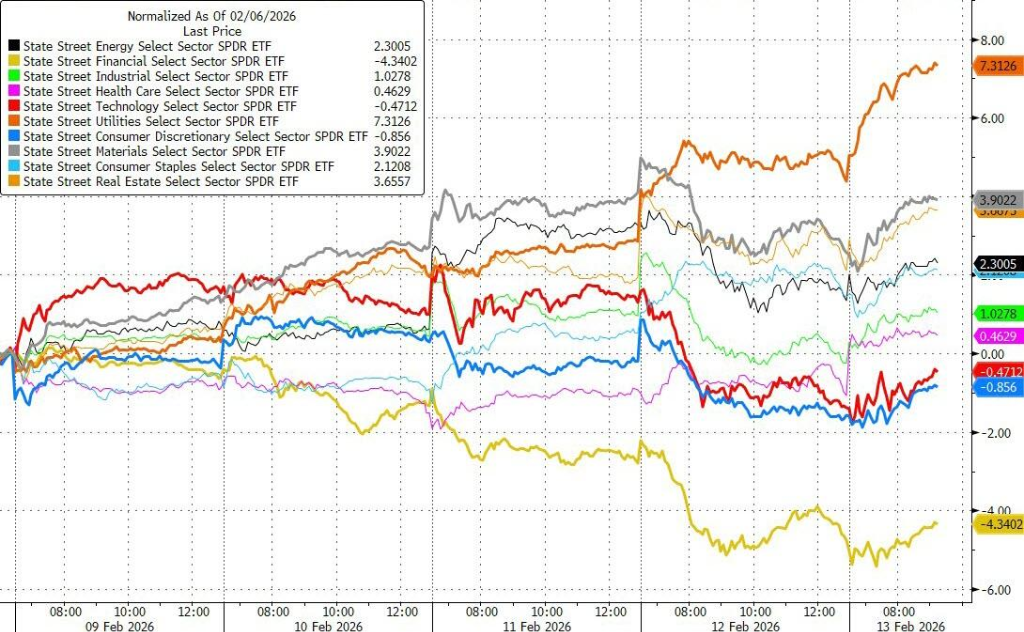
"AI颠覆"冲击软件、金融和物流等行业,而极端仓位和杠杆进一步放大市场波动。投资者开始调整策略增加对冲,看跌期权偏斜度处于历史高位。但高 盛Chris Hussey表示,AI颠覆论与经济韧性数据形成冲突,市场最终方向仍需时间验证。 AI本该是今年确定性最强的交易主题。但它却转变为一种威胁,不是威胁那些构建AI的科技巨头,而是冲击那些可能被AI取代的轻资产企业。 本周,标普500指数一度走向11月以来最糟糕的表现,直到周五通胀数据温和才有所反弹,而AI颠覆恐慌正在各类市场中层层扩散。 软件公司、财富管理机构、经纪商、税务顾问等白领行业,过去十年积累的利润率扩张在几周内被重新定价,冲击波甚至传导至向这些公司提供贷款的 私募信贷市场。 (本周美股公用事业板块作为规避AI冲击的安全港,表现大幅领先,而金融板块则成为当周表现最差的板块) 华尔街高度确信的押注在六周内全面失灵。年初时现金配置创历史新低、对冲降至最低水平的基金经理们,如今正目睹共识交易的溃败,那些最被看好 的资产正输给最不受待见的标的。 能源、必需消费品和美国国债领涨2026年市场,那些年初对AI的共识押注则纷纷落败。 iShares 20+年期美国国债E ...
能源、必选消费和美债领涨2026!华尔街的“AI交易”被“AI颠覆”了
Hua Er Jie Jian Wen· 2026-02-14 01:49
Core Viewpoint - AI, initially seen as a strong investment theme for the year, has shifted to a source of market uncertainty, particularly impacting light-asset companies that may be replaced by AI technology [1][4]. Group 1: Market Performance - The S&P 500 index experienced its worst performance since November until a rebound occurred following mild inflation data on Friday [1]. - The utility sector outperformed as a safe haven against AI impacts, while the financial sector was the worst performer of the week [2]. - Wall Street's previously confident bets have failed over six weeks, with cash allocations at a historic low and hedge levels at their lowest since 2018 [3]. Group 2: AI Impact and Investor Sentiment - Investors are questioning the return timelines on large capital expenditures by tech giants and whether remaining cash can continue to support stock buybacks [4]. - The sentiment is that more stocks have been harmed by AI than benefited, leading to concerns about potential contagion effects across sectors [4]. - The market is undergoing a repricing, particularly in the software industry, raising fears of broader impacts [4]. Group 3: Market Volatility - Two forces are exacerbating volatility in the U.S. stock market: low cash allocations and interconnected leveraged positions that can trigger widespread sell-offs [5]. - The VIX index recently surpassed the critical 20 mark, indicating rising market pressure despite not showing panic signals [6]. - The put-call ratio has surged since January, reflecting increased hedging activity among investors [9][10]. Group 4: Investment Strategy Adjustments - Despite current volatility, the S&P 500 remains near historical highs, and credit spreads are at ten-year lows, indicating that a market collapse has not yet occurred [9]. - There has been a significant inflow of $3.6 billion into ETFs tracking high shareholder return companies this month, suggesting a shift in investment focus [10].
CPI报告后华尔街改写利率剧本,现预计美联储年内降息“2.5次”
Feng Huang Wang· 2026-02-13 23:10
Group 1 - The core viewpoint of the articles indicates that the recent U.S. inflation data has led traders to increase bets on the Federal Reserve potentially lowering interest rates more than twice by 2026, which has driven up U.S. Treasury prices [1] - The January CPI rose by 2.4% year-on-year, lower than the market expectation of 2.5%, and down 0.3 percentage points from 2.7% in December 2025, marking the lowest level since June of the previous year [1] - Traders are now expecting a cumulative rate cut of approximately 63 basis points by the end of the year, indicating a likelihood of two to three rate cuts, with a strong possibility of initiating cuts before the July meeting [1] Group 2 - The recent auction of newly issued 30-year U.S. Treasury bonds saw historically strong demand, reflecting investor confidence that yields will not rise again despite geopolitical tensions and significant fiscal deficits [2] - The positive reaction to the inflation data is somewhat tempered by the ongoing improvement in the labor market, which reduces the necessity for further rate cuts by the Federal Reserve [2] - There is an indication that recent market movements may be more influenced by a shift in risk sentiment rather than the economic data itself [2]
AI颠覆风暴席卷美股旅游休闲板块!在线预订平台惨遭屠戮,酒店股逆势狂飙
Zhi Tong Cai Jing· 2026-02-13 13:05
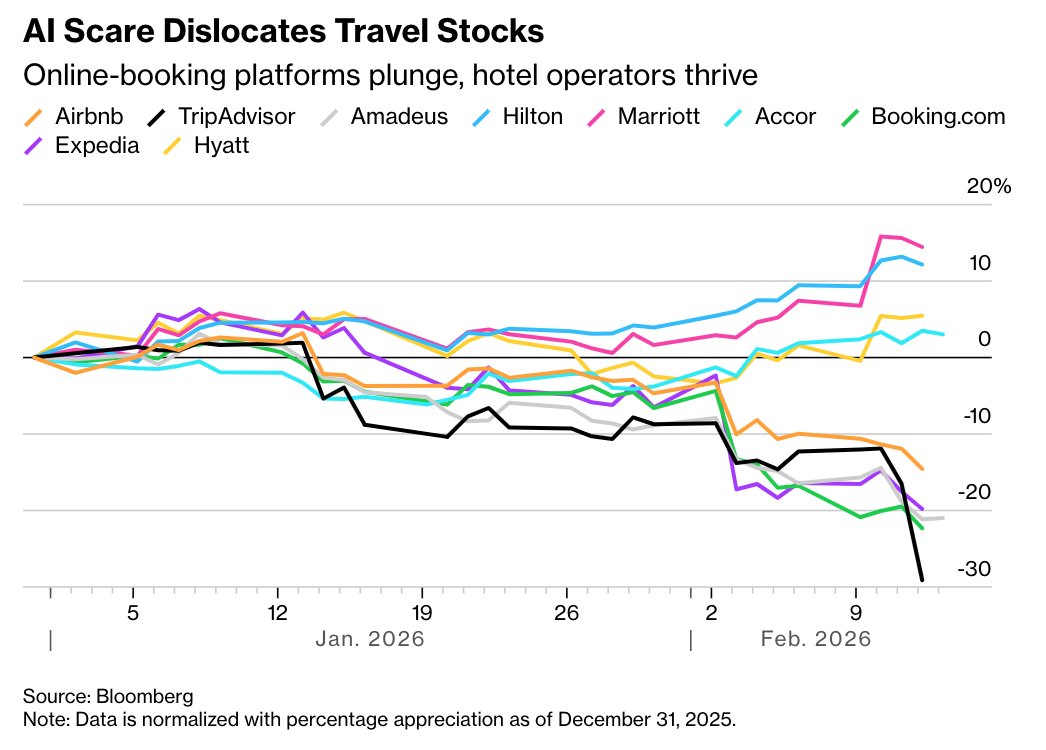
Group 1 - Concerns about AI disruption have led to significant divergence in the travel and leisure industry, with online travel platform stocks plummeting while traditional hotel operators' stocks surged [1] - TripAdvisor's stock has fallen 29% this year, hitting a historical low after disappointing earnings, while Booking Holdings and Amadeus IT Group have seen declines of 22% [1] - In contrast, Marriott's stock has risen 14% and Hilton's stock has increased by 12% this year, with analysts raising target prices following Hilton's earnings report [1] Group 2 - The sell-off in travel stocks accelerated in early February as investors fled companies perceived to be vulnerable to AI disruption, initially triggered by a new tool from Anthropic [4] - The sell-off has spread to IT services, wealth management, real estate platforms, and logistics sectors, with significant drops in stocks like Charles Schwab and LPL Financial [4] - Concerns about AI's impact on office space demand have led to declines in commercial real estate stocks, with major firms like CBRE and JLL experiencing drops of 8.8% and 7.6% respectively [4] Group 3 - The market is currently characterized by a "sell first, ask questions later" mentality, as fears of AI disruption escalate with the rollout of AI products [4] - The Dow Jones Transportation Average has outperformed the S&P 500 by 13 percentage points over the past month and a half, driven by strong economic data and a trend of reducing exposure to tech giants [4] - Investors are increasingly seeking alternatives to AI-related stocks, with strong economic conditions reinforcing positive investment logic in traditional sectors [5] Group 4 - The software sector has experienced significant sell-offs, presenting a buying opportunity for investors, as many software stocks are considered severely oversold [6] - Despite recent declines in software stocks, there is a belief that market turmoil is creating favorable conditions for savvy investors [6] - A significant divergence in growth prospects and fundamental expectations among software companies is anticipated, rather than a uniform rebound across the market [6]
上周科技股和贵金属暴跌时,全球资金逃向了哪里?
智通财经网· 2026-02-13 11:14
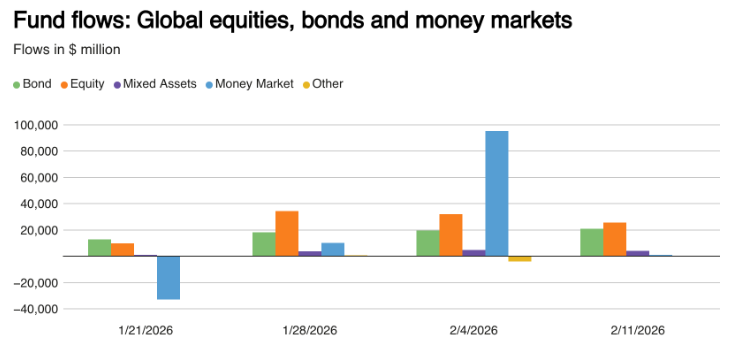
智通财经APP获悉,截至2月11日当周,欧洲和亚洲股票基金资金强劲流入,投资者因担忧估值过高和 人工智能相关支出不断增长而减持美国大型股。LSEG Lipper数据显示,全球股票基金连续第五周净流 入,资金总额达255.4亿美元,其中欧洲基金净流入175.3亿美元,创下至少自2022年以来单周最高纪录; 亚洲基金净流入约62.8亿美元。与此同时,美国股票基金当周净流出14.2亿美元,这是三周以来的首次 净流出。 由于市场再次担忧人工智能技术可能对软件、法律服务和财富管理等行业造成冲击,以科技股为主的纳 斯达克综合指数上周四下跌2.03%。 在新兴市场,投资者向股票基金注入了85.2亿美元,延续了近期的买盘势头,连续第八周买入;债券基金 方面,根据28,723只基金的综合数据显示,资金流入为12.9亿美元。 全球债券基金连续第六周受到投资者青睐,最近一周净流入资金约210.9亿美元。短期债券基金当周净 流入资金达48.7亿美元,创下自去年12月中旬净流入101.7亿美元以来的最高纪录。公司债券基金和欧元 计价债券基金也分别吸引了26.3亿美元和20.6亿美元的资金流入。 | | | 12/24/2025 12/ ...
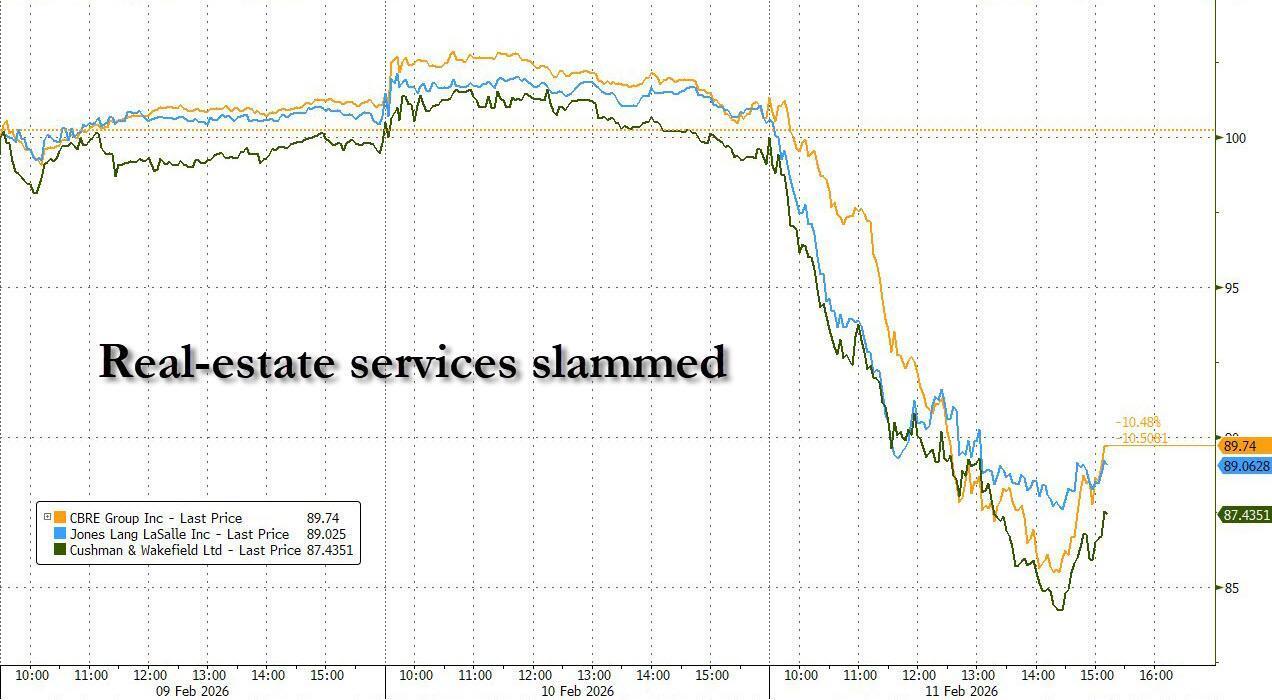
多只地产服务商一夜暴跌 AI“狼人杀”还没结束:点谁谁崩
Feng Huang Wang· 2026-02-13 02:14
Core Viewpoint - The recent sell-off in the U.S. stock market, particularly affecting real estate service stocks, is driven by investor fears regarding the disruptive potential of AI applications in various industries [1][3]. Group 1: Market Impact - Several real estate service stocks, including CBRE Group and JLL, experienced significant declines, with CBRE dropping 12% and JLL falling 14%, marking their largest single-day drops since the COVID-19 pandemic [3]. - The commercial real estate sector is facing renewed challenges, exacerbated by the pandemic's impact on office demand and high interest rates affecting transaction volumes [3]. - Investors are increasingly withdrawing from high-fee, labor-intensive business models perceived as vulnerable to AI disruption, as noted by analysts [3][4]. Group 2: Broader Industry Concerns - The sell-off has extended beyond real estate, affecting SaaS, insurance brokerage, and wealth management stocks, indicating a widespread concern about AI's potential to disrupt various sectors [4][5]. - Companies like CBRE and JLL are attempting to mitigate downward pressure by diversifying into property management and valuation across various sectors, including hotels and life sciences [4]. - Analysts express that the recent stock price declines may be overreactions, as the risks associated with AI disruption have been present for some time and are not new [4][5]. Group 3: AI Disruption Debate - The introduction of AI tools, such as those by Anthropic, has intensified fears of industry-wide disruption, leading to a "sell first, ask questions later" mentality among investors [4][6]. - Concerns about AI's impact on employment and commercial real estate demand are prevalent, but some analysts argue that the actual threat to leasing and capital markets is limited [4][6]. - The market's reaction reflects a broader anxiety about potential reversals in stock valuations, driven by recent AI spending and a resilient U.S. economy [6][7].
苹果一夜蒸发近1.4万亿元人民币 美股集体下挫静待CPI数据
Sou Hu Cai Jing· 2026-02-13 00:12
Group 1 - The U.S. stock market experienced a collective decline due to concerns over the disruptive impact of artificial intelligence (AI) and cautious sentiment ahead of significant CPI inflation data, with all three major indices falling over 1% [1] - The technology sector was the primary driver of the decline, with Apple shares dropping 5%, resulting in a market value loss of approximately $202.2 billion, marking the second-largest single-day market value loss in the company's history [1] - Concerns regarding AI are spreading from the software industry to logistics and real estate, with investors worried that AI tools may replicate business models and erode profit margins [1] Group 2 - Investors are closely monitoring the upcoming U.S. CPI inflation data, following stronger-than-expected January non-farm payroll data, which has reduced expectations for an urgent rate cut by the Federal Reserve [2] - The probability of a 25 basis point rate cut in March is currently estimated at 5.9%, while the probability for a cumulative 25 basis point cut by June stands at 48.1% [2] - The storage sector saw gains, with companies like SanDisk and Seagate Technology rising over 5%, while precious metals faced significant declines, with COMEX gold futures down 3.08% and COMEX silver futures down 10.62% [2]
