
金融活动

Search documents
高瑞东 周欣平:为什么美国非农就业大幅下修?
Sou Hu Cai Jing· 2025-08-03 06:06
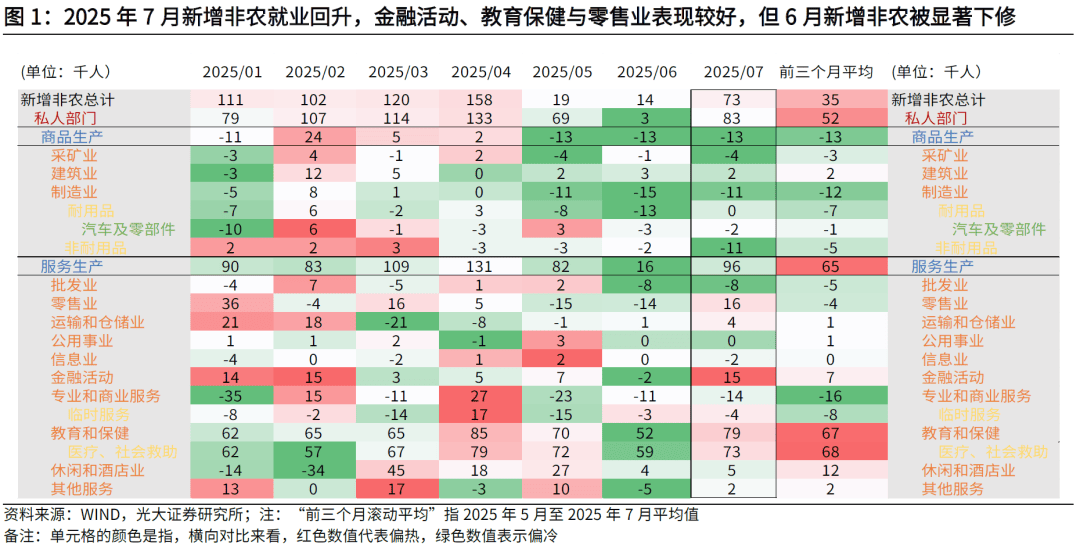
Group 1 - The core viewpoint indicates that the significant downward revision of June non-farm data reflects substantial disruptions to the U.S. economy due to tariffs, suggesting that the resilience of the U.S. economy should not be overestimated, and the direction of interest rate cuts remains highly certain [2][4][17] - In July, non-farm employment increased by 73,000, which is below the expected 110,000, and the previous value was revised down from 147,000 to 14,000, indicating pressure on the U.S. job market [6][11][22] - The unemployment rate in July rose to 4.2%, up from 4.1% in the previous month, while the average hourly wage increased by 3.9% year-on-year, exceeding the expected 3.8% [1][6][31] Group 2 - In July, the financial activities, healthcare, and retail sectors added 15,000, 79,000, and 16,000 jobs respectively, showing a stable demand in the service sector [3][22] - The manufacturing sector has seen negative job growth for three consecutive months, indicating insufficient production willingness among enterprises [3][22] - The labor force participation rate decreased to 62.2% in July, down from 62.3% in the previous month, with a notable decline in employment willingness among younger demographics [26][31] Group 3 - The downward revision of June non-farm data was primarily due to significant adjustments in government, leisure, and hotel employment, which collectively accounted for a 90,000 downward revision, representing nearly 70% of the total revision [12][17] - The cumulative downward revision for May and June non-farm data reached 258,000, while the July employment figure of 73,000 is a significant drop compared to the average monthly increase of over 100,000 in the first quarter [4][17] - The market anticipates that the Federal Reserve will cut interest rates three times in 2025, with an 80% probability for the first cut in September [4][21][37] Group 4 - The average hourly wage growth has shown an upward trend, with a month-on-month increase of 0.3% in July, higher than the previous 0.2% [37][39] - The service sector's job growth in July rebounded to 96,000, compared to a previous value of 16,000, indicating a relatively stable demand in the service industry [22][31] - The overall economic environment remains challenging, with second-quarter GDP growth at 3.0%, driven by a "import rush" effect, while core GDP growth has declined [18][22]

光大证券:为什么美国非农就业大幅下修?
智通财经网· 2025-08-03 01:29
Core Viewpoint - The U.S. non-farm employment data shows a significant decline, with July's job additions at 73,000, down from an expected 110,000, indicating a weakening labor market and increasing likelihood of the Federal Reserve restarting interest rate cuts in the second half of the year [1][2][6]. Employment Data Summary - The U.S. Labor Department reported that July's non-farm employment increased by 73,000, significantly lower than the expected 110,000, and the previous value was revised down from 147,000 to 14,000 [2]. - The unemployment rate for July was reported at 4.2%, matching expectations but up from the previous value of 4.1% [2]. - Average hourly earnings increased by 3.9% year-over-year, slightly above the expected 3.8% [2]. Non-Farm Data Revision Analysis - The downward revision of June's non-farm data by 258,000 jobs was primarily due to adjustments in government, leisure and hospitality, and construction sectors, which accounted for 90,000 of the total revision [3]. - The significant revision reflects the impact of tariffs on the U.S. economy, suggesting that the resilience of the economy may have been overestimated [3][6]. Sector Performance - In July, the financial activities sector added 15,000 jobs, education and health services added 79,000 jobs, and retail added 16,000 jobs, indicating stable demand in these service sectors [4]. - The manufacturing sector has seen negative job additions for three consecutive months, indicating a lack of production willingness among companies [4]. Labor Market Dynamics - The labor force participation rate decreased to 62.2% in July from 62.3% in the previous month, with a notable decline in employment willingness among younger demographics [5]. - The number of unemployed individuals increased by 221,000 in July, contributing to the rise in the U3 unemployment rate to 4.2% [5]. - Temporary unemployment increased by 80,000, while permanent unemployment remained unchanged, suggesting a rise in layoffs by companies [5].

2025年7月美国非农数据点评:为什么美国非农就业大幅下修?
EBSCN· 2025-08-02 12:01
Employment Data Summary - In July 2025, the U.S. non-farm payrolls increased by 73,000, significantly below the expected 110,000, and the previous value was revised down from 147,000 to 14,000[1][11]. - The unemployment rate in July 2025 was 4.2%, matching expectations but up from the previous 4.1%[1][14]. - Average hourly earnings rose by 3.9% year-on-year, exceeding the expected 3.8% and revised from a previous increase of 3.7%[1][14]. Data Revision Insights - The June non-farm payrolls were revised down by a total of 258,000, with significant downward adjustments in government, leisure, and construction sectors, accounting for 90,000 of the total revision[2][12]. - The downward revision reflects the impact of tariffs on the U.S. economy, indicating a decline in the accuracy of the "birth-death model" used for employment predictions[2][5]. Sector Performance - In July, the financial activities, education, and healthcare sectors added 15,000, 79,000, and 16,000 jobs respectively, showing stability in service sector demand[3][27]. - The goods-producing sector continued to show negative job growth for three consecutive months, indicating weak production intentions among businesses[3][28]. Labor Market Dynamics - The labor force participation rate fell to 62.2% in July, down from 62.3% in June, with a notable decline in employment willingness among younger demographics[4][35]. - The number of unemployed individuals increased by 221,000 in July, contributing to the rise in the U3 unemployment rate to 4.2%[4][35]. Economic Outlook - The Federal Reserve is expected to initiate rate cuts, with market predictions indicating three rate cuts in 2025, starting in September with an 83.4% probability[5][26]. - The overall economic environment remains challenging, with the second quarter GDP growth at 3.0%, driven by a "import rush" effect, but core GDP growth showing signs of decline[5][23].
政府就业被高估——7月美国非农数据解读【陈兴团队•财通宏观】
陈兴宏观研究· 2025-08-02 05:56
Core Viewpoint - The July non-farm employment data shows a significant downward revision in previous months, indicating an overestimation of employment levels, particularly in government sectors. The overall labor market is cooling down, with rising unemployment rates and declining labor participation rates [2][3][5]. Employment Data Revision - The July non-farm employment recorded an increase of 73,000 jobs, but previous months' data were heavily revised downwards. June's employment was adjusted from 147,000 to 14,000, and May's from 144,000 to 19,000, totaling a downward revision of 258,000 jobs [3][2]. Unemployment Rate Trends - The unemployment rate rose slightly by 0.1 percentage points to 4.2% in July, while the U6 unemployment rate increased by 0.2 percentage points to 7.9%. This indicates a broad cooling of the job market, with a decrease in labor participation rate to 62.2%, the lowest since the beginning of 2023 [5][6]. Sector-Specific Employment Changes - Job growth in July was concentrated in the education and healthcare sectors, with retail, education, and financial activities seeing the most significant increases. However, government employment decreased by 10,000 jobs, marking the third negative month this year, with substantial downward revisions in previous months [6][2]. Labor Market Supply and Demand - As of June, job vacancies in the U.S. fell to 7.44 million, with a vacancy rate of 4.4%. The labor supply-demand gap recorded 422,000, indicating a return to pre-pandemic levels and suggesting a balance in the labor market [8]. Wage Growth Trends - Average hourly earnings in July increased by 0.3% month-over-month, with a year-over-year growth of 3.9%. However, long-term trends show a slowdown in wage growth since November 2024 [9][10]. Real Wage Growth - The real wage growth, adjusted for inflation, showed a year-over-year increase of 1% in June, down by 0.4 percentage points from the previous month. This indicates stable wage income growth [10]. Sectoral Wage Changes - In July, the highest year-over-year wage growth was observed in the retail and business services sectors, at 5.2% and 5.1%, respectively. Conversely, the slowest growth was in public utilities and construction, with declines of approximately 0.7 and 0.2 percentage points [12]. Interest Rate Expectations - Following the release of weak employment data, expectations for interest rate cuts in September have increased, with the probability rising from 40% to 80%. The anticipated number of rate cuts for the year has also increased from 1.3 to 2.2 [16].

美国7月ADP就业人数增加10.4万人超预期 但雇主对招聘决策趋于谨慎
Hua Er Jie Jian Wen· 2025-07-30 14:35
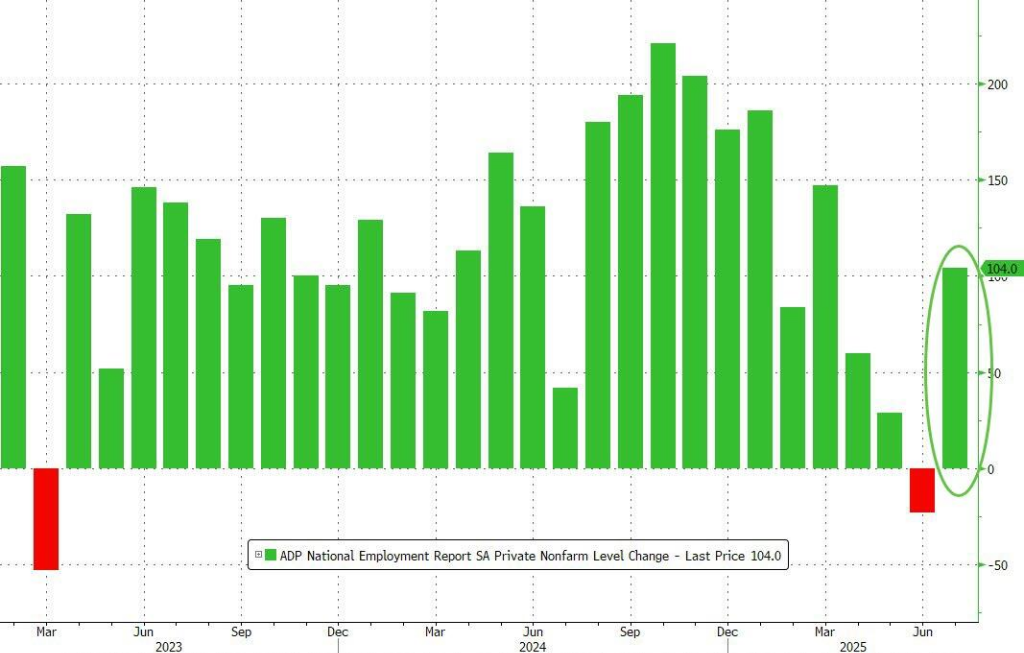
Group 1 - The core point of the article is that the U.S. private sector added 104,000 jobs in July, exceeding economists' expectations but still significantly lower than the average level from the previous year [1][3][8] - The job growth was primarily driven by a recovery in the service sector, with leisure, hospitality, and financial activities showing the most significant employment increases [4][8] - Despite the positive job growth, employers are becoming more cautious in hiring decisions due to increasing economic uncertainty surrounding Trump's policies [1][8] Group 2 - The ADP report indicates that the annual salary growth rate for employees remaining in the same position is at 4.4%, the lowest since May 2021, while job switchers experience a higher growth rate of 7.0% [7] - Initial claims for unemployment benefits remain low, but the duration for unemployed workers to find new jobs is increasing, indicating a potential slowdown in the labor market [5][8] - Following the data release, the U.S. dollar index rose by approximately 10 points, and U.S. stock futures showed minimal fluctuations, with the Nasdaq 100 futures maintaining a gain of about 0.2% [5][9]
美国7月ADP就业人数增加10.4万人超预期,但雇主对招聘决策趋于谨慎
Sou Hu Cai Jing· 2025-07-30 13:22
Core Insights - The private sector in the U.S. added 104,000 jobs in July, exceeding economists' expectations but still significantly lower than the average level from the previous year [1][3][7] - Employers are becoming more cautious in hiring decisions due to increasing economic uncertainty surrounding Trump’s policies, leading to a generally weak demand in the labor market [1][7] Employment Data - The ADP report indicates that the increase of 104,000 jobs in July was above the expected 76,000 and a recovery from a previous loss of 33,000 jobs [3] - The growth in employment is primarily driven by the recovery in the service sector, with leisure, hospitality, and financial activities showing the most significant job growth [4] - However, the education and health sectors have experienced a net loss in jobs so far this year [4] Wage Trends - The year-over-year salary growth for employees remaining in the same position was 4.4%, the lowest rate since May 2021, while job switchers saw a 7.0% increase [6] Market Reaction - Following the employment data release, the U.S. dollar index rose approximately 10 points, while U.S. stock futures showed minimal fluctuations, with the Nasdaq 100 futures maintaining a 0.2% increase [8]
凯德北京投资基金管理有限公司:小非农”意外转负,美国劳动力市场裂缝加深
Sou Hu Cai Jing· 2025-07-03 11:00
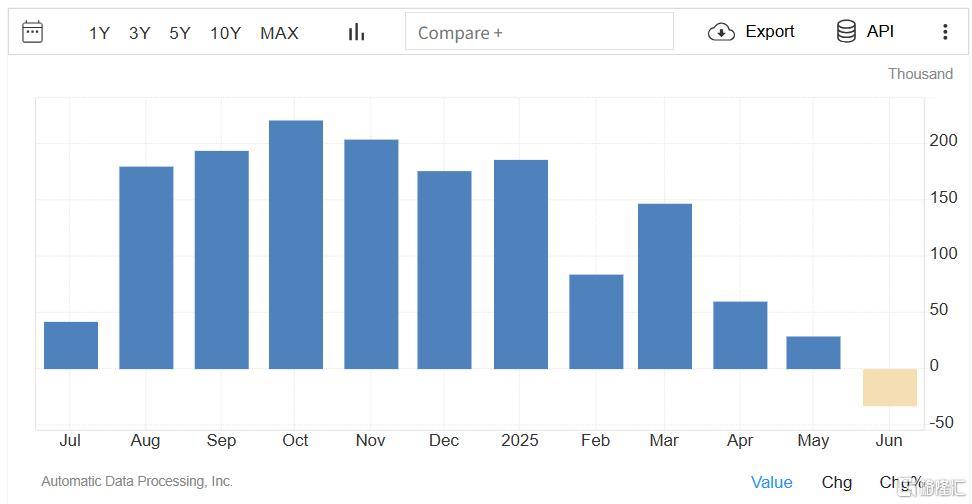
Group 1 - The core point of the news is the significant drop in ADP employment numbers for June, which decreased by 33,000 jobs, contrasting sharply with the market expectation of an increase of 100,000 jobs. This marks the first negative reading since March 2023 and indicates underlying issues in the employment market despite its apparent strength [1][3][5]. Group 2 - The service sector is the hardest hit, with professional and business services losing 56,000 jobs, followed by the education and healthcare sector with a reduction of 52,000 jobs, and financial activities decreasing by 14,000 jobs. The Midwest and Western regions also saw job losses of 24,000 and 20,000 respectively, while the Southern region barely maintained slight growth [3][5]. - Small businesses, defined as those with fewer than 20 employees, experienced a net loss of 29,000 jobs, highlighting their vulnerability under high interest rates and policy uncertainty, whereas larger companies with over 500 employees added 30,000 jobs [3][5]. - ADP's Chief Economist Neela Richardson pointed out that while mass layoffs have not occurred, companies are adopting a strategy of "freezing hiring" and "not filling vacancies," leading to a passive contraction in employment. The average monthly job growth over the past three months has been only 18,700, the lowest since the onset of the pandemic [5][7]. Group 3 - The tightening of immigration policies has led to a decline in foreign labor, resulting in a reduction of 2 million in labor supply, which is more impactful than tariff effects. A recent study warns that net immigration in the U.S. could reach zero or even negative this year, necessitating the creation of only 10,000 to 40,000 jobs monthly to maintain the current unemployment rate, but this could permanently damage economic growth potential [5][7]. - Following the ADP data release, traders increased the probability of a Federal Reserve rate cut in July from 20% to 27.4%, with expectations for at least two rate cuts by the end of the year. The upcoming non-farm payroll report is critical, as economists expect an addition of 110,000 jobs, but past data revisions have raised concerns about the reliability of these figures [7].

“小非农”爆冷转负!美国6月ADP就业人数骤减3.3万人
Ge Long Hui· 2025-07-02 14:37
Core Points - The ADP employment report for June shows a decrease of 33,000 jobs, significantly below the market expectation of an increase of 95,000 jobs, marking the largest decline since March 2023 [1][3] - The data is viewed as a leading indicator for non-farm employment, indicating a rapid slowdown in private sector employment and reinforcing signals of economic cooling [3] - Despite the job losses, wage growth remains resilient, with slight slowdowns in wage increases for both current employees and job switchers [10][11] Employment Sector Analysis - The service sector experienced the most significant job losses, particularly in professional and business services, as well as healthcare and education, with reductions of 56,000 and 52,000 jobs respectively [7] - Financial sector jobs also saw a decline, with a net loss of 14,000 positions [8] - In contrast, the manufacturing and mining sectors added a total of 32,000 jobs, while the overall service sector saw a total decrease of 66,000 jobs [9] Regional Employment Trends - The Midwest and Western regions of the U.S. faced the most severe job declines, losing 24,000 and 20,000 jobs respectively, while the South was the only region to see a net increase of 13,000 jobs [9] Wage Growth Insights - Wage growth for employees remaining in their positions slightly decreased from 4.5% to 4.4%, while job switchers saw a decline from 7% to 6.8% [10] - The stability in wage growth is viewed as a positive sign for the labor market, despite the overall slowdown [11] Market Reactions and Future Expectations - Following the ADP report, the dollar index experienced a short-term drop of about 20 points before rebounding, currently reported at 97.064 [3] - U.S. stock indices showed mixed reactions, with the Dow Jones down 0.16%, while the S&P 500 and Nasdaq saw slight increases of 0.18% and 0.61% respectively [5][6] - Market speculation regarding potential interest rate cuts by the Federal Reserve has intensified, with traders increasing bets on at least two rate cuts by the end of 2025 [12][13] Upcoming Economic Data - The U.S. Labor Department is set to release the June non-farm employment report, with economists predicting an addition of 110,000 jobs and a slight increase in the unemployment rate from 4.2% to 4.3% [15] - Weekly initial jobless claims are also expected to be reported, with an estimate of 240,000 claims [16]
“小非农”意外录得负值,黄金一度站上3350关口!
Jin Shi Shu Ju· 2025-07-02 12:48
Group 1 - The ADP employment report for June shows a decline of 33,000 jobs, marking the first employment contraction since March 2023, which is below the expected increase of 95,000 jobs and the previous value of 37,000 jobs [1] - The report indicates that the labor market remains weak despite some tariff reductions by the Trump administration, with traders increasing bets on at least two rate cuts by the Federal Reserve before the end of 2025 [1][2] - ADP's chief economist, Nela Richardson, noted that while layoffs are still rare, employer hesitance in hiring and negative filling of positions left by departing employees contributed to the job losses [1] Group 2 - Job losses were primarily concentrated in the professional/business services and healthcare/education sectors, with a reduction of 56,000 and 52,000 jobs respectively, while financial activities also saw a decline of 14,000 jobs [3] - In contrast, the goods-producing sectors, including manufacturing and mining, added 32,000 jobs, partially offsetting the losses in the service sector, which saw a total decline of 66,000 jobs [3] - Small businesses experienced more significant layoffs, with large companies (over 500 employees) adding 30,000 jobs, while small businesses (under 20 employees) lost 29,000 jobs [3]

美国经济:非农就业稳健,美联储将保持观望
招银证券· 2025-06-09 02:08
Employment Data - In May, non-farm employment increased by 139,000, exceeding market expectations of 126,000, despite a downward revision of 95,000 in the previous two months[5] - The unemployment rate slightly rose to 4.24% in April, up from 4.19% in March, marking a near three-year high[5] - The labor force participation rate decreased from 62.6% to 62.4%[5] Federal Reserve Outlook - The probability of a rate cut in July dropped significantly to 16.7% following the employment data release[1] - The Federal Reserve is expected to maintain interest rates steady in June and July, with potential cuts in September and either November or December[2] - Market expectations for policy rates have shifted closer to the Federal Reserve's stance rather than the White House's position[2] Sector Performance - Service sector employment rose from 132,000 to 145,000, indicating resilience in this area, while goods-producing jobs fell from an increase of 11,000 to a decrease of 5,000[5] - Average hourly earnings saw a month-on-month increase of 0.42%, maintaining a year-on-year growth rate of 3.9%[5] - Job openings to unemployed persons ratio remains at 1, below the 2019 level, indicating a balanced labor market[5]