
公募基金

Search documents
中加基金:长周期考核如何改变行业生态
Xin Lang Ji Jin· 2025-10-16 01:55
Group 1 - The core viewpoint of the article is the introduction of a long-term assessment mechanism by the China Securities Regulatory Commission, aimed at promoting high-quality development in the public fund industry, marking a significant shift in the industry's evaluation criteria [1][2][7] Group 2 - The long-term assessment mechanism addresses the short-term focus dilemma in the public fund industry, shifting the evaluation weight of medium to long-term returns to at least 80% for three years and making five-year performance a core evaluation metric [2][3] - Fund managers will be encouraged to adopt a long-term investment approach, allowing them to focus on fundamental research and invest in high-potential assets without the pressure of short-term performance [3][4] Group 3 - The implementation of the long-term assessment mechanism will lead fund companies to prioritize long-term products, such as index-enhanced funds and pension-targeted funds, which are designed for sustained growth and stability [4][6] - Fund companies will enhance investor education and personalized services, helping investors develop a long-term investment mindset and providing tailored investment advice based on individual risk tolerance and goals [4][6] Group 4 - The long-term assessment mechanism will enable public funds to better support national strategies and industrial upgrades by directing capital towards innovative and high-potential sectors, contributing to the high-quality development of the real economy [6][7] - Public funds will play a crucial role in supporting technological innovation, green development, and national strategic projects, thereby enhancing their contribution to the financial system and the economy [6][7]
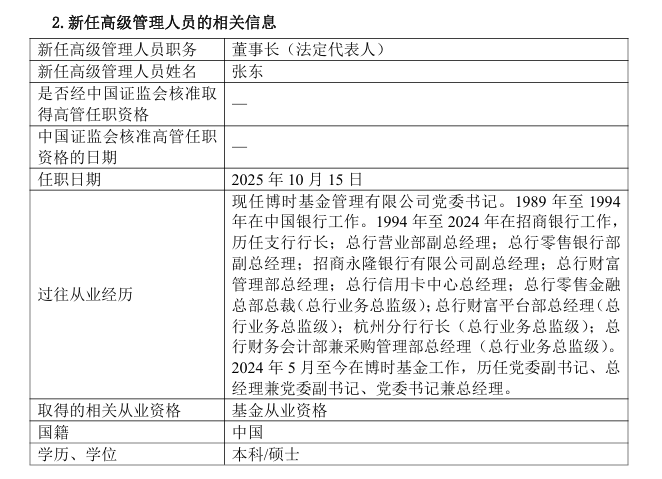
万亿级公募官宣:张东接棒
Shang Hai Zheng Quan Bao· 2025-10-15 15:20
公开信息显示,张东深耕金融行业超过36年,在"招商系"工作就长达31年。多年来,张东在财富管理领 域积累深厚,全程参与及推动招行财富管理体系发展。 2024年5月起,张东担任博时基金总经理。其间,张东带领博时基金积极践行公募基金实现高质量发 展,坚持"稳"字当头,增强内生增长动力,全面提升核心竞争力,持续为持有人的财富增长贡献力量。 同时,公司在复杂的市场环境中实现稳中有进,进中向优,市场地位得到进一步巩固。 10月15日晚间,博时基金发布高级管理人员变更公告,经博时基金管理有限公司第九届董事会2025年第 五次临时会议审议并通过,江向阳因工作安排辞任公司董事长,由博时基金党委书记、总经理张东正式 接任公司董事长暨法定代表人。 | 新任高级管理人员职务 | 董事长(法定代表人) | | --- | --- | | 新任高级管理人员姓名 | 张东 | | 是否经中国证监会核准取 | | | 得高管任职资格 | | | 中国证监会核准高管任职 | | | 资格的目期 | | | 任职目期 | 2025年10月15日 现任博时基金管理有限公司党委书记。1989年至1994 | | | 年在中国银行工作。1994年至 ...

惠升基金北京公募高质量发展系列活动|防非知识课堂
Xin Lang Ji Jin· 2025-10-15 02:13
Group 1 - The core viewpoint of the article emphasizes the importance of investor education and protection in the context of the high-quality development of public funds in Beijing, particularly in light of increasing fraud in the fund sector [1] - The financial industry is characterized as a licensed operation sector, requiring institutions to obtain permits from national financial regulatory bodies to conduct specific financial activities [2] - Asset management, as a financial service, falls under the category of licensed operations and must be regulated by financial authorities [3] Group 2 - Common investment traps include creating a facade of legitimacy through the establishment of companies that lack financial qualifications, often using high-profile marketing tactics to mislead investors [5] - Fraudsters often fabricate investment projects, evolving from traditional sectors to more sophisticated financial products, promising low risk and high returns to alleviate investor concerns [6] - Misleading investment concepts are used to confuse the public, such as misrepresenting the nature of stock listings and utilizing new financial jargon to create a false sense of security [7] Group 3 - To avoid investment traps, individuals should verify whether the financial products are approved by regulatory authorities and confirm their legitimacy [8] - Investors should critically assess their understanding of the product, the market conditions, and whether the expected returns align with market norms [9] - Caution is advised against blindly trusting promotional hype, recommendations from acquaintances, or being lured by high returns, as these can lead to significant losses [10]

智领未来——鹏扬基金大模型助力投研新篇章
Xin Lang Ji Jin· 2025-10-15 02:06
Core Insights - The public fund industry is undergoing a profound transformation driven by technological innovation, with a focus on enhancing core research and investment capabilities as guided by national policies [1][2] - The shift in industry development from scale expansion to capability enhancement is emphasized, necessitating a scientific evaluation system for research and investment capabilities [2] - The integration of large model technology is seen as a solution to challenges faced by traditional research and investment models, enabling better decision-making and value creation for clients [2][7] Policy Guidance - The "Action Plan for Promoting High-Quality Development of Public Funds" aims to shift the industry's driving force towards capability enhancement [2] - There is a need for objective and refined measurement tools to evaluate research and investment capabilities, moving beyond reliance on individual experience [2] Technological Integration - Large model technology is not merely a tool but a comprehensive restructuring of the research and investment value chain, enhancing every aspect from information acquisition to trading execution [3] - The development of intelligent trading assistants that can parse natural language instructions significantly reduces communication costs and operational risks [4] - The implementation of a question-and-answer style portfolio evaluation system allows for real-time insights and deeper analysis, enhancing decision-making capabilities [5] - The ability to process and summarize vast amounts of information through large models aids in extracting valuable insights from research reports and news [6] Long-term Value - The application of large models in public funds not only improves efficiency but also aligns with the industry's high-quality development requirements [7] - Enhanced research capabilities through human-machine collaboration allow investment professionals to focus on strategic innovation and deep analysis [7] - The establishment of technology-driven subsidiaries can provide technical services to the industry, creating new growth opportunities [7] - Improved risk management and compliance foundations are achieved through traceable and analyzable decision-making processes [7] Conclusion - The public fund industry is at a historical juncture where technology and finance are deeply integrated, with a commitment to continuous innovation and the development of leading intelligent investment management infrastructure [8] - The project showcases the potential of financial technology and opens new pathways for strengthening core research and investment capabilities [8]
金融创新赋能 匠心智造未来 ——工银瑞信劳模创新工作室书写普惠金融新篇章
Xin Lang Ji Jin· 2025-10-14 04:11
Core Viewpoint - The article emphasizes the innovative practices and achievements of ICBC Credit Suisse Asset Management in the fields of pension finance and inclusive finance, highlighting their commitment to high-quality development in public funds through a combination of political guidance, technological empowerment, collaborative sharing, and talent cultivation [1][7]. Group 1: Institutional Innovation - The establishment of the labor model innovation studio is integrated into the "14th Five-Year Plan," driving financial innovation through a "red engine" approach [2]. - The studio has developed a closed-loop management system for project management, enhancing service levels in pension business and increasing customer satisfaction [2]. - The integration of party building with business operations has been a key focus, with leaders actively engaging in joint party-building initiatives with major state-owned enterprises [2]. Group 2: Digital Empowerment - The innovation studios are addressing traditional financial service challenges through a "technology + finance" dual-drive model [3]. - Initiatives include the development of a private asset management product sales management system to enhance data management and risk control in pension management [3]. - The implementation of an "intelligent investment research platform" aims to streamline processes and improve risk management capabilities [3]. Group 3: Collaborative Sharing - The studios are breaking away from traditional solitary operations by creating an innovative ecosystem that promotes collaboration between banks and educational institutions [4]. - Customized training programs for financial managers have been developed to address specific pain points, significantly enhancing their professional capabilities [4]. - The introduction of a "visualization platform" for pension accounts allows real-time access to key data for enterprises and employees [4]. Group 4: Talent Development - A three-tiered talent cultivation system is being established, focusing on the mentorship of junior staff by experienced professionals [5][6]. - The studios emphasize the importance of a systematic training approach to enhance the professional skills of sales personnel [6]. - Recognition of the studios' achievements includes awards for excellence in pension service teams, showcasing the effectiveness of their talent development strategies [6].
益民基金|科技赋能:打造公募基金高质量发展新引擎
Xin Lang Ji Jin· 2025-10-14 04:02
"鼓励基金公司加大对人工智能、大数据等新兴技术的研究应用"不仅是一项政策指引,更是公募基金从 重规模向重投资者回报转型的必然选择。通过数量金融实验室的探索,我们深刻体会到:科技并非要取 代基本面研究,而是助力其变得更及时、更精细、更可验证;科技也不应仅是IT部门的职责,而应成为 整个投研体系的文化根基。当更多机构将算法嵌入投研流程、将用户体验纳入考核体系,行业的高质量 发展将不再停留在愿景层面,而是体现在每一条稳健向上的净值曲线中,融入亿万投资者的真实获得感 里。未来回望此时,我们必将庆幸自己站在科技与金融交汇的历史节点,主动迈出了拥抱变革的关键一 步。 风险提示:投资有风险,基金管理公司不保证基金一定盈利,也不保证最低收益。基金的过往业绩不预 示其未来表现。投资者投资基金时,请认真阅读基金合同、招募说明书、产品资料概要等法律文件,了 解基金的具体情况。市场有风险,投资需谨慎。 专题:北京公募基金高质量发展系列活动 新时代、新基金、新价值 《推动公募基金高质量发展行动方案》明确提出"鼓励基金公司加大对人工智能、大数据等新兴技术的 研究应用",这一政策导向令行业倍感振奋。近年来,全球宏观环境与市场结构正经历深刻 ...
陆昊:长期主义重构公募生态
Jing Ji Ri Bao· 2025-10-14 00:34
日前,中国证监会发布《公开募集证券投资基金销售费用管理规定(征求意见稿)》,公募基金第三 阶段降费正式启动。公募基金一系列改革举措直指行业痛点,标志着行业从规模竞赛转向价值深耕,以 长期主义逻辑重构业态。 制度改革为长期主义立规,筑牢行业发展根基。《推动公募基金高质量发展行动方案》要求长周期 考核,对于基金经理,考核需覆盖至少3年的投资业绩,若某产品3年累计跑输基准超10个百分点,基金 经理的绩效薪酬将面临强制性下调。但是,对3年以上产品业绩显著超过业绩比较基准的基金经理,可 以合理适度提高其绩效薪酬,属于奖励机制,彻底打破"以短期排名论英雄"的考核怪圈,鼓励基金经理 沉心价值投资。对基金公司的评价体系升级更具导向性,将投资者盈亏及占比、业绩比较基准对比、权 益类基金占比、投研能力评价情况等纳入基金公司评价指标体系。同时,3年以上中长期业绩、自购旗 下权益类基金规模、投资行为稳定性、权益投资增长规模等指标的加分幅度在现有基础上提升50%,将 公司发展与投资者利益、长期价值深度绑定,从根源上扭转行业经营理念。 公募基金是资产管理行业的关键支柱之一。对于资本市场而言,公募基金通过专业的价值发现和投 资决策,持续提 ...
坚守初心使命 为行业高质量发展贡献“东方”力量
Zhong Guo Zheng Quan Bao· 2025-10-13 20:55
Core Viewpoint - The public fund industry in China is undergoing significant transformation and reform, with a focus on high-quality development to meet diverse wealth management needs and enhance the connection between capital markets and residents' wealth [1][5] Group 1: Industry Development - The China Securities Regulatory Commission issued an action plan in May to promote high-quality development in the public fund industry, providing a clear blueprint for future growth [1] - Public funds are positioned as key players in supporting the real economy, national strategies, and the healthy development of capital markets [1][5] Group 2: Research and Investment Strategy - The company is enhancing its core research and investment capabilities by building a unified research platform and decision support system to facilitate efficient research output and systematic investment decision-making [2] - A diverse investment strategy framework is being developed, focusing on sectors such as total cycle, healthcare consumption, technology, new energy, quantitative investment, multi-asset allocation, and absolute return strategies [2][3] - The investment culture emphasizes long-term and value investing, with a professional and diversified investment approach [2][3] Group 3: Service to Investors - The company prioritizes investor-centric services, aiming to improve investor experience and promote rational investment concepts [3][4] - Educational initiatives are being implemented through collaborations with media and institutions to enhance financial literacy among investors, particularly focusing on retirement planning and asset allocation [4][5] - The company is committed to fostering a culture of long-term investment among younger demographics through outreach programs in educational institutions [4][5] Group 4: Future Outlook - The public fund industry is at a critical juncture for high-quality development, with opportunities and challenges arising from deepening capital market reforms and evolving investor demands [5] - The company aims to continuously improve its internal control systems, research platforms, and industry culture to enhance investment capabilities and investor services [5] - There is a commitment to developing various fund types, including active equity, index, and multi-asset allocation funds, to meet diverse wealth management needs [5]
新时代·新基金·新价值——北京公募基金高质量发展在行动 | 以长期主义为锚 践行高质量发展使命
Zhong Guo Zheng Quan Bao· 2025-10-13 00:16
Core Viewpoint - The public fund industry is transitioning from a scale-oriented approach to a quality-oriented approach, with a focus on long-term value creation and sustainable returns for investors [1][5][11]. Industry Overview - The public fund industry has seen significant growth, with total managed assets reaching 36.25 trillion yuan by August 2025, up from 8 trillion yuan in 2015, highlighting its importance in the capital market [2][3]. - The rapid growth has led to challenges such as product homogenization and a mismatch between scale growth and investor satisfaction [2]. Policy and Regulatory Changes - The "Action Plan for Promoting High-Quality Development of Public Funds" was released in May 2025, emphasizing a return to a "return-oriented" approach and aligning financial support with the real economy [3][4]. - Key measures include optimizing assessment mechanisms, enhancing research capabilities, and promoting fee reforms linked to fund performance [3][4]. Company Strategy and Implementation - Under the guidance of the action plan, the company is committed to long-termism, aiming to create sustainable returns for investors through a systematic and professional approach [5][11]. - The company has established a comprehensive research and investment system that emphasizes deep research, risk control, and a diversified investment style [5][6]. Technological Innovation - The company has developed a forward-looking quantitative investment system, including a proprietary multi-strategy Alpha model that aligns with long-term value investment principles [6][8]. - A factor library covering over 300 factors across various dimensions has been created to assess the long-term competitiveness of listed companies [6]. Talent and Team Structure - The company has built a specialized investment research team with over 70 members, each averaging more than 8 years of experience in finance, ensuring effective collaboration across various investment departments [7][11]. Product Innovation - The company has diversified its product offerings, including various types of funds such as money market, bond, mixed, and thematic ETFs, aligning with national strategic directions [8][10]. - Specific products have been developed to meet long-term investment needs in areas like pension finance, technology, and green finance [8][10]. Investor Engagement and Education - The company prioritizes investor trust and engagement, conducting educational activities to enhance financial literacy and risk awareness among diverse groups [9][10]. - Initiatives include community outreach and tailored services for elderly investors, ensuring their financial needs are met [10]. Performance and Recognition - As of June 2025, the company managed approximately 140 billion yuan, serving over 19 million clients and generating over 20 billion yuan in returns for investors [11]. - The commitment to long-termism is seen as essential for both corporate survival and the safeguarding of residents' wealth, contributing to national strategic goals [11].
公募基金分析人士:四季度通常会进入防御策略阶段 高位板块存在止盈动力
Zheng Quan Shi Bao Wang· 2025-10-12 23:02
Core Viewpoint - The stock market has experienced significant volatility post-holiday, with A-shares, Hong Kong stocks, and U.S. stocks all declining, prompting public fund analysts to suggest a shift towards defensive strategies in the fourth quarter to secure annual performance [1] Group 1: Market Trends - The fourth quarter typically sees a transition to defensive strategies as funds aim to lock in gains from the year [1] - High valuation states in certain sectors have become apparent, leading to profit-taking motivations in high-positioned stocks [1] Group 2: Historical Insights - Historical data from 2010 to 2024 indicates that industries with strong performance in the first three quarters tend to underperform in the fourth quarter [1] - The primary reason for this trend is that institutional funds prefer to secure profits or reposition towards lower-valued assets to mitigate high volatility risks [1]