
服务业

Search documents
透过2025年重要经济数据看亮点 新消费增长点持续涌现
Yang Shi Wang· 2026-01-19 09:45
Economic Overview - In 2025, China's GDP reached 140.19 trillion yuan, growing by 5.0% year-on-year at constant prices, achieving the expected target for economic development [1] - Quarterly GDP growth rates were 5.4% in Q1, 5.2% in Q2, 4.8% in Q3, and 4.5% in Q4 [1] Industry Performance - The primary industry added value was 93.35 billion yuan, growing by 3.9%; the secondary industry added value was 499.65 billion yuan, growing by 4.5%; and the tertiary industry added value was 808.88 billion yuan, growing by 5.4% [1] - Industrial production saw a significant increase, with the total industrial added value growing by 5.9%. Key sectors like equipment manufacturing and high-tech manufacturing performed well, with 3D printing equipment, industrial robots, and new energy vehicles seeing production increases of 52.5%, 28%, and 25.1% respectively [1] Consumption Trends - The total retail sales of consumer goods reached 50.12 trillion yuan, marking a 3.7% increase year-on-year, with final consumption expenditure contributing 52% to economic growth, up by 5 percentage points from the previous year [2][4] - Service retail grew by 5.5%, outpacing goods retail by 1.7 percentage points, with significant growth in tourism, transportation, and leisure services [4] - Online retail sales increased by 8.6%, with physical goods online retail growing by 5.2%, accounting for 26.1% of total retail sales [4] Investment Insights - National fixed asset investment (excluding rural households) totaled 48.52 trillion yuan, with manufacturing investment maintaining growth [3] Emerging Consumption Patterns - New consumption trends such as e-commerce, live streaming sales, and online entertainment are driving rapid growth in online consumption [4] - The "silver economy," "ice and snow economy," and "first-release economy" are emerging as new consumption growth points [5]
国家统计局权威解读2025中国经济年报
证券时报· 2026-01-19 08:05
Core Viewpoint - China's economy is expected to achieve a stable and positive growth trajectory in 2026, with opportunities outweighing challenges and favorable conditions prevailing over unfavorable factors [2][20]. Economic Performance - In 2025, China's GDP reached 140 trillion yuan, marking a 5.0% increase from the previous year, solidifying its position as a leading global economy [2][4]. - The contribution rate of China's economy to global growth is projected to be around 30% during the "14th Five-Year Plan" period [4]. - The total economic output has consistently increased, surpassing significant milestones of 110 trillion, 120 trillion, 130 trillion, and 140 trillion yuan [5]. Industrial Development - The proportion of high-tech manufacturing value added in the total industrial value added rose to 17.1% in 2025 [8]. - The growth rates for industrial robots and civilian drones were 28% and 37.3%, respectively, indicating rapid development in new sectors [9]. - The manufacturing sector's value added in high-tech industries grew by 9.4% [35]. Consumer Trends - Final consumption expenditure contributed over 50% to economic growth in 2025, with total retail sales of consumer goods exceeding 50 trillion yuan, a 3.7% increase from the previous year [13][32]. - Service retail sales grew by 5.5%, outpacing goods retail sales, highlighting a shift towards service consumption [16]. - The proportion of service consumption in per capita household expenditure remained stable at 46.1% [17]. Innovation and R&D - R&D expenditure intensity reached 2.8%, surpassing the OECD average for the first time [10][35]. - Significant advancements in technology and innovation were noted, with breakthroughs in artificial intelligence, quantum technology, and other frontier fields [11]. Policy and Future Outlook - A series of proactive macroeconomic policies are set to support economic development in 2026, including measures to boost consumption and stabilize market expectations [22][23]. - The government plans to implement actions to enhance consumer spending and address restrictions in the consumption sector [24]. - The overall economic environment remains resilient, with positive signals emerging from various economic indicators [21].


“稳、进、新、韧”后劲足!从标志性意义转折点看2025年经济数据
Yang Shi Wang· 2026-01-19 07:01
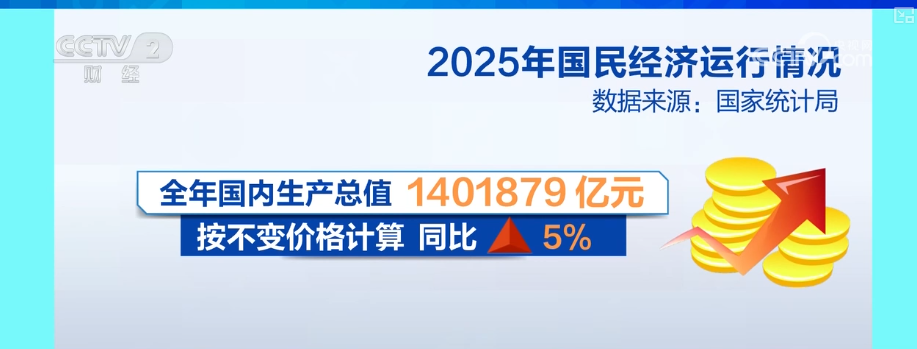
央视网消息:国务院新闻办公室1月19日上午举行新闻发布会,国家统计局发布2025年全年经济数据。2025年,全年国内生产总值突破140万亿 元,按不变价格计算,比上年增长5.0%。我国经济发展向新向优,预期目标圆满实现。 初步核算,全年国内生产总值1401879亿元,按不变价格计算,比上年增长5.0%。分季度看,一季度国内生产总值同比增长5.4%,二季度增长 5.2%,三季度增长4.8%,四季度增长4.5%。 分产业看,第一产业增加值93347亿元,比上年增长3.9%;第二产业增加值499653亿元,增长4.5%;第三产业增加值808879亿元,增长5.4%。 粮食增产丰收,全年全国粮食总产量71488万吨,比上年增加838万吨,增长1.2%。 工业生产较快增长,全年全国规模以上工业增加值比上年增长5.9%。装备制造业和高技术制造业增势较好。3D打印设备、工业机器人、新能 源汽车 产品产量分别增长52.5%、28%、25.1%。 此外,服务业平稳增长,全年服务业增加值比上年增长5.4%,现代服务业发展良好。 从投资看,全年全国固定资产投资(不含农户)485186亿元,制造业投资保持增长。 全国规模以上工业增加 ...
国家统计局:2025年我国国内生产总值突破140万亿元 增长5.0%
Jing Ji Guan Cha Bao· 2026-01-19 02:25
Economic Overview - In 2025, China's GDP reached 1401879 billion yuan, growing by 5.0% year-on-year, with the first, second, and third industries growing by 3.9%, 4.5%, and 5.4% respectively [1] - Quarterly GDP growth rates were 5.4% in Q1, 5.2% in Q2, 4.8% in Q3, and 4.5% in Q4, with a 1.2% increase in Q4 on a quarter-on-quarter basis [1] Agriculture - National grain production totaled 71488 million tons, an increase of 838 million tons or 1.2% from the previous year [2] - Livestock production reached 10072 million tons, a 4.2% increase, with pork production at 5938 million tons, growing by 4.1% [2] Industrial Production - Industrial value-added for large enterprises grew by 5.9%, with manufacturing increasing by 6.4% and high-tech manufacturing by 9.4% [3] - The production of 3D printing equipment, industrial robots, and new energy vehicles saw significant increases of 52.5%, 28.0%, and 25.1% respectively [3] Services Sector - The service sector's value-added grew by 5.4%, with information transmission and software services increasing by 11.1% [4] - The service industry business activity index was at 49.7 in December, indicating stable growth [4] Retail and Consumption - Total retail sales of consumer goods reached 501202 billion yuan, growing by 3.7%, with online retail sales increasing by 8.6% [5] - The retail sales of essential and upgraded goods showed strong growth, with communication equipment sales up by 20.9% [5] Investment Trends - Fixed asset investment decreased by 3.8% to 485186 billion yuan, with manufacturing investment growing by 0.6% [6] - High-tech industries, particularly information services and aerospace manufacturing, saw investment growth of 28.4% and 16.9% respectively [6] Trade Performance - Total goods import and export value reached 454687 billion yuan, a 3.8% increase, with exports growing by 6.1% [7] - Private enterprises accounted for 57.3% of total trade, reflecting a 1.8 percentage point increase from the previous year [7] Price Stability - The Consumer Price Index (CPI) remained stable year-on-year, with food prices decreasing by 0.7% [8] - Core CPI, excluding food and energy, rose by 0.7%, indicating mild inflationary pressure [8] Employment and Income - The urban unemployment rate averaged 5.2% for the year, with a slight decrease to 5.1% in December [9] - Per capita disposable income reached 43377 yuan, with rural income growth outpacing urban income growth [11] Demographic Changes - The total population decreased by 3.39 million to 140489 million, with an urbanization rate of 67.89%, up by 0.89 percentage points [12] Economic Outlook - The economy is expected to face challenges from external changes and domestic supply-demand imbalances, necessitating proactive macroeconomic policies [13]
5.0%!突破140万亿元!2025年GDP出炉
证券时报· 2026-01-19 02:13
2025年GDP数据出炉。 据国家统计局数据,2025年全年国内生产总值1401879亿元,按不变价格计算,比上年增长5.0%。分产业看,第一产业增加值93347亿元,比 上年增长3.9%;第二产业增加值499653亿元,增长4.5%;第三产业增加值808879亿元,增长5.4%。分季度看,一季度国内生产总值同比增长 5.4%,二季度增长5.2%,三季度增长4.8%,四季度增长4.5%。从环比看,四季度国内生产总值增长1.2%。 一、粮食增产丰收,畜牧业稳定增长 全年全国粮食总产量71488万吨,比上年增加838万吨,增长1.2%。其中,夏粮产量14975万吨,下降0.1%;早稻产量2851万吨,增长1.2%;秋 粮产量53662万吨,增长1.5%。分品种看,小麦产量14007万吨,基本持平;玉米产量30124万吨,增长2.1%;稻谷产量20904万吨,增长 0.7%;大豆产量2091万吨,增长1.3%。全年猪牛羊禽肉产量10072万吨,比上年增长4.2%,首次超过1亿吨。其中,猪肉产量5938万吨,增长 4.1%;牛肉产量801万吨,增长2.8%;羊肉产量496万吨,下降4.2%;禽肉产量2837万吨,增长 ...

日照出台20条举措,促进高质量充分就业
Qi Lu Wan Bao· 2026-01-17 17:24
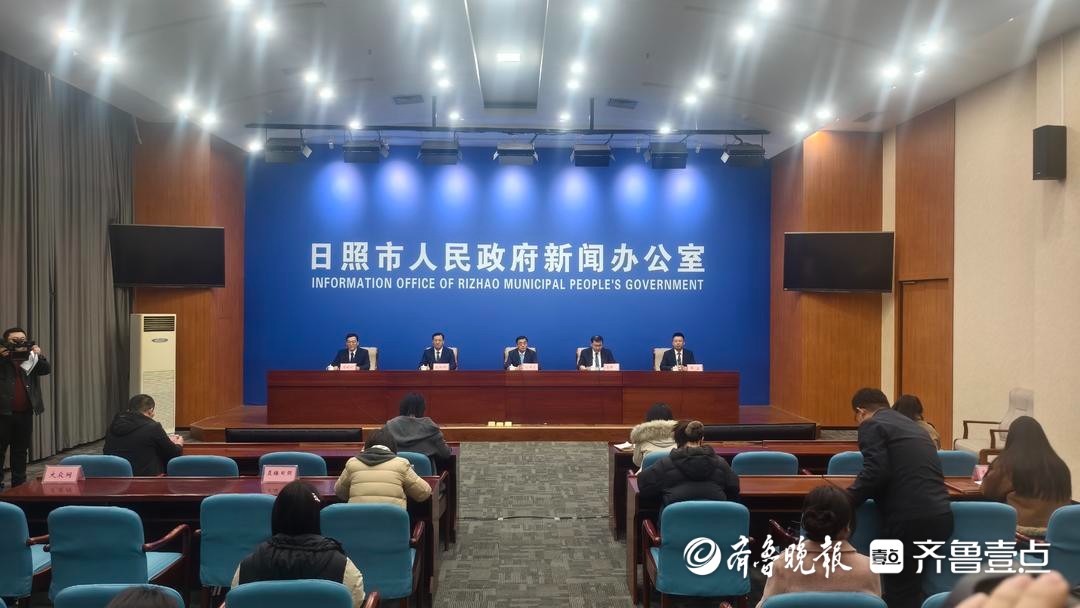
Core Viewpoint - Rizhao City is implementing measures to promote high-quality and full employment, focusing on enhancing employment capacity and addressing structural employment issues while aligning with local economic development needs [3][4]. Group 1: Employment Goals and Strategies - The overall goal is to achieve an annual urban employment increase of over 26,000 by 2030 and over 30,000 high-skilled workers, maintaining overall employment stability [4]. - By 2035, the aim is to create a high-quality employment environment characterized by sufficient job opportunities, optimized employment structure, and effective job matching [4]. Group 2: Employment Capacity and Structural Issues - The strategy emphasizes the need for collaboration between industry and employment, focusing on upgrading traditional industries and developing new ones to create job opportunities [4]. - Policies will be coordinated to integrate high-quality employment into economic and social development plans, establishing an employment-friendly development model [4]. Group 3: Employment Services and Support - A public employment service system will be enhanced, including the establishment of youth employment and entrepreneurship centers and the promotion of a "creation + loan" service model [5]. - The initiative includes upgrading grassroots employment services and implementing a "smart employment" service model to improve information technology in employment services [5]. Group 4: Employment Monitoring and Support for Key Groups - An employment early warning mechanism will be established, including a labor force survey system and a monitoring framework for high-quality employment statistics [5]. - The focus will be on providing comprehensive employment services for key groups, including college graduates and migrant workers, ensuring their job stability [6].
有钱花+有时间花!国务院部署促消费
Sou Hu Cai Jing· 2026-01-17 07:16
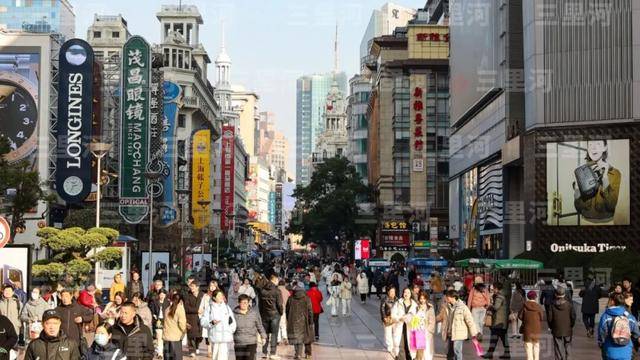
消费,一头连着老百姓的柴米油盐,一头连着宏观经济的冷暖。促消费正是今年经济工作的重头戏。 如何进一步促消费?1月16日召开的国务院常务会议,听取提振消费专项行动进展情况汇报并研究加快 培育服务消费新增长点等促消费举措。 一系列重要部署,既延续了政策的连贯性与稳定性,又精准瞄准消费新潜力,打出了一套兼顾当下与长 远的组合拳。 国家发展改革委宏观经济研究院决策咨询部副主任黄卫挺对三里河表示,服务消费是消费升级的主力方 向,也是提振消费的重点所在,这些重要部署将有效释放服务消费潜力。 在他看来,当前制约服务消费的重要因素是优质供给不足,会议针对背后的关键原因,强调解决好服务 业信用、标准和安全管理等问题,具有很强的现实针对性,有助于促进服务业大发展、大繁荣,加快推 动形成由现代服务业主导的产业体系。 2026年1月7日,上海,2026"购在中国"暨新春消费季活动在南京路步行街举行。 去年以来的提振消费专项行动已见成效,政策红利持续释放。 2025年,以旧换新相关商品销售额超2.6万亿元,惠及超3.6亿人次。这一成果,既让居民以更实惠的价 格换上了心仪的新产品,也为产业发展注入了强劲动能。 会议进一步提出,要深入实施 ...
英经济2025年11月份环比增长0.3% 超过预期
Shang Wu Bu Wang Zhan· 2026-01-17 04:37
Group 1 - The UK GDP is projected to grow by 0.3% in November 2025, driven by Jaguar Land Rover's recovery from a cyberattack, marking the fastest growth since June 2025 [1] - Industrial output increased by 1.1%, with the automotive sector experiencing a significant 25% rise, the largest monthly increase since July 2020 [1] - The services sector also performed better than expected, growing by 0.3% in November after a contraction of 0.3% in October [1] Group 2 - Deutsche Bank's chief economist Sanjay Raja suggests that the better-than-expected November data and reduced uncertainty regarding the budget may lead to stronger economic growth in early 2026 [2] - Despite promises from the Prime Minister and Chancellor to boost economic growth, there has been no substantial change in the UK economy 18 months after the Labour Party's election victory [2] - A survey indicated that UK businesses reached their highest level of pessimism in two years by the end of 2025, although there were signs of optimism in the real estate market in December 2025 [2]
【数说经济】“公共服务随人走”意味什么
Jing Ji Ri Bao· 2026-01-16 07:22
Core Insights - The State Council's recent meeting emphasizes the transition from household registration-based public service provision to residence-based services, aiming to address the urgent needs of the unregistered permanent population [1][2] - The shift will allow unregistered residents to access equal public services in education, healthcare, social security, and housing, breaking the rigid link between public services and household identity [1][2] Group 1: Demographics and Needs - The unregistered permanent population is primarily composed of new-generation migrant workers who are better educated and more eager to integrate into urban life [2] - There is a growing trend of families migrating together rather than individuals, leading to increased demand for comprehensive public services related to education, healthcare, and housing [2] - Major inflow areas include developed eastern coastal regions and key city clusters, resulting in significant public service supply-demand imbalances in these regions [2] Group 2: Economic Implications - Providing public services based on residence is crucial for unlocking domestic demand and increasing investment in human capital [3] - Research indicates that once farmers transition to urban permanent residents, their per capita consumption can increase by 30%, with an additional 30% increase after settling in urban areas [3] - A 1% increase in urbanization rate can generate over 200 billion yuan in consumer demand and more than 1 trillion yuan in investment demand [3] Group 3: Policy Implementation - The meeting outlines targeted measures to address pressing issues in education, housing, and social security, including improving policies for the education of migrant children and expanding public rental housing [3][4] - Emphasis is placed on a scientific and regionally tailored approach to policy implementation, allowing for local exploration while maintaining a unified national policy framework [3][4] - The reform aims to enhance the attractiveness and livability of cities, shifting the focus from GDP and large projects to human-centric development and overall quality of life [4]
《经济日报》金观平:坚持把实体经济作为发展着力点
Jing Ji Ri Bao· 2026-01-16 02:49
Group 1 - The core focus of economic development should be on the real economy, emphasizing the optimization and upgrading of traditional industries while nurturing emerging and future industries [1] - As of 2024, China's manufacturing sector has maintained its position as the largest in the world for 15 consecutive years, providing a solid foundation for economic stability [1] - The real economy serves as a major channel for job creation, providing billions of jobs and reinforcing social stability [1] Group 2 - The development of the real economy faces significant challenges, including pressure on traditional industries to upgrade, resource and environmental constraints, and a lag in high-end and intelligent manufacturing [2] - There is a notable gap in core technology capabilities, with weak basic research and low patent conversion rates, alongside high financing costs for small and medium-sized enterprises [2] - To strengthen the foundation of the real economy, it is essential to optimize traditional industries through technological innovation, digital transformation, and a focus on green and low-carbon development [2] Group 3 - Strengthening the real economy also involves the development of emerging and future industries, which can drive collaborative upgrades across the industrial chain and create new demand [3] - The service sector is a crucial component of the real economy, and its efficient development can facilitate manufacturing upgrades and enhance employment opportunities [3] - Ultimately, the goal is to establish a modern industrial system centered on advanced manufacturing, balancing domestic and international markets while promoting quality and brand transformation in Chinese products [3]