石化化工

Search documents
中美贸易争端再起,行业基本面迎考验
Orient Securities· 2025-10-12 10:13
Investment Rating - The industry investment rating is maintained as "Positive" [5] Core Viewpoints - The basic chemical industry is facing short-term challenges due to renewed US-China trade disputes, which have raised concerns about demand and led to a significant drop in international oil prices, with Brent crude oil prices falling by 4.8% [8] - Despite short-term pressures, the long-term outlook for the petrochemical industry remains positive, as high tariffs from trade disputes are unlikely to have a lasting impact, and domestic companies have gained valuable experience in navigating such challenges [8] - The green low-carbon sector is expected to become a new industry trend, with significant market potential for green methanol, bio-aviation fuel, and green polyester, which are anticipated to achieve rapid growth as they align with sustainable development goals [8] Summary by Sections Investment Recommendations and Targets - The report recommends buying shares of Wan Kai New Materials (301216) for its leading position in the green polyester industry. Other recommended stocks include: - Runfeng Co., Ltd. (301035) - Guoguang Co., Ltd. (002749) - Hailier (603639) - Sinopec (600028) - Hengli Petrochemical (600346) - Rongsheng Petrochemical (002493) - Wanhua Chemical (600309) - Huayi Group (600623) [3]




中国石油和化学工业联合会解读《石化化工行业稳增长工作方案(2025—2026年)》
Zhong Guo Hua Gong Bao· 2025-10-11 01:12
Core Viewpoint - The "Work Plan" for the petrochemical industry aims to stabilize growth and facilitate transformation, aligning with national economic strategies and addressing current challenges in the sector [1][2][3] Group 1: Industry Context and Challenges - The petrochemical industry is a foundational sector with significant economic volume and high industrial interconnectivity, crucial for supply chain stability and economic performance [2][3] - The industry has faced declining profit levels for three consecutive years, with a projected profit drop of 8.8% in 2024 compared to the previous year, alongside a decrease in import and export totals [2][4] - The shift from a growth-driven model focused on capacity expansion to one emphasizing efficiency and transformation is necessary due to intensified competition and reduced profitability [4][6] Group 2: Objectives and Measures of the Work Plan - The "Work Plan" emphasizes quality and efficiency, aiming for economic stabilization and recovery, with a focus on enhancing high-end supply and addressing structural weaknesses [3][4] - Key measures include scientific regulation of major project construction, controlling new refining capacity, and preventing overcapacity risks in coal-to-methanol production [4][6] Group 3: Innovation and Technological Advancement - The plan promotes the establishment of standardized management for pilot projects to enhance innovation and streamline approval processes, thereby facilitating the commercialization of research outcomes [5][6] - Specific initiatives include bundling approval processes for pilot projects and simplifying environmental assessments for projects that only change raw materials and products [5][6] Group 4: Safety and Environmental Upgrades - Upgrading existing facilities and production systems is crucial for cost reduction and enhancing safety and environmental standards, with significant potential for improvement in older installations [6][7] - The plan outlines actions for the safe upgrade of outdated facilities and encourages digital and green transformations within the industry [6][7] Group 5: Standardization and Regulatory Framework - The industry faces a growing need for a robust standardization framework to support production and governance, particularly in light of new materials and low-carbon initiatives [7][8] - The "Work Plan" sets forth requirements for developing standards related to pollution reduction, carbon footprint assessment, and digital transformation maturity [7][8]

当好“稳定器” 做好“压舱石”——中国石油和化学工业联合会解读《石化化工行业稳增长工作方案(2025—2026年)》
Zhong Guo Hua Gong Bao· 2025-10-10 02:43
Core Viewpoint - The Ministry of Industry and Information Technology, along with five other departments, has released the "Work Plan for Stable Growth in the Petrochemical Industry (2025-2026)", which outlines clear requirements for the stable growth objectives, tasks, and support measures for the petrochemical industry in the coming two years [1][3]. Group 1: Industry Context and Challenges - The petrochemical industry plays a crucial role as a foundational and pillar industry in the national economy, with significant economic volume and high industrial relevance [2]. - The industry has faced declining profit levels for three consecutive years, with a projected profit drop of 8.8% in 2024 compared to the previous year, alongside a decrease in total import and export volume for two years [2][4]. - The industry's profit total is expected to decline from 1.16 trillion yuan in 2021 to 789.7 billion yuan in 2024, representing a decrease of over 30%, with revenue profit margins dropping from 8% to below 5% [4]. Group 2: Work Plan Objectives and Measures - The "Work Plan" emphasizes quality and efficiency, aiming for a stable recovery in economic benefits and promoting high-quality development throughout the industry [3][4]. - Key measures include enhancing high-end supply, addressing structural weaknesses, and promoting the quality upgrade of bulk products [4]. - The plan also highlights the need for scientific control over major project construction and the prevention of overcapacity risks in specific sectors [4]. Group 3: Innovation and Project Management - The plan proposes to streamline the management of pilot projects in the petrochemical sector to enhance innovation capabilities and facilitate the industrialization of research outcomes [5][6]. - It suggests simplifying approval processes for pilot projects and encourages local governments to establish clear conditions for the circulation of pilot project products [6]. Group 4: Safety and Environmental Upgrades - The plan outlines the importance of upgrading existing facilities and production systems to improve safety and environmental standards, particularly in older installations [7]. - It includes initiatives for digital and green transformations, supporting enterprises in energy-saving and pollution reduction efforts [7]. Group 5: Standardization and Regulatory Framework - The "Work Plan" stresses the need for a robust standardization framework to support the petrochemical industry's production and operational governance [8]. - It calls for the development of new standards in response to emerging industries and environmental challenges, including carbon footprint assessment and digital transformation standards [8].
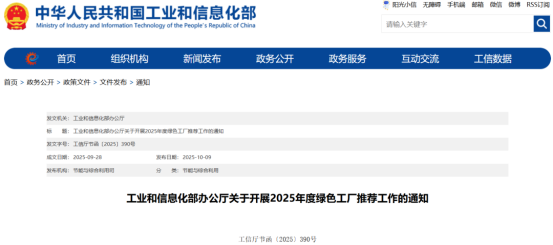
工信部发布《关于开展2025年度绿色工厂推荐工作的通知》
Zhong Guo Neng Yuan Wang· 2025-10-10 01:35
Core Viewpoint - The Ministry of Industry and Information Technology (MIIT) has announced the 2025 Green Factory Recommendation Work, focusing on energy conservation and carbon reduction to enhance the green competitiveness of industries, supporting enterprises in 53 key sectors [1][4]. Group 1: Overall Requirements - The recommendation work includes green factories and green industrial parks, with enterprises or parks meeting the requirements voluntarily conducting self-evaluations based on new evaluation criteria [2][4]. - Provincial industrial and information departments will select enterprises or parks based on the principle of "choosing the best among the best" and ensuring that recommended entities meet or exceed the average level of existing national green factories and parks in their regions [2][4]. Group 2: Specific Requirements - New applicants for national green factories and industrial parks must register on the management platform, complete self-evaluations, and provide supporting materials without needing third-party evaluation reports [3][4]. - Existing national green factories and parks must also log onto the management platform for self-evaluation against new criteria, with those scoring in the bottom 5% for three consecutive years being removed from the list [5][6]. Group 3: Work Requirements - Provincial departments are required to enhance the verification of data and supporting materials for enterprises or parks to ensure the quality of recommendations, with a deadline for submission set for November 7, 2025 [6]. - Experts from MIIT will review the recommended lists, ensuring a rigorous selection process, and any entity found to have falsified data will be removed from the list and barred from reapplying for three years [6]. Group 4: Key Industry List - The key industries supported in this initiative include steel, petrochemical, non-ferrous metals, building materials, machinery, light industry, textiles, and electronics [12].

我省每年开展一次重点行业能效“领跑者”认定
Da Zhong Ri Bao· 2025-10-10 00:57
Core Viewpoint - Shandong Province has introduced a management method for selecting energy efficiency "leaders" in key industries, aiming to enhance overall energy utilization efficiency across the sector through annual recognition and promotion of advanced practices [1] Summary by Relevant Categories Policy and Implementation - The Shandong Provincial Department of Industry and Information Technology, along with the Provincial Development and Reform Commission and the Provincial Market Supervision Administration, will conduct annual assessments to identify energy efficiency "leaders" in key industries [1] - The recognized companies will be prioritized for national energy efficiency "leader" applications and provincial green manufacturing demonstration units [1] Definition and Scope - Energy efficiency "leaders" are defined as enterprises within Shandong that achieve energy consumption indicators meeting or exceeding national mandatory limits and benchmarks while continuously improving energy utilization efficiency [1] - Key industries include petrochemical, steel, non-ferrous metals, building materials, light industry, and textiles, covering 38 specific sub-industries such as crude oil processing and coal-to-chemical production [1] Evaluation Process - The Provincial Department of Industry and Information Technology will collaborate with other provincial bodies to review applications submitted by cities and select the energy efficiency "leaders" based on expert evaluations [1] - The title of energy efficiency "leader" is valid for one year [1]
事关绿色工厂,工信部通知!
中国能源报· 2025-10-09 11:05
Core Viewpoint - The Ministry of Industry and Information Technology (MIIT) has initiated the 2025 Green Factory Recommendation Work to enhance energy conservation and carbon reduction, focusing on 53 key industries to improve the green competitiveness of enterprises [1][5]. Group 1: Overall Requirements - The recommendation work includes both green factories and green industrial parks, with enterprises or parks voluntarily conducting self-evaluations based on new evaluation criteria [5][6]. - Provincial industrial and information departments will select enterprises or parks that meet the requirements, ensuring that recommended entities are at least at the average level of existing national green factories and parks in their regions [5][6]. Group 2: Specific Requirements - New applicants for national green factories and parks must register on the Industrial Energy Conservation and Green Development Management Platform and complete self-evaluations without needing third-party evaluation reports [6][7]. - Existing national green factories and parks are required to conduct self-evaluations against new criteria, with those scoring in the bottom 5% for three consecutive years being removed from the list [6][7]. Group 3: Work Requirements - Provincial departments must ensure the authenticity and accuracy of data and supporting materials submitted by enterprises or parks, with a deadline for submission set for November 7, 2025 [7]. - The MIIT will review the recommended lists and publicize the final list of 2025 green factories and parks, with penalties for any falsification of data [7]. Group 4: Key Industries - The 53 key industries supported in this initiative include sectors such as steel, petrochemicals, non-ferrous metals, building materials, machinery, light industry, textiles, and electronics [14][15][16][17][18][19][20].
七部门联合部署石化化工行业2025-2026年稳增长工作,双氧水、氢氟酸价格上涨 | 投研报告
Zhong Guo Neng Yuan Wang· 2025-10-09 02:42
Core Viewpoint - The joint release of the "Petrochemical Industry Stabilization and Growth Work Plan (2025-2026)" by seven government departments aims to address industry bottlenecks and promote stable operation and structural optimization in the petrochemical sector [1][3]. Group 1: Policy and Industry Outlook - The "Work Plan" outlines ten key tasks across five major directions to create a dual driving force for growth and transformation in the petrochemical industry [3]. - The plan is a collaborative effort involving the Ministry of Industry and Information Technology, Ministry of Ecology and Environment, Ministry of Emergency Management, People's Bank of China, State Administration for Market Regulation, National Financial Supervision Administration, and the All-China Federation of Supply and Marketing Cooperatives [1][3]. Group 2: Market Performance - The top five chemical products with price increases this week include hydrogen peroxide (+16.7%), anhydrous hydrofluoric acid (+10.5%), coking coal (+7.1%), paraquat (+6.3%), and Brent crude oil (+5.2%) [1][5]. - The WTI oil price rose by 4.9% to $65.72 per barrel this week [4]. Group 3: Subsector Analysis - The prices of DMF, organic silicon, titanium dioxide, acetic acid, and caustic soda increased by 2.6%, 0.9%, 0.8%, 0.3%, and 0.1%, respectively [5]. - Conversely, the prices of VE, urea, ethylene glycol, calcium carbide PVC, VA, rubber, polymer MDI, liquid methionine, ethylene PVC, and solid methionine decreased by 7.3%, 1.8%, 1.4%, 1.1%, 0.8%, 0.7%, 0.6%, 0.6%, 0.3%, and 0.2%, respectively [5]. Group 4: Sector Performance - The basic chemical sector increased by 0.32% this week, underperforming the CSI 300 index, which rose by 1.07%, resulting in a 0.75 percentage point lag [7]. - The sub-industries with significant weekly gains include synthetic resin (+15.49%), rubber additives (+12.33%), coatings and inks (+5.22%), polyester (+3.74%), and viscose (+2.26%) [7].
石化化工行业稳增长工作方案发布,关注“反内卷”与新材料 | 投研报告
Zhong Guo Neng Yuan Wang· 2025-10-09 01:09
Market Performance - The basic chemical index decreased by 0.95% from September 20 to September 26, while the CSI 300 index increased by 1.07%, indicating that the basic chemical sector underperformed the CSI 300 by 2.02 percentage points, ranking 17th among all sectors [1][2] - The top-performing sub-industries included: organic silicon (15.44%), rubber additives (7.52%), synthetic resin (2.86%), viscose (2.73%), and coatings and inks (1.79%) [1][2] Price Trends - The top five products with the highest weekly price increases were: hydrochloric acid (Shandong) at 102.50%, hydrochloric acid (Jiangsu) at 100.00%, liquid chlorine at 33.33%, hydrofluoric acid at 10.85%, and Brent crude oil at 5.17% [3] - The top five products with the largest weekly price declines were: sulfuric acid at -10.91%, domestic vitamin B6 at -9.09%, domestic vitamin E at -7.69%, paraxylene (PX) at -5.56%, and methyl acrylate at -4.26% [3] Industry Developments - The "Stabilization and Growth Work Plan for the Petrochemical and Chemical Industry (2025-2026)" was jointly issued by seven departments, focusing on "anti-involution" and optimizing industrial structure [4] - The plan aims for an average annual growth of over 5% in the added value of the petrochemical and chemical industry from 2025 to 2026, with significant improvements in economic benefits and innovation capabilities [4] - Key tasks include enhancing innovation in electronic chemicals, high-end polyolefins, and special rubber, as well as expanding effective investment while controlling new refining capacity [4] Investment Recommendations - Suggested focus areas include: refrigerants sector, with potential price increases; chemical fiber sector; high-quality companies such as Wanhua Chemical and Hualu Hengsheng; tire sector; agricultural chemicals sector; and high-growth companies like Bluestar Technology and Shengquan Group [5] Industry Rating - The basic chemical industry maintains an "overweight" rating [6]
石化化工市场机会在哪儿?分析人士:长期看这三大赛道|观策论市
Qi Huo Ri Bao· 2025-10-04 23:47
Core Viewpoint - The "Stabilizing Growth Work Plan for the Petrochemical Industry (2025-2026)" emphasizes a transformation direction of "stabilizing total volume and optimizing structure," avoiding a one-size-fits-all approach to capacity reduction [1][2] Policy Impact on Chemical Prices - The plan focuses on controlling new capacity and upgrading existing facilities rather than eliminating current capacity, indicating that supply will not significantly shrink in the short term [1][2] - The core contradiction in the chemical market remains high capacity investment with weak demand, leading to a pessimistic market outlook despite policy changes [2] Specific Chemical Products Analysis - The plan supports refining enterprises to "reduce oil and increase chemicals," which may increase the total supply of chemical products, particularly affecting prices of basic chemicals like synthetic resins and ethylene glycol [2][5] - PX is viewed positively by multiple institutions due to the peak of capacity expansion being over, with no new capacity expected from 2024 to 2025, leading to a favorable supply-demand balance [3][4] - Ethylene is still in a capacity expansion cycle, and while the policy may slow down supply growth, the basic market remains loose, with price fluctuations expected to be limited [4] Long-term Market Opportunities - The policy aims to curb blind capacity expansion and improve the supply-demand mismatch, potentially increasing industry profit margins by 3-5 percentage points by 2026 [3] - Long-term investment opportunities are identified in three areas: high-end fine chemicals, green transition sectors, and companies with integrated layouts and technological advantages [5] Short-term Trading Strategies - Short-term trading strategies should focus on "swing trading" to avoid blind chasing of price increases, with attention to short-term mismatches due to policy windows and facility maintenance [6] - Investors are advised to be cautious of the potential for policy expectations to be overvalued in the market, particularly in high-end products [6]
石化化工市场机会在哪儿?分析人士:长期看这三大赛道
Qi Huo Ri Bao· 2025-10-04 23:27
Core Viewpoint - The "Stabilizing Growth Work Plan for the Petrochemical Industry (2025-2026)" emphasizes a transformation direction of "stabilizing total volume and optimizing structure," avoiding a one-size-fits-all approach to capacity reduction and focusing on controlling new capacity and upgrading existing facilities [1][3]. Policy Impact on Chemical Prices - The policy aims to control new capacity in traditional sectors like refining and ethylene while promoting upgrades of existing facilities, indicating that there will not be a significant contraction in supply in the short term [1][2]. - The core contradiction in the chemical market remains high capacity investment against weak demand, leading to a pessimistic market outlook despite policy changes [2]. Specific Chemical Products Analysis - The plan supports refining enterprises to "reduce oil and increase chemicals," which may increase the total supply of chemical products, particularly affecting prices of basic chemicals like synthetic resins and ethylene glycol negatively [2]. - PX is viewed positively by multiple institutions due to the peak of capacity expansion being over, with no new capacity expected from 2024 to 2025, leading to a more stable supply-demand balance [3][4]. - Ethylene is still in a capacity expansion cycle, and while the policy may slow down supply growth, the basic market conditions are unlikely to improve significantly in the short term [5]. Long-term Market Opportunities - The policy's long-term value lies in curbing blind capacity expansion and alleviating capacity mismatch issues, with potential profit margins in the industry expected to rise by 3-5 percentage points by 2026 if the policy is effectively implemented [3][6]. - Long-term investment opportunities are identified in three main areas: high-end fine chemicals, green transition sectors, and companies with integrated layouts and technological advantages [6]. Short-term Trading Strategies - For short-term trading from Q4 2025 to early 2026, a "swing trading" approach is recommended, focusing on short-term mismatches due to policy windows and maintenance schedules [7]. - Investors are advised to be cautious of the potential for policy expectations to be overvalued in the market, particularly in high-end products, and to wait for corrections before making new investments [7].