高技术制造

Search documents
7月经济发展“进”的步伐稳健 高质量发展取得新成效
Zhong Guo Chan Ye Jing Ji Xin Xi Wang· 2025-08-20 23:56
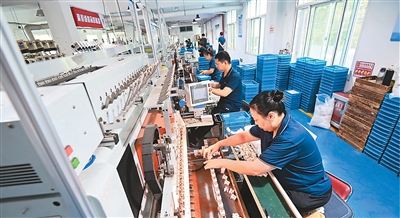
Economic Performance Overview - In July, the industrial added value of large-scale enterprises increased by 5.7% year-on-year, indicating stable growth in production supply [1][2] - The total retail sales of consumer goods rose by 3.7% year-on-year, with retail sales of goods increasing by 4% [2][4] - The total import and export volume of goods grew by 6.7% year-on-year, reflecting resilience in foreign trade [1][2] Sectoral Growth Insights - The equipment manufacturing sector saw an increase of 8.4% in added value, outpacing the overall industrial growth rate [2] - High-tech manufacturing added value grew by 9.3%, continuing to exceed the industrial growth rate [3] - The production index for information transmission, software, and IT services rose by 11.9%, while leasing and business services increased by 8% [3] Consumer Market Dynamics - The combined retail of goods and services is estimated to have grown by around 5% year-on-year from January to July, indicating a stable upward trend in consumption [4][5] - The "old for new" consumption policy has positively impacted sales of home appliances, cultural office supplies, furniture, and communication equipment, with respective growth rates of 28.7%, 13.8%, 20.6%, and 14.9% [4] - The tourism and leisure sectors experienced double-digit growth in retail sales, driven by increased consumer demand during the summer [4] Policy and Future Outlook - The government plans to continue implementing measures to boost consumption, focusing on expanding both goods and service consumption [5][7] - Despite facing challenges, the long-term supportive conditions for economic growth remain unchanged, with a focus on stabilizing employment, enterprises, and market expectations [7][8] - The International Monetary Fund has raised its growth forecast for China's economy by 0.8 percentage points, reflecting increased confidence from the international community [8]
解码制造业高质量发展之路
Jing Ji Ri Bao· 2025-08-20 00:10
Core Viewpoint - The manufacturing industry is emphasized as the foundation of national strength and economic development, with a focus on high-quality growth and strategic importance in the context of global changes and digital transformation [1][3]. Group 1: Manufacturing Industry Performance - In the first half of the year, the manufacturing value added grew by 7%, surpassing GDP growth by over 1 percentage point, indicating an increasing share of manufacturing in GDP [2]. - Manufacturing investment increased by 7.5%, significantly higher than the overall fixed asset investment growth of 2.8% [2]. - Exports of goods primarily from the manufacturing sector rose by 7.2%, showcasing manufacturing as a key driver of economic growth amid challenges in other sectors [2][3]. Group 2: Structural Trends in Manufacturing - High-end equipment manufacturing led growth with an increase of over 10%, outpacing overall manufacturing growth [2]. - High-tech manufacturing value added grew by 9.5%, exceeding the overall manufacturing growth rate by 2.5 percentage points, with significant increases in industrial robots and 3D printing equipment [2][3]. - The transformation of manufacturing is characterized by three trends: high-end, intelligent, and green development [3][4]. Group 3: Green Transformation - The production of new energy vehicles increased by over 10%, with rapid export growth in lithium batteries and wind power equipment [4][5]. - China's unique approach to green transformation integrates economic growth with environmental sustainability, avoiding the pitfalls of merely imposing costs [5][6]. Group 4: Challenges and Responses - The manufacturing sector faces challenges from external factors such as tariffs and technological restrictions, particularly affecting exports to the U.S. [6][7]. - Despite a decline in exports to the U.S., overall goods exports grew by 7.2%, driven by strong performance in emerging markets [7]. - The manufacturing sector's resilience is highlighted by its ability to adapt and maintain competitiveness through innovation and government support [7][8]. Group 5: Manufacturing Share and Reasonableness - The manufacturing share of GDP is projected to be around 24.9% in 2024, which is still significantly higher than the global average of approximately 15% [9][10]. - The decline in manufacturing share over the past decade reflects a natural evolution as economies develop, with a shift in demand from manufacturing to services as GDP per capita rises [9][10][11]. Group 6: Future Directions and Strategies - The future direction of manufacturing includes maintaining a reasonable share, enhancing technological capabilities, and focusing on high-value-added products [23][24]. - Key areas for development include traditional industries, emerging sectors like new energy vehicles and biopharmaceuticals, and future industries such as artificial intelligence [24][25]. - The integration of various industries through common-purpose technologies is essential for driving innovation and maintaining competitiveness in the global market [25].
解码制造业高质量发展之路——对话国务院发展研究中心产业经济研究部部长田杰棠
Jing Ji Ri Bao· 2025-08-19 22:33
Core Insights - The manufacturing industry is emphasized as the foundation of national strength and economic development, with a focus on high-quality growth and strategic importance in the context of global changes [1][3][23]. Manufacturing Industry Development Trends - In the first half of the year, manufacturing value added grew by 7%, outpacing GDP growth by over 1 percentage point, indicating an increasing share of manufacturing in GDP [2][3]. - Manufacturing investment increased by 7.5%, significantly higher than the overall fixed asset investment growth of 2.8% [2]. - Exports of manufacturing products rose by 7.2%, showcasing manufacturing as a key driver of economic growth amid challenges in other sectors like real estate [2][3]. Structural Changes in Manufacturing - High-end equipment manufacturing saw value added growth exceeding 10%, indicating a shift towards advanced manufacturing [2][3]. - High-tech manufacturing value added grew by 9.5%, surpassing the overall manufacturing growth rate by 2.5 percentage points, with significant increases in industrial robots and 3D printing equipment [2][3]. Trends in High-end, Intelligent, and Green Manufacturing - The transformation of manufacturing is characterized by high-end, intelligent, and green development, with significant progress in high-tech industries and equipment [3][4]. - The integration of artificial intelligence into manufacturing processes is increasing, with examples of AI applications in production and the development of intelligent robots [4][5]. - The production of new energy vehicles and related products is growing rapidly, contributing to the green transformation of the economy [4][5]. Policy Support and Market Dynamics - Government policies have played a crucial role in supporting manufacturing, with increased funding and expanded product coverage under the "two new" policies [6]. - Despite challenges such as price index declines and demand pressures, the manufacturing sector remains resilient and is seen as a core growth driver for the economy [6][7]. Export Dynamics and Global Market Position - While exports to the U.S. have declined due to tariffs, overall goods exports still grew by 7.2%, driven by strong performance in emerging markets [7][8]. - The competitiveness of Chinese manufacturing is highlighted by the high proportion of electromechanical products in total exports, which reached 60% [7][8]. Future Manufacturing Strategy - The manufacturing sector's share of GDP is projected to be around 24.9% in 2024, which is still above the global average of approximately 15% [9][10]. - Maintaining a reasonable share of manufacturing is essential, with a focus on balancing supply and demand dynamics and avoiding excessive declines [9][10][11]. - The future direction includes enhancing technological capabilities, product quality, and cultural value in manufacturing [23][24]. Key Areas for Development - Traditional industries are encouraged to innovate and learn from global best practices, while emerging industries like new energy vehicles and biopharmaceuticals are identified as future pillars of growth [24][25]. - Investment in future industries, particularly in general-purpose technologies, is crucial for driving innovation and maintaining competitiveness [25][26].
主要指标总体平稳 新质生产力稳步发展
Si Chuan Ri Bao· 2025-08-18 22:47
Economic Performance - The industrial added value of large-scale industries in Sichuan increased by 7.2% year-on-year, outpacing the national growth rate by 0.9 percentage points [1] - In July, the industrial added value grew by 7.6% year-on-year, exceeding the national average by 1.9 percentage points [1] - Among 41 major industrial categories, 35 experienced growth, indicating a stable growth rate of over 80% across industries [1] Key Industries - The automotive manufacturing sector saw a significant increase in added value, growing by 19.8% year-on-year [1] - The computer, communication, and other electronic equipment manufacturing industries reported a 15.0% increase in added value [1] - Production of smartwatches and integrated circuits surged by 109.3% and 13.2% respectively [1] - Lithium-ion battery production rose by 50.5% year-on-year [1] Investment Trends - Fixed asset investment (excluding rural households) in Sichuan grew by 2.0% year-on-year, surpassing the national growth rate by 0.4 percentage points [1] - Investment in six key advantageous industries increased by 10.7%, accounting for 32.0% of total investment, which is 2.5 percentage points higher than the previous year [1] - High-tech manufacturing investment rose by 7.8%, outpacing overall manufacturing investment by 1.1 percentage points [1] - Clean energy industry investment saw a substantial increase of 22.3% [1] Consumer Market - The total retail sales of consumer goods in Sichuan reached 16,513.2 billion yuan, marking a year-on-year growth of 5.6%, which is 0.8 percentage points higher than the national average [1] - In July, retail and catering revenues from large enterprises through public networks grew by 34.7% and 29.3% year-on-year respectively [1] - The "old-for-new" policy had a notable impact, with retail sales of communication equipment increasing by 103.0% year-on-year [1]
权威解读丨从7月数据看中国经济增长点
Xin Hua Wang· 2025-08-18 07:34
Economic Performance - In July, the industrial production and service sectors experienced rapid growth, with the industrial added value of enterprises above designated size increasing by 5.7% year-on-year [1] - The service production index also saw a year-on-year increase of 5.8%, driven by increased tourism during the summer [1] Consumer Goods and Manufacturing - From January to July, retail sales of home appliances and audio-visual equipment increased by 30.4%, while communication equipment retail sales rose by 22.9% due to the "old for new" policy [5] - The equipment manufacturing industry added value grew by 9.9% year-on-year, supported by significant investments in water conservancy and electricity [5] High-tech Manufacturing - The added value of high-tech manufacturing above designated size increased by 9.5% from January to July, indicating steady growth in new driving forces [8] - Emerging industries such as 3D printing, industrial robots, and new energy vehicles showed remarkable growth [8] Economic Outlook - The International Monetary Fund raised its economic growth forecast for China by 0.8 percentage points, with several international investment banks upgrading China's asset ratings to "overweight" [10] - Experts anticipate that macro, meso, and micro policies will further strengthen efforts to stabilize employment, businesses, markets, and expectations [10]


华龙期货股指周报-20250818
Hua Long Qi Huo· 2025-08-18 02:41
1. Report Industry Investment Rating - Not provided in the given content 2. Core Viewpoints of the Report - Last week, the stock index futures continued to fluctuate upwards, but market differentiation intensified, showing the characteristic of "strong index, weak stocks". The core contradiction lies in the game between policy expectations and economic reality. The market presents a game feature of "policy support" and "fundamental pressure", and it is necessary to focus on the matching degree between policy implementation efficiency and marginal improvement of economic data. Maintain optimism in the medium - long term, but be vigilant against short - term fluctuations caused by repeated expectations of peripheral liquidity [31] 3. Summary by Relevant Catalogs Market Performance - On August 15, the three major A - share indexes continued their strong performance. The Shanghai Composite Index rose 0.83%, the Shenzhen Component Index rose 1.60%, and the ChiNext Index rose 2.61%. Most industry sectors rose, with only the banking sector falling. The trading volume of the Shanghai and Shenzhen stock markets exceeded 2 trillion for three consecutive days, with a turnover of more than 2.2 trillion on that day, slightly lower than the previous trading day [1] - Last week, treasury bond futures rose collectively. The 30 - year, 10 - year, 5 - year, and 2 - year treasury bond futures had respective price changes of - 1.48%, - 0.29%, - 0.15%, and - 0.02% [2] - Last week, the domestic stock index futures market strengthened collectively. The CSI 300 futures, SSE 50 futures, CSI 500 futures, and CSI 1000 futures had weekly increases of 3.09%, 2.19%, 4.88%, and 5.21% respectively [7] Fundamental Analysis - In July, the added value of industrial enterprises above designated size increased by 5.7% year - on - year, and by 0.38% month - on - month. From January to July, it increased by 6.3% year - on - year [8] - From January to July, the national real estate development investment was 535.8 billion yuan, a year - on - year decrease of 12.0%. Residential investment was 412.08 billion yuan, a decrease of 10.9%. Various indicators such as construction area, new construction area, and completion area all declined [8] - In July, the total retail sales of consumer goods was 3.878 trillion yuan, a year - on - year increase of 3.7%. From January to July, it was 28.4238 trillion yuan, a year - on - year increase of 4.8%. The central bank will focus on the supply - side to promote consumption [9] - Last week, the central bank conducted 711.8 billion yuan of reverse repurchase operations and had 1126.7 billion yuan of reverse repurchase maturities, with a net withdrawal of 414.9 billion yuan. It also carried out 500 billion yuan of 6 - month outright reverse repurchase operations. This week, there will be 711.8 billion yuan of reverse repurchase maturities and 22 billion yuan of treasury cash fixed - deposit maturities [10] Valuation Analysis - As of August 15, the PE, percentile, and PB of the CSI 300 Index were 13.42 times, 74.12%, and 1.42 times respectively; those of the SSE 50 Index were 11.55 times, 86.08%, and 1.28 times respectively; those of the CSI 500 Index were 30.95 times, 74.12%, and 2.09 times respectively; those of the CSI 1000 Index were 42.88 times, 69.8%, and 2.38 times respectively [14] - The stock - bond yield spread is the difference between the stock market yield and the treasury bond yield, with two calculation formulas provided [26] China - Buffett Indicator - On August 14, 2025, the ratio of total market capitalization to GDP was 81.59%. The percentile of the current "total market capitalization/GDP" in historical data was 78.56%, and in the last 10 - year data was 78.99% [29] Comprehensive Analysis - The consumer recovery momentum needs to be strengthened, but there are structural highlights in consumption. Industrial production is stable, and high - tech manufacturing continues to lead. Policy - wise, the loose tone of monetary policy remains unchanged, but the rebound of US PPI may restrict the inflow of foreign capital. Domestic fiscal policy is still being implemented, and the impact of special treasury bonds on infrastructure may appear in the third quarter. The market volatility remains low, and investors expect limited short - term breakthroughs [31] Operation Recommendations - Unilateral: Control risks, buy on dips, and avoid chasing highs [32] - Arbitrage: Wait and see [33] - Options: Consider the covered call strategy to increase returns [34]
聊聊近期的中美经济数据
2025-08-18 01:00
Summary of Key Points from Conference Call Records Industry Overview - The industrial production growth is differentiated, with the electronics, electrical machinery, and automotive sectors leading, contributing significantly to overall growth [1][2] - High-end equipment manufacturing, such as shipbuilding and mobile communication base stations, has seen a surge in output, while high-tech manufacturing is accelerating, particularly in integrated circuits [1][2] Core Insights and Arguments - **Industrial Growth**: Out of 41 industrial categories, 35 reported growth with an overall growth rate of 8%, slightly lower than June's figures. Equipment manufacturing grew at 8.4%, consistently outperforming overall industrial growth for 24 months [2] - **Fixed Asset Investment**: The overall growth rate of fixed asset investment has slowed to 1.6%, with real estate being a major drag. Excluding real estate, the growth rate is 5.3%. Manufacturing investment remains relatively stable at 6.2% [3][4] - **Real Estate Challenges**: The real estate market is facing a negative cycle of weak sales, reduced construction starts, and investment contraction. From January to July, real estate investment fell by 12%, with a monthly decline of 17% in July [5] - **Consumer Retail Trends**: The total retail sales of consumer goods grew by 3.7% year-on-year, showing a significant slowdown. However, policies promoting the replacement of old appliances have positively impacted retail sales in categories like home appliances [6] - **Service Consumption**: Service consumption grew by 5.2% from January to July, with a notable increase in travel and leisure services during the summer [7] Additional Important Insights - **Economic Forecast**: The economic growth rate for the third quarter is expected to be significantly lower than the second quarter, with real estate continuing to be a major drag on the economy. However, the target of 5% annual growth remains achievable [8] - **US Economic Data**: Recent US economic data, including CPI and PPI, showed mixed results. The PPI exceeded expectations, leading to market volatility, while the core CPI remains resilient [9][10] - **Inflation Dynamics**: Current inflation in the US appears manageable, with service prices rebounding, particularly in air travel and medical services. However, the prices of tariff-sensitive goods have shown mixed trends [10][11][12] - **Retail Performance in the US**: US retail data for July showed a solid performance with a 0.5% month-on-month increase, driven by promotional activities in department stores, although service-related sectors remain weak [14] This summary encapsulates the key points from the conference call records, highlighting the current state and challenges of various industries, particularly in the context of economic data and trends.
权威数读丨一周“靓”数
Xin Hua Wang· 2025-08-16 02:29
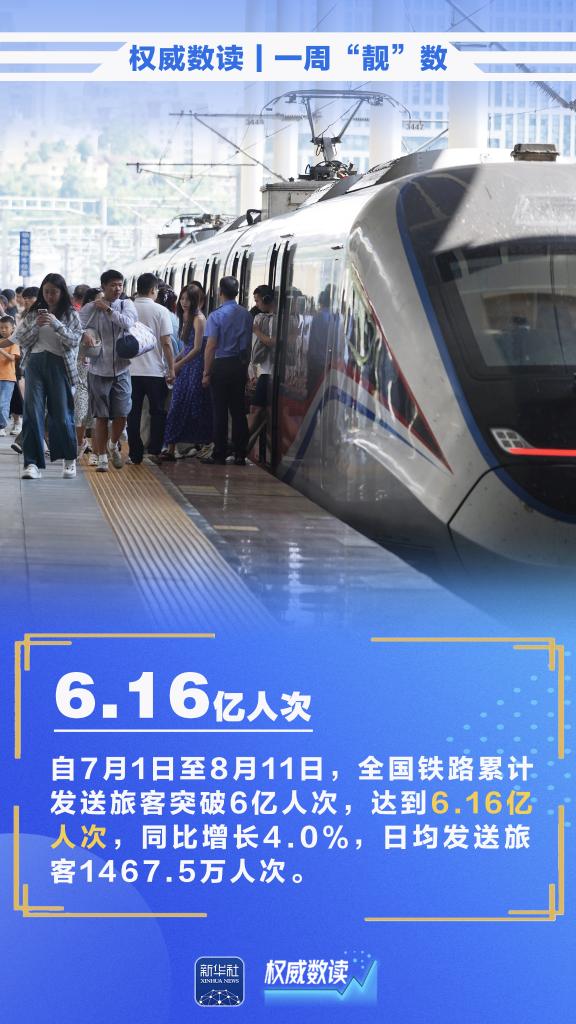
Key Points - From July 1 to August 11, the total number of railway passengers exceeded 600 million, reaching 616 million, with a year-on-year increase of 4.0% and an average daily passenger count of 14.675 million [3] - In the first seven months, the express delivery business volume reached 112.05 billion pieces, showing a year-on-year growth of 18.7% [5] - In July, the industrial added value of large-scale enterprises increased by 5.7% year-on-year and 0.38% month-on-month, with the equipment manufacturing sector growing by 8.4% and high-tech manufacturing by 9.3% [8] - The service production index in July grew by 5.8% year-on-year, with significant increases in information transmission, software, IT services (11.9%), finance (8.7%), and leasing and business services (8.0%) [15] - By June 2025, the total number of 5G base stations is expected to increase fivefold compared to 2020, reaching 4.55 million, while the number of broadband users is projected to grow 34 times to 226 million [13] - In the first half of the year, 13.278 million new business entities were established, including 4.62 million new enterprises and 8.629 million new individual businesses [21] - Under the "Two New" policy, from April 2024 to July 2025, the amount spent on machinery and equipment is expected to grow by 7.3%, with sales of household appliances and audiovisual equipment increasing by 44.5% and 22.8% respectively, and new energy vehicle sales rising by 81.7% [23] - Recently, 188 billion yuan in investment subsidies for equipment upgrades has been fully allocated [19]
生产需求持续增长,消费潜力继续释放,新质生产力培育壮大——7月经济发展“进”的步伐稳健
Ren Min Ri Bao Hai Wai Ban· 2025-08-16 00:54
Economic Performance Overview - In July, the industrial added value above designated size increased by 5.7% year-on-year, indicating stable growth in production supply [1][2] - The total retail sales of consumer goods rose by 3.7% year-on-year, reflecting a steady increase in consumption [1][2] - The total import and export of goods grew by 6.7% year-on-year, showing resilience in foreign trade [1][2] Industrial Growth - The equipment manufacturing industry saw a significant increase, with added value rising by 8.4% year-on-year, outpacing the overall industrial growth rate [2] - High-tech manufacturing also performed well, with added value increasing by 9.3% year-on-year, continuing to exceed the industrial growth rate [3] - The integrated circuit manufacturing sector experienced a remarkable growth of 26.9% year-on-year, while the production of new energy vehicles increased by 17.1% [3] Consumer Market Dynamics - The implementation of consumption-boosting policies has effectively stimulated demand, with retail sales of household appliances and audio-visual equipment increasing by 28.7% year-on-year [4] - Service retail, particularly in tourism and cultural sectors, has shown robust growth, with various service categories maintaining double-digit growth rates [4] - Overall, the combined retail of goods and services is estimated to have grown by around 5% year-on-year from January to July, indicating a stable upward trend in consumption [4][5] Future Economic Outlook - Despite some fluctuations in economic indicators, the overall trend remains stable, with employment and prices under control [6][7] - The macroeconomic policies are expected to continue supporting economic stability and growth, with a focus on expanding market demand and enhancing new productive forces [7][8] - The International Monetary Fund has raised its growth forecast for China's economy by 0.8 percentage points, reflecting increased confidence from the international community [8]
7月经济发展“进”的步伐稳健
Xin Hua Wang· 2025-08-15 23:58
Economic Overview - In July, the industrial added value of enterprises above designated size increased by 5.7% year-on-year, indicating stable growth in production supply [3][4] - The total retail sales of consumer goods rose by 3.7% year-on-year in July, with retail sales of goods increasing by 4% [4][6] - The total import and export volume of goods grew by 6.7% year-on-year in July, reflecting resilient foreign trade [4][8] Industrial Growth - The equipment manufacturing industry saw a significant increase, with added value rising by 8.4% in July, outpacing the overall industrial growth rate [4] - High-tech manufacturing also performed well, with added value increasing by 9.3% year-on-year in July [5] - The integrated circuit manufacturing sector experienced a remarkable growth of 26.9% in added value, while the production of new energy vehicles grew by 17.1% [5] Consumer Trends - The implementation of consumption-boosting policies has led to a steady increase in consumer demand, with a projected overall growth of around 5% in retail sales from January to July [6] - Sales of home appliances and audio-visual equipment surged by 28.7%, while furniture and communication equipment also saw significant increases [7] - The service retail sector maintained stability, with double-digit growth in tourism-related services and cultural activities [7] Future Outlook - Despite some fluctuations in economic indicators, the overall trend remains stable, supported by strong economic fundamentals and effective macro policies [8][9] - The International Monetary Fund has raised its growth forecast for China's economy by 0.8 percentage points, reflecting increased confidence from the international community [9] - Continued efforts to stimulate consumption and diversify foreign trade markets are expected to support stable economic growth moving forward [8][9]