
医药生物

Search documents
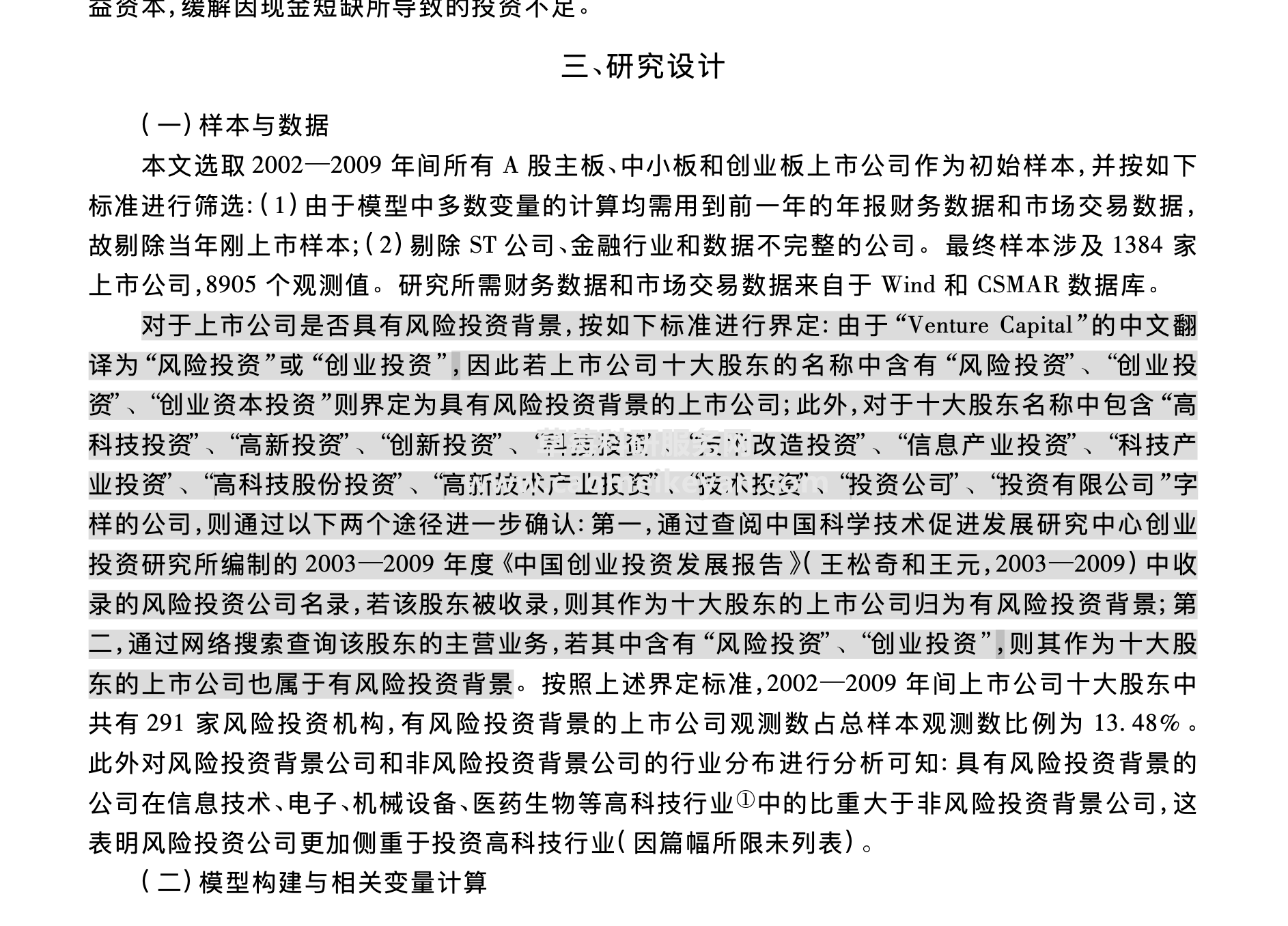
2025-2003年上市公司企业风险投资数据
Sou Hu Cai Jing· 2026-01-28 03:12
Core Insights - The article discusses the analysis of venture capital (VC) backgrounds in publicly listed companies from 2003 to 2025, focusing on the identification and categorization of companies with VC involvement [1][5]. Group 1: Methodology - The study defines companies with a VC background based on the presence of specific terms in the names of their top ten shareholders, such as "Venture Capital" and "Entrepreneurial Investment" [1]. - Additional verification methods include consulting the "China Venture Capital Development Report" for listed VC firms and conducting online searches to confirm the primary business activities of shareholders [1][5]. Group 2: Data Scope - The dataset encompasses over 70,000 samples and more than 5,700 companies, providing original data, calculation codes, and final results for accuracy verification [1]. Group 3: Statistical Analysis - The analysis includes descriptive statistics on various financial metrics, such as average new investment amount (0.054), over-investment (0.108), and under-investment (0.066) [6]. - The average debt financing amounts are reported as 2.4% for total assets, 1.2% for short-term debt, and 1.2% for long-term debt [6]. Group 4: Industry Focus - Companies with VC backgrounds are predominantly found in high-tech sectors, including information technology, electronics, machinery, and pharmaceuticals [5].

融资资金布局,成本管控是核心
Sou Hu Cai Jing· 2026-01-28 02:37
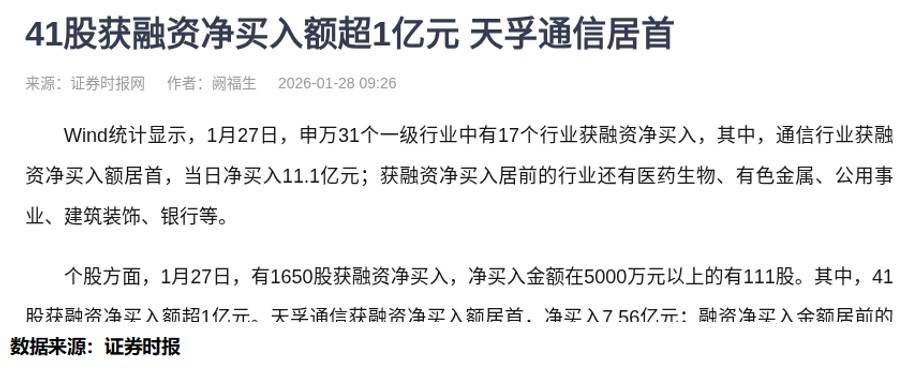
Group 1 - The core viewpoint of the article emphasizes that while short-term capital inflows can indicate market trends, the long-term performance of stocks is primarily determined by institutional investors' cost control strategies [1][3]. - In the recent analysis, 17 out of 31 primary industries received net capital inflows, with the communication sector leading, followed by pharmaceuticals, non-ferrous metals, and public utilities [1]. - Over 1,600 stocks experienced net capital inflows, with 111 exceeding 50 million yuan and 41 surpassing 100 million yuan, indicating significant investor interest [1]. Group 2 - Cost control is a fundamental aspect of value investing, as demonstrated by Warren Buffett's long-term investment in Coca-Cola, where he maintained a low average cost per share [3]. - Institutional trading logic focuses on the safety of holding costs, contrasting with retail investors who often prioritize expected returns [3]. - Quantitative data can reveal institutional trading behaviors, such as increased activity in "institutional inventory" before significant price movements, indicating proactive cost management [3][5]. Group 3 - The behavior of institutional cost management is applicable to both large and small-cap stocks, with early signs of institutional interest often preceding price increases [5]. - Not all small-cap stocks attract institutional interest; for instance, a small-cap stock with low trading volume showed no active institutional inventory, leading to a brief price increase followed by a decline [7]. - The size of a stock's float is not the sole determinant of its performance; rather, the depth of institutional cost management is crucial [9]. Group 4 - Long-term trading behaviors of institutions, such as maintaining active "institutional inventory" for extended periods, can lead to superior stock performance [9]. - Quantitative data can help investors move beyond superficial market sentiments and understand the underlying trading logic of institutional investors [11]. - By focusing on objective trading characteristics, investors can develop a more sustainable and disciplined investment approach, leveraging quantitative data to replace subjective speculation [11].
1月27日机械设备、汽车、国防军工等行业融资净卖出额居前
Sou Hu Cai Jing· 2026-01-28 02:05
Summary of Key Points Core Viewpoint - As of January 27, the latest market financing balance is 27,059.04 billion yuan, showing a decrease of 2.12 billion yuan compared to the previous trading day, with 17 industries experiencing an increase in financing balance, while 14 industries saw a decrease [1]. Industry Financing Balance Changes - The communication industry had the highest increase in financing balance, rising by 1.11 billion yuan to a total of 1,339.67 billion yuan [1]. - Other industries with notable increases include: - Pharmaceutical and biological: increased by 0.44 billion yuan to 1,696.03 billion yuan - Non-ferrous metals: increased by 0.41 billion yuan to 1,494.54 billion yuan - Public utilities: increased by 0.29 billion yuan to 569.69 billion yuan [1]. - Conversely, the following industries experienced significant decreases in financing balance: - Machinery and equipment: decreased by 1.70 billion yuan to 1,418.93 billion yuan - Automotive: decreased by 0.96 billion yuan to 1,242.31 billion yuan - National defense and military: decreased by 0.68 billion yuan to 1,040.47 billion yuan [2]. Percentage Changes in Financing Balance - The coal industry recorded the highest percentage increase in financing balance at 1.09%, totaling 149.82 billion yuan [1]. - Other industries with notable percentage increases include: - Communication: 0.84% - Steel: 0.79% - Agriculture, forestry, animal husbandry, and fishery: 0.59% [1]. - Industries with the largest percentage decreases include: - Machinery and equipment: decreased by 1.19% - Comprehensive: decreased by 1.10% - Oil and petrochemicals: decreased by 0.89% [1].
二级债基规模增幅较大,权益端增持非银金融和通信
Ping An Securities· 2026-01-28 01:32
1. Report Industry Investment Rating - Not provided in the given content. 2. Core Viewpoints of the Report - As of the end of Q4 2025, the total number of active bond - type funds (excluding amortized cost method funds) was 3,399, a 1.5% increase from the previous quarter, and the fund scale was 7.80 trillion yuan, a 1.6% increase [2][5][7]. - In Q4 2025, 93 active bond - type funds were issued, 18 more than the previous quarter, a 24.0% increase. The total issuance scale was 62.49 billion yuan, a 24% increase [2][9][10]. - In Q4 2025, the performance of medium - and long - term pure bond funds was better than that of short - term pure bond funds. Affected by the equity market, the performance of secondary bond funds was slightly weaker [2][14][16]. - Different types of active bond funds had different changes in leverage, duration, and asset allocation. For example, medium - and long - term pure bond funds' heavy - position bond duration decreased, while short - term bond funds' leverage ratio slightly increased [2][19][34]. - The mixed secondary bond funds reduced their stock positions and increased their holdings in non - banking finance and communication sectors [2][54][61]. 3. Summary According to the Table of Contents 3.1 Active Bond - type Fund Scale and Issuance - **Scale Change**: The total number of active bond - type funds increased by 1.5% to 3,399. The scale increased by 1.6% to 7.80 trillion yuan. The number of medium - and long - term pure bond funds, short - term pure bond funds, and mixed secondary bond funds increased by 0.6%, 0.6%, and 5.8% respectively, while the number of mixed primary bond funds decreased by 0.2%. The scale of medium - and long - term pure bond funds and mixed primary bond funds decreased by 4.0% and 2.1% respectively, and the scale of short - term pure bond funds and mixed secondary bond funds increased by 6.2% and 19.7% respectively [2][5][7]. - **Fund Issuance**: In Q4 2025, 93 active bond - type funds were issued, an increase of 18 from the previous quarter. Among them, 52 were mixed secondary bond funds. The total issuance scale was 62.49 billion yuan, a 24% increase. The issuance scale of medium - and long - term pure bond funds and mixed primary bond funds decreased by 21.0% and 79.9% respectively, while the issuance scale of mixed secondary bond funds increased by 117.2% [2][9][10]. 3.2 Active Bond - type Fund Performance - **Performance of Pure Bond Funds**: In Q4 2025, the yields of medium - and long - term pure bond funds were better than those of short - term pure bond funds. The yields of short - term and medium - and long - term pure bond fund indexes were 0.47% and 0.54% respectively [2][14]. - **Performance of Secondary Bond Funds**: Affected by the equity market, the performance of secondary bond funds was slightly weaker. The yields of mixed primary and secondary bond fund indexes were 0.55% and 0.38% respectively, and the maximum drawdowns were - 0.51% and - 1.04% respectively [2][16]. 3.3 Active Bond Fund Position Analysis - **Medium - and Long - term Pure Bond Funds**: The leverage ratio of closed - end medium - and long - term pure bond funds increased, while that of open - end ones decreased. The bond position of closed - end funds increased, while that of open - end funds decreased. Closed - end funds increased their holdings of credit bonds and reduced their holdings of interest - rate bonds, and vice versa for open - end funds. Both types of funds reduced their holdings of financial bonds. The weighted duration of the top five heavy - position bonds of both types of funds decreased [19][22][31]. - **Short - term Bond Funds**: The median leverage ratio increased by 1.5pct to 110.1%. The median bond position increased by 1.2pct to 106.7%. They reduced their holdings of credit bonds and increased their holdings of interest - rate bonds, and the median financial bond position increased by 2.1pct. The weighted duration of the top five heavy - position bonds increased slightly by 0.01 year [34][36][40]. - **Mixed Primary Bond Funds**: The median leverage ratio and bond position increased by 3.1pct and 4.1pct respectively. They increased their holdings of credit and interest - rate bonds, the median financial bond position increased slightly, the median convertible bond position increased by 0.64pct, and the weighted duration of the top five heavy - position bonds decreased by 0.21 year [42][45][49]. - **Mixed Secondary Bond Funds**: The median leverage ratio decreased slightly by 0.3pct to 107.5%. The stock position decreased by 0.80pct to 13.85%, and the bond position increased by 0.40pct to 87.85%. The median convertible bond position decreased by 0.97pct. The weighted duration of the top five heavy - position bonds decreased by 0.08 year. They increased their holdings in non - banking finance, communication, and non - ferrous metals sectors, and reduced their holdings in pharmaceutical biology, media, and electronics sectors. Zijin Mining was the largest heavy - position stock, and the heavy - position holding scale of Zijin Mining, Zhongji Innolight, and Ping An of China increased by more than 2 billion yuan [51][54][64].
A股业绩预告潮:超百家公司净利翻倍 机构寻踪绩优股与新兴赛道
Zhong Guo Zheng Quan Bao· 2026-01-28 00:02
Core Viewpoint - The A-share market is witnessing a significant increase in performance forecasts, with 1,201 listed companies disclosing their 2025 annual performance predictions, indicating a positive trend in various industries, particularly in non-ferrous metals, automotive, chemicals, and semiconductors [1][2]. Group 1: Performance Forecasts - A total of 1,201 listed companies have released performance forecasts, with 475 companies expecting positive results and 107 companies anticipating a doubling of net profit for 2025 [1][2]. - Among the companies that disclosed forecasts, 371 are expected to achieve a net profit exceeding 100 million yuan, 84 companies over 1 billion yuan, and 22 companies over 3 billion yuan [2]. - The performance of leading companies in the non-ferrous metals, automotive, chemicals, and semiconductor sectors has shown significant recovery [2]. Group 2: Institutional Research - Following the performance forecasts, many companies have attracted intensive institutional research, focusing on new and existing order volumes, progress on new production lines, and positive industry changes [3]. - Changhua Chemical reported that its carbon dioxide polyether project is nearing completion, with trial production expected in the first quarter of this year, pending approval [3][4]. - Chutian Technology noted that while competition remains fierce, it is gradually easing, with market concentration increasing and international market expansion becoming a new growth point [5]. Group 3: Emerging Industries - Institutions are increasingly focusing on emerging industries such as semiconductors and energy storage [6]. - Hemai Co. indicated that its energy storage business is experiencing rapid growth, with significant revenue increases expected in the coming years despite rising costs in the domestic market [6]. - Dongxin Co. mentioned that the niche memory market is seeing price increases due to supply constraints, with a positive outlook for its storage products [6].
逾950家A股披露2025业绩预告,高增长赛道浮现!机构建议:2026年投资锁定这些方向→
Xin Lang Cai Jing· 2026-01-27 12:24
Market Overview - The A-share market exhibited a fluctuating and differentiated pattern last week, with major indices showing mixed performance and active rotation among hot sectors [1][7] - Institutions generally hold an optimistic outlook, believing the market is likely to trend upward [1][7] - As of January 25, over 950 companies have disclosed their 2025 earnings forecasts, with around 40% of these companies showing positive performance [1][7] Semiconductor Industry - The semiconductor industry, particularly companies related to artificial intelligence, data center construction, and domestic substitution, is expected to see strong earnings growth in 2025 [1][8] - Notable companies include: - Zhongwei Semiconductor expects revenue of approximately 1.122 billion yuan, a year-on-year increase of about 23%, and a net profit of 284 million yuan, up approximately 107% [8] - Juchip Technology anticipates revenue of 922 million yuan, a 41.44% increase, and a net profit of 204 million yuan, up 91.40% [2] - Baiwei Storage forecasts revenue between 10 billion to 12 billion yuan, a growth of 49.36% to 79.23%, and a net profit of 850 million to 1 billion yuan, a staggering increase of 427.19% to 520.22% [3][9] Pharmaceutical Industry - The pharmaceutical sector is experiencing a "polarized" performance, with over 60 companies disclosing earnings forecasts, about half of which are positive [1][9] - Key performers include: - Zhaoyan New Drug expects a net profit of approximately 233 million to 349 million yuan, a year-on-year increase of 214% to 371% [10] - Shanghai Yizhong anticipates a net profit of 6 million to 7 million yuan, a growth of 760.18% to 903.54% [10] - However, companies like Zhifei Biological are projected to incur significant losses, with an expected net loss of 10.7 billion to 13.7 billion yuan [10][5] Banking Sector - As of January 25, eight listed banks have released earnings reports, with all showing year-on-year growth in net profit [5][11] - Key statistics include: - China Merchants Bank's total assets surpassing 13 trillion yuan, and Industrial Bank exceeding 11 trillion yuan [11] - The highest net profit growth among these banks is from Hangzhou Bank at 12.05%, followed by Shanghai Pudong Development Bank at 10.52% [11] - The growth drivers for banks include improved cost of liabilities and rapid growth in intermediary business income, with Ningbo Bank's net income from fees and commissions increasing by 30.72% [12]



【27日资金路线图】两市主力资金净流出超410亿元 电子等行业实现净流入
证券时报· 2026-01-27 11:13
1月27日,A股市场整体上涨。 截至收盘,上证指数收报4139.9点,上涨0.18%;深证成指收报14329.91点,上涨0.09%;创业板指收报3342.6点,上涨0.71%。两市合计成交 28949.81亿元,较上一交易日减少3532.21亿元。 1. 两市主力资金净流出超410亿元 今日沪深两市主力资金开盘净流出373.34亿元,尾盘净流入41.39亿元,两市全天主力资金净流出414.34亿元。 | | | 沪深两市最近五个交易日主力资金流向情况 (亿元) | | | | --- | --- | --- | --- | --- | | 日期 | | 净流入金额 开盘净流入 | 尾盘净流入 | 超大单净买入 | | 2026- 1- 27 | - 414. 34 | -373. 34 | 41. 39 | - 173. 55 | | 2026- 1- 26 | - 757. 10 | -324. 59 | - 15. 61 | - 496. 92 | | 2026- 1-23 | - 41. 67 | - 83. 56 | 58. 37 | 119. 93 | | 2026- 1- 22 | - 104. ...

1月27日医疗健康(980016)指数跌0.98%,成份股华海药业(600521)领跌
Sou Hu Cai Jing· 2026-01-27 10:28
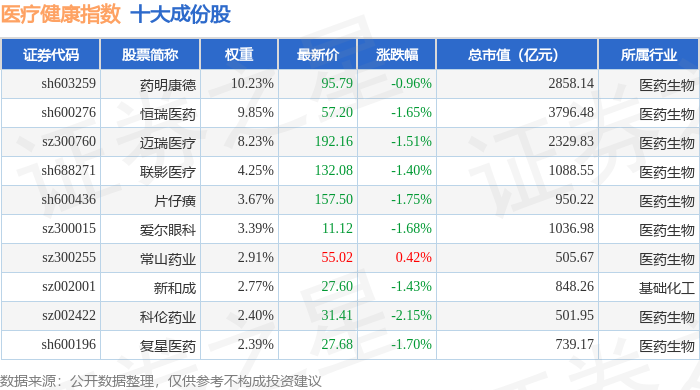
Core Viewpoint - The healthcare index (980016) closed at 6173.05 points, down 0.98%, with a trading volume of 32.835 billion yuan and a turnover rate of 1.29% [1] Group 1: Index Performance - Among the index constituents, 11 stocks rose while 39 stocks fell, with Sangfor Technologies leading the gainers at a 10.93% increase and Huahai Pharmaceutical leading the decliners with a 3.79% drop [1] - The top ten constituents of the healthcare index include major companies such as WuXi AppTec, Hengrui Medicine, and Mindray Medical, with respective weights of 10.23%, 9.85%, and 8.23% [1] Group 2: Market Capitalization and Price Movements - WuXi AppTec has a market capitalization of 285.814 billion yuan, while Hengrui Medicine and Mindray Medical have market capitalizations of 379.648 billion yuan and 232.983 billion yuan, respectively [1] - The latest prices for the top ten constituents range from 11.12 yuan for Aier Eye Hospital to 192.16 yuan for Mindray Medical, with varying price changes [1] Group 3: Capital Flow - The net outflow of main funds from the healthcare index constituents totaled 1.252 billion yuan, while retail investors saw a net inflow of 1.093 billion yuan [1] - Detailed capital flow data indicates that Junshi Biosciences experienced a net inflow of 1.93 million yuan from main funds, while other companies like Dong'e Ejiao and Tigermed saw mixed capital flows [2]

粤开市场日报-20260127-20260127
Yuekai Securities· 2026-01-27 07:49
Market Overview - The A-share market showed mixed performance today, with the Shanghai Composite Index slightly up by 0.18% closing at 4139.9 points, and the Shenzhen Component Index up by 0.09% closing at 14329.91 points. The ChiNext Index increased by 0.71% to 3342.6 points, while the STAR 50 Index rose by 1.51% to 1555.98 points. Overall, there were 1928 stocks that rose and 3450 that fell, with a total trading volume of 28950 billion yuan, a decrease of 3532 billion yuan from the previous trading day [1][2]. Industry Performance - Among the Shenwan first-level industries, electronics, communications, defense and military industry, machinery equipment, and media sectors led the gains with increases of 2.27%, 2.15%, 1.65%, 0.64%, and 0.48% respectively. Conversely, the coal, agriculture, forestry, animal husbandry and fishery, steel, beauty care, and pharmaceutical biotechnology sectors experienced declines, with decreases of 2.27%, 1.95%, 1.34%, 1.22%, and 1.11% respectively [1][2]. Concept Sector Performance - The concept sectors that saw the highest gains today included cultivated diamonds, superhard materials, advanced packaging, optical chips, memory, analog chips, BC batteries, automotive chips, semiconductor silicon wafers, MCU chips, semiconductor selections, optical modules (CPO), wafer industry, and IGBT. In contrast, sectors such as cobalt mining, animal health selections, major infrastructure central enterprises, lithium battery anodes, and central enterprise coal experienced pullbacks [2].
20cm速递|科创创业ETF(588360)收涨超0.6%,科技创新与内需扩张的双轮驱动强化
Mei Ri Jing Ji Xin Wen· 2026-01-27 07:33
Core Viewpoint - The dual drivers of technological innovation and domestic demand expansion are strengthening, creating structural investment opportunities supported by continuous policy efforts [1] Group 1: Market Performance - The Science and Technology Innovation ETF (588360) rose over 0.6%, reflecting active performance in the technology innovation sector [1] - The Science and Technology Innovation 50 Index (931643), which the ETF tracks, includes 50 emerging industry companies with significant technological attributes, covering sectors such as electronics, power equipment, telecommunications, and biomedicine [1] Group 2: Investment Strategy - It is recommended to adopt a "technology innovation + dividend assets" barbell strategy to seize structural opportunities [1] - The strategic focus should align with the "14th Five-Year Plan" direction, emphasizing emerging industries like new energy, new materials, low-altitude economy, and aerospace, as well as future industries such as quantum technology and brain-computer interfaces [1]
