债券市场

Search documents
上证AAA地方国企信用债指数报141.60点
Sou Hu Cai Jing· 2025-07-29 09:29
据了解,上证地方国企信用债指数系列从上海证券交易所上市的公司债和企业债中,选取由地方国有企 业发行的符合条件的债券作为指数样本,以反映相应地方国企信用债的整体表现。该指数以2016年12月 30日为基日,以100.0点为基点。 从债项评级分布来看,上证AAA地方国企信用债指数持仓100.00%为"AAA"级债券。 金融界7月29日消息,上证指数低开高走,上证AAA地方国企信用债指数 (沪AAA地企债,950268)报 141.60点。 数据统计显示,上证AAA地方国企信用债指数近一个月上涨0.08%,近三个月上涨0.84%,年至今上涨 1.20%。 资料显示,上证地方国企信用债指数系列样本每月调整一次,定期调整生效日为每月首个交易日,定期 调整数据截止日为生效日前一交易日。遇临时调整时,若样本发生摘牌等事件,视情况自事件生效之日 起剔除出指数;样本发生其他事件,参照计算与维护细则处理。 来源:金融界 ...
上半年债市政策复盘:“科技板”落地生花,优化债市生态
Zhong Cheng Xin Guo Ji· 2025-07-29 05:32
Report Industry Investment Rating No information provided. Core Viewpoints of the Report In the first half of 2025, China's bond market continued to strengthen its direct financing function, focusing on "improving quality and efficiency, serving the real economy." It launched the "Technology Board" of the bond market, increased targeted support for key areas such as technological innovation and private enterprises, strengthened requirements for issuance, trading, and valuation, promoted market standardization, and further advanced opening - up to promote the interconnection of domestic and foreign bond markets [5]. Summary by Relevant Catalogs 1. Key Areas: The "Technology Board" of the Bond Market Sets Sail, and Policy "Combinations" Inject New Development Momentum - **Policy for Technological Innovation**: Policies in the technological innovation field were intensively introduced. The "Technology Board" of the bond market was officially launched, supporting three types of entities to issue technological innovation bonds. The issuance scale of technological innovation bonds reached about 1 trillion yuan, a year - on - year increase of 86%. The risk - sharing tools and ETFs for technological innovation bonds made positive progress [4][6][11]. - **Support for Consumption and Sports Industries**: The bond market increased support for the consumption and sports industries. In the sports industry, relevant departments issued a guiding opinion to support sports enterprises in issuing bonds. In the consumption field, policies were introduced to support enterprises in service consumption areas to issue bonds [12][14]. 2. Weak Links: Policies Intensify to Release Positive Signals, and the Financing Situation of Private Enterprises Remains to Be Continuously Observed - **Policy Attention**: The central government deployed efforts to solve the financing problems of private enterprises. The "Private Economy Promotion Law" was officially implemented, emphasizing support for private enterprises to obtain direct financing through bonds [15][16][18]. - **Financing Situation**: Although the bond financing of private enterprises improved marginally, overall, it still faced constraints such as insufficient demand and high costs. The improvement of private enterprise bond financing requires time [21][22]. 3. Basic Systems: Adhere to the Main Line of Standardized System Construction and Promote the High - Quality Development of the Bond Market - **System Rule Optimization**: The bond market optimized rules for issuance, trading, and valuation. For example, it reduced bond trading and settlement fees, revised company bond review guidelines, and optimized bond valuation guidelines [25][26][27]. - **Risk Management**: It standardized debt - restructuring bond replacement business and improved the institutional framework of credit risk mitigation tools to enhance the flexibility of product creation [28][29]. 4. Opening - up: The Bond Connect Has Made Positive Progress, and Upgraded Measures May Accelerate the Opening - up Process - **Free - Trade Offshore Bonds**: There are expectations for the restart of free - trade offshore bonds, emphasizing the "two - ends - abroad" principle to support domestic enterprises' overseas financing and attract foreign investment [33]. - **Bond Connect Optimization**: The Bond Connect reached its eighth anniversary. The scope of "South - bound Connect" investors was expanded to non - banking institutions, and relevant mechanisms were optimized to promote the interconnection of domestic and foreign markets [34][37]. - **Bond Allocation Value**: China's bonds have good allocation value. Against the backdrop of Sino - US tariff frictions, they may attract more long - term allocation funds, and the bond market's opening - up level is expected to continue to deepen [38][39].
超5000亿元!点心债市场持续扩容
Sou Hu Cai Jing· 2025-07-28 13:10
Core Viewpoint - The issuance of offshore sustainable dim sum bonds by Mengniu Dairy has reignited market interest in the offshore RMB bond market, highlighting its significance in expanding financing channels for domestic and foreign enterprises and enhancing the international status of the RMB [1][3]. Dim Sum Bond Market Overview - As of July 28, over 700 dim sum bonds have been issued this year, with a total issuance scale exceeding 500 billion RMB, although both the number and scale have decreased compared to the same period last year [1][2]. - The dim sum bond market has seen a significant increase in issuance volume and scale since 2022, with 2023 projected to reach 1,468 bonds and a scale of 925.11 billion RMB, and 2024 expected to further increase to 2,062 bonds and 1,205.52 billion RMB [5]. Factors Driving Growth - The rapid expansion of the dim sum bond market is attributed to several factors, including the rising costs of issuing US dollar bonds due to the Federal Reserve's interest rate hikes, leading domestic issuers to shift towards dim sum bonds for financing [7]. - The tightening of domestic city investment bond approvals has also created new financing channels through dim sum bonds, while the declining risk-free interest rates in China have made dim sum bonds more attractive compared to US dollar bonds [7][9]. Impact on RMB Internationalization - Dim sum bonds not only provide diversified financing options for domestic and Hong Kong enterprises but also significantly enhance the international status and influence of the RMB [9][10]. - The main issuers of dim sum bonds include city investment companies and financial institutions, with a notable increase in issuance from city investment companies in recent years [9]. Investment Demand and Market Dynamics - There is a growing demand from domestic investors for high-yield assets, alongside increased international interest in RMB-denominated assets, making offshore RMB bonds appealing to both domestic and foreign investors [12][13]. - The potential for further expansion in the dim sum bond market is supported by the expectation of a weakening US dollar and the continued attractiveness of RMB assets, which may lead to lower financing costs in the offshore market [13].



10年期国债收益率升至1.73%!债基遭遇千亿赎回,股市走强冲击债市
Sou Hu Cai Jing· 2025-07-27 16:54
Core Viewpoint - The bond market is experiencing significant adjustments due to multiple factors, leading to a continuous rise in yields, with the 10-year treasury yield reaching 1.7325% and the 30-year yield at 1.9475%, both at year-high levels [1][2] Group 1: Market Dynamics - A notable change in market risk appetite is the core driver putting pressure on the bond market, with the stock market breaking key levels and the Shanghai Composite Index nearing 3600 points, showing a weekly increase of 1.67% [2][3] - Commodity prices have surged, with lithium carbonate futures rising over 7% and polysilicon prices hitting new highs, which diminishes the relative attractiveness of bond assets [2][3] Group 2: Liquidity and Institutional Behavior - The liquidity situation has worsened since mid-July, with significant fluctuations in funding rates and the central bank's operations showing a net withdrawal of funds, leading to a spike in the 10-year treasury yield [2][4] - Institutional investors are accelerating withdrawals from the bond market, with redemption pressures on bond funds increasing significantly, and the net subscription index for public bond funds remaining negative since July 21, reaching a record single-day redemption of 29.2 on July 24 [4][5] Group 3: Future Market Expectations - There is a divergence in expectations regarding the future trajectory of the bond market, with some institutions cautious about the potential for further rate increases, while others believe yields are still at historical lows and may rise due to stable economic growth and improving inflation [5] - The current adjustment in the bond market is viewed as manageable, with the 10-year treasury yield rising approximately 7 basis points, which is still within a controllable range compared to historical adjustments [5]

本轮债市调整到位了吗?
ZHONGTAI SECURITIES· 2025-07-27 11:15
Report Industry Investment Rating No relevant content provided. Core Viewpoints of the Report - The bond market adjustment may have some short - term repair due to emerging positives, but in the long run, the probability of interest rates breaking through the lows is small, and the interest rate center is expected to fluctuate and rise [2][8]. - The bond market short - term adjustment is in place, with possible over - decline repair, but the downward amplitude may be limited, and heavy - position participation is not recommended. Strategies suggest being cautious in duration, reducing annual return expectations, and seizing short - term trading opportunities [2][30]. Summary by Related Catalogs Bond Market Adjustment Situation - This week, the bond market sentiment was suppressed by the strong performance of equities and commodities, and the yield of each maturity generally increased. As of July 25, the 10Y Treasury yield rose 6.72BP to 1.73% compared with July 18, and the 30Y Treasury yield reached 1.97%, with the 10Y - 1Y spread widening [5]. Factors Affecting the Bond Market Funding Aspect - The central bank began large - scale injections at the end of the month, showing an obvious attitude of care. On Thursday, the suddenly tightened funding became the "last straw" for the bond market, but on Friday, the central bank's operations led to a rapid shift to a loose funding situation, with a net injection of 8018 billion yuan [2][8]. Asset - Liability Aspect - The reduction of the insurance预定利率 is a short - term positive for the bond market, but it also has two - sided effects. It may lead to a reduction in the adjustment range of the bond market, but it may also cause a loss of insurance liability - side funds [2][10]. Institutional Behavior Aspect - Insurance has changed from a stable configuration strategy to a trading mindset. The weekly average net purchase scale in July decreased to 44.8 billion yuan, lower than that from February to March [2][15]. - During the bond market's weak adjustment this week, the main selling forces were funds and securities companies, while rural commercial banks increased their positions. Funds further reduced their duration, and the 10 - day average of the net purchase duration of funds has dropped to a relatively low historical quantile level [16]. Key Psychological Point and Technical Analysis - 1.75% is a key psychological point in the market, and the probability of a short - term rapid break to 1.80% is low [22]. - Technically, the bearish force has increased marginally, but short - term technical indicators show over - decline rebound signals. There may be over - decline trading opportunities next week, and attention should be paid to the effectiveness of the support level [23]. Long - Term Impact of Re - inflation Trading - The re - inflation trading caused by anti - involution is still in the initial stage, so its impact on the bond market is limited [24][27].
固定收益周度策略报告:“二次调整”的空间评估-20250727
SINOLINK SECURITIES· 2025-07-27 10:01
Group 1 - The report indicates that the recent adjustment in the bond market is driven by a strong rebound in commodity prices, which has led to a rise in market risk appetite and a corresponding increase in stock prices [3][7]. - The current commodity price rebound is characterized as a "lagging pricing" response to the previous mild expansion of the credit cycle, rather than the start of a new macroeconomic cycle [4][10]. - The report suggests that the market environment in the second half of the year may resemble that of 2019 and 2022, with a mild expansion of the credit cycle followed by a potential decline in social financing momentum [5][25]. Group 2 - The report emphasizes that the recent commodity price increases are more of a "catch-up" effect due to previous underpricing in relation to the credit cycle recovery, rather than an indication of a new macroeconomic expansion [11][18]. - It is noted that the leading commodities in the recent price surge were those that had previously underperformed, indicating a tendency towards "oversold recovery" [14][17]. - The analysis highlights that the current credit cycle is nearing its peak, and any adjustments in the bond market are expected to be less severe than those observed in the first half of the year [6][30].
山东省已推动17家企业和机构在债券市场“科技板”发债227亿元
Qi Lu Wan Bao· 2025-07-25 10:18
Core Viewpoint - The People's Bank of China Shandong Branch is actively promoting the issuance of technology innovation bonds to support the financing needs of technology enterprises and enhance the province's financial ecosystem for innovation [1][4]. Group 1: Technology Innovation Bonds - As of now, 17 enterprises and institutions have successfully issued technology innovation bonds totaling 22.7 billion yuan in the interbank market, positioning Shandong among the top provinces in terms of issuance scale [1][5]. - The technology innovation bonds cover a wide range of issuers, including state-owned enterprises, private enterprises, equity investment institutions, and financial institutions, thereby supporting various sectors such as electronic information, new energy, new materials, high-end chemicals, and biomedicine [5][6]. - The bonds feature long maturities and low interest rates, with some institutions issuing bonds with terms of 5 to 10 years and a minimum issuance interest rate of 1.63%, while the weighted average interest rate is only 2% [5][6]. Group 2: Innovative Measures and Support - The issuance of technology innovation bonds includes several innovative aspects, such as flexible issuance methods, diverse funding uses, and rich credit enhancement measures to better match the financing needs of technology enterprises [4][6]. - The People's Bank has established risk-sharing tools for technology innovation bonds to support private enterprises and equity investment institutions, aiming to reduce issuance costs and improve success rates [4][6]. - Future efforts will focus on enhancing the promotion of technology innovation bonds, exploring better mechanisms for central-local credit enhancement, and striving for more entities to issue these bonds to optimize the innovation ecosystem in Shandong [6].

日本至7月18日当周外资买进日债 -9907亿日元,前值1704亿日元。
news flash· 2025-07-24 23:54
Group 1 - Foreign investment in Japanese government bonds decreased by 990.7 billion yen for the week ending July 18, compared to an increase of 170.4 billion yen in the previous period [1]
“去美元化”趋势下 亚洲本币债券发行创纪录高位
Xin Lang Cai Jing· 2025-07-23 14:49
Core Insights - The unpredictable policy moves by President Trump are driving investor demand for Asian local currency bonds, sparking renewed interest in the region [1] - The issuance of local currency bonds in the Asia-Pacific region has reached approximately $1.5 trillion in 2025, marking a 6% increase and setting a record for the period [1] - The trend of de-dollarization is shifting focus towards local currency credit bonds, particularly in markets with AAA sovereign ratings like Australia and Singapore [2] Group 1 - The issuance of local currency bonds in the Asia-Pacific region has reached a record high, with the second quarter seeing the highest issuance volume [1] - There has been an increase in buyers of Asian local currency bonds, particularly from pension funds and sovereign wealth funds seeking diversification away from dollar assets [1] - The Bloomberg Asia-Pacific Composite Index tracking various local currency bonds has risen by 3.9% this year, outperforming the U.S. equivalent index which has returned 3.5% [1] Group 2 - Indian companies raised a record 6.6 trillion rupees (approximately $764 million) through local currency bond issuance in the first half of 2025, reflecting a 29% year-on-year increase [2] - China has issued over $1 trillion in local currency bonds this year, with lower borrowing costs making financing more attractive for domestic companies [3] - The gap between the fiscal conditions of the Asia-Pacific region and the U.S. has widened due to tariff policies, with Australia maintaining a AAA rating from major credit agencies [3] Group 3 - The issuance of dollar bonds in Asia is recovering from a slump caused by record defaults among Chinese real estate developers, with Japanese companies leading in issuance this year [4] - The euro-denominated bond issuance from Asia-Pacific borrowers has exceeded €49 billion (approximately $57.6 billion) this year, surpassing the total for the previous year [4] - There is a growing preference among Asian investors for issuers to frequently issue bonds in euros, offshore renminbi, or other currencies [4]
里程碑!这一市场,发行规模破万亿元
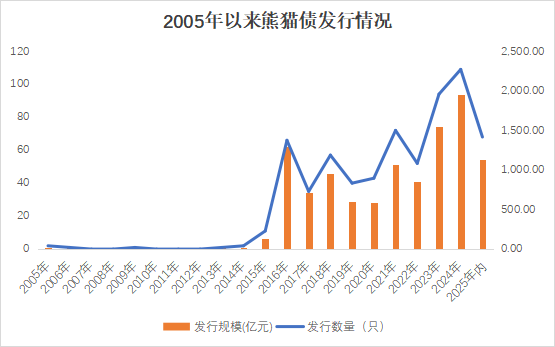
Zheng Quan Shi Bao· 2025-07-23 12:51
Core Insights - The Panda Bond market has rapidly expanded, with cumulative issuance surpassing 1 trillion yuan, marking a significant milestone in China's bond market's internationalization [1][2][4] Group 1: Market Expansion - The cumulative issuance of Panda Bonds reached 10,888.90 million yuan as of July 22, 2025, with 654 bonds issued [2] - The market has experienced two phases: a slow initial phase from 2005 to 2015, followed by rapid growth from 2016 onwards, with annual issuance exceeding 1,000 million yuan in recent years [2][4] - In 2023, multiple entities, including the Asian Infrastructure Investment Bank and Bayer, issued 1,085 million yuan in bonds, with expectations to approach 2,000 million yuan for the year [4] Group 2: Regulatory and Market Environment - Recent regulatory improvements have simplified Panda Bond issuance rules, enhancing the attractiveness for foreign institutions [1][4] - The People's Bank of China expanded the use of Panda Bond proceeds at the end of 2022, and in 2023, the China Interbank Market Dealers Association introduced measures to optimize the issuance process [4][5] Group 3: Interest Rates and Financing Costs - The average issuance interest rate for Panda Bonds has significantly decreased, with the proportion of bonds issued at rates below 2.5% rising from 67.89% in 2024 to 89.58% in 2025 [5] - The low interest rate environment in China has provided a financing cost advantage for foreign issuers, attracting more international entities to issue Panda Bonds [5][6] Group 4: Issuer Structure and Diversity - The issuer structure of Panda Bonds has diversified, now including international development institutions, foreign sovereign governments, financial institutions, and non-financial enterprises across five continents [6][7] - The proportion of bonds issued by international development institutions and multinational corporations increased by 23 percentage points year-on-year in the first half of 2025 [6] Group 5: Future Outlook - The Panda Bond market is expected to continue expanding, driven by the ongoing internationalization of the yuan and favorable financing conditions [8] - Innovations in bond types, including those related to sustainable development, are anticipated to increase, further enriching the Panda Bond market [8]