
能源化工

Search documents
一、动力煤:宝城期货品种套利数据日报(2025年12月12日)-20251212
Bao Cheng Qi Huo· 2025-12-12 01:55
Report Summary 1. Report Industry Investment Rating No information provided in the content. 2. Core View of the Report The report is a daily report on futures variety arbitrage data of Baocheng Futures on December 12, 2025, presenting data on basis, inter - period spreads, and inter - variety spreads for multiple futures varieties across different sectors. 3. Summary by Directory 3.1 Power Coal - **Basis Data**: The basis of power coal on December 11, 2025, was - 48.4 yuan/ton, showing a downward trend compared to previous days. The inter - period spreads of 5 - 1, 9 - 1, and 9 - 5 were all 0 [1][2]. 3.2 Energy and Chemicals - **Energy Commodity Basis**: For fuel oil and INE crude oil, the basis on December 11, 2025, was - 1.64 yuan/ton and - 2.37 yuan/ton respectively. The ratio of crude oil to asphalt was 0.1485 [7]. - **Chemical Commodity Basis**: On December 11, 2025, the basis of rubber was - 285 yuan/ton, methanol was 51 yuan/ton, PTA was - 14 yuan/ton, LLDPE was 466 yuan/ton, V was 84 yuan/ton, and PP was 148 yuan/ton [9]. - **Chemical Commodity Inter - period Spreads**: For the 5 - 1 inter - period, rubber was - 30 yuan/ton, methanol was 57 yuan/ton, etc.; for the 9 - 1 inter - period, rubber was - 10 yuan/ton, methanol was 54 yuan/ton, etc.; for the 9 - 5 inter - period, rubber was 20 yuan/ton, methanol was - 3 yuan/ton, etc. [10]. - **Chemical Commodity Inter - variety Spreads**: On December 11, 2025, LLDPE - PVC was 2267 yuan/ton, LLDPE - PP was 377 yuan/ton, etc. [10]. 3.3 Black Metals - **Black Metal Basis**: On December 11, 2025, the basis of rebar was 181.0 yuan/ton, iron ore was 33.0 yuan/ton, coke was 113.5 yuan/ton, and coking coal was 135.0 yuan/ton [20]. - **Black Metal Inter - period Spreads**: For the 5 - 1 inter - period, rebar was - 10.0 yuan/ton, iron ore was - 20.0 yuan/ton, etc.; for the 9(10) - 1 inter - period, rebar was 22.0 yuan/ton, iron ore was - 43.5 yuan/ton, etc.; for the 9(10) - 5 inter - period, rebar was 32.0 yuan/ton, iron ore was - 23.5 yuan/ton, etc. [19]. - **Black Metal Inter - variety Spreads**: On December 11, 2025, the ratio of rebar to iron ore was 4.05, the ratio of rebar to coke was 2.0289, etc. [19]. 3.4 Non - ferrous Metals - **Domestic Market Basis**: On December 11, 2025, the domestic basis of copper was 170 yuan/ton, aluminum was - 80 yuan/ton, zinc was 125 yuan/ton, lead was 5 yuan/ton, nickel was 3350 yuan/ton, and tin was - 600 yuan/ton [29]. - **London Market Data**: On December 11, 2025, the LME copper premium/discount was 24.76, aluminum was (26.68), etc.; the Shanghai - London ratio of copper was 7.93, aluminum was 7.65, etc.; the CIF price of copper was 94072.03, aluminum was 23768.13, etc.; the domestic spot price of copper was 92950.00, aluminum was 21910.00, etc.; the import profit/loss of copper was (1122.03), aluminum was (1858.13), etc. [34]. 3.5 Agricultural Products - **Agricultural Product Basis**: On December 11, 2025, the basis of soybeans No.1 was - 153 yuan/ton, soybeans No.2 was - 60.11 yuan/ton, soybean meal was 310 yuan/ton, soybean oil was 534 yuan/ton, and corn was 37 yuan/ton [42]. - **Agricultural Product Inter - period Spreads**: For soybeans No.1, the 5 - 1 inter - period was 11 yuan/ton, 9 - 1 was 14 yuan/ton, 9 - 5 was 38 yuan/ton; for other products, similar data are provided [42]. - **Agricultural Product Inter - variety Spreads**: On December 11, 2025, the ratio of soybeans No.1 to corn was 1.86, soybeans No.2 to corn was 1.69, etc. [41]. 3.6 Stock Index Futures - **Stock Index Futures Basis**: On December 11, 2025, the basis of CSI 300 was 12.58, SSE 50 was 7.23, CSI 500 was 8.49, and CSI 1000 was 7.40 [53]. - **Stock Index Futures Inter - period Spreads**: For the CSI 300, the next - month minus current - month was - 16.0, the next - quarter minus current - quarter was - 43.6; for other indices, similar data are provided [53].
美国首申人数超预期,中国中央经济工作会议召开
Dong Zheng Qi Huo· 2025-12-12 00:43
1. Report Industry Investment Ratings No industry investment ratings were provided in the report. 2. Core Views of the Report - The US labor market is weakening as the number of initial jobless claims has reached the highest increase since 2020, causing the US dollar index to decline [17][20]. - A - shares are facing challenges as the tone of the Central Economic Work Conference is prudent, with potentially fewer incremental policies and limited profit - repair elasticity next year [22]. - The bond market has strengthened rapidly due to the unexpected monetary policy statement in the economic work conference, but the room for further increase is limited, and it will gradually enter a relatively strong oscillation [26]. - Zhengzhou cotton futures are firm due to high spot basis, strong willingness of industrial giants to take delivery, and high downstream demand, but short - term chasing is not recommended [4][36]. - Iron ore prices are expected to oscillate weakly as the decline is supported by iron - water rigid demand, and port inventories will continue to accumulate [42]. - Zinc prices may rise as the short - term LME zinc delivery risk intensifies, and a bargain - hunting approach is advisable before December 17 [6][69]. 3. Summary by Catalog 3.1 Financial News and Reviews 3.1.1 Macro Strategy (Gold) - The US House of Representatives rejected the impeachment of Trump. Gold prices rose 2% due to the Fed's dovish rate cut and increased expectations of domestic RRR and rate cuts. There is a risk of over - heating in commodity sentiment [13][15]. - Investment advice: Gold prices will oscillate, and silver will be more volatile. Pay attention to risks [16]. 3.1.2 Macro Strategy (Foreign Exchange Futures - US Dollar Index) - The number of initial jobless claims in the US last week increased by 44,000, the largest increase since 2020. The labor market is weakening, and the US dollar index will continue to decline [17][20]. - Investment advice: The US dollar index will continue to decline [20]. 3.1.3 Macro Strategy (Stock Index Futures) - The World Bank raised China's economic growth forecast for 2025 to 4.9%. The Central Economic Work Conference emphasized a prudent policy tone. The A - share market is facing challenges [21][22]. - Investment advice: Allocate long positions in stock indices evenly [22]. 3.1.4 Macro Strategy (US Stock Index Futures) - Broadcom's Q4 performance exceeded expectations. The US stock market is expected to oscillate strongly supported by the Fed's rate cut and liquidity release [23]. - Investment advice: The US stock market will remain oscillating strongly at the end of the year. Pay attention to economic data [24]. 3.1.5 Macro Strategy (Treasury Bond Futures) - The economic work conference proposed to use RRR and rate cuts flexibly. The bond market has strengthened rapidly, but the upward space is limited and will enter a relatively strong oscillation [25][26]. - Investment advice: Adopt a bullish approach [27]. 3.2 Commodity News and Reviews 3.2.1 Agricultural Products (Soybean Meal) - CONAB lowered Brazil's soybean production forecast by 550,000 tons to 177.12 million tons. The domestic soybean auction had a 77.5% transaction rate, and the 1 - 5 spread of soybean meal continued to widen [28][30]. - Investment advice: The main contract of soybean meal will oscillate. If South American production is normal, short on rallies. Pay attention to China's soybean purchases, state - reserve actions, and South American weather [30]. 3.2.2 Agricultural Products (Soybean Oil/Rapeseed Oil/Palm Oil) - Malaysia's palm oil production from December 1 - 10 increased by 6.87%. German legislation is beneficial to rapeseed oil, and domestic customs inspections are stricter [31]. - Investment advice: Rapeseed oil may stabilize and decline. Palm oil prices will be suppressed by supply pressure. Pay attention to Indonesia's supply and demand - side procurement [32]. 3.2.3 Agricultural Products (Cotton) - Xinjiang cotton enterprises are actively selling at spot prices. Zhengzhou cotton futures are firm due to high basis and strong downstream demand, but short - term chasing is not recommended [33][36]. - Investment advice: Do not chase the rise in the short term [37]. 3.2.4 Agricultural Products (Corn Starch) - Corn starch enterprises' operating rates are high, and inventory has slightly decreased. The short - term inventory pressure is acceptable, and the rice - flour price difference will oscillate [38]. - Investment advice: Use a spread strategy around the current North China processing cost range [39]. 3.2.5 Black Metals (Steam Coal) - Mongolia plans to increase coal exports to 100 million tons in 2027. Steam coal prices are expected to continue to fall until mid - to late January [40][41]. - Investment advice: Coal prices will continue to fall until mid - to late January [41]. 3.2.6 Black Metals (Iron Ore) - It is expected that the sales area of new commercial housing in 2026 will decline by 6.2% year - on - year. Iron ore prices will oscillate weakly, and port inventories will continue to accumulate [42]. - Investment advice: Iron ore prices will oscillate weakly [42]. 3.2.7 Agricultural Products (Pigs) - Tangrenshen expects its meat product revenue to exceed 1.6 billion yuan in 2025. The pig market is trading the problem of oversupply, and there is a risk of price decline [43][45]. - Investment advice: Close short positions in the near - term contracts and trade the far - term contracts in a short - term range [45]. 3.2.8 Agricultural Products (Corn) - Corn processing enterprises' inventories have increased, and port inventories have changed. Corn futures may oscillate weakly, and spreads may show an inverse spread [45][47]. - Investment advice: Contracts 03 and 05 may oscillate weakly. Pay attention to policy regulation and expectations [47]. 3.2.9 Black Metals (Rebar/Hot - Rolled Coil) - It is expected that the sales area of new commercial housing in 2026 will decline by 6.2% year - on - year. Steel prices will oscillate, and the upper and lower limits are limited [48][51]. - Investment advice: Adopt an oscillating trading strategy for steel prices [52]. 3.2.10 Black Metals (Coking Coal/Coke) - The coking coal market in Hebei is under pressure. The coking coal market is in a situation of weak supply and demand, and prices may oscillate in the short term [53]. - Investment advice: The market may oscillate in the short term. Pay attention to restocking [53]. 3.2.11 Non - Ferrous Metals (Copper) - Chile's Codelco's copper production decreased in October. Macro factors support copper prices, and the spot premium may be under pressure [54][58]. - Investment advice: Go long on dips for copper prices [58]. 3.2.12 Non - Ferrous Metals (Polysilicon) - A polysilicon platform company is being established. The polysilicon industry has inventory accumulation, and prices may stop falling. Futures can be bought on dips, and options can sell out - of - the - money put options [60][62]. - Investment advice: Spot prices may stop falling. Consider long positions in futures and selling put options in options [62]. 3.2.13 Non - Ferrous Metals (Industrial Silicon) - The US added 11.7GW of photovoltaic capacity in Q3. The industrial silicon market has weak demand and may accumulate inventory. Short on rallies after rebounds [63][64]. - Investment advice: Short on rallies after rebounds [65]. 3.2.14 Non - Ferrous Metals (Lead) - The LME lead 0 - 3 spread is at a discount. The lead market is oscillating, and the delivery risk has decreased. Observe the delivery volume [66]. - Investment advice: Wait and see for lead trading [66]. 3.2.15 Non - Ferrous Metals (Zinc) - Zinc ingot inventory has decreased, and the LME zinc delivery risk has intensified. Zinc prices may rise, and buy on dips before December 17 [67][69]. - Investment advice: Go long on dips for zinc. Hold positive - spread positions and wait and see for cross - border trading [70][71]. 3.2.16 Non - Ferrous Metals (Nickel) - Indonesia warned mining companies. Nickel is expected to oscillate at a low level in the short term, and the medium - term impact of Indonesia's policies needs to be evaluated [72][73]. - Investment advice: Nickel will oscillate at a low level in the short term. Evaluate Indonesia's policies in the medium term [73]. 3.2.17 Non - Ferrous Metals (Lithium Carbonate) - Albemarle completed a lithium extraction pilot plant. The lithium carbonate market may be supported in the short term but may decline in the off - season. Consider long positions on dips [74]. - Investment advice: The short - term market may be under pressure, and long on dips in the medium - to - long term [75]. 3.2.18 Non - Ferrous Metals (Tin) - South Korea plans to build a chip factory, and the US wants to transfer Taiwan's semiconductor supply chain. Tin prices are expected to oscillate at a high level. Buy on dips and avoid chasing highs [76][80]. - Investment advice: Tin prices will oscillate at a high level. Buy on dips and avoid chasing highs [80]. 3.2.19 Energy Chemicals (Carbon Emissions) - The CEA price closed at 57.41 yuan/ton on December 11, down 2.53%. The market will oscillate in the short term [81]. - Investment advice: The CEA price will oscillate in the short term [83]. 3.2.20 Energy Chemicals (Urea) - Urea enterprise inventory decreased by 5.63 million tons to 1.2342 million tons. Urea prices are oscillating weakly. The 01 contract has limited upward space, and the 05 contract can be considered for long positions after getting a safety margin [83][85]. - Investment advice: The 01 contract's trading range remains unchanged, and consider long positions in the 05 contract after getting a safety margin [85]. 3.2.21 Energy Chemicals (Caustic Soda) - The price of liquid caustic soda in Shandong has risen locally. The supply is sufficient, and the demand is stable. The short - term market may be weak, and pay attention to supply reduction due to profit compression [87][89]. - Investment advice: The short - term market may be weak. Pay attention to supply reduction due to profit compression [89]. 3.2.22 Energy Chemicals (PVC) - The PVC powder market price has declined. PVC supply is high, demand is weak, and the price is dragged down by coal prices. The market will remain weak, and short - selling is not cost - effective [90][92]. - Investment advice: The PVC market will remain weak. Avoid short - selling at low valuations [92]. 3.2.23 Shipping Index (Container Freight Rate) - Portugal and Italy will have strikes, which may affect container transportation. The PA price may decline, and it is recommended to wait and see [93]. - Investment advice: Wait and see in the short term [94].
不止于“看见”:华为云破解工业智能化“规模化”难题,打造能源行业“超级大脑”
Xin Lang Cai Jing· 2025-12-11 11:17
在全球能源格局深刻演变、科技革命浪潮席卷的当下,中国能源产业正迎来一场前所未有的智能化变革。能源, 作为维系国家经济命脉、保障战略安全的核心支柱,其智能化升级的紧迫性和重要性已上升至国家战略层面。 然而,这场变革的路径并非坦途。在高温高压、工况复杂的能源生产一线,AI应用长期面临着"水土不服"的世界 性难题——开发周期长、场景复制难、成本居高不下,导致大量AI项目停留在"盆景式"的单点验证,难以形成"森 林式"的规模化价值。 面对行业的时代之问,华为云给出的答案,是一套"平台+大模型"的双轮驱动战略。这不仅是技术工具的组合,更 是一套全新的AI生产方法论。 这一战略的核心,是为工业AI打造一条真正的"生产线"。平台层,由华为云ModelArtsStudio担当,它将数据准 备、模型训练到部署管理的全流程整合为标准化工序。其关键价值在于,将零散的AI开发过程升级为可集中管理 的"工业流水线",让企业的数据与模型沉淀为可复用的核心资产,彻底告别了高成本、低效率的"手工作坊"模 式。 模型层,则是这条生产线的"超级引擎"——盘古CV大模型。它并非通用模型,而是天生"懂工业"的基座。其革命 性在于创新的"L0-L1- ...

期货市场交易指引-20251211
Chang Jiang Qi Huo· 2025-12-11 03:04
期货市场交易指引 2025 年 12 月 11 日 | | 宏观金融 | | --- | --- | | ◆股指: | 中长期看好,逢低做多 | | ◆国债: | 震荡运行 | | | 黑色建材 | | ◆焦煤: | 区间交易 | | ◆螺纹钢: | 区间交易 | | ◆玻璃: | 观望不追高 | | | 有色金属 | | ◆铜: | 轻仓持多 | | ◆铝: | 建议多单考虑减仓 | | ◆镍: | 建议观望或逢高做空 | | ◆锡: | 区间交易 | | ◆黄金: | 区间交易 | | ◆白银: | 多单持有,新开仓谨慎 | | ◆碳酸锂: | 偏强震荡 | | | 能源化工 | | ◆PVC: | 区间交易 | | ◆烧碱: | 暂时观望 | | ◆纯碱: | 暂时观望 | | ◆苯乙烯: | 区间交易 | | ◆橡胶: | 区间交易 | | ◆尿素: | 区间交易 | | ◆甲醇: | 区间交易 | | ◆聚烯烃: | 偏弱震荡 | | | 棉纺产业链 | | ◆棉花棉纱: | 震荡偏强 | | ◆PTA: | 震荡上行 | | ◆苹果: | 震荡偏强 | | ◆红枣: | 震荡偏弱 | | | 农业 ...
招商期货-期货研究报告:商品期货早班车-20251211
Zhao Shang Qi Huo· 2025-12-11 01:59
1. Report Industry Investment Ratings - No industry investment ratings are provided in the report. 2. Core Views - The Fed's third rate cut this year has influenced the commodity futures market. Different commodities have different market performances, fundamentals, and trading strategies due to various factors such as supply - demand relationships, policy changes, and inventory fluctuations [1][2][3]. 3. Summary by Commodity Categories Precious Metals Gold - Market performance: After the Fed's third rate cut this year, precious metal prices first declined and then rose, with the silver price approaching $62 per ounce [1]. - Fundamentals: The Fed announced the third rate cut this year and the purchase of short - term bonds. Powell's speech was considered dovish, and there were internal voting differences in the FOMC. Domestic gold ETFs had outflows, and inventories in different markets showed different changes [1]. - Trading strategy: As the Fed cut rates as expected, gold prices regained strength, so it is recommended to go long. For silver, the overseas market is tight, but domestic inventories have been accumulating for many days, so it is recommended to take profits in long positions temporarily [1]. Silver - Market trends are affected by the same Fed rate - cut event. The overseas market is tight, while domestic inventories have been increasing [1]. - The trading strategy is related to the inventory situation, suggesting taking profits in long positions temporarily [1]. Base Metals Copper - Market performance: Copper prices oscillated strongly yesterday [2]. - Fundamentals: Domestic market sentiment improved due to discussions on bond extension and mortgage贴息. The CPI and PPI continued to weaken. The Fed's dovish rate cut and bond - buying plan also had an impact. The supply - side copper mine shortage will be difficult to change in the medium term, and the demand - side showed certain trading prices [2]. - Trading strategy: It is recommended to buy on dips [2]. Aluminum - Market performance: The closing price of the main electrolytic aluminum contract increased by 0.73% compared to the previous trading day, and there were corresponding price differences and LME prices [2]. - Fundamentals: On the supply side, electrolytic aluminum plants maintained high - load production, and the operating capacity increased slightly. On the demand side, the weekly aluminum product start - up rate declined slightly [2]. - Trading strategy: Both long and short positions decreased, and the aluminum price retreated from a high level. However, the favorable macro - environment and low inventory provided support, so it is expected that the price will maintain a range - bound oscillation [2]. Alumina - Market performance: The closing price of the main alumina contract decreased by 2.71% compared to the previous trading day, and there was a corresponding price difference [2]. - Fundamentals: On the supply side, some alumina plants started maintenance, and the operating capacity decreased, but there was no large - scale production reduction. On the demand side, electrolytic aluminum plants maintained high - load production [2]. - Trading strategy: Before large - scale production reduction occurs, the spot price will continue to decline under pressure. Be cautious of technical rebounds in the futures market due to the concentrated stop - profit of short positions [2][3]. Industrial Silicon - Market performance: On Wednesday morning, it opened flat and oscillated narrowly throughout the day. The main 01 contract price decreased, the position decreased, the variety's settled funds decreased, and the warehouse receipt volume increased [3]. - Fundamentals: On the supply side, the number of open furnaces decreased this week, mainly in Sichuan. Social inventories increased slightly, and warehouse receipt inventories also increased. On the demand side, the polysilicon and organic silicon industries were promoting anti - involution, and the production and start - up rates of related industries showed certain trends [3]. - Trading strategy: The current supply - demand is stable, but social inventories have increased slightly for three consecutive weeks. There may be further production cuts in the southwest, and environmental protection disturbances need to be monitored in the northwest. It is recommended to wait and see [3]. Lithium Carbonate - Market performance: Affected by news, the LC2605 contract price increased [3]. - Fundamentals: The spot price of Australian spodumene concentrate increased. The supply showed certain production trends, and the demand of related industries such as lithium iron phosphate and ternary materials was expected to change. The inventory situation showed a trend of destocking, but the shortage degree was narrowing [3]. - Trading strategy: Currently, there is a situation of strong reality and weak seasonal expectations. The short - term upward price drive is limited. It is necessary to pay attention to inventory data and downstream inventory trends. It is recommended to consider selling call options with high implied volatility or shorting on rallies [3]. Polysilicon - Market performance: On Wednesday morning, it rushed up and then oscillated narrowly throughout the day. The main 01 contract price increased, the position decreased, the variety's settled funds decreased, and the warehouse receipt volume increased [3]. - Fundamentals: The weekly production was stable, and the industry inventory increased slightly this week. The prices of silicon wafers and battery cells declined, and the downstream production plan in December decreased significantly compared to the previous month. The new photovoltaic installation in October had certain changes, and the policy implementation was expected to put pressure on the fourth - quarter photovoltaic installation [3]. - Trading strategy: After the Guangzhou Futures Exchange added two new delivery brands on Friday, it is expected that the main contract price will first return to the core spot trading range. It is necessary to focus on the new brands' production capacity, supply stability, and product quality to judge their long - term impact on the market [3]. Tin - Market performance: Tin prices oscillated strongly yesterday [4]. - Fundamentals: Domestic market sentiment improved, the CPI and PPI continued to weaken, and the Fed's dovish rate cut and bond - buying plan had an impact. The supply - side tin mine shortage continued, and the demand - side showed certain premium and inventory trends. There was also new information about the war in the Congo tin - producing area [4]. - Trading strategy: It is recommended to buy on dips [4]. Black Industry Rebar - Market performance: The main 2605 contract of rebar closed at 3108 yuan per ton, up 24 yuan from the previous night's closing price [5]. - Fundamentals: The building material apparent demand decreased in different statistical calibers, and the production also decreased. The steel supply - demand was weak, and there was significant structural differentiation. Rebar futures had a large discount and low valuation, while hot - rolled coil futures' discount was basically flat and the valuation was high. Steel mills continued to lose money, and production may continue to decline slightly [5]. - Trading strategy: It is recommended to close short positions and try to go long on the rebar 2605 contract, with the RB05 reference range of 3080 - 3130 [5]. Iron Ore - Market performance: The main 2605 contract of iron ore closed at 767 yuan per ton, up 8.5 yuan from the previous night's closing price [5]. - Fundamentals: The arrival volume of iron ore decreased, and the shipment volume from Australia and Brazil increased. The iron ore supply - demand was weak, and the iron water production decreased significantly. The fourth - round coke price increase failed, and the first - round price cut was implemented and the second - round was proposed. Steel mills' profits were poor, and future blast furnace production may decline steadily. The supply was in line with seasonal rules and slightly increased year - on - year. The iron ore maintained a forward discount structure but with a relatively low absolute level, and the valuation was moderately high [5]. - Trading strategy: It is recommended to try to go long on the iron ore 2605 contract, with the I05 reference range of 750 - 780 [5]. Coking Coal - Market performance: The main 2605 contract of coking coal closed at 1078 yuan per ton, down 5 yuan from the previous night's closing price [5]. - Fundamentals: The iron water production decreased significantly, and steel mills' profits deteriorated. The first - round price cut was implemented, and the second - round was proposed. The inventory at each supply - side link was differentiated, and the overall inventory level was moderate. The futures were at a premium to the spot, and the forward premium structure was maintained, with a relatively high futures valuation [5]. - Trading strategy: It is recommended to try to go long on the coking coal 2605 contract, with the JM05 reference range of 1060 - 1100 [5]. Agricultural Products Soybean Meal - Market performance: The overnight CBOT soybean price rose slightly [8]. - Fundamentals: On the supply side, there was a slight near - term production reduction, and the long - term South American supply was expected to be large. On the demand side, the US soybean crushing was strong, and the export was still in a game. The global supply - demand was improving marginally but still in a loose state [8]. - Trading strategy: The US soybean price was weak, reflecting the expectation of a South American bumper harvest. The domestic market was strong in the near - term and weak in the long - term, and the medium - term situation depends on the tariff policy and production in the producing areas [8]. Corn - Market performance: The corn futures price was weak, and the spot price was falling rapidly [8]. - Fundamentals: The national corn channel inventory was low, and there was a need for inventory building. The short - term procurement was concentrated in the northeast, causing logistics tension. The rising spot price intensified farmers' reluctance to sell, resulting in a short - term supply shortage. However, the continuous rise in corn prices increased the losses of downstream deep - processing enterprises, and the feed - end procurement enthusiasm would decline after continuous inventory replenishment. The short - term spot price is expected to decline gradually [8]. - Trading strategy: As the spot price weakens, the futures price is expected to oscillate and decline [8]. Oils and Fats - Market performance: The Malaysian palm oil futures price fell yesterday due to a negative report [8]. - Fundamentals: On the supply side, the estimated November production in Malaysia decreased by 5% month - on - month, entering the seasonal production reduction period. On the demand side, the estimated November exports decreased by 28% month - on - month. Overall, the near - term Malaysian palm oil inventory continued to accumulate, and the long - term was in the seasonal production reduction period [8]. - Trading strategy: There are no major contradictions in the short - term, with a weak seasonal production reduction and differentiation among oil varieties. It is necessary to pay attention to future production and biodiesel policies [8]. Cotton - Market performance: The US cotton futures price started to rebound, and the international crude oil price stopped falling and rebounded [8]. - Fundamentals: Internationally, the US cotton planting and harvesting areas in 25/26 had certain data, and the Turkey's cotton import volume in October decreased. Domestically, the Zhengzhou cotton futures price oscillated upward, with strong buying support below. Spinning enterprises adjusted their raw material procurement strategies, planning to replenish inventory before the Chinese New Year, and the high - count yarn sales were good [8]. - Trading strategy: It is recommended to buy on dips, with a strategy based on the 13700 - 14000 yuan per ton range [8]. Eggs - Market performance: The egg futures price was weak, and the spot price was stable [8]. - Fundamentals: The number of laying hens in production decreased, the enthusiasm for culling decreased, and the capacity reduction slowed down. The market sales were average, and traders mainly purchased on a need - to - buy basis, with increasing wait - and - see sentiment and accumulating inventory. The rising vegetable price supported the egg price, and currently, there is no major supply - demand contradiction, so the egg price is expected to oscillate [8]. - Trading strategy: Due to the lack of major supply - demand contradictions, the futures price is expected to oscillate [8]. Pigs - Market performance: The pig futures price fell, and the spot price rose slightly [8]. - Fundamentals: The demand is expected to increase seasonally, and the supply - demand pressure has eased compared to the previous period. Before the Winter Solstice, there will be a concentrated slaughter in the breeding sector, with weak pig prices in the first half of the month. As the demand continues to increase later, the pig price is expected to stop falling and rebound. It is necessary to pay attention to the recent slaughter volume changes [8]. - Trading strategy: Due to the seasonal increase in demand, the futures price is expected to oscillate [8]. Energy and Chemicals LLDPE - Market performance: The main LLDPE contract fell slightly yesterday. The low - price spot price in North China was 6530 yuan per ton, the 01 contract basis was stable, the market trading was average, the overseas US dollar price fell slightly, and the import window was closed [10]. - Fundamentals: On the supply side, new production facilities were put into operation, some facilities reduced production or stopped, and the domestic supply pressure eased. The import window remained closed, and the future import volume is expected to decrease slightly. Overall, the domestic supply pressure increased but at a slower pace. On the demand side, the current downstream agricultural film is in the off - season, and the demand decreased month - on - month, while the demand in other fields remained stable [10]. - Trading strategy: In the short - term, the industrial chain inventory decreased slightly, the basis was weak, the supply - demand was weak, and it is expected to oscillate weakly in the short - term as it enters the delivery month, with the upside space significantly restricted by the import window. In the long - term, the new production capacity will decrease in the first half of next year, and the supply - demand pattern will improve. It is recommended to buy the far - month contract on dips [10]. PP - Market performance: The main PP contract fell slightly yesterday. The PP spot price in East China was 6150 yuan per ton, the 01 contract basis was stable, the overall market trading was average, the overseas US dollar price fell slightly, the import window was closed, and the export window was open [10]. - Fundamentals: On the supply side, in the short - term, new production facilities were still being put into operation, some facilities unexpectedly stopped, and the domestic supply gradually increased, and the supply pressure in the market increased. The export window was open. On the demand side, the downstream start - up rate decreased month - on - month, and the national subsidy this year over - exploited part of the fourth - quarter demand [10]. - Trading strategy: In the short - term, the industrial chain inventory decreased slightly, the supply - demand was weak, the basis was weak, and due to the repeated situation in Russia - Ukraine, it is expected that the futures price will still oscillate weakly as it enters the delivery month, with the upside space significantly restricted by the import window. In the long - term, the new production facilities will decrease in the first half of next year, and the supply - demand pattern will improve. It is recommended to seize the opportunity to buy the far - month contract on dips [10]. Crude Oil - Market performance: Oil prices weakened again yesterday. The US and Ukraine held talks on a peace proposal, and if a peace agreement is reached, the risk premium may be reversed, and the support for oil prices will be broken. The EIA weekly report showed that the US crude oil inventory drawdown was lower than expected, the gasoline and diesel inventories increased more than expected, and the EIA raised the US annual supply forecast by 20,000 barrels per day, indicating strong US supply resilience [10]. - Fundamentals: On the supply side, due to US sanctions on Russia, the Russian oil production and exports in December need to be monitored, and the impact of the US - Venezuela military conflict on Venezuelan exports also needs attention. OPEC+ plans to nominally increase production by 130,000 - 140,000 barrels per day per month in December, but the actual monthly increase is expected to be less than 100,000 barrels per day. At the same time, the increased production in the US, Canada, Brazil, Guyana, and Norway continues to be released, and the supply pressure is still large. On the demand side, the refinery start - up rates in Europe and the US have fully recovered, but the terminal demand is still in the off - season. The OECD oil product inventory is higher than the five - year average, and both water and land inventories have accumulated [10]. - Trading strategy: The probability of supply surplus is high at the end of the year and in Q1, and crude oil should still be used as a short - position allocation. It is possible to wait for a premium due to geopolitical events and then short on rallies [10]. Styrene - Market performance: The main EB contract fell slightly yesterday. The spot price in East China was 6500 yuan per ton, and the market trading atmosphere was average. The overseas US dollar price rose slightly, and the import window was still closed [10]. - Fundamentals: On the supply side, the pure benzene inventory is at a normal - to - high level, and the future pure benzene supply - demand is still weak, with a large overall contradiction. The styrene inventory is at a normal - to - high level, and short - term maintenance increased, with a marginal improvement in supply - demand. On the demand side, the finished - product inventory of downstream enterprises is still at a high level, the demand is in the off - season, the start - up rate decreased month - on - month, and the national subsidy over - exploited part of the future demand [10][11]. - Trading strategy: In the short - term, the pure benzene inventory increased slightly, the supply - demand was weak, the valuation was low, and the overall contradiction was still large; the styrene inventory decreased slightly, was at a normal - to - high level, the basis was stable, the supply - demand weakened with the resumption of facilities, and due to the repeated situation in Russia - Ukraine, it is expected that the futures price will oscillate in the short - term, with the upside space restricted by the import window. In the medium - to - long -
宝丰能源:公司没有风力发电项目
Mei Ri Jing Ji Xin Wen· 2025-12-10 11:25
Group 1 - The company does not have any wind power generation projects [2] - The company responded to an investor inquiry regarding the renewable energy development fund and its comparison to grid electricity prices [2]

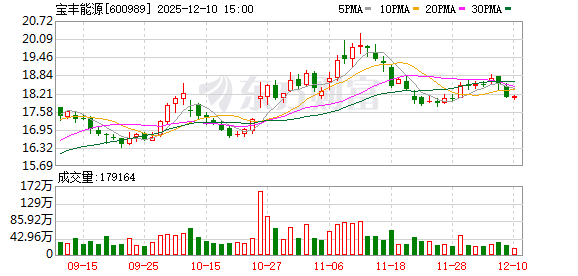
宝丰能源(600989.SH):本公司没有风力发电项目
Ge Long Hui· 2025-12-10 08:45
Group 1 - The company, Baofeng Energy (600989.SH), confirmed that it does not have any wind power generation projects [1]
宝丰能源:本公司没有风力发电项目
Ge Long Hui· 2025-12-10 08:43
Group 1 - The company Baofeng Energy (600989.SH) has confirmed that it does not have any wind power generation projects [1]
国泰君安期货商品研究晨报-20251210
Guo Tai Jun An Qi Huo· 2025-12-10 02:04
Report Date - The report is dated December 10, 2025 [1] Investment Ratings for Industries - No overall industry investment ratings are provided in the report. Core Views - The report provides short - term trend forecasts for various commodities, including precious metals, base metals, energy, chemicals, agricultural products, etc. For example, gold shows a trend of rising due to increased expectations of interest rate cuts, while copper prices are under pressure due to the rising US dollar [2][5][9] Summary by Commodity Categories Precious Metals - **Gold**: With rising interest - rate cut expectations, its trend strength is 1. The price of domestic and international gold futures and spot has different performances, and the market is affected by factors such as the US employment data and the attitude of the Bank of Japan [5][7] - **Silver**: It has reached a new high, breaking through 60. The trend strength is 1, and it is affected by macro - economic factors and market sentiment [2][5][7] - **Platinum**: It has broken through the box, and attention should be paid to the previous high. The trend strength is 1 [24][26] - **Palladium**: The bottom is continuously rising, and the trend strength is 1 [24][26] Base Metals - **Copper**: The rising US dollar puts pressure on its price. The trend strength is 0. The production of some mines is affected, and the import volume of China shows an increasing trend [9][11] - **Zinc**: Pressure is gradually emerging, and the trend strength is 0. The market is affected by factors such as Sino - US economic relations and the approval of chip sales [12][14] - **Lead**: The increase in domestic inventory puts pressure on the price. The trend strength is 0, and it is affected by the US employment data and interest - rate cut expectations [15][16] - **Tin**: Supply is disturbed again, and the trend strength is 0. It is affected by macro - economic news and market sentiment [18][20] - **Aluminum**: It shows a range - bound oscillation. The trend strength is 0. The market is affected by factors such as production data and industry news [21][23] - **Nickel**: The structural surplus has changed, but the game contradiction remains unchanged. The trend strength is 0. The market is affected by factors such as Indonesian mining policies and supply - demand relationships [28][32] - **Stainless Steel**: The supply - demand continues to be weak, and the cost - support logic is strengthened. The trend strength is 0 [28][32] Energy and Chemicals - **Crude Oil - related Products**: - **Fuel Oil**: It has weakened again, and the center of the disk continues to move down. The trend strength is 0 [135] - **Low - Sulfur Fuel Oil**: It shows a narrow - range oscillation, and the spot price difference between high - and low - sulfur in the overseas market is temporarily stable. The trend strength is 0 [135] - **Chemicals**: - **Methanol**: It is under pressure to operate. The trend strength is - 1. The market is affected by factors such as inventory and supply - demand relationships [111][115] - **Urea**: It shows an oscillating operation, and attention should be paid to inventory indicators during the day. The trend strength is 0 [116][118] - **PVC**: The trend is weak. The trend strength is 0. The market is affected by factors such as supply, inventory, and cost [132][133] - **LPG**: The short - term demand is strong, but it is still under pressure in the medium - to long - term. The trend strength is 0 [124][128] - **Propylene**: There is an expectation of increased supply, and the upward driving force is limited. The trend strength is - 1 [124][128] Agricultural Products - **Grains and Oils**: - **Palm Oil**: Attention should be paid to the reaction after the MPOB report's negative factors are exhausted. The trend strength is 0 [163][170] - **Soybean Oil**: The driving force from US soybeans is insufficient, and it shows an oscillating trend. The trend strength is 0 [163][170] - **Soybean Meal**: The USDA report is mediocre, and the disk shows a low - level oscillation. The trend strength is 0 [171][173] - **Soybean**: It shows a rebound and oscillation. The trend strength is 0 [171][173] - **Corn**: Attention should be paid to the spot market. The trend strength is 0 [174][177] - **Sugar**: It shows a weak operation. The trend strength is - 1 [178][181] - **Cotton**: It shows an oscillating and strengthening trend, and attention should be paid to downstream demand. The trend strength is 0 [183][186] - **Other Agricultural Products**: - **Eggs**: The spot shows an oscillation. The trend strength is 0 [187] - **Pigs**: The market is trading the winter solstice expectation in advance. The trend strength is 0 [189][193] - **Peanuts**: Attention should be paid to the purchase of oil mills. The trend strength is 0 [195][197] Others - **Lumber**: It shows a low - level oscillation. The trend strength is 0 [56][59] - **Paper Pulp**: It shows an oscillating operation. The trend strength is 0 [100][102] - **Glass**: The price of the original sheet is stable. The trend strength is - 1 [107][109] - **Synthetic Rubber**: It shows a range - bound operation. The trend strength is 0 [74][76] - **Rubber**: It shows an oscillating and strengthening trend. The trend strength is 1 [71] - **Asphalt**: It shows a weak oscillation. The trend strength is - 1 [78][87] - **LLDPE**: It shows a unilateral decline, and the basis is passively positive. The trend strength is 0 [91][92] - **PP**: There is selling pressure from the upstream, and the price difference between powder and granular materials is inverted. The trend strength is 0 [93][94] - **Caustic Soda**: It is not advisable to chase short positions. The trend strength is 0 [95][98] - **PTA**: It is supported by cost, and the 5 - 9 spread is in a positive carry. The trend strength is - 1 [2][66][68] - **MEG**: Multiple sets of devices have reduced their loads, and the downside space is limited. The trend strength is 0 [2][66][69] - **PX**: The demand is seasonally weak, the supply is still tight, and it shows a high - level oscillating market. The trend strength is - 1 [2][66][67] - **Benzene Ethylene**: It shows a short - term oscillation. The trend strength is - 1 [119] - **Soda Ash**: The spot market changes little. The trend strength is - 1 [122] - **Short - Fiber**: There is pressure in the medium - term, and it is advisable to short the processing margin when the price is high. The trend strength is - 1 [150][151] - **Bottle - Chip**: There is pressure in the medium - term, and it is advisable to short the processing margin when the price is high. The trend strength is - 1 [150][151] - **Gummed Printing Paper**: It is advisable to wait and see. The trend strength is 0 [153] - **Pure Benzene**: It shows a short - term oscillation. The trend strength is - 1 [158][161] - **Shipping Index (European Route)**: It shows an oscillating market. The trend strength is 0 [137][147][149]
建信期货多晶硅日报-20251210
Jian Xin Qi Huo· 2025-12-10 01:54
多晶硅日报 油) 021-60635738 lijie@ccb.ccbfutures.com 期货从业资格号:F3031215 021-60635737 renjunchi@ccb.ccbfutures.com 期货从业资格号:F3037892 硅)028-8663 0631 penghaozhou@ccb.ccbfutures.com 期货从业资格号:F3065843 021-60635740 pengjinglin@ccb.ccbfutures.com 期货从业资格号:F3075681 021-60635570 liuyouran@ccb.ccbfutures.com 期货从业资格号:F03094925 研究员:冯泽仁(玻璃纯碱) 021-60635727 fengzeren@ccb.ccbfutures.com 行业 日期 2025 年 12 月 10 日 能源化工研究团队 研究员:李捷,CFA(原油燃料 研究员:任俊弛(PTA/MEG) 研究员:彭浩洲(工业硅/多晶 研究员:彭婧霖(聚烯烃) 研究员:刘悠然(纸浆) 期货从业资格号:F03134307 请阅读正文后的声明 每日报告 一、行情回顾与展望 ...