
轻工制造

Search documents
社保基金三季度抱团持有16股(附股)
Zheng Quan Shi Bao Wang· 2025-10-29 02:37
Core Insights - The Social Security Fund has disclosed its stock holdings as of the end of Q3, appearing in the top ten shareholders of 360 companies, with new investments in 108 companies and increased holdings in 93 companies [1][2] Group 1: Stock Holdings Overview - The total number of shares held by the Social Security Fund is 5.535 billion, with a total market value of 117.406 billion yuan [1] - The fund maintained its position in 49 companies, reduced holdings in 110 companies, and increased stakes in 93 companies [1] - The top three companies by shareholding are Sun Paper Industry (10.883 million shares), Weixing Co., Ltd. (7.314 million shares), and Guangxin Co., Ltd. (4.709 million shares) [1] Group 2: Shareholding Proportions - The highest shareholding proportion is in Norsun, with 8.16% of circulating shares, followed by Baiao Intelligent at 7.23% [1] - A total of 19 companies have over 50 million shares held by the Social Security Fund, with Vanadium Titanium Holdings leading at 170 million shares [1][2] Group 3: Performance of Held Stocks - Among the stocks held, 227 companies reported year-on-year net profit growth, with the highest increase seen in Xinqianglian at 1939.50% [2] - The average performance of the Social Security Fund's heavy stocks since October has seen a slight increase of 0.03%, underperforming the Shanghai Composite Index [2] - Notable performers include Beifang Changlong with a cumulative increase of 46.53%, while Guomai Culture experienced the largest decline at 41.78% [2] Group 4: Sector Distribution - The Social Security Fund's holdings are primarily concentrated in the pharmaceutical, machinery, and basic chemical industries, with 39, 36, and 34 companies respectively [2] - The distribution of holdings includes 244 companies on the main board, 86 on the ChiNext board, and 29 on the Sci-Tech Innovation board [2]
高股息+低PE+低PB+机构扎堆青睐股出炉
Zheng Quan Shi Bao Wang· 2025-10-29 01:09
Core Viewpoint - The article highlights the increasing trend of high dividend yields among listed companies in China, driven by supportive government policies encouraging companies to enhance investor returns through dividends and share buybacks [2][3]. Group 1: Policy Environment - The China Securities Regulatory Commission has introduced measures to strengthen investor protection, advocating for companies to enhance returns through multiple dividends per year and share buybacks [2]. - The shift from a financing-focused market to one emphasizing returns is seen as crucial for the capital market's evolution, with increased dividends attracting long-term capital [2]. Group 2: High Dividend Stocks - As of October 27, 2023, there are 120 stocks with a dividend yield exceeding 5%, with six stocks yielding over 10%, including Oriental Yuhong at 13.94%, which ranks first [3]. - Oriental Yuhong has distributed a total of 58.81 billion yuan in cash dividends over the past year and has significant holdings from social security funds [3]. Group 3: Performance of High Dividend Stocks - Among the high dividend stocks, 24 companies reported year-on-year profit growth in the first three quarters, with Xiantan Co. leading at a 72.48% increase in net profit [3]. - Other notable performers include Woer Home, with a 70.92% increase in net profit, attributed to rising revenue and reduced expenses [3][4]. Group 4: Institutional Interest - A total of 69 stocks have received positive ratings from five or more institutions, indicating strong institutional interest in high dividend, low PE, and low PB stocks [8]. - Stocks like Hongcheng Environment and Xinghu Technology are highlighted for their potential upside, with Hongcheng Environment showing a projected increase of 43.92% based on institutional target prices [8][9].


从全行业负债与投融资变化观察信用扩张信号是否出现?
Soochow Securities· 2025-10-28 12:02
Report Industry Investment Rating No relevant content provided. Core Viewpoints - The overall credit expansion of the entire industry is moderate, showing no significant momentum compared to the past. The non - current liabilities, financing inflows, and investment expenditures all indicate that the economy is in a slow - repair process, and the probability of a rapid turnaround in the economic fundamentals in the short term is low [1]. - There is still significant structural differentiation among industries in credit expansion. Different industries show different trends in non - current liabilities, financing inflows, and investment expenditures, presenting a "structural bias + uneven rhythm" mild recovery situation [2]. - Industries currently in the credit expansion stage, such as light manufacturing, electronics, basic chemicals, and public utilities, are recommended for credit bond allocation. Industries in credit contraction, like real estate, food and beverage, beauty care, and household appliances, suggest focusing on credit bonds of enterprises with controllable refinancing pressure and asset impairment risks [2]. Summary by Directory 1. The overall credit expansion of the entire industry is moderate, showing no significant momentum compared to the past 1.1 Non - current liabilities: Scale expansion continues, but growth rate remains low - As of the end of the first half of 2025, the total non - current liabilities of listed companies in the entire industry reached 20.28 trillion yuan, with a year - on - year increase of 3.62% and a quarter - on - quarter increase of 3.52%. The growth rate is at a low or medium - low level compared to historical data, indicating that the willingness of Chinese enterprises to expand credit through long - term bank loans and bond issuance is not significantly increasing [9][10]. 1.2 Financing inflows: The rhythm is stable, and the support from funding sources remains - In the first half of 2025, the financing inflows of listed companies in the entire industry reached 9.95 trillion yuan, with a year - on - year increase of 0.89% and a quarter - on - quarter increase of 12.51%. The growth rate is similar to recent years but slower than before 2023, suggesting that the ability and willingness of enterprises to obtain funds through medium - and long - term bank credit and bonds have not significantly increased, and the credit expansion is still moderate [12][15]. 1.3 Investment expenditures: Year - on - year growth is continuously negative, and credit implementation is somewhat weak - In the first half of 2025, the investment expenditures of listed companies in the entire industry were 2.13 trillion yuan, with a year - on - year decrease of 1.71% and a quarter - on - quarter decrease of 21.83%. The year - on - year data has been in a downward trend since 2024, indicating that enterprises' ability and willingness to carry out production investment activities by increasing leverage are still weak, and the signal of credit expansion is not obvious [18][19]. 2. Structural differentiation among industries remains the main theme of credit expansion 2.1 Non - current liabilities - In the first half of 2025, industries such as comprehensive, public utilities, building decoration, light manufacturing, and basic chemicals had high year - on - year growth rates of non - current liabilities, while industries like household appliances, food and beverage, agriculture, forestry, animal husbandry, and computer had significant contractions. The differentiation is affected by industry cycle attributes and factors such as consumer demand and policies [25][26]. 2.2 Financing inflows - In the first half of 2025, industries such as household appliances, coal, social services, electronics, light manufacturing, public utilities, non - ferrous metals, and environmental protection had high year - on - year growth rates of financing inflows, while industries like communication, real estate, food and beverage, and social services had negative growth rates. Credit expansion is shifting from traditional industries to industries related to high - end technology manufacturing, consumption upgrading, and export [30][31]. 2.3 Investment expenditures - In the first half of 2025, industries such as coal, automobiles, comprehensive, and electronics showed certain resilience in investment expenditures, while industries like real estate, building materials, petroleum and petrochemicals, and public utilities had weak performance. Many industries have room for improvement in investment implementation, and some industries' investment funds may come from internal sources [33][34]. 2.4 Summary - Credit expansion in recent years has not returned to the pre - pandemic level, showing a structural and moderate recovery. Industries in credit expansion, such as light manufacturing, electronics, basic chemicals, and public utilities, are recommended for credit bond allocation, while industries in credit contraction, like real estate, food and beverage, beauty care, and household appliances, suggest focusing on enterprises with controllable risks [38].
轻工制造行业快评报告:9月工业企业利润加快恢复,超半数消费制造行业利润端有所改善
Wanlian Securities· 2025-10-28 08:17
Investment Rating - The industry investment rating is "Outperform the Market," indicating an expected increase of over 10% in the industry index relative to the market over the next six months [9]. Core Insights - In the first nine months of 2025, the total profit of industrial enterprises above designated size reached 537.32 billion yuan, a year-on-year increase of 3.2%, with a growth acceleration of 2.3 percentage points compared to January-August [2]. - In September alone, the profit of these enterprises increased by 21.6% year-on-year, reflecting continuous improvement in industrial profits [2]. - The revenue for the same period was 1,020,846.7 billion yuan, showing a year-on-year growth of 2.4% [2]. Summary by Relevant Sections Consumer Goods Manufacturing - Among 13 major categories in consumer goods manufacturing, six industries, including agricultural and sideline food processing, food manufacturing, and beverages, reported positive profit growth from January to September. Notably, the beverage and agricultural processing industries saw profit growth rates exceeding 10%, at +14.4%, +12.5%, and +10.7% respectively [3]. - Conversely, seven industries experienced negative profit growth, with six of them declining over 10%. The furniture manufacturing industry faced a decline of -19.1%, while textiles and apparel saw a drop of -16.2% [3]. - Compared to January-August, profit growth in agricultural processing and food manufacturing further expanded, while the printing and chemical fiber industries turned from negative to positive growth [3]. Investment Recommendations - The report suggests focusing on sectors benefiting from macro policies and low base effects from the previous year. Key recommendations include: 1. **Food and Beverage**: The liquor industry is seen as bottoming out, with low valuations and high dividends providing strong support. The market is expected to see an upward turn ahead of financial reports as channel inventories clear [4]. 2. **Social Services**: As a core driver of consumption, sectors like tourism, duty-free, hotels, and restaurants are expected to benefit from policy support [4]. 3. **Retail**: In the context of a changing global trade environment, gold jewelry is highlighted as an attractive investment due to its status as a safe-haven asset [4]. 4. **Light Industry**: With policies promoting real estate recovery and "old-for-new" subsidies, demand for home and appliance products is anticipated to rise [4].
创业板融资余额增加95.50亿元 39股获融资客大手笔加仓
Zheng Quan Shi Bao Wang· 2025-10-28 03:02
Core Viewpoint - The financing balance of the ChiNext market has increased significantly, indicating a positive trend in investor sentiment and market activity, with notable individual stocks experiencing substantial growth in financing balance [1][2]. Financing Balance Overview - The latest financing balance for ChiNext stocks is 527.196 billion yuan, an increase of 9.550 billion yuan compared to the previous period [1]. - The total margin balance for ChiNext stocks reached 529.059 billion yuan, with a day-on-day increase of 9.625 billion yuan [1]. - Among the stocks, 554 experienced an increase in financing balance, with 39 stocks seeing growth exceeding 10% [1]. Notable Stocks with Increased Financing Balance - The stock with the highest increase in financing balance is Jiangxin Home, with a balance of 29.232 million yuan, reflecting a 54.41% increase [3]. - Other significant increases were observed in Dingtai High-Tech (40.62%) and Weston (27.07%) [3]. - On average, stocks with over 10% increase in financing balance rose by 4.23% on the same day, with top performers including Xinle Energy (17.65%), Dingtai High-Tech (14.70%), and Suzhou Tianmai (14.17%) [1][3]. Stocks with Decreased Financing Balance - A total of 392 stocks saw a decrease in financing balance, with 53 stocks experiencing a decline of over 5% [4]. - The largest decrease was recorded by Guanzhong Ecology, with a financing balance of 73.5036 million yuan, down by 39.22% [4]. - Other notable declines included JuJiao Co. (-29.87%) and Weili Transmission (-19.26%) [4]. Capital Flow Insights - Among the stocks with increased financing balance, 23 stocks saw net inflows of main funds, with the highest inflows in Xiechuang Data (288 million yuan), Deepin Technology (193 million yuan), and Oulu Tong (155 million yuan) [2]. - Conversely, 16 stocks experienced net outflows, with the largest outflows in Yiwei Lithium Energy (-585 million yuan), Aerospace Intelligent Equipment (-282 million yuan), and Jinfeng Technology (-208 million yuan) [2].

创业板融资余额增加95.50亿元,39股获融资客大手笔加仓
Zheng Quan Shi Bao Wang· 2025-10-28 02:20
创业板股最新融资余额为5271.96亿元,环比增加95.50亿元,39只股融资余额环比增长超10%,融资余 额环比降幅超5%的有53只。 证券时报·数据宝统计显示,10月27日创业板指上涨1.98%,创业板股两融余额合计5290.59亿元,较上 一交易日增加96.25亿元,其中,融资余额合计5271.96亿元,环比上一日增加95.50亿元;融券余额18.62 亿元,环比增加7455.62万元。 具体来看,融资余额增长的创业板股有554只,其中,39股融资余额增幅超过10%。增幅最大的是匠心 家居,该股最新融资余额2923.20万元,环比上一交易日增幅为54.41%;股价表现上,该股当日下跌 0.43%,表现弱于创业板指;融资余额增幅较多的还有鼎泰高科、威士顿等,分别增长40.62%、 27.07%。 融资余额增幅10%以上的个股中,从市场表现来看,当日平均上涨4.23%,上涨的有25只,涨幅居前的 有新雷能、鼎泰高科、苏州天脉,涨幅分别为17.65%、14.70%、14.17%。跌幅居前的有中来股份、盘 古智能、合康新能,跌幅分别为6.17%、5.69%、5.53%。 资金流向方面,融资余额环比增幅居前个股中 ...
四中全会定调与市场锚点解析
2025-10-27 15:22
Summary of Key Points from Conference Call Records Industry or Company Involved - The discussion primarily revolves around the Chinese economy, focusing on key policies set forth during the 20th Central Committee's Fourth Plenary Session, as well as implications for the bond market and various sectors within the economy. Core Points and Arguments 1. **Emphasis on Core Industries** China aims to strengthen its core industries, including manufacturing, quality, internet, aerospace, and transportation, to counter global de-globalization risks [3][4] 2. **Technological Development as a Priority** Technological advancement is identified as a crucial driver of new productive forces, with the new economy contributing approximately 17-18% to GDP. Future efforts will focus on original innovation and tackling key core technologies [3][4] 3. **Expansion of Domestic Demand** The strategy to expand domestic demand is highlighted, with an emphasis on integrating material and human investments to stimulate consumption and investment. Special government bonds may be used to support consumption subsidies [3][4] 4. **Real Estate Sector Focus** For the first time, the real estate sector is addressed in the context of people's livelihoods, with a push for high-quality development that returns to its residential nature. This indicates a policy shift to mitigate the economic drag from the real estate sector [3][4] 5. **Local Government Debt Management** The need to manage local government debt risks is reiterated, with expectations for new debt limits to be issued early next year. The government may increase bond issuance and align monetary policy with potential rate cuts [4][5] 6. **Market Liquidity and Interest Rates** The People's Bank of China may restart net purchases of government bonds to enhance market liquidity, with expectations for the effective repurchase rate to decrease from the current range of 1.8-1.85% to 1.75-1.8% [4][5] 7. **Impact of U.S.-China Trade Relations** Ongoing U.S.-China trade negotiations and their outcomes are expected to influence market sentiment and the bond market's direction [4][8] 8. **Performance of Key Sectors** The third-quarter earnings reports indicate strong performance in sectors such as communication equipment, electronic semiconductors, chemicals, and industrial metals, particularly in AI computing and consumer electronics [11] 9. **Foreign Capital Inflows** Recent weeks have seen strong foreign capital inflows into the A-share market, with October's inflow reaching a multi-year high. In contrast, foreign interest in Hong Kong stocks remains weaker [12] 10. **New vs. Old Economic Drivers** The transition from old to new economic drivers is accelerating, with significant growth in new productive forces, particularly in computing power and cloud computing, which have seen increases of around 1.5 times [13] 11. **Investment Value of Anti-Overwork Policies** Anti-overwork policies are expected to impact various sectors, including photovoltaics and steel, presenting investment opportunities aligned with new productive forces [14] 12. **Consumer Sector Investment Logic** Investment in the consumer sector should focus on fundamental performance, with specific attention to sectors like light manufacturing, textiles, and agriculture, which have shown strong performance [15] Other Important but Possibly Overlooked Content - The potential for further monetary policy adjustments, including rate cuts, is anticipated in response to economic data releases [5] - The upcoming "15th Five-Year Plan" is expected to provide detailed policy guidance, particularly regarding modern industrial systems and domestic market strength [9]
民士达(920394):受蜂窝芯材交付节奏影响,公司业绩略低于预期
Jianghai Securities· 2025-10-27 09:02
Investment Rating - The investment rating for the company is "Buy" (maintained) [1] Core Views - The company has shown a revenue increase of 21.8% year-on-year for the first three quarters of 2025, reaching 343 million yuan, with a net profit of 91.17 million yuan, up 28.9% year-on-year [3] - The third quarter revenue was 106 million yuan, reflecting a 9.9% year-on-year increase, but the performance was below market expectations [3] - The company is experiencing a slowdown in revenue growth due to changes in the delivery schedule of honeycomb core materials, which impacted overall revenue growth [7] - The company maintains stable gross and net profit margins, with a gross margin of 40.4% for the first three quarters, up 2.8 percentage points year-on-year [7] - The company is in a ramp-up phase for its new production capacity, which is expected to gradually release in the future [7] - The company is positioned as a leading domestic aramid paper manufacturer, with significant potential for domestic substitution and is actively developing a second growth curve to ensure long-term development [7] Financial Forecast - Total revenue is projected to grow from 340.47 million yuan in 2023 to 801.96 million yuan in 2027, with a compound annual growth rate (CAGR) of approximately 24.84% [6] - Net profit is expected to increase from 81.63 million yuan in 2023 to 209.45 million yuan in 2027, with a CAGR of approximately 28.22% [6] - The company’s return on equity (ROE) is forecasted to rise from 12.10% in 2023 to 16.62% in 2027 [6] - The earnings per share (EPS) is projected to grow from 0.56 yuan in 2023 to 1.43 yuan in 2027 [6] Market Data - The current stock price is 39.75 yuan, with a total share capital of 146.25 million shares [1] - The stock has a price-to-earnings (P/E) ratio projected at 44x for 2025, 36x for 2026, and 28x for 2027 [7]
10月24日沪深两市强势个股与概念板块
2 1 Shi Ji Jing Ji Bao Dao· 2025-10-24 12:05
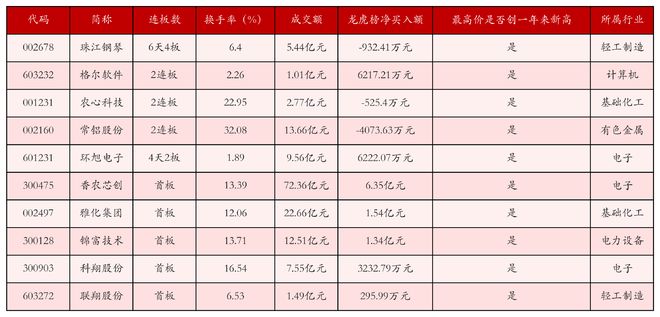
Strong Stocks - As of October 24, the Shanghai Composite Index rose by 0.71% to 3950.31 points, the Shenzhen Component Index increased by 2.02% to 13289.18 points, and the ChiNext Index surged by 3.57% to 3171.57 points [1] - A total of 71 stocks in the A-share market hit the daily limit, with the top three strong stocks being: Zhujiang Piano (002678), Geer Software (603232), and Nongxin Technology (001231) [1] - Detailed data for the top 10 strong stocks includes metrics such as consecutive limit-up days, turnover rates, trading volumes, and net buying amounts from the Dragon and Tiger List [1] Strong Concept Sectors - The top three concept sectors by percentage increase are: Storage Chips (5.66%), National Big Fund Holdings (4.88%), and Co-Packaged Optics (CPO) (4.25%) [2] - The top 10 concept sectors show a high percentage of rising constituent stocks, with Storage Chips having 96.15% of its stocks rising [2] - Other notable sectors include AI PC (3.99%), AI Mobile (3.88%), and MCU Chips (3.72%), all showing significant increases [2]
今日72只个股涨停 主要集中在电子、建筑装饰等行业
Zheng Quan Shi Bao Wang· 2025-10-24 07:45
Core Viewpoint - On October 24, the A-share market showed a positive trend with 2,872 stocks rising, indicating a bullish sentiment among investors [1] Group 1: Market Performance - A total of 2,872 stocks increased in value, while 2,163 stocks declined, and 119 stocks remained flat [1] - Excluding newly listed stocks on that day, there were 72 stocks hitting the upper limit of price increase, and 11 stocks hitting the lower limit of price decrease [1] Group 2: Industry Analysis - The stocks that reached the upper limit were primarily concentrated in the following sectors: electronics, construction decoration, light industry manufacturing, machinery equipment, and automotive [1]