
机械

Search documents
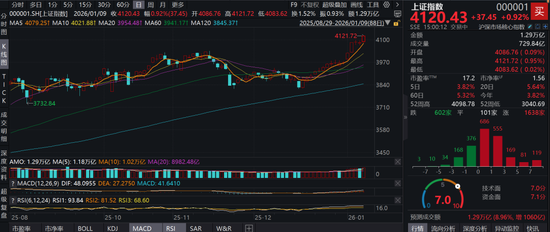
沪指暴力16连阳!机构:热度有望延续,中信看好资源和传统制造
Xin Lang Cai Jing· 2026-01-11 23:37
Core Viewpoint - The A-share market is experiencing a significant upward trend, with the Shanghai Composite Index breaking through 4100 points and achieving a historical 16 consecutive days of gains, driven by sectors such as commercial aerospace, controllable nuclear fusion, brain-computer interfaces, humanoid robots, and resource stocks [1][11]. Group 1: Market Trends - The current market rally is attributed to concentrated inflows from previously cautious funds, with a notable focus on thematic stocks and small-cap stocks rather than traditional allocation strategies [3][13]. - Short-term market sentiment remains high, with no signs of weakening emotional indicators, suggesting that the upward trend in thematic and small-cap stocks may continue until after the Two Sessions [3][13]. - The market is currently characterized by a high level of trading activity, with a significant increase in transaction volume, indicating strong investor confidence [16]. Group 2: Sector Recommendations - Analysts recommend focusing on sectors with high cost-performance ratios, particularly those benefiting from external demand recovery, such as gaming, duty-free, batteries, engineering machinery, and agricultural chemicals [4][14]. - The commercial aerospace sector is highlighted as a key area for investment, with expectations of continued upward momentum despite potential short-term profit-taking pressures [19]. - The resource sector, particularly traditional manufacturing, is advised for increased allocation, with a focus on enhancing pricing power [3][13]. Group 3: Future Outlook - February is anticipated to be a favorable period for the market, with historical data suggesting that significant trading volumes often lead to sustained upward trends [16]. - The market is expected to enter a phase of basic performance evaluation after the annual report disclosures in January, which may provide opportunities for investors to capitalize on growth potential [17]. - The overall sentiment indicates that the upward potential in the market outweighs the risks, with a focus on sectors that align with long-term growth trends, such as AI and semiconductor industries [20].

【十大券商一周策略】短期热度有望延续,A股估值有望继续提升
券商中国· 2026-01-11 14:55
Group 1 - The market is currently experiencing a high level of enthusiasm, with a focus on theme stocks and small-cap stocks, while traditional investment funds are more cautious [2] - The expectation is that the market will continue to show a pattern of oscillation and upward movement until the National People's Congress, driven by improved domestic demand expectations [2] - There is a recommendation to focus on resources and traditional manufacturing sectors, as well as to increase allocation in non-bank financials to reduce portfolio volatility [2] Group 2 - A-share valuations are expected to continue to rise, with a potential rebound in overall ROE by 2026, influenced by factors such as increased profits from emerging industries and a slowdown in PPI [3] - The influx of certain types of funds, including regulatory, insurance, and bank wealth management funds, is seen as a solid foundation for the A-share market [3] - The market is likely to see a continuation of the spring rally, with a focus on small-cap stocks and potential adjustments providing good entry points for investors [3] Group 3 - The current market environment suggests limited downside risk and significant potential for upward movement, particularly in the commercial aerospace sector, which is experiencing positive changes [5] - The market is characterized by a concentration of themes and strong trading sentiment, with upcoming earnings reports expected to drive structural adjustments [5] - There is a focus on sectors such as AI, semiconductor, and resource price increases as key areas for investment [9] Group 4 - The spring rally is supported by improved liquidity and a favorable economic environment, with expectations of continued strong performance in the A-share market [6] - The focus on technology and growth sectors is expected to provide significant investment opportunities, particularly in AI applications and commercial aerospace [11] - The market is likely to remain strong leading up to the Spring Festival, with a focus on sectors benefiting from policy support and economic recovery [14]

中信建投:短期或有震荡,无碍中期行情
Xin Lang Cai Jing· 2026-01-11 11:48
Core Viewpoint - The recent rebound of the US dollar index has not negatively impacted the strength of the RMB exchange rate, creating a favorable environment for the A-share market [1] Market Environment - Inflation levels are showing a mild recovery, and the internal momentum of economic recovery is gradually being restored, which is beneficial for the sustained slow bull market of A-shares [1] - Market sentiment indicates that the year-end rally is likely to continue, although there is an increased risk of short-term technical corrections [1] Industry Performance - Current market performance is characterized by sector differentiation, with well-anticipated sectors consolidating while waiting for validation, and previously lagging sectors are experiencing a rebound [1] - The focus for the year-end rally is on future industry hotspots, particularly in AI, semiconductors, and the resource price increase chain [1] Key Industry Focus - Key industries to watch include semiconductors, AI, non-ferrous metals, chemicals, machinery, media, computers, and pharmaceuticals [1] - Key themes to focus on include brain-computer interfaces, commercial aerospace, controllable nuclear fusion, humanoid robots, and quantum technology [1]

投资策略周报:春季躁动:从提前布局到加速突破-20260111
KAIYUAN SECURITIES· 2026-01-11 07:13
Group 1 - The report emphasizes the strong underlying drivers of the current bull market, including liquidity support, policy backing for capital markets, moderate fundamental recovery, and continuous industry catalysts, despite short-term overseas disturbances [1][9][10] - The report highlights the significant inflow into the A500 ETF, which accounted for 92.2% of the total net inflow of 110.6 billion yuan in December, indicating a strong market sentiment and confidence in the Chinese market [10][14] - The continuous appreciation of the RMB reflects a recovery in international capital confidence towards China, supported by a decline in the US dollar index and a surge in corporate foreign exchange settlements [18][19][21] Group 2 - The report identifies the small-cap index, CSI 2000, as an "invisible champion," outperforming the large-cap index during the recent market rally, supported by a favorable liquidity environment and moderate fundamental recovery [2][25] - The report suggests that the current bull market is characterized by a unique valuation expansion, where small-cap stocks face less resistance compared to large-cap stocks, potentially breaking the historical underperformance of small caps at year-end [2][25] - The report anticipates strong elasticity in small-cap stocks under conditions of risk appetite and liquidity support, indicating a positive outlook for their performance [2][25] Group 3 - The report discusses the dual focus on technology and cyclical sectors, suggesting that both can thrive simultaneously, driven by a global tech cycle and supportive policies [3][28] - It highlights the importance of monitoring the marginal change in profit growth (ΔG) for AI hardware, indicating that as long as ΔG remains stable, the sector is likely to continue benefiting from the ongoing valuation bull market [38] - The report notes that AI applications are transitioning from being a supporting role to becoming the core narrative of the tech sector, driven by policy support, demand release, and a mature industry ecosystem [49][50]
——金融工程市场跟踪周报20260111:春季躁动仍可期-20260111
EBSCN· 2026-01-11 04:48
- The report discusses a volume-timing model that has issued buy signals for major broad-based indices, indicating a positive market sentiment[1][2][22] - The volume-timing model is constructed by analyzing the volume indicators of major broad-based indices and their ETFs, which have shown an increase in trading volume, suggesting a bullish market outlook[1][2][22] - The specific construction process of the volume-timing model involves tracking the trading volume of major indices and ETFs, and when the volume increases significantly, the model issues a buy signal[1][2][22] - The evaluation of the volume-timing model indicates that it is effective in capturing market sentiment and providing timely buy signals[1][2][22] - The report also introduces a sentiment indicator based on the proportion of rising stocks within the CSI 300 index, which helps gauge market sentiment by tracking the number of stocks with positive returns over a specified period[23][24] - The construction process of this sentiment indicator involves calculating the proportion of CSI 300 index constituent stocks with positive returns over a given period, and using this proportion to assess market sentiment[23][24] - The evaluation of this sentiment indicator suggests that it is useful for quickly capturing market upturns, although it may miss out on gains during prolonged bullish phases and has limitations in predicting market downturns[23][24] - Another sentiment indicator discussed in the report is the moving average sentiment indicator, which uses the eight moving averages of the CSI 300 index to determine market trends[30][31] - The construction process of the moving average sentiment indicator involves calculating the eight moving averages (8, 13, 21, 34, 55, 89, 144, 233) of the CSI 300 index closing prices, and assigning values based on the number of moving averages the current price exceeds[30][31] - The evaluation of the moving average sentiment indicator indicates that it provides a clearer understanding of the market trends and is effective in identifying bullish phases[30][31] - The report includes backtesting results for the volume-timing model, showing that the model has consistently issued buy signals for major indices such as the Shanghai Composite Index, SSE 50, CSI 300, CSI 500, CSI 1000, and the ChiNext Index[23] - The sentiment indicator based on the proportion of rising stocks within the CSI 300 index has shown that the proportion of rising stocks is around 74%, indicating a positive market sentiment[24] - The moving average sentiment indicator shows that the CSI 300 index is currently in a bullish phase, as the short-term moving average is above the long-term moving average[30][31]




2025年四季度策略总结与未来行情预判:四季度指数涨跌互现,市场或震荡向上
Huachuang Securities· 2026-01-11 03:12
Summary of Key Points Core Viewpoints - The fourth quarter of 2025 saw mixed performance across different indices, with the Growth Index rising by 5.03% and the Shanghai Composite Index increasing by 2.22% [1] - Most sectors within the CITIC first-level industries showed positive returns, particularly the Oil & Petrochemical sector, which rose by 16.97%, and the Defense & Military sector, which increased by 16.74% [1][10] - Timing models in the fourth quarter demonstrated the ability to achieve absolute positive returns, with several models performing notably well [1] Sector Performance - The Oil & Petrochemical sector had a closing price of 3,424.25 with a quarterly increase of 16.97% [11] - The Defense & Military sector closed at 11,864.34, reflecting a quarterly rise of 16.74% [11] - Other sectors with significant gains included Nonferrous Metals (15.63%), Communications (14.72%), and Consumer Services (8.45%) [11][10] Fund Performance - Balanced mixed funds outperformed others with an average return of 1.22%, while stock funds showed a decline of 1.71% [14] - A total of 715 new public funds were established in Q4 2025, raising a total of 2,784.53 billion, with mixed funds raising 997.56 billion [14] Investment Themes - The report emphasizes the importance of utilizing historical timing, sector rotation, and stock selection models to identify future investment opportunities [5][6] - The focus for Q1 2026 is on sectors such as Construction Materials, Automotive, and Electronics [3] Timing Strategies - The report outlines various timing models, including short-term models like the Price-Volume Resonance Model and the Low-Volatility Blade Model, which aim to capture market trends and rebounds [15][16] - The Long-term Momentum Swing Model has shown a 7.01% annualized return since June 2008, indicating its effectiveness in long-term market analysis [43][44] Comprehensive Models - The Comprehensive Weapon V3 Model integrates multiple timing strategies and has achieved an annualized return of 29.55% since February 2015 [46] - The Smart Algorithm Timing Model for the CSI 300 Index has demonstrated a remarkable annualized return of 35.42% since January 2014, showcasing its superior performance compared to the index itself [49][50]
由创新高个股看市场投资热点
量化藏经阁· 2026-01-09 11:03
Market Trends and Highs - The report tracks stocks, industries, and sectors reaching new highs, indicating market trends and hotspots [1][4] - As of January 9, 2026, major indices such as the Shanghai Composite and Shenzhen Component are at 0.00% distance from their 250-day highs, while the CSI 300 is at 0.66% [5][23] - Among the CITIC first-level industry indices, home appliances, defense, non-ferrous metals, media, and electronics are closest to their 250-day highs, while food and beverage, banking, pharmaceuticals, real estate, and utilities are further away [8][24] High-Performing Stocks - A total of 911 stocks reached 250-day highs in the past 20 trading days, with the highest numbers in machinery, electronics, and basic chemicals [2][13] - The highest proportion of new high stocks is found in the defense, non-ferrous metals, and oil and petrochemical sectors, with respective proportions of 48.36%, 43.09%, and 32.00% [13][24] - The manufacturing and technology sectors have the most stocks reaching new highs this week, with respective counts of 323 and 241 [15] Stable High-Performing Stocks - The report identifies 50 stable high-performing stocks based on analyst attention, relative strength, price path stability, and continuity of new highs [3][19] - The cyclical and technology sectors have the most stocks selected, with 22 and 14 respectively, and the non-ferrous metals and electronics industries leading within these sectors [19][24]




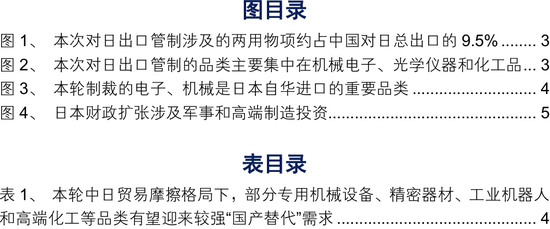
兴证宏观:对日本出口管制影响几何?
Xin Lang Cai Jing· 2026-01-09 08:48
Group 1 - The Chinese Ministry of Commerce announced on January 6, 2026, a ban on the export of all dual-use items to Japanese military users and any end-users that contribute to enhancing Japan's military capabilities [1][21] - The announcement follows negative remarks from Japan's right-wing cabinet regarding Taiwan, and the recent leadership of conservative politician Sanae Takaichi, who has adopted a hawkish stance towards China [1][21] - The sanctions target Japan's economic recovery, highlighting the strength of Chinese manufacturing while creating opportunities for domestic substitution [2][22] Group 2 - From a trade perspective, the impact on Japan is expected to be significantly greater than on China. The dual-use items involved in the sanctions amounted to approximately $13.7 billion, representing 9.5% of China's total exports to Japan [3][23] - Japan's reliance on imports from China is about 23.6%, and the sanctions could reduce Japan's imports by approximately 2.2 percentage points, particularly affecting high-weight categories such as electronics, machinery, and chemicals [3][23] - The sanctions reflect the vulnerabilities of the Japanese economy, which is currently facing internal economic weakness and external security challenges, prompting the Japanese government to expand its fiscal budget to support recovery [4][24] Group 3 - The sanctions may create strong demand for domestic substitution in industries previously reliant on Japanese imports, particularly in specialized machinery, precision instruments, industrial robots, and high-end chemicals [4][24][28] - China's stable supply amidst global uncertainties is expected to lead to asset revaluation opportunities, as the country continues to demonstrate a proactive strategic posture in the face of external pressures [5][24]
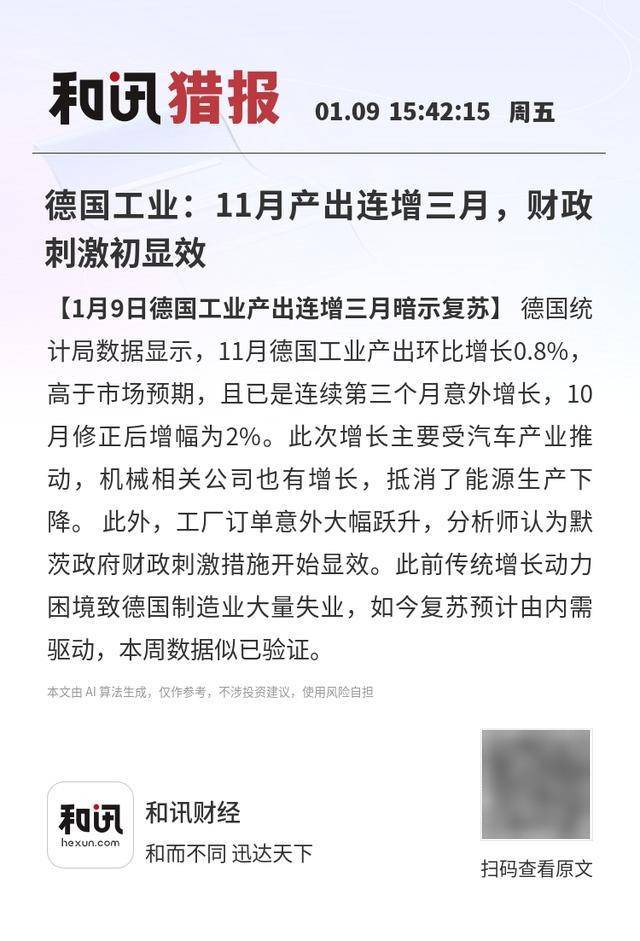
德国工业:11月产出连增三月,财政刺激初显效
Sou Hu Cai Jing· 2026-01-09 08:17
德国工业:11月产出连增三月,财政 刺激初显效 【1月9日德国工业产出连增三月暗示复苏】德国统计局数据显示,11月德国工业产出环比增长0.8%, 高于市场预期,且已是连续第三个月意外增长,10月修正后增幅为2%。此次增长主要受汽车产业推 动,机械相关公司也有增长,抵消了能源生产下降。此外,工厂订单意外大幅跃升,分析师认为默茨政 府财政刺激措施开始显效。此前传统增长动力困境致德国制造业大量失业,如今复苏预计由内需驱动, 本周数据似已验证。 本文由 AI 算法生成,仅作参考,不涉投资建议,使用风险自担 和讯猎报 01.09 15:42:15 周五 和讯财经 和而不同 迅达天下 扫码查看原文 【1月9日德国工业产出连增三月暗示复苏】 德国统 计局数据显示,11月德国工业产出环比增长0.8%, 高于市场预期,且已是连续第三个月意外增长,10 月修正后增幅为2%。此次增长主要受汽车产业推 动,机械相关公司也有增长,抵消了能源生产下 降。此外,工厂订单意外大幅跃升,分析师认为默 茨政府财政刺激措施开始显效。此前传统增长动力 困境致德国制造业大量失业,如今复苏预计由内需 驱动,本周数据似已验证。 本文由 Al 算法生成,仅 ...
广西做优做强工业经济
Jing Ji Ri Bao· 2026-01-09 03:01
经济日报南宁1月8日讯(记者童政、臧潇)近年来,广西坚定不移实施工业强桂战略,着力扩投 资、调结构、增效益,做优做强工业经济,在工业经济总量提升、产业结构优化、数智化与绿色化转型 方面成效显著,构建起体现广西特色与优势的现代化产业体系。 "十四五"期间,广西工业经济实现跨越式增长。2025年,广西规模以上工业总产值预计达2.7万亿 元,5年增长9000亿元;工业增加值占地区生产总值比重超27%,5年提升近4个百分点,工业成为全区 经济发展的"压舱石"。 目前,广西已形成十大千亿元级支柱产业。其中,有色金属产业产值5年实现翻番,2025年预计突 破4500亿元;钢铁、食品2个产业产值超3000亿元,造纸与木材加工、石化化工、机械、电力4个产业产 值超2000亿元,汽车、电子信息、建材3个产业产值超1000亿元。 在数智化与绿色化转型方面,广西实施"智改数转""人工智能+制造"行动。"十四五"期间,全区累 计推动5000多家企业实施"智改数转"、近万家企业完成数字化诊断,新增国家级绿色工厂105家、绿色 园区11个,3个园区入选首批国家级零碳园区建设名单。 广西壮族自治区工业和信息化厅党组书记、厅长袁煌说,广西将 ...