光模块

Search documents
6000亿光模块龙头突遭减持
2 1 Shi Ji Jing Ji Bao Dao· 2026-01-22 05:32
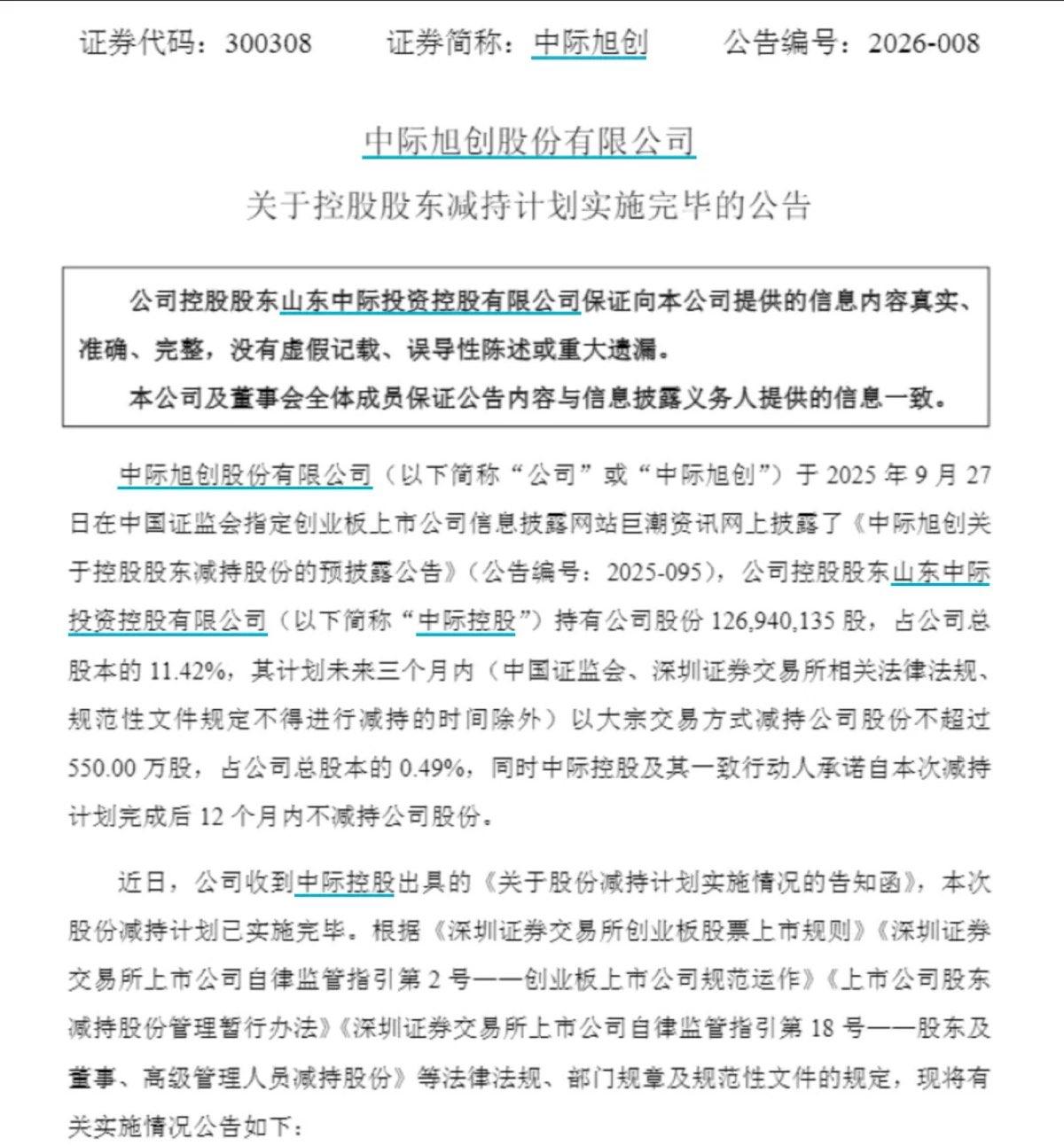
翻倍基金开始调整持仓结构!部分龙头牛股遭遇减持。 2025年,AI算力引爆A股科技行情,一批重仓算力产业链的主动权益基金,年度收益率高达100%以上。根据部分2025年度"翻倍基"最新披露的重仓股数据, 过去一个季度,不同基金经理对个别AI细分赛道龙头股的操作截然相反。 以光模块龙头中际旭创(300308)为例,永赢科技智选、中欧数字经济均在2025年四季度减持了中际旭创。其中,前者持有中际旭创的数量较2025年三季度 末减少了17%至224.49万股,中际旭创仍为基金第二大重仓股;中欧数字经济持有中际旭创的数量较2025年三季度末减少了33.42%至185.42万股,但仍为其 第一大重仓股。 截至1月22日午盘,中际旭创A股市值超6500亿元,2025年中际旭创全年涨幅近400% 除了机构密集减持,1月16日,中际旭创也公告,控股股东中际控股已完成550万股减持计划,减持均价为521.73元/股,占公司总股本的0.49%。 图/1月16日上市公司公告 而交银优择回报、前海开源沪港深乐享生活则在2025年四季度增持了中际旭创,前者持仓数量环比增长了77.25%,后者持仓数量环比大增了266.44%。截至 20 ...


6000亿光模块龙头突遭减持
21世纪经济报道· 2026-01-22 05:19
Core Viewpoint - The article discusses the adjustments in the holdings of various funds, particularly in the AI and technology sectors, highlighting contrasting strategies among fund managers regarding key stocks like Zhongji Xuchuang and the broader implications for investment opportunities in 2026 [1][4][15]. Fund Adjustments - In Q4 2025, several funds reduced their holdings in Zhongji Xuchuang, with Yongying Technology Select decreasing its shares by 17% to 2.2449 million shares, while China Europe Digital Economy cut its holdings by 33.42% to 1.8542 million shares [1][4]. - Conversely, funds like Jiaoyin Youze and Qianhai Kaiyuan increased their positions in Zhongji Xuchuang, with increases of 77.25% and 266.44% respectively [8]. Sector Focus - The article notes a consensus among high-performing funds to focus on the PCB sector, with funds like Yongying Technology Select and Qianhai Kaiyuan increasing their stakes in companies like Dongshan Precision and Shenzhen South Circuit [9][12]. - The adjustments reflect a strategic shift towards domestic AI and AI infrastructure, with funds optimizing their selections in smart robotics while reducing exposure to smart driving and edge AI [12]. Investment Strategies - Fund managers are increasingly considering "reversal strategies" that capitalize on high-confidence areas driven by global tech trends, particularly in AI, while balancing growth and safety [15][18]. - The article emphasizes the importance of diversifying investments across different sectors to mitigate risks associated with high valuations in the AI sector, which may lead to increased volatility [19]. Future Outlook - Looking ahead to 2026, fund managers are focusing on the expansion of AI applications and the potential for significant breakthroughs in various sectors, including robotics and commercial space ventures [16][18]. - The article highlights the ongoing competition in the large model AI field and the anticipated demand for computing power, suggesting a continued interest in AI-related assets despite the risks associated with high valuations [17].

ETF盘中资讯|AI驱动+数据中心催化,光模块龙头净利涨超40%!创业板人工智能ETF(159363)继续反弹超2%
Sou Hu Cai Jing· 2026-01-22 02:43
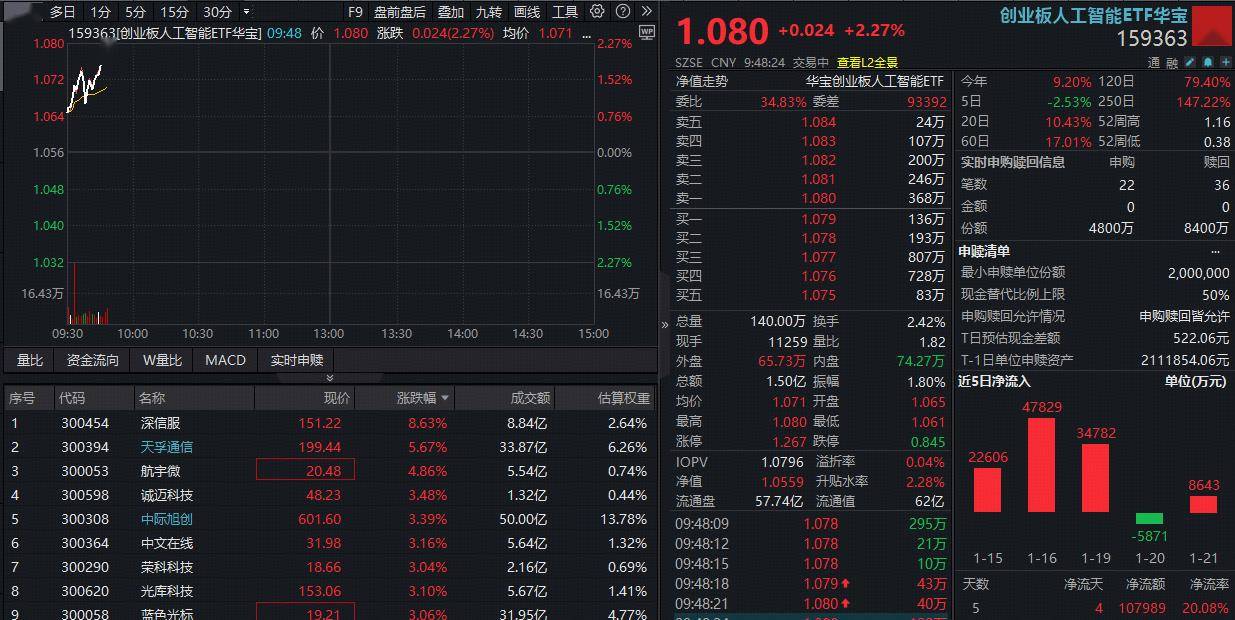
Core Viewpoint - The performance expectations in the optical module CPO sector are driving the rise of the AI sector in the ChiNext market, with significant gains in stocks like Tianfu Communication and AI application companies like Deepin Technology [1] Group 1: Market Performance - The ChiNext AI sector rose over 1%, with Tianfu Communication up 6%, Zhongji Xuchuang up over 2%, and Xinyi Sheng up over 1% [1] - The ChiNext AI ETF (159363) saw a 2% increase, with real-time transactions exceeding 150 million yuan and over 1 billion yuan added in the past five days [1] Group 2: Company Performance - Tianfu Communication announced a profit forecast for 2025, expecting net profit attributable to shareholders to be between 1.881 billion yuan and 2.150 billion yuan, representing a year-on-year growth of 40% to 60% [1] - The growth is attributed to the accelerated development of the AI industry and the ongoing global data center construction, which has driven stable demand for high-speed optical device products [1] Group 3: Industry Insights - Tianfeng Securities expresses optimism about investment opportunities in the core players of the computing power supply chain, driven by AI-related demand [2] - The communication industry has seen a low increase in stock prices despite strong earnings forecasts, indicating potential for capital inflow during the earnings disclosure period [2] - The ChiNext AI ETF is positioned to benefit directly from the commercialization of AI technology, with approximately 60% of its portfolio in computing power and 40% in AI applications [2]



AI驱动+数据中心催化,光模块龙头净利涨超40%!创业板人工智能ETF(159363)继续反弹超2%
Xin Lang Cai Jing· 2026-01-22 02:04
Group 1 - The core viewpoint of the news highlights the positive performance of the AI sector, particularly driven by the optical module CPO segment, with notable stock increases such as Tianfu Communication rising by 6% and Deepin Technology leading with a 7% gain [1][5] - The AI application sector is showing active performance, with multiple stocks, including Chinese Online and BlueFocus, experiencing gains of over 2% [1][5] - The entrepreneurial board AI ETF (159363) has seen a 2% increase in trading, with real-time transactions exceeding 150 million CNY and over 1 billion CNY added in the past five days [1][5] Group 2 - Tianfu Communication has released a profit forecast for 2025, estimating net profits attributable to shareholders between 1.881 billion CNY and 2.150 billion CNY, representing a year-on-year growth of 40% to 60% [1][5] - The growth is attributed to the accelerated development of the AI industry and the ongoing construction of global data centers, which have driven stable demand for high-speed optical device products [1][5] - The company’s continuous cost reduction and efficiency improvement in smart manufacturing have also contributed to revenue growth across its active and passive product lines [1][5] Group 3 - Tianfeng Securities expresses a strong outlook on investment opportunities within the core segments of the computing power supply chain, driven by AI, indicating potential for significant business growth [2][6] - The report emphasizes the high prosperity of the overseas computing power supply chain, with ongoing financial reports reflecting strong AI-related demand [2][6] - Industrial chain fundamentals are resonating strongly, particularly in the optical module sector, which is expected to attract more attention during the earnings disclosure period [2][6] Group 4 - The entrepreneurial board AI ETF is structured with approximately 60% of its portfolio focused on computing power (primarily optical modules) and about 40% on AI applications, representing both core computing power and true AI application sectors [7]


A股盘前播报 | 美欧关税警报解除!全球资产集体大涨 中概股指数涨超2%
智通财经网· 2026-01-22 00:55
Industry Insights - The People's Bank of China is accelerating the construction of a cross-border payment system for the renminbi, promoting interconnectivity in cross-border payments and aiming for a diversified and multi-layered development of the payment system [2] - The Ministry of Finance and four other departments announced the establishment of new duty-free shops at 41 ports to boost consumption, facilitating duty-free shopping for incoming travelers [3] - The demand for AI is driving significant revenue growth for several companies in the industry, with storage chip leader Demingli expected to achieve revenue of 10.3 billion to 11.3 billion yuan in 2025, representing a year-on-year increase of 115.82% to 136.77% [4] - The consumer electronics market is showing signs of recovery, with companies like Jin'an Guoji and Baiao Intelligent reporting impressive performance [4] Company Performance - Demingli, a leader in storage chips, anticipates a revenue increase of 115.82% to 136.77% in 2025, projecting revenues between 10.3 billion and 11.3 billion yuan [4] - Tianfu Communication, a core supplier of optical modules, expects a net profit growth of 40% to 60% in 2025 [4] - Jin'an Guoji forecasts a net profit of 280 million to 360 million yuan in 2025, reflecting a year-on-year increase of 655.53% to 871.40% [14] - Daikin Heavy Industries projects a net profit of 1.05 billion to 1.2 billion yuan in 2025, indicating a growth of 121.58% to 153.23% [14]




兴证全球基金谢治宇:重点配置海外算力、半导体设备等领域
Sou Hu Cai Jing· 2026-01-22 00:21
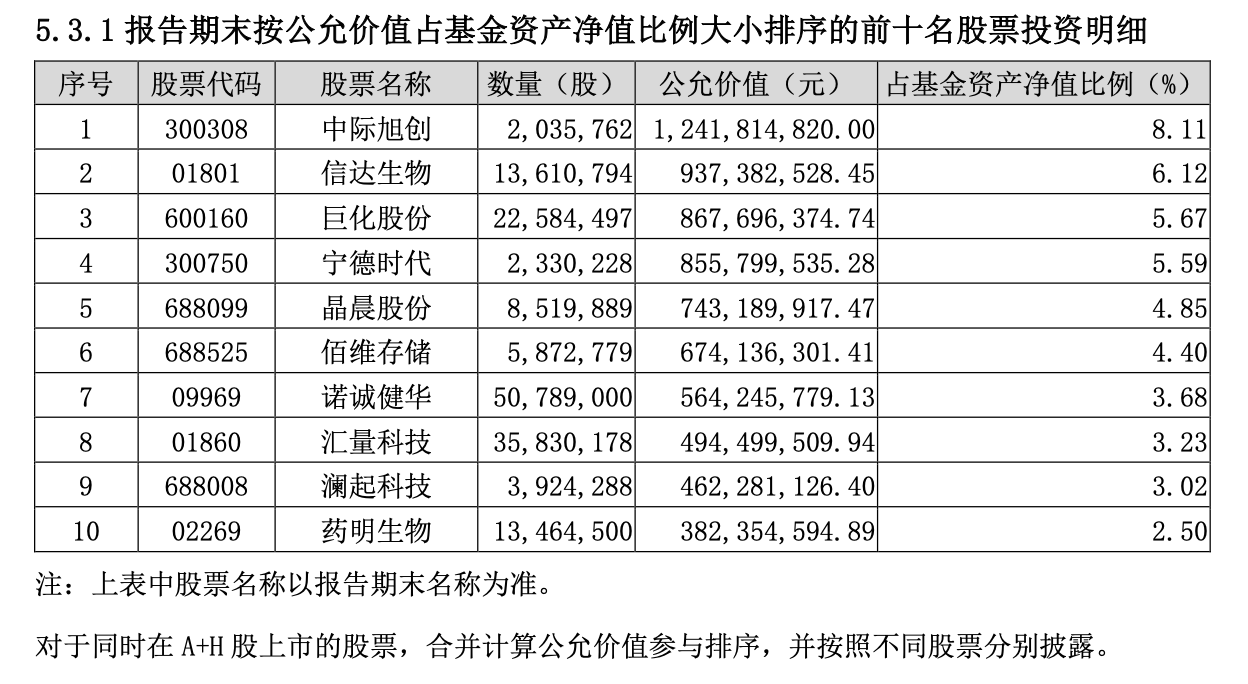
Core Insights - The report highlights significant investments made by fund manager Xie Zhiyu in various technology sectors, particularly in overseas computing power and semiconductor equipment, indicating a strategic focus on high-growth areas for 2026 [1][2] Investment Strategy - The funds managed by Xie Zhiyu, namely Xingquan He Yi and Xingquan He Run, have newly increased their positions in companies such as Baiwei Storage, Huiliang Technology, and WuXi Biologics, while also increasing their holdings in CATL [1] - The report emphasizes the importance of tracking core competitive trends in companies over a longer cycle to identify investment opportunities arising from technological transformations and sectoral rebounds [2] Sector Performance - The overseas computing power sector, particularly in optical modules, is experiencing record highs due to increased orders from major clients and advancements in new technologies [1] - Domestic supply chain leaders are gaining more influence on the international stage, especially in the optical module and PCB sectors, while also achieving breakthroughs in liquid cooling and power supply [1] - The AI-driven capital expenditure surge is creating challenges such as power shortages and storage deficits overseas, leading to heightened demand in domestic energy storage, gas turbines, and related industries [1] Company Holdings - The report lists significant stock holdings, including: - Zhongji Xuchuang: 2,035,762 shares valued at approximately 1.24 billion yuan - CATL: 2,330,228 shares valued at approximately 855.8 million yuan - Baiwei Storage: 5,872,779 shares valued at approximately 674.1 million yuan - Huiliang Technology: 35,830,178 shares valued at approximately 494.5 million yuan - WuXi Biologics: 13,464,500 shares valued at approximately 382.4 million yuan [3]




光模块龙头净利齐涨超40% 2026年争夺1.6T市场
2 1 Shi Ji Jing Ji Bao Dao· 2026-01-21 23:22
Core Insights - The global AI computing power construction is experiencing a boom, with optical modules becoming essential for high-speed data transmission, marking the beginning of a golden era for the industry. Starting in 2025, the demand for 800G will continue to grow, and 1.6T has entered the commercial introduction phase, shifting the industry's focus from speed competition to efficiency competition [1] Group 1: Industry Performance - The optical module industry is expected to show a "volume and price rise" pattern in 2025, with leading companies like Tianfu Communication and Cambridge Technology reporting impressive growth. Tianfu Communication forecasts a net profit of 1.881 billion to 2.15 billion yuan for 2025, representing a year-on-year increase of 40% to 60% [2] - Cambridge Technology anticipates a net profit of 252 million to 278 million yuan for 2025, with a year-on-year growth rate of 51.19% to 66.79%. This growth is driven by the acceleration of global data center construction and AI computing demand, alongside the company's effective cost reduction and efficiency improvement strategies [2] Group 2: Market Size and Demand - The Chinese optical module market is projected to reach approximately 60.6 billion yuan in 2024, a 12.22% increase from the previous year, with expectations to approach 70 billion yuan in 2025. The global data sphere is predicted to reach 175 to 181 zettabytes by 2025, tripling from 2020, which will significantly boost the demand for high-speed optical modules [3] Group 3: Technological Advancements - The year 2025 marks the commercial launch of 1.6T optical modules, with 800G products already achieving large-scale deployment. The global shipment of 800G optical modules is expected to reach 18 to 19.9 million units in 2025, doubling year-on-year. Leading companies are ramping up their production capacities for 800G modules [4] - Cambridge Technology aims to achieve an annual production capacity of 2 million units for its 800G series products by the end of 2025, while other companies are also expanding their production capabilities to meet increasing demand [4] Group 4: Future Outlook - Key clients are beginning to deploy 1.6T modules in the third quarter of 2025, with expectations for continued growth in shipments. Cambridge Technology has indicated that while some 1.6T products are entering small-scale supply, mass production has been delayed to 2026 due to supply chain issues [5] - The optical module industry is entering a new cycle characterized by strong demand, supply constraints, and intensified competition. Major tech companies are expected to increase their capital expenditures significantly in 2025 and 2026, which will further drive demand for optical modules [6][7]
最新调仓路径显现 基金经理关注确定性与安全边际
Zhong Guo Zheng Quan Bao· 2026-01-21 22:00
Group 1 - The core viewpoint of the article highlights significant portfolio adjustments by well-known fund managers in anticipation of growth in sectors like AI, non-ferrous metals, and lithium battery materials for 2026 [1][4] - Fund manager Fu Pengbo indicates that high-growth sectors such as AI and non-ferrous metals will see substantial growth, while manager Li Xiaoxing emphasizes that AI remains the main theme of global technological innovation [1][7] - Manager Yang Jinjing advocates for avoiding currently popular but overvalued sectors, focusing instead on blue-chip stocks that are expected to show long-term performance turning points [1][5] Group 2 - In the fourth quarter of 2025, the top ten holdings of the Ruiyuan Growth Value Fund managed by Fu Pengbo and Zhu Lin saw minor changes, with Maiwei Co. replacing China Mobile, and significant adjustments in holdings of companies like Tencent and Alibaba [2] - The Silver华心怡 Fund, managed by Li Xiaoxing and Zhang Ping, underwent substantial adjustments, with new entries including Tencent, Alibaba, and Meituan, while exiting positions in China Mobile and HSBC [2] - The Yongying Ruixin Fund, managed by Gao Nan, also made notable adjustments, adding companies like WISCO and Haier, while reducing positions in companies like Zhongji Xuchuang [3] Group 3 - Fu Pengbo and Zhu Lin plan to reduce investments in companies with weak fundamentals and increase holdings in data center-related companies based on industry trends and individual stock research [2][4] - Gao Nan focuses on company growth potential and performance realization, aiming for a diversified portfolio while capturing growth opportunities [4] - Yang Jinjing emphasizes a contrarian investment approach, seeking undervalued stocks and avoiding following irrational market trends [4][5] Group 4 - Li Xiaoxing believes that the domestic equity market presents more opportunities than risks, with AI continuing to drive technological innovation and domestic internet giants expected to maintain stable growth [7][8] - The domestic consumption sector, which underperformed in 2025, is viewed as having high potential, with many quality consumer stocks offering attractive dividend yields [8] - Long-term prospects for the domestic innovative pharmaceutical sector are positive, with a focus on companies with data catalysts and explosive performance potential [8]
最新调仓路径显现基金经理关注确定性与安全边际
Zhong Guo Zheng Quan Bao· 2026-01-21 21:08
Group 1 - The core viewpoint of the article highlights significant portfolio adjustments by well-known fund managers in anticipation of growth in sectors such as AI, non-ferrous metals, and lithium battery materials for 2026 [1][2][4] - Fund manager Fu Pengbo indicates that high-growth sectors like AI and non-ferrous metals are expected to perform well, while also noting the importance of reducing investment uncertainties in the upcoming quarter [2][4] - Fund manager Li Xiaoxing emphasizes that AI remains a key driver of global technological innovation, with expectations for stable growth in the performance of major domestic internet companies [4][5] Group 2 - The report details that Fu Pengbo and Zhu Lin's fund made minor changes in their top ten holdings, replacing China Mobile with Maiwei Co., and increasing positions in Han's Robotics while reducing stakes in several major companies [1][2] - Fund manager Li Xiaoxing's Silver华心怡 fund saw significant adjustments, with new entries including Tencent, Alibaba, and Meituan, while exiting positions in China Mobile and HSBC [2][3] - Fund manager Gao Nan's Yongying Ruixin fund also made notable changes, adding new stocks such as WISCO and Haier, while increasing holdings in Zhongfu Industrial and reducing stakes in other companies [2][3] Group 3 - Gao Nan focuses on selecting stocks based on growth potential and performance realization, aiming for diversification within the portfolio while capturing growth opportunities [3] - Yang Jinjing adopts a contrarian investment approach, seeking undervalued stocks and avoiding following irrational market trends, focusing on companies at turning points [3] - Yang Jinjing notes a shift in the core contradictions of the domestic equity market, highlighting the disparity between high valuations of growth stocks and the undervaluation of leading blue-chip companies [3] Group 4 - Yang Jinjing anticipates that as PPI data improves, leading companies will leverage competitive advantages to achieve long-term performance turning points, resulting in a "Davis double play" for blue-chip stocks [4] - Li Xiaoxing believes that the overall opportunities in the domestic equity market outweigh risks, with a focus on AI as a central theme for innovation and growth [4][5] - Li Xiaoxing also sees potential in the domestic consumer sector, particularly in high-quality consumer stocks with favorable dividend yields, while maintaining a long-term positive outlook on the domestic innovative pharmaceutical sector [5]
光模块龙头净利齐涨超40%,2026年争夺1.6T市场
2 1 Shi Ji Jing Ji Bao Dao· 2026-01-21 12:20
Core Insights - The global AI computing power construction is experiencing unprecedented growth, with optical modules entering a golden era as the demand for 800G and 1.6T products surges from 2025 onwards [1] - Leading domestic optical module companies like Tianfu Communication and Cambridge Technology reported impressive profit growth, with net profit increases exceeding 40% year-on-year, reflecting the high demand for AI computing infrastructure [2][3] - The industry is transitioning from a speed competition to an efficiency competition, with a focus on technological iteration and supply-demand dynamics [1][4] Industry Performance - The optical module industry showed a "volume and price rise" trend last year, with leading companies optimizing product structures and leveraging capacity advantages to achieve remarkable performance [3] - Tianfu Communication expects a net profit of 1.881 billion to 2.15 billion yuan for 2025, representing a year-on-year growth of 40% to 60%, driven by the acceleration of the AI industry and global data center construction [3] - Cambridge Technology anticipates a net profit of 252 million to 278 million yuan for 2025, with a year-on-year increase of 51.19% to 66.79% [3][4] Market Dynamics - The 800G shipment volume is expected to double to nearly 20 million units, while 1.6T products are entering the commercial introduction phase, marking a significant shift in the industry [1][5] - The Chinese optical module market is projected to reach approximately 60.6 billion yuan in 2024, with a growth rate of 12.22%, and is expected to approach 70 billion yuan in 2025 [4] - IDC predicts that the global data sphere will reach 175-181 zettabytes by 2025, tripling from 2020, which will significantly boost the demand for high-speed optical modules [4] Competitive Landscape - Major companies are ramping up their 800G production capacity, with Cambridge Technology targeting an annual capacity of 2 million units by the end of 2025 [6] - The 1.6T optical module technology has completed validation and is set to enter the commercial phase, with significant orders expected in the coming quarters [6][7] - The competition has shifted from downstream assembly capabilities to upstream supply chain control, particularly regarding core components like silicon photonic engines [9] Future Outlook - The optical module industry is entering a new cycle characterized by strong demand, supply constraints, and intensified competition [8] - Major tech companies are optimistic about capital expenditures, with projected spending from Microsoft, Google, Meta, and Amazon reaching $406.5 billion and $596.4 billion in 2025 and 2026, respectively [8] - The average selling price (ASP) of optical modules is expected to improve as the industry transitions from 800G to 1.6T and beyond, with a potential new market opening up as copper is replaced by optical interconnects [8][9]