
制造业

Search documents
1月份越南工业生产指数同比增长21.5%
Shang Wu Bu Wang Zhan· 2026-02-11 17:36
Core Viewpoint - Vietnam's industrial production index (IIP) experienced a significant year-on-year growth of 21.5% in January, indicating a robust recovery and expansion in various sectors [1] Group 1: Overall Industrial Growth - The manufacturing sector saw a remarkable growth of 23.6% year-on-year [1] - The electricity production and distribution sector grew by 14.1% [1] - Water supply, waste management, and sewage treatment increased by 13.6% [1] - The mining sector recorded a growth of 10.3% [1] Group 2: Key Industrial Segments - Non-metallic mining exhibited the fastest growth rate at 41.9% [1] - The automotive manufacturing sector grew by 36.6% [1] - Metal manufacturing increased by 35.4% [1] - The chemical and chemical products industry saw a growth of 35.2% [1] - The paper industry grew by 31.9% [1] - Beverage production increased by 26.1% [1] - The rubber and plastics sector grew by 25.8% [1] - Tobacco manufacturing saw a growth of 25.6% [1] - The apparel industry increased by 25.3% [1] - Wood processing and bamboo, rattan industries grew by 21.7% [1] - Electrical equipment manufacturing increased by 21.1% [1] - The production of electronic products, computers, and optical products grew by 20.9% [1] - The food processing industry saw a growth of 17.7% [1]
美国经济的四重风险
Sou Hu Cai Jing· 2026-02-11 16:49
Core Viewpoint - The U.S. economy is experiencing structural misalignments and differentiation, with the financial sector showing signs of easing while the real economy faces constraints due to high interest rates [1][2][3]. Group 1: Structural Misalignment - The financial sector is operating under a narrative-driven logic, where asset prices are recovering due to expectations of interest rate cuts, while the real economy is constrained by high refinancing costs and credit availability [2][3]. - High interest rates have led to a cautious approach in capital expenditures among businesses, resulting in a longer decision-making cycle for private investments [2][3]. - The easing in financial conditions does not offset the tightening in the real economy but rather delays the exposure of risks [1][3]. Group 2: Regional Economic Differentiation - The U.S. economy shows significant regional disparities due to differences in industrial structure and population characteristics, leading to varied responses to high interest rates [4][5]. - Regions with a high concentration of traditional industries face longer adjustment periods and higher transformation costs compared to those with advanced industries [5]. - Areas with a strong service sector or supported by public investment exhibit greater economic resilience and lower sensitivity to interest rate changes [5]. Group 3: Social Confidence Erosion - The structural divide in American society is becoming a significant constraint on long-term growth potential, with middle-class income growth lagging behind productivity increases [6][7]. - Rising costs in housing, healthcare, and education have reduced disposable income elasticity for middle-class families, making them more vulnerable to economic shocks [6][7]. - The concept of "the kill line" reflects the diminishing buffer for low- and middle-income groups, indicating a shift towards defensive economic behavior [7]. Group 4: Institutional Expectation Erosion - The core risks in the U.S. economy are shifting from short-term fluctuations to long-term expectation uncertainties, influenced by political cycles and policy inconsistencies [8][9]. - Discussions around the Federal Reserve's independence and policy direction have heightened market sensitivity to monetary policy predictability [9]. - Any disturbance in institutional expectations could complicate the coordination between monetary and fiscal policies, amplifying macroeconomic volatility and constraining long-term stability [9].
浙江:创新浪潮涌金东
Xin Lang Cai Jing· 2026-02-11 16:40
Core Insights - The article highlights the transformation of Jindong District in Jinhua City, Zhejiang Province, during the 14th Five-Year Plan, focusing on high-quality economic and social development [3][4] - Jindong has seen significant growth in innovation, with the number of national high-tech enterprises increasing from 183 to 284 and the number of municipal R&D centers rising from 100 to 323 [3][6] Innovation Platforms - Jindong has established a strong innovation ecosystem by integrating industry, academia, and research, creating a "strong magnetic field" for innovation [5][6] - Notable innovation platforms include the Zhejiang University Jinhua Research Institute and the Zhejiang Chinese Medical University Jinhua Research Institute, which have achieved significant breakthroughs in their respective fields [6][7] Enterprise Dynamics - The district emphasizes the role of enterprises as key players in the innovation ecosystem, with a focus on nurturing technology-driven companies [8][9] - Companies like Hengdong Technology have developed advanced products, such as an AI-driven pig health inspection robot, showcasing the shift from "I have to innovate" to "I want to innovate" among enterprises [8][9] Talent Development - Jindong has implemented various initiatives to attract and cultivate talent, including the establishment of doctoral innovation stations and mechanisms for dual hiring of talent from universities [9][10] - The district's policies have led to a significant increase in technology transaction volumes, with 565 technology demand lists published and 149 successfully addressed from 2021 to 2025 [9][10] Ecosystem Efficiency - The article discusses efforts to enhance the conversion of scientific achievements into productive forces, addressing the "last mile" of technology transfer [10][11] - Jindong has seen a steady increase in R&D investment intensity, rising from 2.83% in 2021 to 3.21% in 2024, reflecting a commitment to sustained innovation [10][11] Future Goals - Looking ahead, Jindong aims to establish a regional innovation system characterized by integrated reforms in education, technology, and talent, focusing on enhancing innovation capabilities and industry collaboration [11]


深夜,集体拉升!美联储,重磅突发!
券商中国· 2026-02-11 14:38
Core Viewpoint - The article highlights a significant increase in U.S. non-farm employment in January, which has led to a shift in market expectations regarding the Federal Reserve's interest rate decisions, with a focus now on inflation trends rather than rate cuts [1][7]. Employment Data - The U.S. non-farm employment increased by 130,000 in January, significantly surpassing the expected increase of 70,000 and the previous month's increase of 50,000 [2][3]. - The unemployment rate fell to 4.3%, lower than the expected 4.4% and marking the lowest level since August 2025 [3][9]. Market Reactions - Following the employment data release, U.S. stock index futures rose, with the Dow Jones futures up by 0.51%, S&P 500 futures by 0.6%, and Nasdaq 100 futures by 0.88% [3]. - The U.S. dollar index saw a sharp increase, rising by 0.43% before narrowing its gains, while U.S. Treasury yields also increased, with the 2-year yield at 3.535%, the 10-year yield at 4.2%, and the 30-year yield at 4.83% [5]. Federal Reserve Expectations - Traders have adjusted their expectations for the Federal Reserve's interest rate cuts, moving the anticipated cut from June to July, with the probability of a 25 basis point cut in March dropping from 19.6% to 6% [1][9]. - The market is currently pricing in a total rate cut of 50 basis points for 2026, down from 60 basis points prior to the employment data release [7]. Labor Market Insights - The report indicates that sectors such as healthcare, social services, and construction saw job increases, while federal government and financial sectors experienced job losses [7]. - Specifically, the healthcare sector added over 123,000 jobs, manufacturing added 5,000 jobs, and private education added approximately 13,000 jobs, while the federal government reduced its workforce by 34,000 [7]. Analyst Perspectives - Analysts view the employment report as largely positive, with better wage and hours data being crucial for sustaining consumer spending [8]. - There are indications of tightening in the labor market, but analysts believe there is still a way to go before it fully stabilizes [8].

奋楫争先永冲锋 稳中有进开新局
Xin Lang Cai Jing· 2026-02-11 14:38
Economic Performance - The city's GDP reached 282.96 billion, growing by 5.6%, ranking third in the province, outperforming both provincial and national growth rates [4] - During the "14th Five-Year Plan" period, the economic increment exceeded 70 billion, with an average annual growth of 5.5%, surpassing provincial and national averages by 0.3 and 0.1 percentage points respectively [4] - The financial institutions' deposit balance surpassed 400 billion, and the total retail sales of consumer goods exceeded 100 billion, reaching 109.66 billion, with a growth of 4.6%, ranking fifth in the province [5] Industrial Development - The three industrial structures optimized to 16.8:32.3:50.9, with agriculture maintaining a stable role, producing over 6 billion jin of grain for five consecutive years [5] - The manufacturing industry's added value accounted for 23.1% of GDP, with an average annual growth of 7.4% during the "14th Five-Year Plan" [9] - The number of industrial enterprises increased by 70, reaching a total of 1,340 [7] Service Sector Growth - The service sector contributed over 50% to GDP, with revenue growth in cultural, sports, and research sectors nearing 30% [10][11] - High-tech enterprises and the number of invention patents per ten thousand people doubled, with total R&D expenditure exceeding 4.5 billion, resulting in 48 major innovation achievements [11] Investment and Infrastructure - A total of 378 investment projects exceeding 50 million were introduced, with a total investment of 68.14 billion [14] - New registered projects from Hunan merchants reached 162, with funds amounting to 48.243 billion [15] - The modern transportation system is rapidly developing, with an increase of 1,340 kilometers in total highway mileage since 2020, and the annual throughput of the Yongzhou land port exceeding 3 million tons [15] Living Standards - The per capita disposable income of residents reached 32,300, growing by 6.2%, ranking third in the province [17] - The high school entrance examination pass rate reached 45.9%, and the out-of-city medical treatment rate decreased by 10.3% [17] - The average life expectancy increased by over one year compared to 2020, and household savings nearly doubled, indicating an improvement in living quality and health standards [17]

美国1月非农新增就业13万人,创去年4月以来最大增幅,失业率降至4.3%,25年3月非农下修86.2万!
Sou Hu Cai Jing· 2026-02-11 14:35
Core Insights - The U.S. labor market shows resilience with January non-farm employment growth reaching 130,000, significantly exceeding the market expectation of 65,000, marking the largest increase since April 2025 [1][7] - The unemployment rate unexpectedly dropped to 4.3%, down from the expected and previous value of 4.4%, indicating a slight improvement in labor market conditions [1] - However, the annual benchmark revision revealed a substantial downward adjustment of the previous year's employment growth from 584,000 to 181,000, highlighting a more severe weakness in the labor market than previously understood [3][7] Employment Data - January's non-farm payroll growth was driven primarily by the healthcare sector, which has been a key engine for employment expansion in 2025 [9] - The construction and professional services sectors also recorded job growth, while manufacturing saw its first positive monthly growth this year [9] - Temporary help services continued to decline, with a reduction of 42,000 jobs in January, marking the fifth month of decline in the past six months [9] Wage and Labor Participation - Average hourly earnings increased by 0.4% month-over-month, surpassing the expected 0.3% and the revised previous value of 0.1% [1] - The labor force participation rate slightly rose to 62.5%, marginally better than anticipated [1] Employment Quality and Structure - The quality of employment improved, with full-time positions increasing by 582,000 and part-time positions rising by 31,000, continuing the trend from the previous month [10] - The unemployment rates for major labor groups showed slight declines, with youth unemployment at 13.6% and adult male and female rates at 3.8% and 4.0%, respectively [14] Market Reactions and Future Outlook - Following the data release, U.S. stock futures and Treasury yields rose, with traders reducing bets on a rate cut in June, now expecting the first cut to be delayed until July [5] - Despite the strong January data, the annual revision indicates underlying vulnerabilities in the labor market, complicating the Federal Reserve's assessment of future rate cuts [6][5] - The overall employment growth for 2026 is expected to remain weak, although some employers may reconsider hiring plans due to easing labor cost pressures [12]
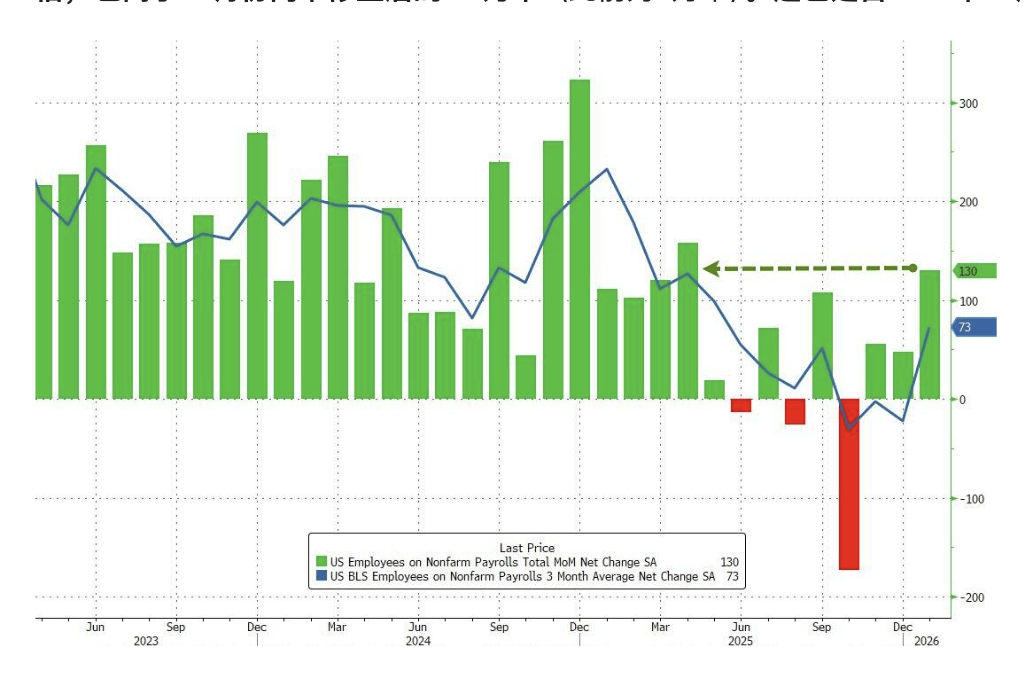
US economy added 130K jobs in January, delayed report shows
Fox Business· 2026-02-11 14:06
Job Growth Overview - The U.S. economy added 130,000 jobs in January, surpassing economists' expectations of 70,000 jobs [2] - The unemployment rate decreased to 4.3%, slightly better than the anticipated 4.4% [2] Revisions to Previous Reports - Revisions indicated that November's job gains were adjusted down by 15,000 from 56,000 to 41,000, and December's gains were revised down by 2,000 from 50,000 to 48,000, totaling 17,000 fewer jobs than previously reported for November and December [3] Sector Performance - Private payrolls increased by 172,000 jobs in January, significantly exceeding the LSEG estimate of 70,000 [4] - The manufacturing sector added 5,000 jobs, contrary to expectations of a loss of 5,000 jobs [6] - The healthcare sector saw a substantial increase of 82,000 jobs, with notable gains in ambulatory healthcare services (+50,000), hospitals (+18,000), and nursing and residential care facilities (+13,000), surpassing its monthly average of 33,000 jobs added in 2025 [6] - Construction firms added 33,000 jobs, primarily in nonresidential specialty trade contractors (+25,000), after a flat performance in 2025 [7] - The financial sector experienced a decline of 22,000 jobs, with a total loss of 49,000 jobs since its peak in May 2025, including a loss of 11,000 jobs in insurance carriers and related activities [7] Government Employment Changes - Government payrolls decreased by 42,000 jobs in January, with federal job cuts accounting for 34,000 and state job cuts for 18,000, partially offset by a gain of 10,000 jobs in local governments [5] - The federal workforce has decreased by 327,000 jobs since its peak in October 2024, representing a decline of 10.9% [5]

36万亿债务压顶!美国霸权倒计时,中国或将在2028成全球经济第一
Sou Hu Cai Jing· 2026-02-11 11:47
Group 1 - The U.S. national debt is approaching $36 trillion, significantly impacting the economy and diverting funds from infrastructure and education to debt repayment [2] - The rapid growth of debt since the 2008 financial crisis has resulted in an average debt burden of over $100,000 per American [2] - Economists warn that rising interest rates could lead to an additional annual interest expenditure of over $300 billion, further constraining other spending areas [4] Group 2 - The debt issue is a long-term result of policies such as large tax cuts and military spending, which have exacerbated the fiscal deficit [5] - The hollowing out of the manufacturing sector has led to a significant loss of factory jobs, dropping from over 17 million in 2000 to over 12 million currently, increasing reliance on imports [8] - The wealth gap is widening, with the top 1% holding 30% of the wealth while the bottom 50% only possess 2.4%, leading to decreased social mobility [8] Group 3 - Political gridlock between the two parties has stalled infrastructure legislation, further hindering economic growth [10] - China's rapid economic development is projected to surpass the U.S. GDP by 2028, accelerated by a more stable recovery from the pandemic [10][12] - China's manufacturing output has grown significantly, accounting for nearly 30% of global production, enhancing its competitiveness in global trade [12] Group 4 - The U.S. military spending accounts for 40% of global military expenditure, but involvement in conflicts has increased debt without yielding long-term benefits [14] - China's Belt and Road Initiative has invested $1.3 trillion in over 150 countries, enhancing its influence and support in developing nations [14][16] - China's high savings rate and investment in infrastructure, such as high-speed rail and renewable energy, contribute to its economic resilience [17][19] Group 5 - China's patent applications account for 38% of the global total, significantly aiding its technological advancement [19] - The U.S. faces challenges from its reliance on consumer spending, which constitutes 70% of its economy, while China focuses on long-term development [19] - The transition to green energy is progressing rapidly in China, with significant investments in renewable energy technologies [19] Group 6 - Some analysts believe that China's rise to surpass the U.S. may not be straightforward due to demographic challenges and a potential slowdown in growth rates [21] - China's debt levels have increased since the 2000s, posing a risk to its economic stability [23] - The U.S. dollar's status as a reserve currency is at risk if confidence wanes, which could lead to volatility in global financial markets [25] Group 7 - Future geopolitical tensions are expected to intensify, with the U.S. potentially using alliances to pressure China [27] - Economic strength is central to national competition, with both the U.S. and China facing internal challenges that could impact their global standing [27]

蓝黛科技:股票价格受市场情绪、行业周期、宏观环境等多重因素影响
Zheng Quan Ri Bao Zhi Sheng· 2026-02-11 11:35
Group 1 - The core viewpoint of the article is that the stock price of the company is influenced by multiple factors including market sentiment, industry cycles, and macroeconomic environment [1] - The company is committed to continuously advancing its business development [1] - The company aims to enhance its profitability and development quality to promote long-term stable growth [1]

恒勃股份:截至2026年2月10日,公司股东人数为7036户
Zheng Quan Ri Bao Wang· 2026-02-11 11:13
Group 1 - The core point of the article is that Hengbo Co., Ltd. (301225) reported a total of 7,036 shareholders as of February 10, 2026 [1]