制造业

Search documents
贝索斯募了一只“捡尸基金”
投中网· 2026-03-29 08:33
Core Viewpoint - The article discusses the controversial implications of artificial intelligence (AI) on the manufacturing industry, particularly focusing on Jeff Bezos's new $100 billion fund aimed at acquiring and automating companies affected by AI disruption [4][10][15]. Group 1: Bezos's New Fund and Its Purpose - Jeff Bezos is reportedly raising a $100 billion fund to acquire manufacturing companies severely impacted by AI, intending to transform them into fully automated and intelligent factories [4][10]. - The fund is part of the "Project Prometheus," which aims to apply AI to the physical economy, focusing on sectors like aerospace and automotive [6][10]. - The initial financing round for Project Prometheus raised $6.2 billion, with a team of over 100 employees, primarily from leading AI firms [6][7]. Group 2: Historical Context and Criticism - The article draws parallels between the current AI revolution and the Industrial Revolution, highlighting the potential for significant societal changes and disruptions [12][21]. - Critics, including political figures like Bernie Sanders, argue that Bezos's fund represents a threat to workers, as it aims to replace human labor with robots in manufacturing [15][17]. - Concerns are raised about the concentration of power in the hands of a few capitalists who could dictate production and labor organization across multiple industries, potentially leading to a "shadow government" scenario [19][21]. Group 3: The Luddites and Modern Implications - The historical Luddites, who protested against the Industrial Revolution's impact on their livelihoods, are referenced to illustrate the potential for similar movements in response to AI advancements [13][22]. - The article suggests that while technology progresses, the societal implications and the fate of workers remain unresolved questions that need addressing [21][22]. - It emphasizes the need for transparency and accountability from companies like Project Prometheus, which could reshape industrial systems without sufficient public oversight [19][21].


股指周报:外部扰动加剧,逢低布局-20260328
Wu Kuang Qi Huo· 2026-03-28 14:31
1. Report Industry Investment Rating - No relevant content provided 2. Core View of the Report - The conflict between the US and Iran is recurring, and Trump's verbal intervention is losing effectiveness. Rising energy prices and increasing inflation have led to a decline in expectations of a Fed rate cut and even a shift towards rate hikes. The probability of a rate hike by traders has exceeded 50% for the first time, causing an increase in US bond yields and suppressing the valuation of global risk assets. In China, the narrowing of PPI and strong profitability of industrial enterprises at the beginning of the year, along with energy self - sufficiency and reserve advantages, have maintained export resilience. The short - term market may continue to fluctuate, but the medium - to - long - term strategy is mainly to go long on dips [11]. 3. Summary by Directory 3.1 Week - to - Week Assessment and Strategy Recommendation - **Important News**: Iran rejected the 15 - point cease - fire agreement proposed by the US and demanded that the US stop aggression. The OECD predicts that the US inflation rate will reach 4.2% this year, much higher than the Fed's expected 2.7%. China's innovation drug external authorization in the first three months exceeded $60 billion, approaching half of last year's $130 billion. The Shanghai and Shenzhen Stock Exchanges expanded the scope of the "light - asset, high - R & D investment" recognition standard to main - board companies. The central bank's net open - market injection this week was 231.9 billion yuan [11]. - **Economic and Corporate Earnings**: From January to February, industrial enterprises above a designated size achieved an operating income of 20.84 trillion yuan, a year - on - year increase of 5.3%, and a total profit of 1.02456 trillion yuan, a year - on - year increase of 15.2%. The profit of the computer, communication, and other electronic equipment manufacturing industries increased by 2 times year - on - year, and that of the non - ferrous metal smelting and rolling processing industries increased by 1.5 times. National fixed - asset investment from January to February increased by 1.8% year - on - year, and excluding real - estate development investment, it increased by 5.2%, while real - estate development investment decreased by 11.1%. China's March LPR remained unchanged for 10 consecutive months, with the 1 - year LPR at 3.0% and the over - 5 - year LPR at 3.5%. Experts predict a 10 - 20 basis - point rate cut in the middle of the year. From January to February, China's fiscal expenditure was 4.67 trillion yuan, a year - on - year increase of 3.6%, and fiscal revenue was 4.42 trillion yuan, a year - on - year increase of 0.7%. The preliminary value of the US S&P Global Manufacturing PMI in March was 52.4, higher than the expected 51.3 and the previous value of 51.6. The US import prices in February increased by 1.3% month - on - month, the largest monthly increase since March 2022, and export prices increased by 1.5% month - on - month, the largest increase since May 2022 [11]. - **Interest Rates and Credit Environment**: This week, both the 10 - year Treasury bond rate and the credit bond rate decreased slightly, the credit spread remained unchanged, and liquidity was abundant [11]. - **Trading Strategy Recommendations**: Hold a small amount of IM long positions in the long term as the valuation is at a moderately low level and IM has a long - term discount. Hold IF long positions for 6 months as a new rate - cut cycle is expected to start, and high - dividend assets are likely to benefit [13]. 3.2 Spot and Futures Markets - **Index Performance**: The Shanghai Composite Index was at 3913.72, down 43.33 points or 1.09%; the Shenzhen Component Index was at 13760.37, down 105.83 points or 0.76%; the ChiNext Index was at 3295.88, down 56.22 points or 1.68%; the CSI 300 was at 4502.57, down 64.45 points or 1.41%; the SSE 50 was at 2837.31, down 46.56 points or 1.61%; the CSI 500 was at 7737.61, down 22.42 points or 0.29%; the CSI 1000 was at 7746.31, down 37.12 points or 0.48%; the Hang Seng Index was at 24952, down 325 points or 1.29%; the AH ratio was at 120.48, up 0.56%; the Dow Jones Index was at 45167, down 411 points or 0.90%; the Nasdaq Index was at 20948, down 699 points or 3.23%; the S&P 500 was at 6369, down 138 points or 2.12% [16]. - **Futures Contract Performance**: Details of the performance of various futures contracts such as IF, IH, IC, and IM in terms of points, trading volume, and price changes are provided [17]. 3.3 Economy and Corporate Earnings - **Economic Indicators**: In Q4 2025, the actual GDP growth rate was 4.5%, in line with expectations and down from the previous value of 4.8%. The official manufacturing PMI in February was 49.0, down from the previous value of 49.3, possibly due to the long and late holiday's impact on the supply side. In January - February 2026, the consumption growth rate was 2.8%, up from the previous value of 0.9%, as the "trade - in" fund quota slightly decreased and the public's consumption demand was concentratedly released at the beginning of the year. In January - February 2026, exports denominated in US dollars increased by 21.8% year - on - year, up from the previous value of 6.9%, with the drag on exports to the US repaired, exports to Africa growing by nearly 50%, and exports to the EU increasing by 27.8% year - on - year. In January - February 2026, the investment growth rate was 1.8%, up from the previous value of - 3.8% and 2.5 percentage points higher than the whole of 2025. Manufacturing investment increased by 3.1% year - on - year, real - estate investment decreased by 11.1%, and infrastructure investment increased by 11.4%. Among them, investment in transportation, warehousing, and postal services increased by 9.1% year - on - year, 10.3 percentage points higher than the whole of 2025; investment in water conservancy, environment, and public facilities management increased by 8.3% year - on - year, 16.7 percentage points higher than the whole of 2025; investment in the production and supply of electricity, heat, gas, and water increased by 13.1% year - on - year [35][38][41]. - **Corporate Earnings**: In the Q3 2025 quarterly report, the year - on - year growth rate of operating income was 1.24%, and the growth rate rebounded by 1.22% compared with the semi - annual report. The year - on - year growth rate of net profit was 3.89%, and the growth rate rebounded by 1.83% compared with the semi - annual report [44]. 3.4 Interest Rates and Credit Environment - **Interest Rates**: The weighted average R007 rate on March 27 was 1.4398%, up 1.89 basis points from last week. The central bank's net open - market injection this week was 231.9 billion yuan, with an injection of 474.2 billion yuan and a withdrawal of 242.3 billion yuan [53]. - **Credit Environment**: In February 2026, the M1 growth rate was 5.9%, up from the previous value of 4.9%; the M2 growth rate was 9.0%, the same as the previous value. With high - level fiscal efforts, corporate cash flow continued to improve, and the demand for foreign exchange settlement continued to be released as the exchange rate strengthened in February. From January to February 2026, the social financing increment was 9.6 trillion yuan, a year - on - year increase of 31.62 billion yuan, with corporate credit effectively filling the gap and strong external demand effectively offsetting the Spring Festival misalignment [61]. 3.5 Capital Flows - **Inflow**: This week, about 2.1048 billion new shares of equity - biased funds were established, maintaining a normal level. The margin trading balance in the two markets decreased by 16.088 billion yuan this week, and the latest balance was 259.8731 billion yuan. The scale of each ETF decreased slightly [68][71]. - **Outflow**: This week, major shareholders had a net increase of - 2.455 billion yuan in shareholding, and the net reduction was relatively stable. The number of IPOs was 0 [74]. 3.6 Valuation - **P/E Ratio (TTM)**: The P/E ratio of SSE 50 was 11.28, CSI 300 was 13.91, CSI 500 was 35.22, and CSI 1000 was 47.00. - **P/B Ratio (LF)**: The P/B ratio of SSE 50 was 1.22, CSI 300 was 1.45, CSI 500 was 2.42, and CSI 1000 was 2.54 [79].
中游制造毛利率之“浴火重生”——1-2月工业企业利润点评
一瑜中的· 2026-03-28 02:36
Core Viewpoint - The article highlights the significant improvement in industrial enterprise profits in early 2026, with a year-on-year profit growth of 15.2% for large-scale industrial enterprises, driven by both revenue and profit margin increases [2][25]. Group 1: Industrial Enterprise Profit Data - In January-February 2026, the profit growth for state-owned industrial enterprises was 5.3%, while private enterprises saw a remarkable growth of 37.2%, and foreign and Hong Kong-Macau-Taiwan enterprises experienced a decline of 3.8% [2][25]. - The inventory level as of February 2026 showed a year-on-year increase of 6.6%, up from 3.9% previously [2][25]. - The revenue growth rate for large-scale industrial enterprises in January-February 2026 was 5.3%, compared to a decline of 3.2% in December 2025 [3][25]. Group 2: Profit Margin Analysis - The overall profit margin for January-February 2026 was 4.92%, an increase from 4.49% in the same period last year [3][25]. - The gross profit margin for January-February 2026 was 15.2%, compared to 14.9% in the previous year, while the expense ratio was 8.66%, slightly up from 8.56% [3][25]. - The mining industry saw a year-on-year profit growth of 9.9%, while the manufacturing sector experienced a growth of 18.9% [26]. Group 3: Midstream Manufacturing Margin Challenges - The midstream manufacturing sector has faced three major challenges affecting its gross profit margin: tariff impacts, direct cost shocks from rising metal prices, and high oil prices [4][10]. - Tariff impacts began in April 2025, with tariff revenues increasing from $8.16 billion in March 2025 to $29.67 billion in September 2025, before decreasing to $26.59 billion by February 2026 [5][12]. - Despite significant increases in metal prices, the gross profit margin for midstream manufacturing rose to 15.2% from 14.8% year-on-year, indicating resilience in the face of rising costs [6][15]. Group 4: Sector-Specific Performance - Within the manufacturing sector, the midstream equipment manufacturing industry saw a year-on-year growth rate of 23.4%, with the computer, communication, and other electronic equipment manufacturing sector's profits increasing by 200% [26]. - The automotive manufacturing sector, however, faced a significant decline of 30.2% in profits [26]. - The upstream sectors, including non-ferrous metal smelting and rolling, reported a profit growth of 150%, while the chemical raw materials and products manufacturing sector grew by 35.9% [26].

1-2月工业企业利润点评:强劲的外需,和不请自来的通胀
Changjiang Securities· 2026-03-27 15:08
Group 1: Economic Performance - In the first two months of 2026, the total profit of industrial enterprises increased by 15.2% year-on-year, while operating revenue grew by 5.3% year-on-year, marking the strongest performance since 2023[4]. - The profit recovery is primarily driven by strong external demand and rising prices of upstream cyclical products, particularly in the mining and manufacturing sectors[2][8]. - The mining industry's profit growth reached 9.9%, while manufacturing profits surged by 18.9%[8]. Group 2: Sector Analysis - The computer electronics, non-ferrous metallurgy, and chemical industries collectively contributed 17.6 percentage points to the profit growth in January-February 2026, significantly outperforming other sectors[8]. - The electronic industry showed the highest growth rate, supported by robust export and industrial growth data, with machinery and high-tech products driving exports[8][16]. - The inclination for enterprises to replenish inventory has returned, with nominal inventory growth reaching 6.6%, the highest since April 2023[8]. Group 3: Future Outlook - The interplay between external demand and inflation may lead to a tug-of-war effect on future corporate profits, as rising oil prices could increase production costs for downstream enterprises[2][33]. - The external economic environment remains volatile, with uncertainties in policy decisions affecting domestic demand growth[6][38].
——2026年1-2月工业企业盈利数据点评:企业盈利高增,利润分配向中上游倾斜
EBSCN· 2026-03-27 12:08
Profit Growth - In January-February 2026, industrial enterprises' profits increased by 15.2% year-on-year, compared to a mere 0.6% growth for the entire previous year[2] - Revenue for the same period grew by 5.3% year-on-year, up from 1.1% for the previous year[2] - The profit margin for industrial enterprises reached 4.92%, an increase of 0.39 percentage points year-on-year, marking the highest level for the same period since 2023[5] Structural Changes - Profit distribution is shifting towards midstream and upstream sectors, with mining profits growing by 9.9% and manufacturing profits rising by 18.9% year-on-year[15] - The share of manufacturing profits increased to 70.46%, up by 1.1 percentage points from the previous year, while the share of consumer goods manufacturing profits decreased to 23.7%, down by 6.2 percentage points[16][23] - Upstream raw materials manufacturing profits surged by 72.2%, with non-ferrous metal smelting profits increasing by 148.2%[20] Market Outlook - The Producer Price Index (PPI) is expected to turn positive in March 2026, driven by rising oil prices and improved supply-demand dynamics due to "anti-involution" policies[3][5] - Short-term pressures on profit margins are anticipated for midstream equipment and downstream consumer goods sectors due to high oil prices[34] Inventory Trends - Industrial enterprises showed signs of proactive inventory replenishment, with finished goods inventory growing by 6.6% year-on-year, aligning with a revenue growth of 5.3%[32][33]
1-2月工企利润数据点评:年内采矿业盈利同比增速有望继续改善
Bank of China Securities· 2026-03-27 11:05
Profit Performance - In January-February 2026, industrial enterprises achieved a total profit of 10,245.6 billion yuan, a year-on-year increase of 15.2%, accelerating by 14.6 percentage points compared to December 2025[2] - The profit growth of the mining industry in January-February 2026 was 9.9%, contributing 1.5 percentage points to the overall profit growth of industrial enterprises[4] - The manufacturing sector's profit increased by 18.9%, accelerating by 13.9 percentage points compared to December 2025, significantly supporting the overall profit performance[11] Revenue and Cost Analysis - Industrial enterprises' operating revenue grew by 5.3% year-on-year, an increase of 4.2 percentage points from December 2025, with revenue per 100 yuan of assets at 66.4 yuan, down by 9.5 yuan[2] - Operating costs rose by 5.0% year-on-year, an increase of 3.7 percentage points from December 2025[2] - The operating profit margin for industrial enterprises was 4.9%, a decrease of 0.4 percentage points compared to December 2025[2] Economic Indicators - The industrial added value in January-February 2026 increased by 5.3% year-on-year, accelerating by 4.2 percentage points from December 2025, indicating active industrial production[3] - The Producer Price Index (PPI) and the PPI for production materials both saw a narrowing decline of 1.2% and 1.0%, respectively, compared to December 2025, alleviating the pressure on industrial profits[3] Risk Factors - Potential risks include fluctuations in overseas commodity prices, geopolitical uncertainties, and the possibility that policy effects may not meet expectations[19]
2026年1-2月工业企业利润分析:利润修复提速,库存增速回升
CMS· 2026-03-27 10:04
Group 1: Profit and Revenue Growth - In January-February 2026, the revenue of industrial enterprises above designated size increased by 5.3% year-on-year, up from 2.8% in the same period of 2025[1] - The profit growth rate for these enterprises was 15.2%, a significant recovery from -0.3% in January-February 2025, marking an increase of 14.6 percentage points[1] - Over 60% of industries saw profit growth, with manufacturing up 18.9%, mining up 9.9%, and utilities up 3.7%[2] Group 2: Sector Performance - High-tech manufacturing contributed over 50% to the profit growth of industrial enterprises, indicating a recovery pattern that remains uneven across sectors[3] - Profits in the non-ferrous and chemical industries surged by 148.2% and 35.9%, respectively, driven by new growth drivers[2] - The equipment manufacturing sector showed strong performance, particularly in electronics and aerospace, with profits growing by 59.3% and 50.0%[2] Group 3: Inventory and Cost Trends - The nominal inventory growth rate increased to 6.6%, with actual inventory growth rising to 7.6%, up 1.7 percentage points from the previous month[3] - The cost per 100 yuan of revenue for industrial enterprises was 84.83 yuan, a decrease from December 2025, while expenses slightly increased to 8.66 yuan[3] - The revenue profit margin for industrial enterprises improved to 4.92%, up 0.43 percentage points year-on-year[3]
【数据发布】2026年1—2月份全国规模以上工业企业利润增长15.2%
中汽协会数据· 2026-03-27 07:04
Core Viewpoint - In the first two months of 2026, China's industrial enterprises above designated size achieved a total profit of 10,245.6 billion yuan, representing a year-on-year increase of 15.2% [1] Group 1: Profit and Revenue Overview - In January-February, state-owned enterprises achieved a total profit of 3,665.6 billion yuan, up 5.3% year-on-year; joint-stock enterprises reported a profit of 8,032.9 billion yuan, an increase of 22.1%; foreign and Hong Kong, Macao, and Taiwan-invested enterprises saw profits decline by 3.8% to 2,167.5 billion yuan; private enterprises experienced a profit increase of 37.2% to 2,844.5 billion yuan [1] - The mining industry reported a total profit of 1,556.1 billion yuan, a year-on-year increase of 9.9%; the manufacturing sector achieved a profit of 7,321.5 billion yuan, up 18.9%; the electricity, heat, gas, and water production and supply industry reported a profit of 1,368.0 billion yuan, an increase of 3.7% [1] Group 2: Industry-Specific Profit Growth - The computer, communication, and other electronic equipment manufacturing industry saw profits increase by 2.0 times; the non-ferrous metal smelting and rolling processing industry grew by 1.5 times; the chemical raw materials and chemical products manufacturing industry increased by 35.9%; the non-metallic mineral products industry grew by 16.2% [2] - The textile industry reported a profit increase of 12.6%; the agricultural and sideline food processing industry grew by 8.0%; the electrical machinery and equipment manufacturing industry increased by 6.2% [2] - The coal mining and washing industry grew by 4.5%; the specialized equipment manufacturing industry increased by 4.3%; the general equipment manufacturing industry grew by 3.6%; the electricity and heat production and supply industry increased by 3.4% [2] - The automotive manufacturing industry saw a profit decline of 30.2%; the black metal smelting and rolling processing industry reported increased losses [2] Group 3: Financial Indicators - In January-February, industrial enterprises above designated size achieved operating revenue of 20.84 trillion yuan, a year-on-year increase of 5.3%; operating costs amounted to 17.68 trillion yuan, up 5.0%; the operating revenue profit margin was 4.92%, an increase of 0.43 percentage points year-on-year [2] - By the end of February, total assets of industrial enterprises above designated size reached 188.40 trillion yuan, a year-on-year increase of 5.5%; total liabilities amounted to 108.59 trillion yuan, up 5.8%; total owners' equity was 79.82 trillion yuan, an increase of 5.1% [3] - The asset-liability ratio stood at 57.6%, up 0.1 percentage points year-on-year; accounts receivable reached 26.55 trillion yuan, a year-on-year increase of 7.1%; finished goods inventory was 6.68 trillion yuan, up 6.6% [3] Group 4: Efficiency Metrics - The cost per 100 yuan of operating revenue was 84.83 yuan, a decrease of 0.24 yuan year-on-year; expenses per 100 yuan of operating revenue were 8.66 yuan, an increase of 0.02 yuan year-on-year [3] - By the end of February, the average revenue per 100 yuan of assets was 66.4 yuan, a decrease of 0.1 yuan year-on-year; per capita revenue was 1.749 million yuan, an increase of 95,000 yuan year-on-year [3] - The turnover days for finished goods inventory were 22.7 days, an increase of 0.4 days year-on-year; the average collection period for accounts receivable was 76.4 days, an increase of 1.3 days year-on-year [3]
利润“跳升”!国家统计局,最新公布!
券商中国· 2026-03-27 05:31
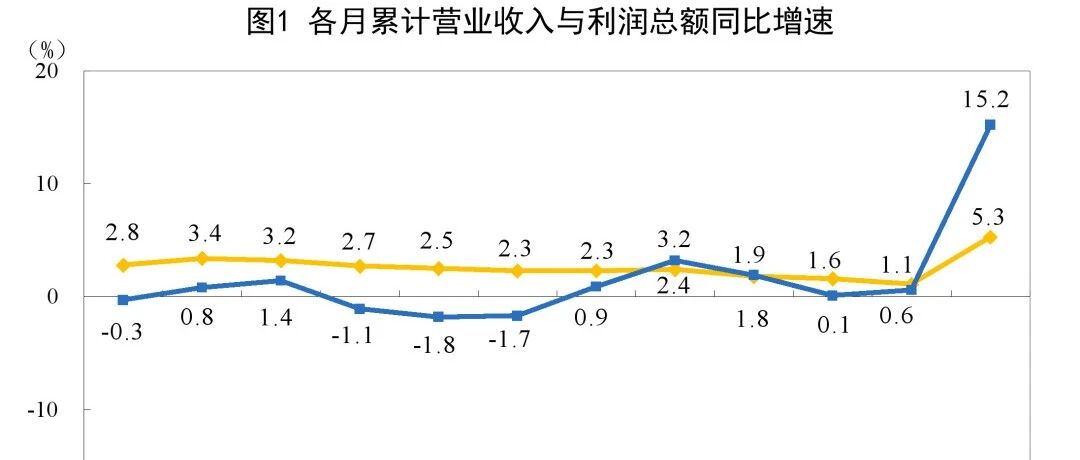
Core Viewpoint - In the first two months of 2023, China's industrial enterprises above designated size achieved a total profit of 10,245.6 billion yuan, marking a year-on-year increase of 15.2%, with the growth rate accelerating by 14.6 percentage points compared to the previous year [1][2]. Group 1: Profit Growth and Indicators - The total profit of industrial enterprises increased significantly, supported by a 6.9% rise in gross profit, compared to flat growth in the previous year [2]. - Revenue for these enterprises grew by 5.3% year-on-year, driven by increased production and recovering product prices, with a notable acceleration of 4.2 percentage points from the previous year [2]. - The cost per 100 yuan of revenue decreased to 84.83 yuan, a decline of 0.24 yuan year-on-year, while the profit margin improved to 4.92%, up by 0.43 percentage points [2]. Group 2: Sector Performance - The manufacturing sector saw a profit increase of 18.9%, with mining and electricity sectors also showing positive growth of 9.9% and 3.7% respectively [2]. - New growth drivers significantly boosted profits in the raw materials manufacturing sector, which saw an 88.3% year-on-year increase, with the non-ferrous metals sector experiencing a remarkable profit growth of 148.2% [3]. - High-tech manufacturing profits rose by 58.7%, contributing 7.9 percentage points to the overall profit growth of industrial enterprises [3]. Group 3: Challenges in Certain Industries - Out of 41 industrial categories, 24 reported profit growth, indicating a recovery in over 58.5% of sectors [4]. - However, some industries faced profit declines, notably the automotive manufacturing sector, which saw a drop of 30.2%, and the black metal smelting sector continued to incur losses [4]. - Foreign-invested enterprises reported a profit decrease of 3.8%, contrasting with the growth seen in state-owned and private enterprises [4].

1—2月份全国规上工业企业利润增长15.2%
21世纪经济报道· 2026-03-27 01:47
Group 1 - In the first two months of the year, the total profit of industrial enterprises above designated size reached 10,245.6 billion yuan, a year-on-year increase of 15.2% [1] - State-owned enterprises achieved a total profit of 3,665.6 billion yuan, growing by 5.3%, while private enterprises saw a significant increase of 37.2%, reaching 2,844.5 billion yuan [1] - The total revenue of industrial enterprises above designated size was 20.84 trillion yuan, with a year-on-year growth of 5.3%, and the profit margin was 4.92%, up by 0.43 percentage points [2] Group 2 - The mining industry reported a total profit of 1,556.1 billion yuan, a year-on-year increase of 9.9%, while the manufacturing sector's profit was 7,321.5 billion yuan, growing by 18.9% [2] - The computer, communication, and other electronic equipment manufacturing industry saw profits increase by 200%, and the non-ferrous metal smelting and rolling processing industry grew by 150% [2] - The total assets of industrial enterprises above designated size reached 188.40 trillion yuan, with a year-on-year growth of 5.5%, and the liability total was 108.59 trillion yuan, increasing by 5.8% [3] Group 3 - The average collection period for accounts receivable was 76.4 days, an increase of 1.3 days year-on-year, indicating a potential liquidity concern for industrial enterprises [3] - The cost per 100 yuan of revenue was 84.83 yuan, a slight decrease of 0.24 yuan year-on-year, while expenses per 100 yuan of revenue increased by 0.02 yuan to 8.66 yuan [3] - The inventory turnover days for finished goods were 22.7 days, which is an increase of 0.4 days compared to the previous year, suggesting a slower turnover rate [3]