
非银行金融

Search documents
2026新旧共舞:一定要注意“再均衡”
Guotou Securities· 2026-02-01 13:00
Group 1 - The core view of the report emphasizes the importance of "rebalancing" in the investment strategy for 2026, highlighting the dual focus on AI technology, overseas equipment, and global pricing resources as the main consensus among institutional investors [1][2] - The report indicates that the share of technology and overseas sectors in A-share profits (excluding finance) is approaching 40% by Q4 2025, suggesting a significant shift in the profit structure towards high-end technology and manufacturing, which is expected to reshape the A-share profit landscape and drive a new upward cycle in 2026-2027 [1][2] - The report outlines a transition from "new triumphing over old" in 2025 to "new and old dancing together" in 2026, where "new" refers to AI technology moving downstream and "old" refers to traditional industries stabilizing and growing through overseas business [2][3] Group 2 - The report highlights that global pricing resources, particularly gold, are experiencing a shift in asset allocation due to narratives of de-globalization and financialization, with a notable increase in trading sentiment driven by interest rate cuts and a weak dollar [2][3] - It is noted that the pricing of resource commodities is becoming increasingly differentiated, with financial attributes of resource pricing outperforming those based on commodity attributes [2][3] - The report stresses the need to be cautious of the assumption that the dollar will remain weak throughout 2026, as there may be a return to commodity attributes and a decline in financial attributes, making supply-demand fundamentals more critical for resource price increases [3] Group 3 - Observations from Q4 2025 indicate a significant increase in institutional holdings in sectors such as non-ferrous metals, communications, basic chemicals, non-bank financials, and machinery, while reductions were noted in pharmaceuticals, computing, electronics, media, and power equipment [9][10] - The report identifies a divergence in institutional investment in the AI industry chain, with a decrease in holdings in sectors with weaker earnings visibility, while sectors with strong earnings visibility, such as optical modules, saw increases [10][11] - The report also notes that institutional investors are increasingly favoring resource commodities that benefit from price increases, particularly in the non-ferrous and chemical sectors, indicating a strategic shift towards these areas [10][11]
港股市场速览:大盘风格传统行业估值拉升
Guoxin Securities· 2026-02-01 09:19
证券研究报告 | 2026年02月01日 港股市场速览 优于大市 大盘风格传统行业估值拉升 股价表现:大盘风格传统行业带动市场显著上涨 本周,恒生指数+2.4%,恒生综指+1.8%。风格方面,大盘(恒生大型股+2.2%) >中盘(恒生中型股+0.3%)>小盘(恒生小型股-1.2%)。 主要概念指数分化。上涨的主要有恒生高股息(+4.2%);下跌的主要有恒 生生物科技(-2.5%)。 国信海外选股策略分化。上涨的主要有红利贵族 50(+2.8%);下跌的主要 有自由现金流 30(-1.7%)。 16 个行业上涨,14 个行业下跌。上涨的主要有:石油石化(+8.7%)、综合 (+6.3%)、建材(+6.3%)、房地产(+5.8%)、非银行金融(+5.8%);下 跌的主要有:国防军工(-4.5%)、电力设备及新能源(-3.4%)、医药(-2.8%)、 钢铁(-2.3%)、汽车(-2.2%)。 估值水平:红利估值拉升,多数概念下降 本周,恒生指数估值(动态预期 12 个月正数市盈率,后同)+1.8%至 12.0x; 恒生综指估值+1.2%至 12.0x。 主要概念指数估值普遍下降。上升幅度较大的是恒生高股息(+4.2 ...
港股市场速览:盘盘风格传统行业估值拉升
Guoxin Securities· 2026-02-01 09:14
证券研究报告 | 2026年02月01日 港股市场速览 优于大市 大盘风格传统行业估值拉升 股价表现:大盘风格传统行业带动市场显著上涨 本周,恒生指数+2.4%,恒生综指+1.8%。风格方面,大盘(恒生大型股+2.2%) >中盘(恒生中型股+0.3%)>小盘(恒生小型股-1.2%)。 主要概念指数分化。上涨的主要有恒生高股息(+4.2%);下跌的主要有恒 生生物科技(-2.5%)。 国信海外选股策略分化。上涨的主要有红利贵族 50(+2.8%);下跌的主要 有自由现金流 30(-1.7%)。 16 个行业上涨,14 个行业下跌。上涨的主要有:石油石化(+8.7%)、综合 (+6.3%)、建材(+6.3%)、房地产(+5.8%)、非银行金融(+5.8%);下 跌的主要有:国防军工(-4.5%)、电力设备及新能源(-3.4%)、医药(-2.8%)、 钢铁(-2.3%)、汽车(-2.2%)。 估值水平:红利估值拉升,多数概念下降 本周,恒生指数估值(动态预期 12 个月正数市盈率,后同)+1.8%至 12.0x; 恒生综指估值+1.2%至 12.0x。 主要概念指数估值普遍下降。上升幅度较大的是恒生高股息(+4.2 ...
中银量化多策略行业轮动周报–20260129-20260130
Bank of China Securities· 2026-01-30 09:03
Core Insights - The report highlights the current industry allocation of the Bank of China’s multi-strategy system, with the highest weights in basic chemicals (22.3%), telecommunications (14.0%), and building materials (11.0) [1] - The average weekly return for the CITIC primary industries was 0.4%, with a one-month average return of 6.3% [3][10] - The report indicates that the composite strategy achieved a cumulative return of 1.0% this week, outperforming the CITIC primary industry equal-weight benchmark by 0.5% [3] Industry Performance Review - The top three performing industries this week were non-ferrous metals (15.6%), petroleum and petrochemicals (7.3%), and food and beverage (4.5%) [3][10] - The bottom three performing industries were defense and military (-3.7%), automotive (-3.5%), and home appliances (-2.5%) [10] - The report provides detailed weekly and monthly performance data for each industry, indicating a mixed performance across sectors [11] Valuation Risk Warning - The report employs a valuation warning system based on the PB ratio over the past six years, identifying industries with high valuation risks [12] - Industries currently flagged for high valuation include retail, computers, non-ferrous metals, defense and military, petroleum and petrochemicals, electronics, media, machinery, steel, and composite industries, all exceeding the 95th percentile of historical PB valuations [12][13] Single Strategy Rankings and Recent Performance - The report outlines the top three industries based on the S1 high prosperity industry rotation strategy: telecommunications, basic chemicals, and coal [15] - The S2 implied sentiment momentum strategy ranks the top three industries as basic chemicals, building materials, and telecommunications [19] - The S3 macro style rotation strategy identifies the top six industries as banking, petroleum and petrochemicals, coal, home appliances, non-ferrous metals, and construction [23] Strategy Composite - The report details the composite strategy's adjustments, indicating a significant increase in positions within the TMT sector while reducing exposure to consumer and financial sectors [3] - The report emphasizes the importance of monitoring macroeconomic indicators and their correlation with industry performance to optimize investment strategies [21][22]
机器学习因子选股月报(2026年2月)
Southwest Securities· 2026-01-30 07:20
Investment Rating - The report does not explicitly state an investment rating for the industry or specific companies [3]. Core Insights - The top five sectors with the highest excess returns for long positions in January 2026 (excluding comprehensive) are Defense and Military, Communication, Agriculture, Home Appliances, and Electric Equipment & New Energy, with excess returns of 11.41%, 8.40%, 7.85%, 6.01%, and 4.98% respectively [2]. - Over the past year, the sectors with the highest average monthly excess returns (excluding comprehensive) are Real Estate, Home Appliances, Retail, Construction, and Defense and Military, with excess returns of 2.17%, 2.09%, 1.69%, 1.69%, and 1.58% respectively [2]. - The GAN_GRU factor has shown a mean Information Coefficient (IC) of 0.1107 and an annualized excess return of 22.36% from January 2019 to January 2026 [41]. - As of January 28, 2026, the latest IC for the GAN_GRU factor is 0.0003, with a one-year mean IC of 0.0553 [41]. - The top five sectors based on the recent IC performance of the GAN_GRU factor are Defense and Military, Construction, Real Estate, Banking, and Communication, with IC values of 0.3498, 0.2478, 0.2165, 0.1993, and 0.1976 respectively [41]. - The long position combination based on the GAN_GRU factor has shown the highest excess returns in the sectors of Defense and Military, Communication, Agriculture, Home Appliances, and Electric Equipment & New Energy [45]. Summary by Sections GAN_GRU Model Overview - The GAN_GRU model utilizes Generative Adversarial Networks (GAN) for processing time-series features and GRU for encoding these features into stock selection factors [4][13]. GAN_GRU Factor Performance - The GAN_GRU factor has demonstrated significant performance metrics, including a mean IC of 0.1107 and an annualized excess return of 22.36% [41]. - The recent IC rankings for various sectors indicate strong performance in Defense and Military, Construction, and Real Estate [41][45]. Long Position Combinations - The report lists the top ten stocks selected based on the GAN_GRU factor, including companies like Xinhua Insurance, Guanghong Technology, and Guangdong Expressway [50].




瑞银关于A股十问十答:估值还有空间!
Datayes· 2026-01-27 12:09
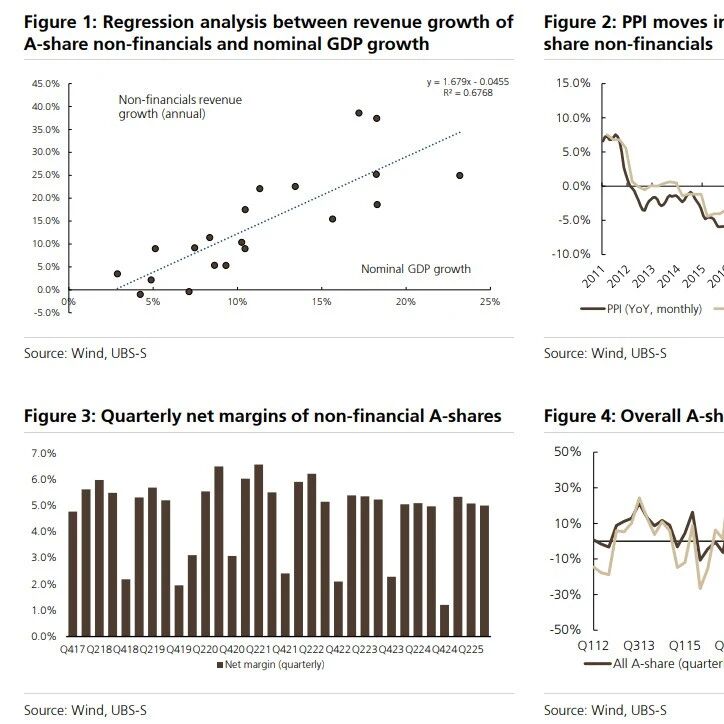
Group 1 - The overall A-share profit growth is expected to accelerate from 6% in 2025 to 8% in 2026, primarily driven by the non-financial sector [1] - The revenue growth of non-financial A-shares is closely related to China's nominal GDP growth and PPI inflation, with a projected nominal GDP growth of 4.3% in 2026 [1] - The net profit margin (NPM) of non-financial A-shares has rebounded in the first nine months of 2025, reversing a long-term downward trend since 2021 [1] Group 2 - The financial sector's profit growth is expected to remain stable, supported by solid asset quality in the banking sector and improved market sentiment [2] - The cumulative profit growth of industrial enterprises in China was only 0.1% in the first eleven months of 2025, but certain sectors like computer and electronic equipment manufacturing saw a 15% profit increase [2] - Investors should pay attention to potential revisions in profit growth expectations around April 2026, as historical data shows discrepancies in profit growth forecasts during that period [2] Group 3 - The current rolling P/E ratio of the Wind All A-share index has risen above the historical average, leading some investors to worry about overvaluation [13] - Despite concerns, the equity risk premium in the A-share market remains above historical averages, indicating potential for further revaluation [13][16] - Factors such as clearer fiscal support, accelerating profit growth, and increased household savings reallocating to stocks are expected to drive A-share growth in 2026 [16] Group 4 - The Chinese central bank plans to moderately expand the deficit and maintain stable credit pulses, which is expected to support A-share revaluation [17] - The anticipated reduction in policy rates and reserve requirement ratios by the central bank may further enhance liquidity in the market [17] - A moderate expansion in P/E ratios is expected as profit growth accelerates, with historical data showing a correlation between profit growth and P/E ratios [21] Group 5 - The ongoing market capitalization management reforms are changing investor perceptions, leading to increased focus on shareholder returns [27] - A-share cash dividends reached 2.06 trillion yuan in 2025, marking a significant increase, while stock buybacks have also risen [27] Group 6 - Daily trading volume in A-shares has significantly increased in 2026, driven by improved investor risk appetite, with average daily turnover reaching 3.03 trillion yuan [28] - Regulatory measures have been implemented to cool down excessive trading activity, with daily turnover ratios fluctuating [28][33] - The financing balance in A-shares reached a historical high of 2.7 trillion yuan, indicating increased leverage in the market [33] Group 7 - The trend of reallocating household savings towards stocks is evident, with a significant portion of household deposits still available for investment in A-shares [40] - Despite a recent uptick in the stock market, the influx of household funds into the market has not yet reached overheating levels [42][46] - The potential for further inflows into A-shares exists as investors may gradually shift from fixed-income products to equity investments [49] Group 8 - The issuance of active funds has been slow, but the performance of equity funds has improved, potentially leading to increased inflows as market conditions stabilize [53] - The ETF market has seen rapid growth, with A-share holdings in ETFs surpassing those in active equity funds for the first time [58] Group 9 - The "anti-involution" policies are expected to improve supply-demand dynamics and support price recovery, enhancing corporate profitability [64] - The narrowing and eventual recovery of PPI is crucial for the revenue growth of non-financial A-shares, which may lead to stock price revaluation [65] Group 10 - The growth style is expected to outperform the value style in the mid-term, with cyclical stocks likely to perform better than defensive stocks [66] - Tactical preferences lean towards sectors benefiting from innovation, ample liquidity, and narrowing PPI, such as electronics, telecommunications, and chemicals [66] Group 11 - Despite recent declines in financing balances and market turnover, the technology sector's fundamentals remain strong, with expectations for continued growth in 2026 [75] - Metrics for assessing trading congestion in technology stocks include the proportion of trading volume and financing balances relative to market capitalization [78]

市场分析:金融有色行业领涨,A股小幅整理
Zhongyuan Securities· 2026-01-26 09:14
Market Overview - On January 26, the A-share market experienced slight fluctuations after reaching resistance at 4160 points, with the Shanghai Composite Index closing at 4132.61 points, down 0.09%[7] - The total trading volume for both markets was 32,810 billion yuan, above the median of the past three years[3] Sector Performance - Financial, pharmaceutical, non-ferrous metals, and petroleum sectors performed well, while aerospace, electronic chemicals, computer equipment, and semiconductors lagged[3] - Over 60% of stocks in the two markets declined, with non-ferrous metals and precious metals leading the gains, while aerospace and semiconductor sectors saw significant outflows[7] Valuation Metrics - The average price-to-earnings (P/E) ratios for the Shanghai Composite and ChiNext indices were 16.91 times and 54.02 times, respectively, above the median levels of the past three years, indicating a suitable environment for medium to long-term investments[3][13] Investment Strategy - Investors are advised to adopt a balanced allocation strategy, focusing on AI, high-end manufacturing, and cyclical sectors, as well as resource and consumer sectors for future investment opportunities[3] - Short-term investment opportunities are recommended in the financial, pharmaceutical, petroleum, and coal industries[3] Risk Factors - Potential risks include unexpected overseas economic downturns, domestic policy changes, and macroeconomic disturbances that could impact recovery[4]
量价深度学习因子超额显著修复
HTSC· 2026-01-25 10:38
Quantitative Models and Construction Methods Model: AI CSI 1000 Enhanced Portfolio - **Construction Idea**: The model is based on the full-spectrum fusion factor, which integrates both high-frequency and low-frequency price-volume data using deep learning and multi-task learning techniques[6][7] - **Construction Process**: 1. Train 27 high-frequency factors using a deep learning model to obtain high-frequency deep learning factors 2. Use multi-task learning to extract end-to-end features from low-frequency price-volume data, resulting in low-frequency multi-task factors 3. Combine the high-frequency and low-frequency factors to form the full-spectrum fusion factor[6] - **Evaluation**: The model shows significant excess returns and a high information ratio, indicating strong performance and effective risk management[1][7] - **Backtest Results**: - Annualized excess return: 21.60% - Annualized tracking error: 6.06% - Information ratio (IR): 3.57 - Maximum drawdown of excess return: 7.55% - Calmar ratio of excess return: 2.86[1][7] Model: LLM-FADT Text Stock Selection Strategy - **Construction Idea**: The model enhances the BERT-FADT strategy by incorporating additional interpretations from a large language model (LLM), including new title interpretations, market catalysts, implied meanings, potential risks, and return guidance[2][14][17] - **Construction Process**: 1. Input six types of text into a fine-tuned FinBERT model: original text, new title interpretations, market catalysts, implied meanings, potential risks, and return guidance 2. Convert these texts into text feature vectors 3. Train an XGBoost model using these enriched text features[17] - **Evaluation**: The LLM-FADT strategy is more stable and has smaller excess drawdowns compared to the BERT-FADT strategy, showing better performance in extreme market conditions[2][14][20] - **Backtest Results**: - Annualized return: 30.10% - Annualized excess return: 25.52% - Sharpe ratio: 1.18 - Information ratio (IR): 2.00[2][20][24] Model: AI Industry Rotation Model - **Construction Idea**: The model uses the full-spectrum fusion factor to score 32 primary industries and constructs a weekly rebalancing strategy by equally weighting the top 5 industries[3][38] - **Construction Process**: 1. Score each industry using the full-spectrum fusion factor based on the industry component stocks 2. Select the top 5 industries with the highest scores 3. Equally weight these industries and rebalance weekly[38][43] - **Evaluation**: The model effectively utilizes AI's feature extraction capabilities to capture patterns in multi-frequency price-volume data, complementing top-down strategies[3][38] - **Backtest Results**: - Annualized return: 26.87% - Annualized excess return: 19.02% - Maximum drawdown of excess return: 12.43% - Sharpe ratio of excess return: 1.85[3][41] Model: AI Thematic Index Rotation Model - **Construction Idea**: The model scores 133 thematic indices using the full-spectrum fusion factor and constructs a weekly rebalancing strategy by equally weighting the top 10 thematic indices[4][28] - **Construction Process**: 1. Score each thematic index using the full-spectrum fusion factor based on the index component stocks 2. Select the top 10 thematic indices with the highest scores 3. Equally weight these indices and rebalance weekly[28][31] - **Evaluation**: The model leverages AI to identify and capitalize on trends in thematic indices, providing a diversified and dynamic investment approach[4][28] - **Backtest Results**: - Annualized return: 16.92% - Annualized excess return: 9.37% - Maximum drawdown of excess return: 20.79% - Sharpe ratio of excess return: 0.73[4][30] Model Backtest Performance AI CSI 1000 Enhanced Portfolio - Annualized excess return: 21.60% - Annualized tracking error: 6.06% - Information ratio (IR): 3.57 - Maximum drawdown of excess return: 7.55% - Calmar ratio of excess return: 2.86[1][7] LLM-FADT Text Stock Selection Strategy - Annualized return: 30.10% - Annualized excess return: 25.52% - Sharpe ratio: 1.18 - Information ratio (IR): 2.00[2][20][24] AI Industry Rotation Model - Annualized return: 26.87% - Annualized excess return: 19.02% - Maximum drawdown of excess return: 12.43% - Sharpe ratio of excess return: 1.85[3][41] AI Thematic Index Rotation Model - Annualized return: 16.92% - Annualized excess return: 9.37% - Maximum drawdown of excess return: 20.79% - Sharpe ratio of excess return: 0.73[4][30]
2025年四季报公募基金十大重仓股持仓分析
Huachuang Securities· 2026-01-24 12:42
Market Performance - Since October 2025, major indices have shown upward volatility, with the CSI 2000, CSI 500, and National CSI 2000 all achieving over 10% gains, while the Shanghai Composite Index has repeatedly surpassed 4000 points, reaching recent highs[1] - The top five performing sectors in Q4 2025 were non-ferrous metals (33.48%), national defense and military industry (28.59%), oil and petrochemicals (25.94%), basic chemicals (18.59%), and building materials (18.01%)[1] Fund Establishment and Positioning - A total of 100 new actively managed equity funds were established in Q4 2025, with a total share of 604.71 billion[2] - The average stock positions of various types of actively managed equity funds decreased compared to Q3 2025, with mixed equity funds averaging 88.69% (down 1.05%) and ordinary stock funds at 90.52% (down 0.52%)[3][31] Industry Distribution - The sectors with increased holdings of over 10 billion included non-ferrous metals, communication, basic chemicals, and non-bank financials, while sectors with decreased holdings included pharmaceuticals, computers, electronics, power equipment and new energy, and media[4] - The top five heavy-weight sectors for actively managed equity funds in Q4 were electronics (22.89%), communication (11.14%), power equipment and new energy (9.29%), pharmaceuticals (8.1%), and non-ferrous metals (8.09%) with notable increases in non-ferrous metals (up 2.08%) and communication[4][47] Individual Stock Analysis - The top five stocks with the largest increases in holdings were Zhongji Xuchuang, Dongshan Precision, China Ping An, Xinyi Technology, and Shengyi Technology[5] - The largest reductions in holdings were seen in Industrial Fulian, Yiwei Lithium Energy, Ningde Times, Luxshare Precision, and Focus Media[5] Billion Fund Holdings - As of January 22, 2026, there were 31 funds with over 10 billion in assets, a decrease of 3 from the previous quarter, with significant changes in holdings for companies like Shengyi Technology and Zhongji Xuchuang[6] Hong Kong Stock Holdings - The top three Hong Kong stocks held by funds in Q4 2025 were Tencent Holdings, Alibaba-W, and SMIC, each with a market value exceeding 18 billion, but all saw reductions of over 10 billion compared to the previous quarter[7]



公募基金资金流向哪些行业?:主动权益基金2025 四季度持仓解析
ZHONGTAI SECURITIES· 2026-01-23 15:35
- The report does not contain any quantitative models or factors for analysis, as it primarily focuses on the analysis of active equity funds' holdings, preferences, and structural changes in Q4 2025[3][6][7] - The report provides detailed insights into the number, scale, and allocation preferences of active equity funds, including their industry and sectoral adjustments, but does not include any specific quantitative models or factor construction methodologies[3][6][7] - The analysis highlights the changes in fund holdings and preferences, such as increased allocation to cyclical and financial sectors and reduced allocation to technology and healthcare, but no quantitative models or factors are discussed[44][48][49]



