智能手机

Search documents
小米汽车将出海!雷军:计划4年内英国开150家店,卖手机、汽车
Sou Hu Cai Jing· 2026-01-30 08:48
Group 1 - Xiaomi has successfully entered the overseas market, generating approximately 1 billion RMB in revenue from the UK last year and plans to open 150 stores in the UK within four years [1][3] - The company aims to introduce its entire product line, including smartphones, wearable devices, home appliances, and cars, to the UK market, with the Xiaomi car expected to launch there [3][5] - Xiaomi's automotive division plans to officially enter the European market in 2027, leveraging its existing store presence and user base in Europe, which provides a competitive advantage over other domestic car manufacturers [5][8] Group 2 - The trend of domestic car manufacturers expanding overseas is becoming more prevalent as the domestic market becomes saturated, with companies like BYD, Chery, and Geely already establishing a presence abroad [7] - Xiaomi has set an ambitious goal to become one of the top five global automotive manufacturers within 15-20 years, making international expansion a necessary step for the company [8]



2026,手机业进入轻资产生存时代
Feng Huang Wang· 2026-01-30 07:59
Core Insights - The smartphone market is entering a phase of intense competition, with the youngest player, Honor, showing potential for growth amidst a challenging environment [1][21] - The Chinese smartphone market is characterized by a fragile balance among the top six players, with market shares fluctuating around 15% [2][4] Market Dynamics - The competition is becoming increasingly fierce, with every percentage point of market share requiring significant resource investment [4] - Honor's global smartphone shipments are projected to exceed 71 million units in 2025, marking a 9% year-on-year growth [4][9] Competitive Positioning - Honor, as the youngest and only single-brand player among the top six, demonstrates unique resilience in a competitive landscape [5] - The company is avoiding the pitfalls of heavy asset models by maintaining a lean organizational structure and flexible channel strategies, allowing for greater financial agility [6][12] Strategic Focus - Honor is strategically positioned in the mid-to-high-end market segment, focusing on the $300-$499 price range to avoid price wars in the sub-$200 category [9] - The brand is actively pursuing high-end market opportunities, evidenced by successful product launches like the Magic8 Pro Air and the RSR Porsche Design model [11] Global Expansion - Honor's overseas market share is set to surpass 50% in 2025, with significant growth in Latin America and the Middle East and Africa [9][14] - The company is transitioning from a broad market approach to a more focused strategy, emphasizing key regions and building a structured growth framework [14][20] Leadership and Strategy - Under the leadership of CEO Li Jian, Honor has implemented a clear strategy focusing on youthfulness, high-end positioning, and globalization [21] - The company has successfully restructured its competitive capabilities, positioning itself as a significant player in the global market within five years of independence [21]
华为手机被网友称为“机坚强”:被扎出一个窟窿还能用
Nan Fang Du Shi Bao· 2026-01-30 06:17
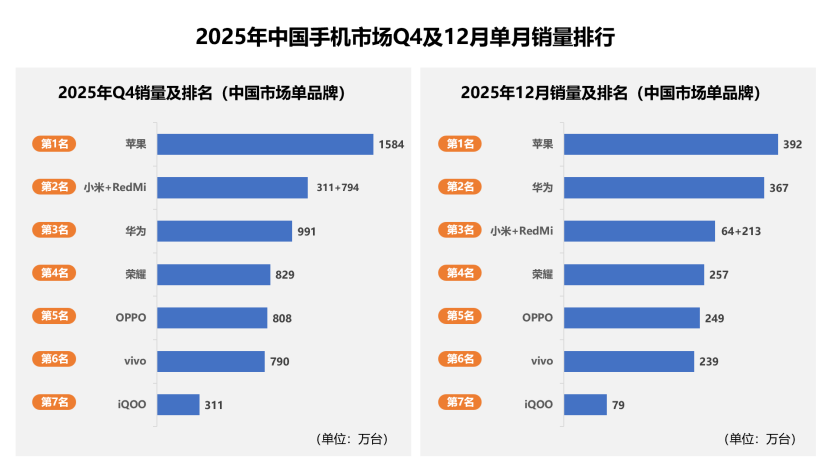
Core Viewpoint - The durability and quality of Huawei smartphones are highlighted through recent social media posts showcasing devices that have survived extreme damage while still functioning, reinforcing consumer trust in the brand's reliability [1][2]. Group 1: Product Durability - A Huawei smartphone was reported to have survived being punctured yet continued to operate normally, demonstrating the device's resilience [1]. - Other users shared similar experiences with Huawei devices, including one that survived being burned and another that was bent under pressure, all while remaining functional [1]. - Industry experts noted that the ability of a smartphone to function after damage often depends on whether critical components like the battery or motherboard are affected [1]. Group 2: Quality Assurance and R&D Investment - Huawei emphasizes product quality as a cornerstone of its business, with a commitment to meeting customer expectations throughout its value chain [2]. - The company plans to invest 179.7 billion yuan in research and development in 2024, accounting for approximately 20.8% of its total revenue, with cumulative R&D spending exceeding 1.249 trillion yuan over the past decade [2]. - Strong product quality is a key factor driving consumer preference for Huawei smartphones, as evidenced by its leading market share in China [2]. Group 3: Consumer Expectations - The phenomenon of the "durable phone" reflects a growing consumer demand for smartphones that are durable, impact-resistant, and safe for everyday use [3]. - As smartphones become essential tools for work, life, and payment, consumer expectations for stability and reliability continue to rise [3].
第一波存储涨价的手机受害者出现了
Di Yi Cai Jing· 2026-01-30 04:36
Core Viewpoint - The global storage chip prices are rising, significantly impacting smartphone manufacturers, with Transsion Holdings reporting a notable decline in revenue and profit due to increased component costs [3][5]. Company Summary - Transsion Holdings expects a revenue of approximately 65.568 billion yuan for 2025, a year-on-year decrease of about 4.6%, and a net profit of around 2.546 billion yuan, down 54.11% year-on-year, marking the first time the company has experienced such a significant profit drop since its listing [3][5]. - The company attributes the decline to rising supply chain costs, particularly for storage components, which have negatively affected product costs and gross margins [3][5]. - As of January 30, Transsion's stock price was 57.79 yuan, down 4.50%, reflecting a 44% decline from its one-year high [3][5]. Industry Summary - In the first three quarters of the previous year, Transsion's net profit fell by 44.97%, indicating a trend of increasing revenue without corresponding profit growth [5]. - Other smartphone manufacturers, such as Xiaomi and realme, have also reported challenges in fully passing on the increased costs of storage components to consumers [5][6]. - UBS forecasts that by Q4 2026, the cost of memory in the BOM (Bill of Materials) for mid-range smartphones will rise to 34%, up from 22% in Q4 2024 and 27% in Q4 2025, with an expected increase of about $16 per unit, representing a 37% rise [6]. - Counterpoint Research predicts that the increase in DRAM prices will raise BOM costs for smartphones across all price segments, with low, mid, and high-end models seeing increases of approximately 25%, 15%, and 10%, respectively, and further increases of 10% to 15% expected by Q2 2026 [6][7]. - The anticipated rise in component costs is expected to lead to a 2.1% decline in global smartphone shipments in 2026, particularly affecting lower-priced models where price adjustment options are limited [7].


第一波存储涨价的手机受害者出现了
第一财经· 2026-01-30 04:21
Core Viewpoint - The rising prices of storage chips are significantly impacting smartphone manufacturers, particularly in the mid to low-end market, leading to decreased profitability and increased costs [3][4]. Group 1: Company Performance - Transsion Holdings announced a projected revenue of approximately 65.568 billion yuan for 2025, representing a year-on-year decline of about 4.6%, with a net profit of approximately 2.546 billion yuan, a significant drop of 54.11% [3]. - This marks the first time Transsion has experienced a "halved" net profit since its listing, attributed to rising supply chain costs and increased expenses in sales and R&D [3][4]. - As of January 30, Transsion's stock price fell by 4.50% to 57.79 yuan, marking a 44% decline from its one-year high [3]. Group 2: Market Impact - The increase in storage prices is eroding profits in the smartphone market, especially for mid to low-end devices, with Transsion's net profit down 44.97% year-on-year in the first three quarters of the previous year [4]. - Other manufacturers, such as Xiaomi and realme, have also reported challenges in fully passing on the increased costs of storage components to consumers [4]. - Apple indicated that rising storage prices would impact its gross margins, and the company is currently evaluating response strategies [4]. Group 3: Cost Structure Changes - According to UBS, by Q4 2026, the cost of memory in the BOM (Bill of Materials) for mid-range smartphones is expected to rise to 34%, up from 22% in Q4 2024 and 27% in Q4 2025 [5]. - The cost of memory per smartphone is projected to increase by approximately $16, a 37% rise, which represents about 6% of the average selling price of mid-range smartphones [5]. - To fully offset the impact of rising memory prices, the average selling price of mid-range smartphones would need to increase by 17%, while flagship and high-end models would require a 7% increase [5]. Group 4: Future Projections - Counterpoint Research predicts that the increase in DRAM prices will continue to raise BOM costs for smartphones, with low, mid, and high-end models expected to see increases of approximately 25%, 15%, and 10% respectively, with potential further increases of 10% to 15% by Q2 2026 [6]. - The anticipated rise in component costs is expected to negatively affect terminal demand, with a projected 2.1% decline in global smartphone shipments in 2026 [6].

阿里“通云哥”概念亮相;贵州茅台辟谣参与SpaceX融资
2 1 Shi Ji Jing Ji Bao Dao· 2026-01-30 03:28
Group 1: Technology Sector Developments - Alibaba's "Tongyun Ge" concept integrates "Cloud + AI + Chips" as a strategic support triangle for future technology initiatives, emphasizing AI as a core driver of change in cloud computing over the next decade [2] - ByteDance's CEO Liang Rubo announced the company's 2026 focus on "climbing to new heights," highlighting the importance of AI opportunities and the need to enhance talent density and incentives [5] - Waymo plans to launch fully autonomous ride-hailing services in London by Q4 2023, expanding its operations internationally despite regulatory challenges [7] Group 2: Market and Company News - Guizhou Moutai denied rumors of participating in SpaceX's Series A funding, with its stock closing at 1437.72 yuan per share, up 8.61%, and a market capitalization exceeding 1.8 trillion yuan [3] - Byte's new "Doubao" smartphone is expected to be released in late Q2 2026, with significant improvements over its predecessor, developed in collaboration with ZTE Nubia [4] - Meituan's new "one-shot" verification feature requires new restaurant partners to upload unedited videos showcasing their premises, aimed at enhancing platform integrity [8] Group 3: Industry Collaborations - Black Sesame Intelligence and Baidu's "萝卜快跑" signed a strategic cooperation agreement to develop a collaborative ecosystem for autonomous driving, focusing on technology research and product development [11] - Shanghai Xixi Intelligent Technology completed several million yuan in angel financing, aimed at integrating AI with flexible robotics for food processing solutions [12] Group 4: Consumer Electronics - Apple's iPhone 16 was the best-selling smartphone globally in 2025, with Apple and Samsung dominating the top ten list, holding seven and three positions respectively, indicating strong market leadership [10]



摩根士丹利科技论坛-Erik-Woodring评希捷-STX-与西部数据-WDC-预期调整及估值重估-苹果-AAPL-毛利率与AI路线图争议-戴尔-DELL-NetApp-NTAP-慧与-HPE-惠普-HPQ-面临利润率压力
摩根· 2026-01-30 03:11
Investment Rating - The report maintains a positive outlook on the hard disk industry, with expectations for revenue to exceed forecasts by 5% and gross margins to increase by over 200 basis points [1][3]. Core Insights - The hard disk market is benefiting from growing data storage demand, with major manufacturers facing supply shortages and possessing pricing power. Customer demand is inelastic, and the telecom industry's development is expected to provide long-term benefits [1][2]. - Western Digital's optimistic earnings per share (EPS) forecast for fiscal year 2027 is between $17 and $18, with an 18x valuation, indicating a potential stock price increase of 35%-40%. Seagate's EPS forecast is approximately $24, with a 19x valuation, targeting a stock price of $425-$450 [1][4]. - Commodity price surges are stimulating short-term purchases but may lead to significant price increases for equipment, posing risks of demand shrinkage and asset utilization decline. A potential demand cliff may occur in the second half of the year, with long-term concerns regarding workload shifts to the cloud [1][5]. Summary by Sections Industry Background and Drivers - The hard disk industry has become highly consolidated, forming a rational duopoly. This structure has significant influence in major end markets, particularly among large telecom operators focused on AI and data projects. The industry benefits from trends in data retention demand across various sectors [2]. Quarterly Performance Expectations - Due to supply constraints, pricing remains a core reason for hard disk purchases. Revenue growth is expected to exceed last year's September forecasts, driven by improved factory utilization and favorable pricing conditions. EPS for both major companies is projected to exceed expectations by 5%, with gross margins increasing [3]. Future Price and Earnings Outlook - The primary drivers for stock price increases will be upward revisions in earnings expectations, leading to valuation multiple expansions. Western Digital's EPS is expected to be around $14 to $14.50, with an optimistic scenario reaching $17 to $18. Seagate's EPS is projected at $21, with an optimistic scenario of $24 [4]. Impact of Commodity Prices on OEMs - Rising commodity prices are prompting OEMs to inform customers of future price increases to stimulate current purchasing behavior. However, significant price increases for equipment could lead to demand shrinkage and asset utilization risks, particularly in the second half of the year [5]. Companies with Downside Risk - HP and Logitech are identified as having significant downside potential due to low market consensus. Dell and NetApp also face considerable downside risk due to their current valuations being in a premium range [6]. Market Sentiment and Spending Cuts - Despite strong recent performance, concerns arise from rising commodity prices, which could lead to negative market sentiment. Hardware spending growth is projected to be the worst in 15 years, with many customers expected to cut spending plans [7].
招银国际每日投资策略-20260130
Zhao Yin Guo Ji· 2026-01-30 02:45
Macro Commentary - Chinese policymakers are signaling a strategic shift to prioritize domestic demand as the primary economic task by 2026, addressing issues like overcapacity, deflationary pressures, and weak confidence [2] - Demand-side policies will focus on stabilizing the real estate market and boosting consumption through measures such as lowering mortgage rates and purchasing unsold properties [2] - Supply-side policies will aim at structural adjustments, enhancing industry concentration by curbing capacity expansion and encouraging mergers and acquisitions [6] Market Performance - The Hang Seng Index closed at 27,968, up 0.51% for the day and 9.12% year-to-date, while the Hang Seng Tech Index fell by 1.00% [3] - The Chinese stock market saw gains, particularly in real estate, consumer staples, and financial sectors, with net inflows of 4.374 billion HKD from southbound funds [5] - The U.S. stock market experienced a pullback, with technology, consumer discretionary, and materials sectors leading the decline, while communication services, real estate, and energy sectors gained [5] Company Insights - Meta (META US) reported a 24% year-on-year revenue increase to 59.9 billion USD for Q4 2025, driven by AI-enhanced advertising growth, and provided a revenue guidance of 53.5-56.5 billion USD for Q1 2026 [6] - Microsoft (MSFT US) achieved 16.7% revenue growth to 81.3 billion USD in Q2 FY26, with strong performance in productivity and business processes, and provided a target price of 614.6 USD [6] - ServiceNow (NOW US) reported a 21% revenue increase to 3.57 billion USD for Q4 2025, with a positive outlook for FY26 driven by AI efficiencies, maintaining a target price of 215.0 USD [7][8] - Sunny Optical Technology (2382 HK) expects a 70-75% increase in net profit for 2025, driven by high-end camera upgrades and growth in automotive and smart glasses segments, with a target price of 91.38 HKD [8]
苹果电话会全文实录:更个性化Siri今年上线,存储涨价+3nm产能紧张成Q2毛利压力
美股IPO· 2026-01-30 02:19
Core Insights - Apple reported its best quarter ever with revenue of $143.8 billion, a 16% year-over-year increase, and iPhone revenue reaching $85.3 billion, up 23% year-over-year [11][23][31] - The company expects double-digit revenue growth in the next quarter but warns of potential constraints from 3nm chip production and rising memory prices affecting supply and margins [3][7][37] - Apple announced a partnership with Google to develop the next generation of Apple Foundation Models, enhancing the personalization of Siri, marking a significant shift in its AI strategy [6][73] Revenue Performance - Total revenue for the first fiscal quarter of 2026 was $143.8 billion, with product revenue at $113.7 billion, driven primarily by strong iPhone sales [23][24] - iPhone revenue reached $85.3 billion, setting a new record and contributing significantly to overall growth [31][32] - Service revenue hit $30 billion, a 14% increase year-over-year, with strong performance across various markets [25][34] Regional Performance - The Greater China region saw a remarkable 38% year-over-year revenue growth, dispelling concerns about weak demand in the market [5][42] - Apple achieved record iPhone sales in China, with significant upgrades and conversions from Android users [5][44] Product Highlights - The iPhone 17 series was highlighted as the strongest and most popular product line, with a customer satisfaction rate of 99% in the U.S. [4][31] - Mac revenue was $8.4 billion, showing a decline of 7% year-over-year, while iPad revenue was $8.6 billion, up 6% [13][32] - Wearables, home, and accessories generated $11.5 billion, a slight decline of 2% due to supply constraints on AirPods Pro 3 [14][33] Supply Chain and Cost Challenges - Apple is currently in a supply catch-up mode due to unprecedented demand for the iPhone, with supply constraints expected to persist into the next quarter [5][7] - The company warned of rising memory prices impacting margins, although the overall gross margin for Q1 was 48.2%, exceeding guidance [26][29][37] Future Outlook - For the March quarter, Apple expects revenue growth of 13% to 16%, factoring in supply constraints and rising memory prices [37] - The company anticipates maintaining a gross margin of 48% to 49% despite challenges [37][80]

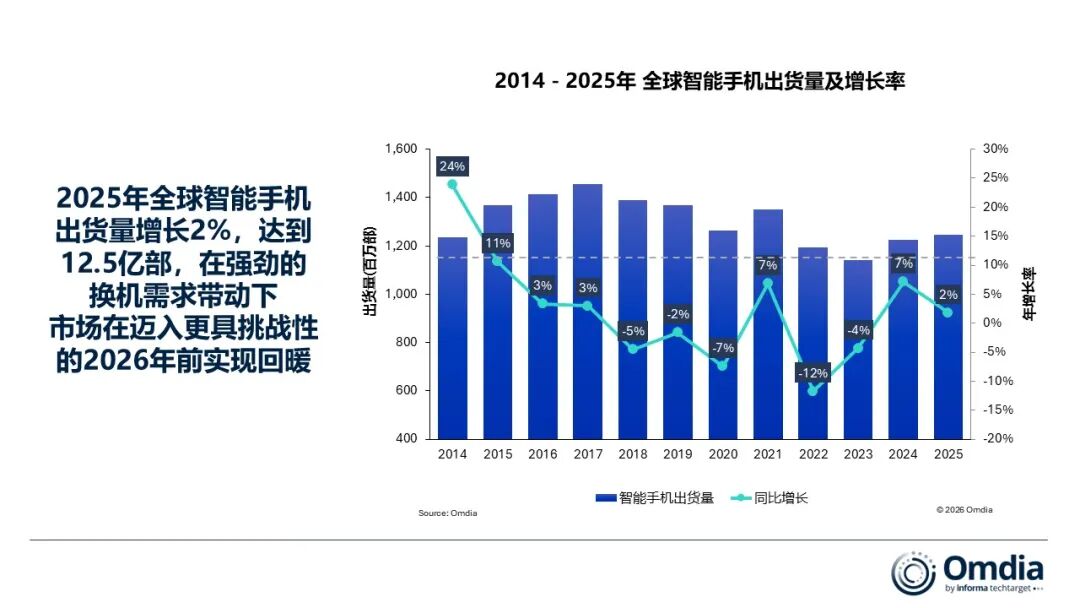
Omdia:2025年全球智能手机出货量增长2% 达到12.5亿部
Zhi Tong Cai Jing· 2026-01-30 01:41
Core Insights - Global smartphone shipments are projected to grow by 2% in 2025, reaching 1.25 billion units, marking the highest level since 2021, with all regions except Greater China experiencing year-on-year growth [1] - The fourth quarter of 2025 saw a 4% year-on-year increase in global smartphone shipments, driven by seasonal factors and strong vendor performance, although rising costs of key components began to suppress expectations for 2026 [1] Group 1: Company Performance - Apple achieved a record annual shipment of 240.6 million iPhones in 2025, a 7% increase year-on-year, maintaining its position as the largest smartphone manufacturer for the third consecutive year [4] - Samsung rebounded in 2025 with a 7% year-on-year increase in shipments, closing the year with a strong fourth quarter, driven by resilient demand for flagship models and a recovery in the entry-level market [4] - Xiaomi defended its top three position despite a 2% decline in fourth-quarter shipments, impacted by weak entry-level demand and significant market contraction [5] Group 2: Market Dynamics - Vivo entered the fourth position for the first time, with a 4% year-on-year increase in shipments to 10.53 million units, supported by success in the Indian market and stable domestic performance [5] - OPPO ranked fifth, with annual shipments of 10.07 million units, experiencing a 3% year-on-year decline, but returning to growth in the fourth quarter with the launch of new models [5] - Despite challenges, several manufacturers outside the top five maintained positive growth, with Honor and Lenovo achieving year-on-year increases of 11% and 6%, respectively [5] Group 3: Future Outlook - Concerns for 2026 are emerging due to escalating supply-side pressures on DRAM, NAND, and other semiconductors, which may compress profit margins and force price adjustments [8] - Companies must effectively manage supply chain pressures and strengthen long-term partnerships to mitigate the impact of rising costs on consumer demand [8] - The focus for manufacturers will shift towards profitability and exploring alternative revenue sources, with a strategic opportunity to capture upgrade demand and ensure market share sustainability [11]