
交通运输

Search documents
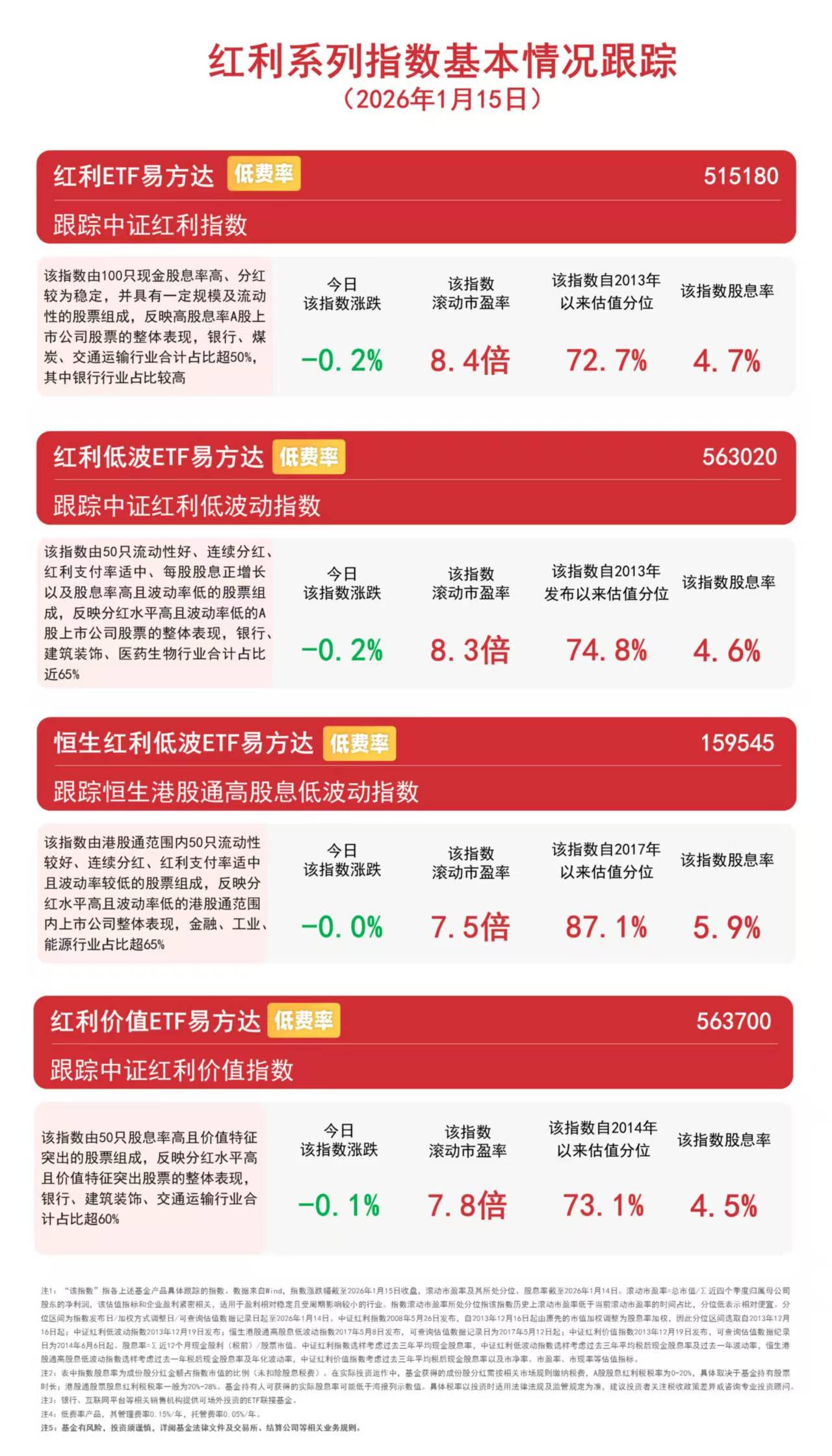
红利板块小幅回调,红利ETF易方达(515180)、红利低波ETF易方达(563020)受资金关注
Sou Hu Cai Jing· 2026-01-15 11:18
Core Viewpoint - The dividend sector experienced a slight decline today, with various indices reflecting a decrease in performance, while the E Fund dividend ETFs saw significant net inflows [1][4]. Group 1: Market Performance - The Hang Seng High Dividend Low Volatility Index fell by 0.01%, the CSI Dividend Value Index decreased by 0.1%, and both the CSI Dividend Index and CSI Dividend Low Volatility Index dropped by 0.2% [1]. - E Fund's dividend ETFs, including E Fund Dividend ETF (515180) and E Fund Low Volatility Dividend ETF (563020), received over 100 million yuan in net inflows yesterday [1]. Group 2: Fund Management and Fees - E Fund is currently the only fund company offering all dividend ETFs at a low fee rate of 0.15% per year, which aids investors in low-cost allocation to high-dividend assets [1][5]. - The management fee for E Fund's various dividend ETFs, including the Hang Seng Low Volatility Dividend ETF (159545), is set at 0.15% per year, with a custody fee of 0.05% per year [5]. Group 3: Index Composition - The CSI Dividend Index consists of 100 stocks with high cash dividend yields and stable performance, with banking, coal, and transportation sectors accounting for over 50% of the index [3]. - The CSI Low Volatility Dividend Index is composed of 50 stocks characterized by good liquidity, continuous dividends, and low volatility, with banking, construction, and pharmaceutical sectors making up nearly 65% of the index [3]. - The CSI Dividend Value Index includes 50 stocks with high dividend yields and value characteristics, with banking, construction, and transportation sectors representing over 60% of the index [4].

美联储褐皮书:经济、物价温和增长,通胀压力难以忽视
Sou Hu Cai Jing· 2026-01-15 01:20
Economic Activity - The Federal Reserve's Beige Book indicates that economic activity in most regions of the U.S. has recently grown, with employment conditions remaining stable, but inflationary pressures have not fully dissipated [1][2] - Economic activity has accelerated at a "slight to moderate" pace since mid-November 2025, with 8 out of 12 Federal Reserve districts reporting growth, 3 reporting no change, and 1 reporting a moderate decline [4] - The improvement in economic activity is characterized by significant "unevenness," with regions dependent on consumption and services benefiting from a slight rebound in consumer spending [5][6] Employment Conditions - The employment market shows a "mixed" result, with 8 out of 12 districts reporting stable employment levels and near stagnation in job growth, indicating a lack of growth momentum [11][12] - Employment conditions vary significantly by industry, with stable employment in healthcare and education, while manufacturing and retail sectors face challenges due to tariffs and economic cycles [13][14] - Wage growth is described as "moderate," with reports indicating that wage increases have returned to "normal" levels [15] Price Pressures - Most Federal Reserve districts report moderate price increases, with only 2 districts noting slight price rises, driven by ongoing cost pressures from tariffs [16] - Companies are beginning to pass on tariff-related costs to consumers, although some sectors, like retail and dining, are hesitant to do so due to price sensitivity [16] - Energy and insurance sectors continue to significantly impact profit margins, with expectations of some price relief in the future, but prices are anticipated to remain high due to rising costs [17] Regional Highlights - Boston: Economic activity shows slight improvement, with consumer spending increasing, particularly in high-end goods and services [18] - New York: Economic activity continues to decline slightly, with a decrease in employment and moderate wage growth [19] - Philadelphia: Economic activity has shown signs of recovery, with slight improvements in employment levels [19] - Chicago: Economic activity remains unchanged, with slight increases in consumer spending and construction demand [20] - Dallas: Economic activity remains stable, with growth in the banking sector and cautious outlook due to inflation concerns [20]
促进服务业提质、消费扩容u3000上海发布28条举措
Shang Wu Bu Wang Zhan· 2026-01-14 16:48
Core Viewpoint - Shanghai has introduced 28 specific measures to enhance service quality and stimulate consumption, focusing on optimizing supply and expanding demand to foster new growth points in the service sector [2]. Group 1: Focus Areas - The measures target six key industries: finance, information services, transportation, cultural and entertainment services, life services, and inspection and certification, which together account for approximately 60% of Shanghai's service sector value and about 70% of service consumption [2]. - In financial services, the measures include enhancing personal consumer finance services, supporting innovation in insurance products, and strengthening financial support for business entities and consumption infrastructure [2]. Group 2: Platform Economy - The measures emphasize the development of the platform economy, supporting e-commerce and life service platforms to innovate and cultivate specialized consumption platforms in areas like maternal and child care, housekeeping, and elderly care [3]. - The government aims to regulate platform competition, prevent forced low-cost sales, and encourage platforms to reduce fees and optimize transparent pricing rules [3]. Group 3: Cultural and Sports Integration - The measures also focus on enhancing the synergy between cultural, tourism, and commercial events, proposing initiatives to enrich cultural performances, leverage sports events, and support the gaming and short video content industries [4]. - The approach aims to create a collaborative ecosystem that boosts both supply quality and consumption expansion, particularly in the cultural and entertainment sectors [4]. Group 4: Economic Implications - The policy is expected to facilitate a virtuous cycle of supply upgrading, consumption stimulation, and industry income growth, addressing the mismatch between service supply and demand [5]. - It aims to cultivate new growth drivers, stimulate digital consumption, and enhance the economic resilience of the city by improving the quality of services and optimizing the consumption environment [5].
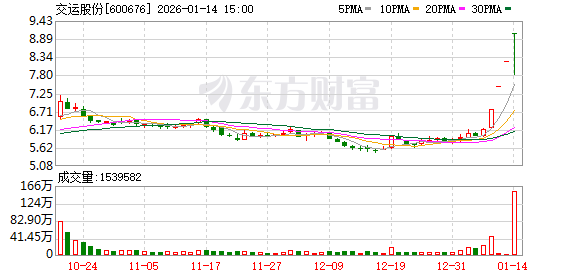
交运股份:股票交易异常波动公告
Zheng Quan Ri Bao· 2026-01-14 12:52
(文章来源:证券日报) 证券日报网讯 1月14日,交运股份发布公告称,公司股票于2026年1月13日、1月14日连续两个交易日内 收盘价格涨幅偏离值累计达20%,属于异常波动;经自查及向控股股东征询,除已披露的重大资产置换 暨关联交易外,不存在其他应披露未披露事项。 ...

红利国企ETF(510720)飘红,近20日资金净流入超1.6亿元,市场关注价值风格配置逻辑
Sou Hu Cai Jing· 2026-01-14 05:55
Group 1 - The core viewpoint indicates that in the first half of 2025, incremental funds are primarily flowing into the technology and dividend sectors, with insurance capital increasing allocations in banks, transportation, and communication sectors [1] - Passive funds, based on ETF tracking index component weightings, are mainly flowing into the computer and banking sectors during the same period [1] - Foreign capital, as per the changes in industry holdings through Stock Connect, is primarily flowing into the automotive, electronics, and banking sectors [1] Group 2 - The Dividend State-Owned Enterprise ETF (510720) tracks the State-Owned Dividend Index (000151), which selects high-dividend capable and stable dividend record companies across industries such as banking, coal, and transportation [1] - The index employs a strict examination of component stocks' dividend yields and sustainability, utilizing a cross-industry diversification strategy to effectively control investment risks and reflect the overall market performance of high-dividend companies [1] - The Dividend State-Owned Enterprise ETF has successfully distributed dividends monthly since its listing, achieving continuous dividends for 21 months [1]
深耕“租”动力 探寻“质”慧路
Jin Rong Shi Bao· 2026-01-14 01:26
Core Viewpoint - The 2026 People's Bank of China work conference emphasizes enhancing financial services for high-quality development of the real economy, focusing on structural monetary policy tools to support key areas like domestic demand, technological innovation, and small and medium enterprises [1] Group 1: Financial Leasing's Role - Financial leasing serves as a crucial link between finance and the real economy, facilitating technological iteration and capacity upgrades [1] - In 2026, financial leasing is expected to leverage its "financing + physical integration" features to inject financial momentum into advanced manufacturing, green energy, and computing infrastructure [1] Group 2: Strategic Emerging Industries - Central enterprises' revenue in strategic emerging industries exceeded 11 trillion yuan in the first 11 months of 2025, highlighting the sector's growth potential [2] - Emerging industries typically require significant upfront investment and have long return cycles, leading to challenges in financing, particularly in core technology equipment R&D and technology transformation [2] - Financial management departments have introduced targeted policies to support the development of strategic emerging industries, including a list of encouraged and restricted business activities for financial leasing companies [2] Group 3: Traditional Industry Transformation - The transformation and upgrading of traditional industries are essential for building a modern industrial system, with a focus on high-end, intelligent, and green development [3] - 2025 is identified as a critical year for traditional industry transformation, with 2026 marking a phase of significant technological upgrades and equipment renewal [3] Group 4: Financial Leasing Initiatives - Financial leasing companies are implementing practical service measures to support traditional industries, including customized leasing solutions for sectors like steel and chemicals to reduce capital pressure [4] - In agriculture, there is an emphasis on leasing support for smart farming equipment and irrigation systems to enhance agricultural productivity [4] - The transportation sector is focusing on green leasing initiatives for new energy vehicles and smart logistics equipment [4] Group 5: Enhancing Professional Capabilities - The new quality productivity sectors are characterized by high technology and knowledge intensity, necessitating improved industry understanding, risk assessment, product innovation, and post-leasing management capabilities for financial leasing companies [5][6] - Financial leasing companies are expected to deepen their specialization in 2026, focusing on core areas and developing a "specialized field + unique service" model [6] - Talent development in emerging technologies, leasing models, and risk management is crucial for enhancing professional capabilities within the industry [6]
从“物理聚合”到“化学反应” 泉州国企改革“改”出新活力
Xin Lang Cai Jing· 2026-01-13 20:53
Core Viewpoint - The integration and restructuring of state-owned enterprises (SOEs) in Quanzhou, Fujian Province, is seen as a key strategy to enhance the efficiency of state capital allocation and drive high-quality economic development during the 14th Five-Year Plan period [1]. Group 1: Economic Indicators and Goals - By the end of 2025, the total assets of enterprises funded by the Quanzhou State-owned Assets Supervision and Administration Commission (SASAC) are expected to exceed 500 billion yuan, with operating income surpassing 80 billion yuan, both indicators projected to double during the 14th Five-Year Plan [1]. Group 2: Market-oriented Integration and Restructuring - The Quanzhou SASAC has initiated multiple rounds of integration and restructuring to transform small, scattered enterprises into larger, more competitive entities, enhancing the efficiency and core competitiveness of state capital [1][2]. - The successful establishment of Quanzhou International Trade Group in early 2024 is a result of three rounds of restructuring, addressing the issues of small, weak, and homogeneous competition among trade enterprises [2]. Group 3: Strategic Support and Public Services - Quanzhou's transportation and construction groups are focusing on professional integration to enhance the strategic support capabilities of state-owned enterprises, while also forming a grain and oil operation company to improve urban construction and resource allocation [2]. - The restructuring of Quanzhou Water Group into an urban operation company aims to improve the quality and efficiency of public service supply, addressing the community's needs for a better quality of life [2]. Group 4: Mechanism Reform and Internal Development - The reform of the governance structure and market-oriented mechanisms is crucial for activating the internal development dynamics of state-owned enterprises, with a focus on labor, personnel, and distribution systems [3][4]. - The implementation of a modern corporate governance system includes the appointment of external directors and the establishment of clear responsibilities, enhancing decision-making processes and accountability [3][4]. Group 5: Transition from Asset Management to Capital Management - The ongoing reforms signify a transition from managing assets to managing capital, with a focus on modern governance, market-oriented operations, and risk prevention [5]. - The Quanzhou SASAC aims to consolidate the achievements of the two rounds of SOE reform actions, further guiding state capital to play a significant role in local strategic services, industry leadership, and public welfare [5].
促进服务业提质、消费扩容 上海发布28条举措
Xin Lang Cai Jing· 2026-01-13 19:50
Core Insights - Shanghai has released a set of 28 specific measures aimed at enhancing service quality and boosting consumption, focusing on the dual approach of optimizing supply and expanding demand [1][4] - The measures target six key sectors: finance, information services, transportation, cultural and entertainment services, life services, and inspection and certification, which together account for approximately 60% of the city's service industry value added [1][3] Group 1: Financial Services - The measures propose four initiatives to innovate financial products and services, including enhancing personal consumer finance services and supporting insurance product innovation [1] - The Shanghai government emphasizes that financial services play a crucial role in stimulating industry and activating consumption, with growing demand for diverse financial services in areas like wealth management and commercial insurance [1] Group 2: Platform Economy - The measures support the innovation and development of comprehensive platform enterprises, such as e-commerce and life service platforms, while promoting healthy competition and regulating pricing practices [2] - Encouragement is given to platform enterprises to enhance quality consumption through brand promotion activities and support for quality merchants, aiming to shift focus from price competition to quality competition [2] Group 3: Cultural and Entertainment Sectors - The measures aim to enhance the supply of cultural and entertainment offerings, promote the spillover effects of sports events, and support the development of the gaming and esports industries [3] - The focus is on creating a synergistic effect between cultural tourism and commercial exhibitions, thereby expanding consumption and improving service quality [3] Group 4: Economic Development Implications - The policy is seen as significant for exploring high-quality economic development paths, aiming to create a virtuous cycle of supply upgrading, consumption boosting, and industry income growth [4] - It seeks to cultivate new growth drivers, stimulate digital consumption, and enhance the internal dynamics of the economy through events and exhibitions [4]
上海新政激活六大行业吸金潜力 金融创新将成促消费重要手段
Di Yi Cai Jing· 2026-01-13 13:44
Core Viewpoint - The article discusses Shanghai's new measures to enhance the quality and efficiency of the service industry while boosting consumption, emphasizing a systematic approach to link supply and demand across various sectors [1][2]. Group 1: Policy Measures - The "Several Measures" document outlines 28 policy initiatives targeting six key sectors: finance, information services, transportation, cultural and entertainment, life services, and inspection and certification [1][6]. - The new policies aim to shift the focus from short-term stimulus to a long-term strategic layout that promotes service quality and consumption expansion [2][3]. - The measures highlight the importance of integrating financial services directly into consumption promotion, focusing on personal consumption finance, insurance product innovation, and financial support for service industry operators [1][9]. Group 2: Economic Context - The service industry and consumption in Shanghai have shown positive growth trends, with a 5.9% increase in service value added and a 5% rise in retail sales of consumer goods in the first eleven months of 2025, both exceeding national averages [2][6]. - The article emphasizes the need for a virtuous cycle of "supply upgrade - consumption boost - industry income - reinvestment," particularly through integrated sectors like cultural tourism and sports [2][3]. Group 3: Industry Focus - The six targeted sectors account for approximately 60% of Shanghai's service industry value added and about 70% of service consumption, making them critical for the linked development strategy [6]. - The measures encourage e-commerce platforms to transition from "price competition" to "quality competition," enhancing the connection between online and offline consumption [6][10]. - Specific initiatives include enhancing the quality of cultural and entertainment offerings, supporting high-level exhibitions, and promoting the gaming and esports industries [6][7]. Group 4: Financial Innovation - The measures stress the integration of "consumption scenarios + consumer finance," supporting the development of tailored financial products for various needs, including retirement and wealth management [9][10]. - Financial support is positioned as a key tool for stimulating consumption, with a focus on providing payment convenience through consumer credit products and easing financial pressures for service industry operators [10][11]. - The policy aims to create a dual support system, reducing consumer financial costs while simultaneously providing financing support to service industry businesses [10].
上海新政激活六大行业吸金潜力,金融创新将成促消费重要手段
Di Yi Cai Jing· 2026-01-13 13:31
Core Viewpoint - The new policy emphasizes systematic linkage and quality competition on the supply side, aiming to enhance service quality and stimulate consumption in Shanghai's service industry [1][2][3]. Group 1: Policy Measures - The "Several Measures" document outlines 28 policy initiatives targeting six key sectors: finance, information services, transportation, cultural and entertainment services, life services, and inspection and certification [1][6]. - The focus is on optimizing supply and expanding consumption to create new growth points in the service sector [1][2]. - The policy integrates finance directly into consumption promotion, addressing personal consumer finance, insurance product innovation, and financial support for service industry operators [1][9]. Group 2: Economic Strategy - The strategic shift in Shanghai's consumption promotion focuses on long-term structural changes rather than short-term stimulus, aligning with national directives to expand domestic demand [2][3]. - The service sector and consumption have shown positive growth trends, with service value added increasing by 5.9% and retail sales of consumer goods growing by 5% in the first eleven months of 2025, both surpassing national averages [2][6]. Group 3: Industry Focus - The six targeted industries account for approximately 60% of Shanghai's service sector value added and about 70% of service consumption [6]. - The policy aims to break down industry barriers and promote deep integration across various fields, creating a "service + consumption" ecosystem [3][4]. Group 4: Quality and Innovation - The measures highlight the importance of high-quality service supply to drive consumption demand, with a focus on digitalization and cross-industry integration [4][5]. - Specific initiatives include enhancing the quality of cultural and entertainment offerings, supporting high-level exhibitions, and promoting the gaming and esports industries [6][7]. Group 5: Financial Support - The policy emphasizes the integration of consumption scenarios with financial services, encouraging the development of tailored financial products for sectors like elderly care and wealth management [9][10]. - Financial support is aimed at easing payment pressures for consumers and providing funding assistance to service industry operators [10][11].