
航空

Search documents
西南航空(LUV.US)拟全线部署SpaceX星链Wi-Fi 紧跟同业步伐
智通财经网· 2026-02-12 02:55
Core Viewpoint - Southwest Airlines has announced the rapid deployment of SpaceX's Starlink in-flight Wi-Fi service across its fleet, marking its entry into the competitive in-flight connectivity market [1] Group 1: Company Developments - Southwest Airlines plans to equip over 300 aircraft with Starlink service by the end of this year, with the first flight expected to operate this summer [1] - This move comes after pressure from activist investor Elliot Investment Management, which has become one of Southwest Airlines' largest shareholders [1] - The airline has begun charging for checked baggage and introduced assigned seating, moving away from its previous differentiators compared to competitors like Delta Airlines and American Airlines [1] Group 2: Industry Trends - The in-flight Wi-Fi market is experiencing rapid growth, with SpaceX quickly gaining market share among major airlines, including Air France, Qatar Airways, and United Airlines [1] - Traditional in-flight Wi-Fi services have been criticized for unstable signals and poor experiences, while Starlink offers faster and more reliable connectivity due to its use of thousands of low Earth orbit satellites [1] - The growth of Starlink is contributing to the increasing valuation of SpaceX, which has also acquired Elon Musk's xAI to create a space data center, aiming for an IPO this year [1]


【环球财经】南非优质低成本航空公司将出售
Xin Hua Cai Jing· 2026-02-12 01:04
新华财经约翰内斯堡2月12日电(记者蒋国鹏靳博文)据多家媒体11日报道,南非基础设施投资与开发 商哈里斯资产管理公司(Harith General Partners)计划今年年内收购"飞行萨法(FlySafair)"航空公 司,以扩大其在非洲大陆的交通运输投资组合。 2025年,"飞行萨法"获全球航空公司评级权威机构斯凯特拉克斯公司(Skytrax)颁发的年度"非洲最佳 低成本航空公司"奖。 (文章来源:新华财经) "飞行萨法"总部位于南非约翰内斯堡,是南非萨法航空(Safair)的子公司,拥有30余架波音737型系列 客机,经营南非境内多条航线以及纳米比亚、津巴布韦、坦桑尼亚、毛里求斯等国多个目的地航线,以 准点率高以及可靠性高受到市场肯定。 哈里斯资产管理公司董事长特谢波·马赫洛勒表示,与"飞行萨法"的谈判已进入后期阶段,哈里斯资产 管理公司将以包括股权和债务融资相结合在内的方式收购"飞行萨法",相关细节正在接受监管部门审 查。预计收购可望于今年第四季度完成。 ...
春运期间推七大暖心服务
Xin Lang Cai Jing· 2026-02-11 16:40
Core Viewpoint - The Hainan Province has reported a cumulative passenger flow of 4.86 million during the first nine days of the 2026 Spring Festival travel period, marking a year-on-year increase of 6.34% [1] Group 1: Transportation Services - The provincial government has introduced seven major warm-hearted services for the 2026 Spring Festival travel, including extended ticket pre-sale periods for ferry services and the establishment of convenient transfer services at high-speed rail stations [2] - A self-driving car rental guide has been released to facilitate easy car rental and return for travelers, along with the establishment of tourism consultation points at new ports [2] - The "Cool Travel Hainan" platform has been enhanced with a multilingual AI assistant for easy access to flight dynamics and ferry reservations [2] Group 2: Travel Optimization - Special activities like "Spring Warmth for Migrant Workers" and "Campus Direct Bus" have been launched to provide group tickets and point-to-point transport services for students and workers [2] - Volunteer services are organized at transportation hubs, and "Warm Service Stations" are set up to provide free mobile charging and other assistance [2] - A one-stop service center for foreign travelers has been established at airports, offering exclusive services for international transit passengers [2] Group 3: Supply and Consumption - A "Vegetable Supply Guarantee" initiative has been launched to ensure affordable access to vegetables and fresh produce, with priority given to vehicles transporting these goods [3] - The government plans to increase vegetable reserves and establish price-controlled zones to ensure market stability during the festival [3] - Promotional activities for duty-free shopping and consumer vouchers are set to enhance the shopping experience for residents and tourists [3] Group 4: Safety Measures - 24-hour law enforcement at highway stations and increased police patrols on major routes are implemented to ensure traveler safety [4] - Strict enforcement against illegal driving behaviors and regulations for rental vehicles is emphasized to maintain safety standards [4] Group 5: Support for Frontline Workers - The government is promoting a "Caring for Frontline Workers" initiative to support those working during the holiday, including truck drivers and delivery personnel [4] - Encouragement for companies to provide incentives such as "stay-on bonuses" and "New Year gift bags" for employees who remain on duty during the festival [4]
周期专场-节后投资主线解读
2026-02-11 15:40
Summary of Key Points from Conference Call Records Industry Overview Commercial Aerospace - Shanghai Port Bay's perovskite technology in collaboration with Dongfang Risen is expected to benefit from the SpaceX supply chain. The increase in satellite launches will boost the demand for solar wings, positively impacting related companies [1][3]. Refractory Materials - Companies like Zhongsen Technology, Luyang Energy, and Zhonggang Nairuo are performing well through business extensions and are considered important targets for investment as the sector begins to rally [1][3]. AI+ Sector - Companies such as China National Materials, Honghe Technology, Feilihua, and China Jushi are benefiting from LDK demand, leading to significant profit increases. Attention is drawn to upstream raw materials like high-end electronic fabrics [1][3]. Construction and Building Materials - New business models in the construction and building materials industry focus on increasing market share and revenue scale, with a clear supply clearing and gradual industry improvement. Sanjias Tree's beautiful countryside business and community stores are rapidly developing, while Yuhong enhances competitiveness through service model innovation [1][4]. Real Estate Market Insights Recent Data and Trends - Recent data indicates a positive trend in the real estate market, particularly in first and second-tier cities where second-hand housing transaction volume has increased year-on-year, and price indices have turned positive. The listing volume has decreased, with demand driven by school district housing improving transaction structure. The new housing market is expected to rebound post-holiday due to supply constraints [1][5]. Investment Strategy - The current rally in real estate stocks is characterized by a mix of speculative and long-term capital, suggesting a more sustainable upward trend. The second quarter may present an opportunity to increase real estate positions, with recommended stocks including China Merchants Shekou, New City Holdings, Jindi Group, and Wo Ai Wo Jia [1][6][8]. Transportation and Logistics Sector Investment Themes - The transportation and logistics sector has four main investment themes: 1. Domestic express logistics is entering a critical consolidation phase, with a focus on leading companies like ZTO Express and YTO Express [2][9]. 2. Cross-border e-commerce and the Belt and Road Initiative, with key companies including SF Holding and JD Logistics [2][9]. 3. Platform transportation through internet platforms like Didi and Cao Cao Mobility, which are expected to enhance profits with the realization of autonomous driving and new energy vehicle replacements [2][10]. 4. Large cycle sectors, including aviation and shipping, are anticipated to see profit growth due to tight supply and recovering demand. Companies like China Merchants Energy and COSCO Shipping are recommended, with significant profit elasticity expected from VLCC operations [2][10]. Additional Considerations - The real estate market's upward speed is not expected to be as rapid as in previous cycles, with a potential long-term upward trend following policy implementation. The core cities' housing prices may stabilize by the end of the year, with real estate stocks likely leading the fundamental bottom by 2 to 3 quarters [1][8]. - Long-term capital movements should be closely monitored to adjust investment strategies accordingly [1][7].
大摩闭门会-金融-旅游-酒店行业更新
2026-02-11 15:40
Summary of Conference Call Records Industry Overview Banking Sector - Significant trend towards household deposits being converted into fixed-term deposits, with a growth rate of 9.7% for fixed deposits, although the volume of high-interest fixed deposits maturing is expected to decline slightly [1][2] - If the growth rate of fixed deposits slows by 1%, it could release approximately 1.6 to 1.7 trillion yuan into other investment channels, potentially benefiting capital markets [1][2] - High repurchase rates for fixed deposits indicate a strong preference for liquidity among depositors, despite a 12% growth in household financial assets last year [2][3] - Long-term normalization and rebound of loan and deposit rates are expected to stabilize capital markets, with a positive outlook for the insurance sector, projecting growth rates of 15% to 20% [1][3] Tourism Industry - China's tourism industry is becoming a key pillar for economic growth, with projected revenue reaching 12 trillion yuan by 2030 and a compound annual growth rate (CAGR) of approximately 11% [1][4] - Domestic tourism market expected to reach 10 trillion yuan, with per capita consumption increasing to 1,050 yuan [1][4] - Inbound tourism is anticipated to grow at a CAGR of 19% due to favorable policies and cultural attractions [1][4] Airline Industry - Improvement in supply-demand structure and rising ticket prices are expected to continue through 2026-2027, benefiting major airlines [1][5] - A 1% increase in ticket prices could lead to a 10% to 20% increase in pre-tax profits for major airlines [1][5] - Major airlines (China Eastern, Air China, China Southern) are currently undervalued compared to global averages, leading to an upgrade in their ratings to "overweight" [1][5] Key Insights Banking Sector Insights - The likelihood of a large-scale deposit migration is low due to the high growth rate of fixed deposits and the concentration of maturing deposits in shorter terms [2][3] - The banking sector's liquidity remains stable, with interbank deposits growing faster than ordinary deposits [3] Tourism and Airline Opportunities - The tourism sector is supported by changing consumer behaviors, including increased travel frequency among younger generations and the aging population [4] - Airlines are expected to benefit from improved ticket pricing strategies and increased international travel demand, particularly if direct flights between China and the US are established [6] Hotel Industry Developments - The hotel industry has fully recovered to pre-pandemic levels, with room night sales exceeding 6% compared to 2019 [7] - Major hotel groups, particularly Huazhu, have seen significant market share growth, with Huazhu's room night sales increasing from 140 million to 370 million [7] - The hotel sector is expected to experience a dual-driven growth in demand and supply, leading to improved revenue per available room (RevPAR) [7] Conclusion - The banking sector shows resilience with stable deposit growth and a positive outlook for insurance - The tourism and airline industries are poised for significant growth, driven by changing consumer trends and favorable policies - The hotel industry is recovering strongly, with key players expected to outperform in the coming years
交通运输行业航空国际航线专题研究一:中国航司运力出海抢夺哪些市场?重拾增长的入境游
Guolian Minsheng Securities· 2026-02-11 15:19
Investment Rating - The report recommends a "Buy" rating for China Eastern Airlines, China Southern Airlines, and Air China, highlighting their potential to benefit from the growth in international travel demand [2][3]. Core Insights - The growth in inbound tourism demand is expected to become a long-term trend, with significant opportunities for Chinese airlines to expand their international capacity, particularly in Europe, the Middle East, and Central Asia [2][15]. - The report predicts a compound annual growth rate (CAGR) of up to 15% for international passenger flow for Chinese airlines over the next three years, driven by the gradual recovery of inbound tourism and the slow recovery of foreign airlines' capacity [12][13][15]. Summary by Sections 1. Policy: Visa Relaxation and Local Support - The report discusses the expansion of visa-free entry policies, with China implementing unilateral visa exemptions for 48 countries and optimizing transit visa policies to enhance the convenience of inbound travel [11][24]. - The ongoing policy support is expected to significantly boost inbound tourism, with a focus on improving travel experiences and product offerings for foreign visitors [39][42]. 2. Market Potential: Growth Projections - The report estimates that there is over a 30% growth potential for inbound tourist flows in China, comparing the current contribution of inbound tourism to GDP (0.3%) with that of other major economies (1.2%) [12][13]. - The analysis indicates that the international passenger flow for Chinese airlines could see a CAGR of up to 15% due to the increasing demand from both outbound Chinese travelers and inbound foreign tourists [12][15]. 3. Airline Capacity and Passenger Flow Outlook - Chinese airlines are expected to capture a larger share of the inbound passenger flow, with significant increases in flight frequencies and new routes planned for 2025 [2][15]. - The report highlights that the recovery of international passenger traffic is primarily driven by the growth in inbound tourism, with foreign tourist entry numbers expected to increase significantly [12][39]. 4. Investment Recommendations - The report emphasizes the importance of positioning in the international market, recommending investments in leading airlines such as China Eastern Airlines, which has a strong base in Shanghai and is expected to benefit the most from international route expansions [2][15].



恒指站稳27000点盘整向上 短线活跃资金离场观望
Xin Lang Cai Jing· 2026-02-11 13:36
Market Performance - The Hong Kong stock market continued its upward momentum, with the Hang Seng Index and the Hang Seng China Enterprises Index rising by 0.31% and 0.28% respectively, while the Hang Seng Tech Index saw a peak increase of 1.3% before closing up by 0.9% [2] - Major tech stocks showed recovery, with Xiaomi surging by 5.4%, and slight increases in NetEase, Kuaishou, Baidu, and Meituan [2] Sector Analysis - Gold stocks rebounded strongly, contributing to the activity in the non-ferrous sector, while other industries such as building materials, cement, automotive, lithium batteries, shipping, and coal also experienced gains [3][4] - In contrast, sectors such as film, semiconductors, insurance, dining, and aviation showed weak performance, with AI application concepts experiencing divergence [4] Trading Volume and Short Selling - The total trading volume for the day was HKD 217.218 billion, indicating a continued trend of reduced trading activity as some funds began to exit ahead of the holiday [4] - The total short selling amount reached HKD 28.824 billion, accounting for 13.27% of the Hang Seng Index's trading volume, with Alibaba, Tencent, and Xiaomi leading in short selling amounts [4] Macroeconomic Context - The macroeconomic environment appears to be warming, with overseas markets showing overall strength, as evidenced by the Dow Jones Index reaching a new high [5] - The People's Bank of China released a report indicating a focus on supporting key areas such as expanding domestic demand and technological innovation, which may benefit sectors like chemicals and raw material imports [6] Investment Outlook - Analysts suggest that the technology sector remains a long-term investment focus, supported by rising prices in the supply chain, trends towards domestic production, and accelerated AI applications [8] - The consumer sector is also expected to benefit from policy support, with current valuations at relatively low levels, indicating potential for long-term growth [8]







关税大战,本质上是美国继美元收割战后对中国经济的第二次围剿
Sou Hu Cai Jing· 2026-02-11 11:47
Group 1 - The U.S. has maintained its dominant position in the global economy for many years, leveraging various means to uphold this status, with the dollar as the international reserve currency providing significant advantages [2] - The Federal Reserve's interest rate hikes have led to a "dollar harvesting" effect, attracting global capital back to the U.S., which began to manifest in 2015 when the dollar index rose from 90 to a peak of 103 [2] - Emerging markets have faced severe capital outflows, with China's foreign exchange reserves dropping from nearly $4 trillion to around $3 trillion [2] Group 2 - In response to capital outflows, the Chinese government has strengthened capital controls and foreign exchange approvals, while companies have reduced dollar-denominated debt in favor of financing in renminbi [4] - The dollar harvesting strategy essentially allowed the U.S. to indirectly weaken its economic rivals, with China managing to endure this phase without collapsing [4] Group 3 - The trade war initiated by the Trump administration in 2018, under the guise of intellectual property concerns, involved imposing tariffs on Chinese goods, starting with $34 billion worth at a 25% rate, to which China retaliated with equivalent tariffs on U.S. soybeans and automobiles [6] - The U.S. escalated tariffs on $200 billion worth of goods from 10% to 25%, while China responded with tariffs ranging from 5% to 25% on $60 billion worth of U.S. products, targeting China's high-tech industries [6] Group 4 - During Trump's second term starting in 2025, tariffs on all Chinese imports were increased significantly, reaching as high as 145%, while China retaliated with equivalent tariffs on U.S. coal, LNG, and agricultural products [8] - The trade war has led to significant shifts in supply chains, with U.S. importers turning to countries like Vietnam and Mexico due to port congestion in the U.S. [8] Group 5 - Chinese manufacturers have adjusted their production lines, redirecting exports to Southeast Asia and the EU, while the EU has initiated anti-subsidy investigations against China [10] - Despite the trade war, China's trade surplus reached a record high, projected to hit $1.2 trillion by 2025, while U.S. consumer prices surged, with appliance prices doubling [10] Group 6 - The trade war represents a direct confrontation, contrasting with the previous dollar harvesting strategy, and reflects the U.S.'s attempt to reshape global trade dynamics while risking self-damage [12] - The outcome of this confrontation hinges on which country can endure longer, with the U.S. employing a high-stakes strategy to dominate global resources [12] Group 7 - The trade war is viewed as the second round of economic encirclement against China, following the unsuccessful dollar harvesting attempt, with the U.S. facing increasing trade deficits with China [15] - The slow recovery of U.S. manufacturing and the lowest job growth post-pandemic highlight the challenges faced by the U.S. economy amid high inflation and interest rates [17] Group 8 - China has demonstrated strong resilience, with historical precedents suggesting it can withstand economic pressures, emphasizing the importance of endurance in the ongoing U.S.-China rivalry [18] - The trade war serves as a reminder that building a strong trade nation is fraught with challenges, prompting China to accelerate its self-sufficiency in high-tech sectors [20] Group 9 - The ultimate goal of the U.S. appears to be the destabilization of China's economic landscape, with a focus on depleting foreign reserves, while China has shown resilience against both dollar harvesting and the trade war [22]
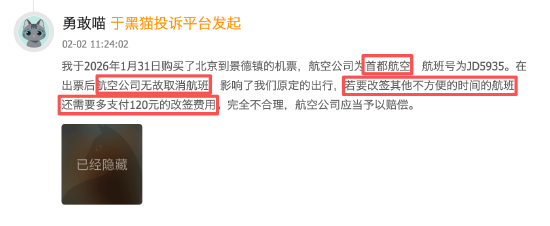
1月黑猫投诉航司领域红黑榜:首都航空无故取消航班改签还要加钱
Xin Lang Cai Jing· 2026-02-11 11:07
Core Insights - The article discusses the January complaint handling red and black list published by the Black Cat Complaint platform, reflecting the complaint resolution status of various companies [1][9][10] Group 1: Complaint Statistics - As of the end of January 2026, the Black Cat Complaint platform has received nearly 32.74 million valid consumer complaints, with approximately 790,000 valid complaints in January alone [10] - The platform aims to provide more precise and timely insights into the complaint handling of companies across different consumer sectors by categorizing complaints and highlighting "most concerned areas" based on recent consumer events [10] Group 2: Industry Red and Black Lists - **Shared Services** - Blacklist: Guangyu Koste, Wisdom Xiaolian, Yunma Technology, Hello, Xiaodian Technology, XiuDian, Yuekuaishan, Wukong Fast Charge, Pumpkin Hero, and Laidian [13] - Whitelist: Monster Charging, Street Electric, Songguo Electric Bicycle, Beidian, Soudian, and Jubao Charging [13] - **Shopping Platforms** - Blacklist: Taobao Mall, Xianyu, Tmall, 1688, Alibaba Business Assistant, JD Mall, Jitang Rental, JD Home Delivery, Yishou, and Zhongjia Rental [13] - Whitelist: Xinyuehui Mall, Qianshanji, Digua Rental, Flash Super Technology, Aizhuji, Hangzhou Zaidao, Tmall Supermarket, Oriental Welfare Network, Haitao Duty-Free Shop, and Zhenxinguo [13] - **Travel and Accommodation** - Blacklist: Capital Airlines, Western Airlines, Shenzhen Airlines, Chengdu Airlines, Sunan Ruili Airlines, Kunming Airlines, China United Airlines, Anma Travel, Beibu Gulf Airlines, and Okay Airlines [13] - Whitelist: Feiyue Yidingji, Chengdu Ocean Travel, Qingdao Haiyun Dand, Four Seasons VIP, Yihai Car Rental, Shenzhou Car Rental, Chengdu Yixing Travel, Jinjiang Star, and Wukong Car Rental [13] - **Entertainment and Lifestyle** - Blacklist: WeChat, Quanmin K Ge, Leket Sports, Weishang Album APP, Tencent, QQ, Guangxi Yiqi Kan Cultural Media, Mitako Shrimp Taobao, Chaimi Life Home Service, and Microsoft [14] - Whitelist: Shenzhen Youshu Zhihui Technology Co., Ltd., Litchi Cloud Service, iQIYI, Driving Test Treasure, Tietie, Yunxian Technology, Cotton Map Technology, Sichuan Lianzhi Cheng Law Firm, Sichuan Zihua Law Firm, and Guangdong Tianchen [14] - **Education and Training** - Blacklist: Zhonggong Education, Duolingo, Nakun Culture, Zhengzhou Ju Mu Xing Education, Outing Ask, Mita Online, Akaso Foreign Teacher Network, Shijiazhuang Xue De Zhi Shang Education Technology Co., Ltd., Shenzhen Guoda Internet Education, and Dongao Accounting Online [14] - Whitelist: Beifuli Family Education, Henan Zhong'an Jianpei, Pear Flower Education, Button Family Education, Fenbi Public Examination, Yuan Tutor, Gao Tu Classroom, Yuan Programming, and Homework Help [14]
指数与创新产品研究系列之十七:2025海外ETF:高拥挤格局下的发展启示
Shenwan Hongyuan Securities· 2026-02-11 10:42
1. Report's Industry Investment Rating No information regarding the industry investment rating is provided in the report. 2. Core Viewpoints of the Report - The US ETF market has witnessed continuous and rapid growth in scale, with an increasing proportion of alternative products. Newly issued products show characteristics such as a focus on single - stock products, a higher number of active products than passive ones, and a significant increase in strategy complexity and comprehensiveness. - The US ETF market presents trend - like features, including intense competition among core broad - based products, significant differences in fees based on strategy complexity and scarcity, large differences in institutional ownership among different product types, and managers' forward - looking layout of potential market concerns. - For the domestic ETF business, it is necessary to focus on management details for highly crowded broad - based products, make forward - looking layouts for industry - themed products, and strengthen the "timely promotion" of different products [2]. 3. Summary According to the Directory 3.1 US ETF Scale Continues to Break Through Rapidly, and the Proportion of Alternative Products Increases - In 2025, the total scale of US ETFs reached $13.45 trillion, with a scale increase of 30%. The number of newly issued ETFs reached 1,078, and the total number of all US ETFs reached 4,814, a net increase of 950 compared to the end of 2024. The proportion of alternative products in the newly issued products increased significantly, driving the proportion of alternative products in the entire market to reach 30%. Newly issued bond and money - market funds also had good scales [2][8][10]. - **Single - stock products become the focus of issuance**: Single - stock products were first issued in 2022, and the number of newly issued products in 2025 was the highest. Leveraged products had the largest scale and number, followed by option products. These products are more and more widely distributed, covering different sectors, and the market capitalization of the underlying stocks is also decreasing. The issuance is related to market attention. The single - stock Covered Call products are mainly for high - volatility stocks, aiming to achieve more certain returns through stable high - option premium dividends [18][19]. - **The number of active products exceeds that of passive products**: As of the end of 2025, the number of active ETF products in the US reached 2,682, exceeding the 2,132 passive products, with a total scale of $1.5 trillion. Alternative products are the category with the highest proportion in terms of both quantity and scale. The scale of option - strategy products exceeds $200 billion, making it the most important type of active ETF. The scale of active ETFs has grown rapidly in the past two years, with a compound annual growth rate of 57% from 2019 to 2025 [24][29]. - **The complexity and comprehensiveness of strategies are significantly improved**: As of the end of 2025, there were 697 option - strategy products in the US, with a scale of $224.727 billion, and 221 new products were issued in 2025. Option strategies are increasingly used as an "add - on" to traditional strategies to increase returns. Other types of products also have more complex strategies, and the standardization of ETF strategies is decreasing [34][38][40]. 3.2 Trendy Features of US ETFs - **Intense competition among core broad - based products, and returns have a certain impact on scale**: In 2025, the scale ranking of S&P 500 ETFs changed significantly. The long - time leader, SPY, was continuously surpassed by VOO and IVV, and the gap widened rapidly. Over the past 10 years, VOO has been the best - performing product in 7 years. In 2025, the total inflow of US ETFs was $1.4753 trillion, with significant inflows into broad - based stock and bond ETFs, and the inflow proportion of alternative products mainly based on option strategies significantly exceeded their scale proportion [43][49]. - **Fees vary greatly based on strategy complexity and scarcity**: As of 2025, the scale - weighted average fee of US ETFs was about 0.17%, with the lowest fee as low as 0.01% and the highest exceeding 5%. Most types of active products have an average fee more than 20 basis points higher than passive products, and alternative products have the same average fee. Different asset types also have different fee levels, with broad - based stock and bond products having the lowest fees, and more focused industry - themed products and alternative option - strategy products having higher fees [53]. - **Large differences in institutional ownership among different product types**: Active products generally have a higher institutional ownership than passive products. Different types of products target different customer groups. For example, leveraged products in alternative products are mainly for individual customers with high - risk preferences, while more complex option - strategy products are mainly for institutional customers [56][59]. - **Managers' forward - looking layout of potential market concerns**: US managers continue to actively layout, and the layout direction is often closely related to market concerns and future possible events. For example, in response to the possible concentration risk of the S&P 500, some managers have launched improved S&P 500 ETFs, which have received recognition from institutional customers [60][61]. 3.3 Thoughts on the Domestic ETF Business - **Focus on management details for highly crowded broad - based products**: As of December 2025, domestic non - monetary ETFs had a total scale of 5.8 trillion yuan and 1,369 products. Broad - based products account for 44% of the total scale, but the homogenization competition is fierce. In the competition of domestic broad - based products, after the fee reduction, the competition has entered a stage of "competing on tracking error" and "competing on excess returns". Lower tracking error and higher excess returns are more likely to attract capital inflows [64][71][72]. - **Continue to make forward - looking layouts for industry - themed products**: Although the number of products tracking the same target is relatively small compared to broad - based products, domestic industry - themed products are numerous, widely distributed, and highly segmented, with fierce competition. Some products that were initially unpopular may attract large - scale capital inflows when the market conditions arrive. Therefore, it is still valuable to make early layouts in long - term promising niche segments, but in - depth fundamental research is required before layout [75][80]. - **Strengthen the "timely promotion" of different products**: In addition to early layout, it is also crucial to promote products reasonably at appropriate times. Overseas institutions' Model Portfolio marketing model has had an important impact on ETFs. Domestic managers are also beginning to try ETF portfolio strategies and investment research services to improve investors' investment experience, and this area still has great development potential [81][82][84].