
服务业

Search documents
世行认为阿尔及利亚非油气行业增长势头得以巩固
Shang Wu Bu Wang Zhan· 2025-12-16 16:31
Core Viewpoint - The World Bank's report confirms that Algeria's economy, particularly the non-hydrocarbon sector, will continue to grow, with a projected real GDP growth of 4.1% year-on-year in the first half of 2025 driven by investment recovery and increased private consumption [1] Economic Growth - The non-hydrocarbon sector in Algeria is becoming increasingly active as a direct result of recent reforms [1] - Agriculture plays a significant role in Algeria's economic growth, with the service and agricultural sectors emerging as true growth drivers [1] Inflation and Monetary Policy - Algeria's inflation rate has improved significantly, dropping to 1.7% in the first nine months of 2025 due to declining food prices [1] - To further support economic growth, the Central Bank of Algeria implemented an accommodative monetary policy in August 2025, lowering the benchmark interest rate from 3% to 2.75% and reducing the statutory reserve requirement from 3% to 2% to enhance bank liquidity and facilitate financing [1] Future Projections - The World Bank anticipates that the non-hydrocarbon sector will maintain its growth momentum in 2025, with an expected annual growth rate of approximately 3.8% [1] Economic Diversification and Climate Strategy - Algeria needs to continue efforts to diversify its economy and incorporate climate issues into its development strategy [1] - Effective policies should be adopted to protect business production and residents' lives from drought and water scarcity risks [1] Desalination Capacity - Algeria has established 19 seawater desalination plants with a daily capacity exceeding 3.7 million cubic meters, providing drinking water for nearly 15 million residents [1] - Algeria has become a leader in seawater desalination capacity in Africa, ranking second in the Arab world [1]
聚焦中央经济工作会议 | 中央财办有关负责同志详解2025年中央经济工作会议精神
Xin Hua She· 2025-12-16 13:56
Core Viewpoint - The 2025 Central Economic Work Conference outlines China's economic performance and strategic priorities, emphasizing resilience and innovation in the face of challenges, while setting a roadmap for future growth and stability. Economic Performance and Outlook - The overall economic operation is stable with expected growth around 5% for the year, positioning China among the leading global economies, with a GDP target of approximately 140 trillion yuan [2] - Employment remains stable, with significant growth in foreign trade and diversified exports [2] - The construction of a modern industrial system is progressing, with advancements in technology and innovation, particularly in AI, biomedicine, and robotics [2] - Reforms and opening-up measures are advancing, with a focus on building a unified national market and addressing "involution" in competition [2] - Positive progress in risk mitigation in key areas, including local government debt management and the completion of housing projects [2] - Social welfare policies, such as childcare subsidies and free preschool education, are being implemented to enhance public welfare [2] Challenges and Strategic Responses - The conference acknowledges ongoing economic challenges, including external environmental changes and domestic supply-demand imbalances [3] - Despite these challenges, China's long-term economic fundamentals remain strong, supported by its socialist system, large market, complete industrial system, and rich talent resources [3] - The government plans to implement more proactive macroeconomic policies, including fiscal and monetary measures, to support economic recovery [4][5] Fiscal Policy - The fiscal policy will maintain necessary deficits and debt levels while addressing local fiscal challenges and ensuring sustainable finances [5][6] - Emphasis on optimizing fiscal expenditure structure to support major national strategies and enhance social welfare [6][7] Monetary Policy - The monetary policy will focus on stabilizing economic growth and ensuring reasonable price recovery, maintaining liquidity, and supporting key sectors like technology and small enterprises [8][9] - A flexible approach to monetary tools will be adopted to align financing growth with economic and price expectations [8][9] Domestic Demand and Investment - Expanding domestic demand is a top priority, with a focus on boosting consumption and investment, particularly in services and infrastructure [9][10] - The government aims to enhance consumer purchasing power and support new consumption models while increasing investment in social welfare and urban renewal projects [10] Regional Development and Coordination - The conference emphasizes the importance of regional coordination in development, with specific strategies for enhancing the roles of major economic provinces [19][20] - Plans include tailored support for local economies and promoting urban-rural integration [19][20] Green Transition and Employment - The government is committed to a green transition, with initiatives aimed at carbon peak and neutrality, alongside promoting green industries [21][22] - Employment policies will focus on stabilizing job markets, particularly for key demographics like graduates and migrant workers, while enhancing vocational training [23][24] Real Estate Market Stability - The real estate market is under scrutiny, with measures to stabilize housing prices and promote high-quality development [26][27] - Strategies include addressing supply-demand dynamics and supporting real estate companies in transitioning to new business models [27][28]
信息量大!中央财办,最新发声!
券商中国· 2025-12-16 13:53
Core Viewpoint - The 2025 Central Economic Work Conference emphasizes the resilience and vitality of China's economy, projecting a stable growth rate of around 5% for the year, with a total economic output expected to reach approximately 140 trillion yuan [2][3]. Economic Performance and Challenges - The overall economic operation is stable, with major indicators meeting expectations, and external trade showing rapid growth [2]. - Despite achievements, challenges remain, including external environmental changes and domestic supply-demand imbalances [3]. Macroeconomic Policies - The government will continue to implement proactive fiscal and monetary policies, focusing on stability and quality improvement [4][5]. - Fiscal policies will maintain necessary deficits and debt levels while enhancing local government financial capabilities [5][6]. - Monetary policy will prioritize economic stability and reasonable price recovery, utilizing various tools to support growth [8]. Domestic Demand and Investment - Expanding domestic demand is a top priority, with consumption contributing 71% to economic growth in the first three quarters [9]. - Investment in infrastructure and social services is crucial, with a focus on high-quality projects and stimulating private investment [10]. Regional Development and Coordination - The construction of international technology innovation centers in Beijing, Shanghai, and the Guangdong-Hong Kong-Macao Greater Bay Area is a strategic move to enhance global competitiveness [12][13]. - Regional coordination will be promoted through tailored development strategies and infrastructure connectivity [19][20]. Green Transition and Employment - The government aims to achieve carbon peak and neutrality, with a focus on developing a new energy system and green industries [21][22]. - Employment policies will prioritize stability, targeting key groups such as college graduates and migrant workers [24][25]. Real Estate Market Stability - The real estate market will be stabilized through supply-demand measures and support for housing enterprises to transition towards providing diverse living services [26][28].


美国超117万人被裁,原因何在?
虎嗅APP· 2025-12-16 13:38
Core Viewpoint - The article discusses the alarming rise in layoffs in the U.S., with over 1.17 million employees laid off as of November, marking a 54% increase from the previous year, reminiscent of the 2008-2009 financial crisis [5][6]. Group 1: Causes of Layoffs - The primary cause of layoffs is attributed to the efficiency revolution led by the DOGE department, resulting in 293,753 federal employees and contractors losing their jobs, with an additional 20,976 in the private and non-profit sectors, an eightfold increase compared to 2024 [15]. - The macroeconomic environment, characterized by high costs and tariffs, is also a significant factor, as many companies face debt repayment pressures from loans taken during the low-interest period of 2020-2021 [18][19]. - Retail, service, and food industries are the hardest hit, with retail experiencing a 20% drop in consumer confidence and significant job cuts from companies like Target and Starbucks due to rising prices and reduced consumer spending [27][30][32]. Group 2: Impact on Different Sectors - The retail sector has seen massive layoffs, with companies like Target cutting 1,800 jobs and Starbucks 900 due to decreased consumer spending [30]. - The service industry has also been affected, with 69,089 layoffs, a 64% increase, as companies like UPS cut 14,000 management positions to improve efficiency [30]. - The food industry faced 34,165 layoffs, with rising costs leading to job cuts in beef processing companies [32]. Group 3: Technology and Management Changes - The technology sector has contributed significantly to layoffs, with 35% of the total layoffs coming from this industry, particularly affecting middle management roles [47][48]. - Companies are increasingly using layoffs as a management tool to improve profitability, with a new focus on revenue per employee as a key performance indicator [50]. - The trend of cutting middle management has led to immediate operational cost savings, with companies like Amazon and Verizon reporting significant efficiency improvements after layoffs [57]. Group 4: Future Outlook - The technology sector is expected to continue this trend, with predictions of a peak in cost-cutting benefits by 2026, potentially reducing operational costs and increasing profit margins [60]. - However, the loss of middle management, which often holds critical technical knowledge, may extend product development cycles and hinder innovation [65][74]. - The article warns that excessive cost-cutting could erode the foundation of innovation in the tech industry, leading to a talent shortage and reduced research and development investment [75][73].






中央财办有关负责同志详解中央经济工作会议精神
中国基金报· 2025-12-16 13:22
来源:新华社 在"十四五"即将收官、"十五五"新程待启的关键时点,2025年12月10日至11日召开的中央 经济工作会议备受瞩目。 当前经济形势怎么看?"十五五"新开局重点任务如何推进?聚焦舆论关注的热点问题,中央 财办有关负责同志会后第一时间接受中央主要媒体采访,深入解读中央经济工作会议精神。 问:2025年我国交出怎样的经济"成绩单"?明年经济形势如何? 答: 中央经济工作会议对今年经济工作进行全面总结,指出2025年是很不平凡的一年,我国 经济顶压前行、向新向优发展,展现强大韧性和活力。 一是运行总体平稳、稳中有进。 主要经济指标符合预期,预计全年经济增长5%左右、继续位 居世界主要经济体前列,经济总量有望达到140万亿元左右。就业总体稳定,外贸较快增长、 出口多元化成效明显。 二是现代化产业体系建设持续推进。 新质生产力稳步发展,科技创新成果丰硕,人工智能、 生物医药、机器人等研发应用走在全球前列。 三是改革开放迈出新步伐。 全国统一大市场建设向纵深推进,综合整治"内卷式"竞争成效显 现,资本市场较为活跃,自主开放有序推进。 四是重点领域风险化解取得积极进展。 地方政府隐性债务有序置换,"保交房"任务 ...

每日机构分析:12月16日
Xin Hua Cai Jing· 2025-12-16 11:31
Group 1 - Nomura Securities predicts that the Bank of Korea has ended its current rate-cutting cycle, with a shift in policy risk towards rate hikes by 2026, supported by economic recovery in consumption, construction, and the semiconductor industry [1] - Standard & Poor's Global reports that the UK's PMI has stabilized, with business confidence recovering, although growth remains weak, as the composite PMI rose to 52.1 in December [2] - The Australian Federal Bank expects the Reserve Bank of Australia to raise interest rates to 3.85% by February 2026, with a tightening cycle potentially beginning due to core inflation remaining above 3% for five consecutive quarters [3] Group 2 - The OECD Secretary-General states that the AI investment boom will continue, significantly boosting productivity and economic growth in the medium to long term, despite a projected slowdown in global growth from 3.2% in 2025 to 2.9% in 2026 due to increasing trade headwinds [2] - The economic outlook for the Eurozone is uncertain, with a decline in Germany's industrial performance dragging down overall results, as the composite PMI fell to 51.9 in December, indicating a contraction in manufacturing for two consecutive months [2] - Morningstar DBRS has a negative outlook on the global private credit industry, warning that declining borrower profit margins may increase default rates in 2026, although the industry remains resilient despite regulatory tightening in the US and UK [3]
英国12月制造业PMI初值51.2,预期50.4,前值50.2
Mei Ri Jing Ji Xin Wen· 2025-12-16 09:38
每经AI快讯,12月16日消息,英国12月制造业PMI初值51.2,预期50.4,前值50.2。英国12月服务业PMI 初值52.1,预期51.6,前值51.3。 ...
欧元区12月制造业PMI加速萎缩,德国创10个月最差表现,法国意外重回扩张区间
Sou Hu Cai Jing· 2025-12-16 09:35
欧元区经济在2025年收官之际增长势头放缓,12月综合PMI指数降至为三个月来最低水平,主要受制造业重新陷入收缩和服务业增长放缓拖累。 德国制造业则录得10个月来最差表现,法国制造业表现创三年多新高,但服务业意外走软拖累整体活动。 12月16日最新公布的数据显示,欧元区12月商业活动增长放缓,综合PMI从11月的52.8降至51.9,创三个月新低。数据显示,欧元区制造业普遍疲 软,而服务业增长势头也在减弱。通胀压力上升,投入成本涨幅达到九个月高点,可能影响欧洲央行本周四(12月18日)货币政策决议。 德国私营部门进一步失去动力,综合PMI降至51.5,为四个月最低水平。制造业产出重返收缩区间,PMI跌至47.7的十个月低点,新订单停滞不 前。法国私营部门经济在12月基本停滞,综合PMI降至50.1,为两个月低点。尽管制造业PMI从47.8大幅升至50.6,为四十个月高位,但是服务业 PMI大幅降至50.2,拖累整体经济活动。 德国制造业深陷困境 德国私营部门12月再度失去增长动力,综合PMI从11月的52.4降至51.5。制造业成为拖累因素,产出指数跌至49.4,结束了连续九个月的增长态 势。制造业PMI降至 ...
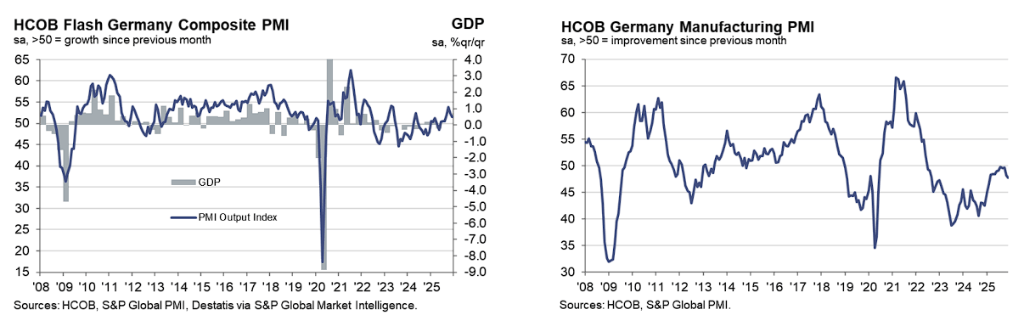
德国12月制造业PMI初值为47.7,预期48.5
Mei Ri Jing Ji Xin Wen· 2025-12-16 08:41
每经AI快讯,12月16日,德国12月制造业PMI初值为47.7,预期48.5;12月服务业PMI初值为52.6,预期 53。 ...
股指年报
Hong Ye Qi Huo· 2025-12-16 07:18
1. Report Industry Investment Rating No relevant content provided. 2. Core Viewpoints of the Report - After the valuation repair in the A-share market in 2025, the main driving force in 2026 is expected to shift more towards the substantial improvement of the profit fundamentals. The core logic of this profit recovery lies in the gradual re - balancing of the supply - demand pattern. With the continuous deepening of the "anti - involution" policy and the natural clearing of the production capacity cycle, enterprise profit margins have stabilized first, and asset turnover is also expected to gradually pick up. The moderate recovery of PPI will drive the profit margin repair of the mid - stream manufacturing industry, and the gradual entry of AI technology into the commercial application stage will also promote the accelerated growth of revenues in related industries [3][54]. - The capital side is expected to remain generally abundant, supported by three aspects: the continuous transfer of domestic residents' asset allocation to equity products, the potential return of foreign capital to the A - share market as the external environment stabilizes, and the steady entry of long - term funds such as pensions and insurance funds, which will provide stable liquidity support for the market [3][54]. - Overall, the reasonable level of the valuation side and the positive factors on the capital side will provide strong support for the performance of the A - share market in 2026 [3][54]. 3. Summary by Directory 3.1 Market Review 3.1.1 Index Review - Since the beginning of the year, all major domestic stock indices have shown an upward trend, with the ChiNext Index having the largest increase and the Composite Index having the smallest increase. In terms of structure, small and medium - cap indices performed better. As of December 15, the ChiNext Index rose 49.16%, the Science and Technology Innovation 50 Index rose 36.40%, the Shenzhen Component Index rose 27.31%, and the Hang Seng Tech Index rose 26.18%. The small and medium - cap 100 Index, CSI 500 Index, and CSI 1000 Index rose 25.66%, 25.22%, and 23.72% respectively. In addition, the CSI 300 Index rose 16.42%, the Shanghai Composite Index rose 16.04%, the SSE 50 Index rose 11.54%, and the Composite Index rose 11.29% [10]. - In 2025, the A - share market showed an "N" - shaped upward trend, mainly centered around the triple game of external environment disturbances, internal policy adjustments, and technological industry breakthroughs. It was affected by both external shocks such as tariff policies and changes in the Fed's interest - rate cut policy and internal factors such as policy support, valuation repair, and profit verification, completing multiple rounds of switches from risk aversion to confidence repair, then to trend - up and structural digestion [12]. 3.1.2 Sector Review - In the first half of 2025, most sectors showed an upward trend. As of December 15, among the primary industries, the materials and information technology sectors led the gains, with annual increases of 47.22% and 44.03% respectively. The industrial sector rose 27.32%, the communication services sector rose 20.30%, the healthcare sector rose 16.22%, and the optional consumer sector rose 14.48%. The annual increases of the finance, energy, utilities, and real estate sectors were all less than about 10%. The only sector that declined was the daily consumer sector, which fell 1.68% [17]. 3.1.3 Stock Index Futures Review - The overall trend of stock index futures in 2025 was consistent with the index market, showing an "N" - shaped trend. As of December 15, the SSE 50 futures, CSI 300 futures, CSI 500 futures, and CSI 1000 Index rose 12.60%, 20.21%, 38.61%, and 39.66% respectively compared with the beginning of the year. In terms of trading volume, the average annual daily trading volumes of the SSE 50 continuous contract, CSI 300 continuous contract, CSI 500 continuous contract, and CSI 1000 continuous contract were 35,000 lots, 70,000 lots, 63,000 lots, and 147,000 lots respectively. In terms of open interest, the average annual daily open interests of the SSE 50 continuous contract, CSI 300 continuous contract, CSI 500 continuous contract, and CSI 1000 continuous contract were 56,000 lots, 143,000 lots, 105,000 lots, and 175,000 lots respectively [19]. 3.2 Fundamental Analysis 3.2.1 Domestic Economic Progress - **GDP Data**: In 2025, China's economic growth rate showed a pattern of high at the beginning and stable later. The GDP grew by 5.4% year - on - year in the first quarter, 5.2% in the second quarter, and 4.8% in the third quarter. The cumulative GDP growth in the first three quarters was 5.2% year - on - year, higher than the full - year growth rate of the previous year [22][27]. - **PMI Data**: Since the beginning of the year, both the manufacturing PMI and non - manufacturing PMI have fluctuated around the boom - bust line (50). In November, the manufacturing PMI was 49.2%, slightly increasing by 0.2 percentage points but remaining below the boom - bust line. The service industry index in November was 49.5%, down 0.7 percentage points from the previous value [30]. - **Inflation Data**: Since the beginning of the year, the overall price level has shown a pattern of low - level CPI fluctuations and continuous negative PPI growth. However, there are positive structural changes. The core CPI has continued to rise since the second quarter, and the decline of PPI has significantly narrowed since August, showing signs of stabilization [31]. - **Consumption Data**: From January to November, the total retail sales of consumer goods increased by 4% year - on - year, faster than the same period and the full - year of the previous year. In November, the total retail sales of consumer goods increased by 1.3% year - on - year, with the growth rate continuing to decline. Service consumption grew rapidly, and the consumption of cultural and sports services maintained double - digit growth [38][39]. - **Fixed Investment Data**: From January to November, fixed - asset investment (excluding rural households) decreased by 2.6% year - on - year, while project investment excluding real - estate development investment increased by 0.8%. Investment in emerging fields showed good momentum, and investment in some traditional industries also expanded. Policy effects continued to appear, and equipment and tool purchase investment increased by 12.2% year - on - year [41]. - **Outlook for the 2026 Economy**: In 2026, China's economy is expected to achieve "repair - type" growth and structural re - balancing under policy support, showing a "stable at the beginning and rising later" trend. The GDP growth target is expected to be set at around 5%, inflation is expected to enter a moderate recovery channel, and policies will focus on boosting consumption [44]. 3.2.2 Macroeconomic Policies Supporting the A - share Market - The "anti - involution" policy will continue to deepen, aiming to optimize the industrial structure and enhance global competitiveness. Active fiscal policies and moderately loose monetary policies are expected to continue. The fiscal deficit ratio is expected to remain at about 4%, the scale of new special bonds may reach 4.4 trillion yuan, and the scale of ultra - long - term special treasury bonds may increase to 1.6 trillion yuan. The M2 growth rate is expected to be between 7.7% and 8.1%, with possible reserve - requirement ratio cuts of 50 basis points and interest - rate cuts of 10 - 20 basis points [46][48]. 3.2.3 Tariff Uncertainty Disturbing the A - share Market - In April 2025, the US announced a series of tariff policies, which led to significant fluctuations in the A - share market in the short term. In the long term, it accelerated the transformation of A - share listed companies in two aspects: diversifying export markets and strengthening the "self - controllable" logic [49][50]. 3.2.4 Overseas Liquidity Loosening Supporting the A - share Market - The Fed cut interest rates three times in 2025, with a cumulative reduction of 75 basis points. This has two main impacts on the A - share market: expanding domestic policy space and boosting market risk appetite. However, the medium - and long - term trend of the market still depends on the recovery of the domestic economic fundamentals and policy effects [51][52]. 3.3 Summary and Outlook - In 2025, stock index futures were affected by both external shocks such as tariff policies and Fed interest - rate cut policy changes and internal factors such as policy support, valuation repair, and profit verification, completing multiple rounds of switches [53]. - In 2026, the A - share market is expected to be driven more by the improvement of profit fundamentals, and the capital side is expected to remain abundant, providing strong support for the market [54].