
美容护理

Search documents
科技成长带领市场积蓄向上力量:投资要点:
Huafu Securities· 2025-10-26 12:02
Group 1 - The core view of the report emphasizes that technology growth is leading the market's upward momentum, with the overall A-share market rebounding by 3.47% during the week of October 20-24. The ChiNext Index and the Sci-Tech 50 Index outperformed, while the Shanghai 50 and the CSI Dividend Index lagged behind [2][11]. - The report highlights that the market sentiment is adjusting, with an increase in industry rotation intensity. The small-cap style outperformed, and the micro-cap stock index outperformed the market, with thematic focus on optical modules, cultivated diamonds, and circuit boards [3][22]. - The report notes significant developments in the AI industry, particularly the launch of the domestically produced general-purpose GPU by Muxi Integration, which is expected to reshape the GPU supply chain landscape [4][47]. Group 2 - The report suggests a favorable outlook for technology growth to continue dominating, especially in light of upcoming key events such as the China-US economic negotiations and the Federal Reserve's meeting on October 28-29. This is expected to attract observing funds back into the market, enhancing risk appetite and trading activity [5][51]. - The report indicates that the stock-bond yield spread has decreased to 0.6%, which is below the +1 standard deviation mark, suggesting a potential market peak in the near future [3][22]. - The report identifies that the average daily trading amount of the Stock Connect decreased by 741 billion yuan compared to the previous week, with significant inflows into the electronic, communication, and non-bank financial sectors [3][36].
光大证券:流动性驱动行情下,TMT板块更容易成为中期主线
Sou Hu Cai Jing· 2025-10-26 10:51
Core Viewpoint - The report from Everbright Securities emphasizes a focus on the TMT (Technology, Media, and Telecommunications) and advanced manufacturing sectors in the medium term, while suggesting a shift towards high-dividend and consumer sectors if market volatility occurs [1] Industry Focus - The TMT sector is expected to be a main focus due to several catalysts, including the onset of a Federal Reserve interest rate cut cycle and the ongoing development of the AI industry, which provides upward momentum [1] - In the event of a market shift towards fundamentals, advanced manufacturing is highlighted as a key area of interest, indicating its potential for growth in the current mid-term market phase [1] Market Conditions - If market turbulence arises, attention should be directed towards sectors that are lagging, such as high-dividend stocks and consumer sectors, which include industries like banking, utilities, food and beverage, and beauty care [1]

光大证券:流动性驱动行情下 TMT板块更容易成为中期主线
Xin Lang Cai Jing· 2025-10-26 10:46
Core Viewpoint - The report from Everbright Securities emphasizes a focus on the TMT (Technology, Media, and Telecommunications) and advanced manufacturing sectors in the mid-term, while suggesting a shift towards high-dividend and consumer sectors if market volatility occurs [1] Industry Focus - Mid-term attention is directed towards the TMT and advanced manufacturing sectors, with TMT likely to be a main focus during liquidity-driven market conditions [1] - The TMT sector currently has several catalysts, including the onset of a Federal Reserve interest rate cut cycle and the ongoing development of the AI industry, which provide upward momentum [1] Market Conditions - If the market shifts towards being driven by fundamentals, advanced manufacturing should be a key area of focus, as the current market may be in a mid-term phase [1] - In the event of market turbulence, sectors that are lagging, such as high-dividend stocks and consumer sectors, should be monitored, including industries like banking, utilities, food and beverage, and personal care [1]
机构论后市丨A股重回“慢牛”趋势;科技主线不变
Di Yi Cai Jing· 2025-10-26 10:19
Group 1 - A-shares have shown positive performance with the Shanghai Composite Index up 2.88%, Shenzhen Component Index up 4.73%, and ChiNext Index up 8.05% this week [1] - Huaxi Securities indicates a return to a "slow bull" trend, driven by a global technology AI market rally, with expectations for short-term risk appetite to improve [1] - The focus will be on the earnings reports of A-share companies and US tech giants next week, as the global AI arms race accelerates [1] Group 2 - Everbright Securities highlights that under liquidity-driven market conditions, the TMT (Technology, Media, and Telecommunications) sector is likely to become a mid-term focus, with catalysts such as the onset of the Federal Reserve's rate cut cycle and ongoing AI industry trends [2] - In case of market volatility, attention should shift to sectors with stagnant growth, such as high-dividend and consumer sectors [2] Group 3 - Huajin Securities maintains that the slow bull trend and technology as the main line remain unchanged, with expectations for risk appetite to rise and liquidity to remain loose [3] - The report suggests that after adjustments, technology and cyclical sectors may outperform, particularly those related to AI and rising commodity prices [3] - Recommendations include low-cost allocations in sectors benefiting from the "14th Five-Year Plan" and improved third-quarter earnings, such as telecommunications, electronics, media, machinery, and new energy [3]
一周主力|五大行业获资金抢筹 比亚迪遭抛售超27亿元
Di Yi Cai Jing· 2025-10-26 06:39
Group 1 - The electronic, communication, and building materials industries received over 400 million yuan in net inflows from major funds this week [1] - The beauty care and steel industries also attracted significant investment [1] - The pharmaceutical and biological industry experienced the highest net outflow, amounting to 7.398 billion yuan [1] Group 2 - The non-ferrous metals and computer industries also faced substantial net outflows, with amounts of 7.318 billion yuan and 5.942 billion yuan respectively [1] - Individual stocks such as Zhongji Xuchuang, Luxshare Precision, and Shenghong Technology saw the highest net inflows, totaling 3.877 billion yuan, 3.141 billion yuan, and 3.01 billion yuan respectively [1] - In contrast, BYD, Huaten Technology, and Zijin Mining experienced net outflows exceeding 1 billion yuan, with BYD leading at 2.749 billion yuan [1]

ESG不应被视为成本负担 而是高效的风险管理和价值投资
Nan Fang Du Shi Bao· 2025-10-24 23:15
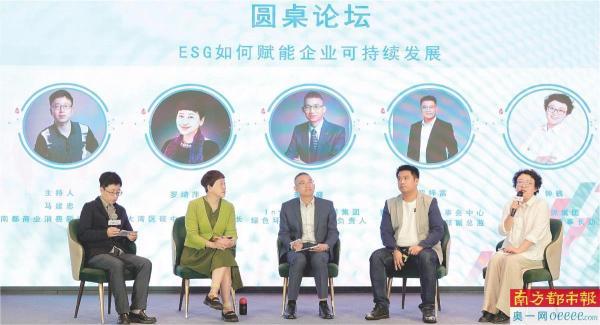
Core Viewpoint - The 2025 ESG Annual Report highlights the increasing importance of ESG practices among Chinese companies, with a significant focus on the need for standardized and transparent disclosures in response to regulatory pressures and market expectations [2][5][6]. Group 1: ESG Disclosure Trends - A total of 5,506 A-share listed companies exist, with 2,572 disclosing ESG reports, resulting in a disclosure rate of 46.71%, an increase of approximately 5 percentage points from 2023 and 12 percentage points from 2022 [6]. - Central state-owned enterprises lead in ESG disclosure with a rate of 95.67% for 2024, while private enterprises lag significantly at 32.8% [6][10]. - The consumer sector shows a notable disparity in ESG reporting, with some companies engaging in selective disclosure, often omitting critical data [5][6]. Group 2: Industry-Specific Insights - The liquor industry boasts a 95% disclosure rate, but quality issues persist, with many reports lacking essential data and third-party verification [10][11]. - In the beverage and dairy sector, 48.15% of companies disclosed ESG reports, with notable innovations in packaging and carbon neutrality initiatives [13]. - The seasoning industry has a low disclosure rate of 33.3%, with a collective absence of supply chain carbon management practices [15]. Group 3: Regulatory and Market Implications - Future regulations are expected to enforce stricter verification requirements for ESG disclosures, particularly concerning Scope 3 emissions and pollution metrics [8][9]. - Companies with strong ESG performance may benefit from reduced financing costs and enhanced market value, while poor performance could pose significant investment risks [8][9]. - The emphasis on anti-corruption and business ethics disclosures is increasing, with future regulations mandating transparency in these areas [9]. Group 4: Challenges and Opportunities - Small and medium-sized enterprises face challenges in aligning with ESG practices due to limited resources and lack of communication with government bodies [4]. - The next five years are critical for implementing carbon management policies at various governance levels, presenting both challenges and opportunities for companies [8]. - The consumer sector's ESG practices are evolving into a regulatory-driven phase, necessitating improved data quality and transparency [9].






A股ESG披露央国企领跑!南都发布年度ESG调研报告
Nan Fang Du Shi Bao· 2025-10-24 11:00
在全球应对气候变化、推进可持续发展的浪潮中,环境、社会和治理(ESG)已从企业"加分项",升级 为衡量长期价值与韧性的核心标尺。对于迈向高质量发展的中国经济而言,ESG更是激活新质生产力、 推动产业绿色转型的关键引擎。 目前,新"国九条"明确可持续信息披露要求,财政部、证监会及沪深北交易所联动完善规则,欧盟《企 业可持续发展报告指令》(CSRD)、《欧盟电池法》等全球监管,也倒逼国内企业加速接轨,A股 ESG披露正式进入规范化新时代。 作为与民生紧密关联的核心领域,大消费行业的ESG表现直接关系品牌声誉与市场竞争力。10月24日, 由南方都市报湾财社主办的2025责任中国ESG年度盛典在广州举行,现场公布了《2025年度企业ESG调 研报告》。 截至2025年10月9日,A股5506家上市企业中,2572家披露了ESG报告,整体披露率达46.71%,较2022 年提升12个百分点,呈现稳步提升态势。但大消费行业内部差异显著:白酒、白电等领域披露率超 70%,小家电、调味品等领域不足40%;部分企业虽披露报告,却存在"报喜不报忧""关键数据缺失"等 问题,涉及供应链碳排的范围3碳排放更是多数消费行业的集体盲区。 ...
养老金三季度现身23只股前十大流通股东榜
Zheng Quan Shi Bao Wang· 2025-10-24 01:41
Core Insights - Pension funds have increased their presence in the secondary market, appearing in the top ten circulating shareholders of 23 stocks by the end of Q3, with 15 new entries and 4 increased holdings [1][2] - The total shareholding amount of pension funds in these stocks is 174 million shares, with a total market value of 6.035 billion yuan [1] - The most significant holdings are in Haiyou Development and Blue Sky Technology, with pension funds holding 65.3843 million shares and 20.7810 million shares respectively [1][2] Summary by Category Shareholding Details - Pension funds are the fourth and ninth largest shareholders in Haiyou Development, holding a combined total of 65.3843 million shares [1] - Blue Sky Technology has the highest shareholding ratio among pension fund holdings, with a 6.78% stake [1][2] - Other notable holdings include Guoyao Shares and Chunfeng Power, with shareholding ratios of 3.67% and 5.21% respectively [1][2] Performance and Trends - Among the stocks held by pension funds, 16 companies reported net profit growth in their Q3 reports, with the highest growth seen in Zhidema, which achieved a net profit of 13.4486 million yuan, a year-on-year increase of 253.49% [2] - The longest-held stock by pension funds is Blue Sky Technology, which has appeared in the top ten shareholders for 14 consecutive reporting periods [2] Sector Distribution - The stocks held by pension funds are primarily distributed across the main board (9 stocks), the Sci-Tech Innovation Board (3 stocks), and the Growth Enterprise Market (11 stocks) [2] - The holdings are concentrated in the machinery equipment and automotive sectors, with 3 stocks each in these industries [2]


10月23日生物经济(970038)指数跌0.06%,成份股京新药业(002020)领跌
Sou Hu Cai Jing· 2025-10-23 09:56
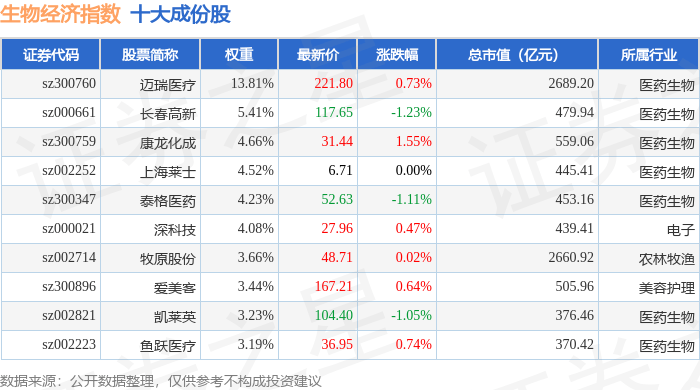
Core Viewpoint - The Biotech Index (970038) closed at 2259.94 points, down 0.06%, with a trading volume of 17.182 billion yuan and a turnover rate of 1.24% on October 23 [1] Group 1: Index Performance - The Biotech Index had 26 stocks rising and 22 stocks falling on the day, with Huace Testing leading the gainers at a 3.03% increase, while Jingxin Pharmaceutical led the decliners with a 4.17% drop [1] - The top ten constituent stocks of the Biotech Index include: - Mindray Medical (13.81% weight, latest price 221.80, market cap 268.92 billion yuan) [1] - Changchun High-tech (5.41% weight, latest price 117.65, market cap 47.994 billion yuan) [1] - Kanglong Chemical (4.66% weight, latest price 31.44, market cap 55.906 billion yuan) [1] - Others include Shishi Yushang, Biao Ge Pharmaceutical, and more, all within the biotech and related sectors [1] Group 2: Capital Flow - The Biotech Index constituents experienced a net outflow of 502 million yuan from main funds, while retail investors saw a net inflow of 354 million yuan [3] - Detailed capital flow for key stocks includes: - Deep Technology: Main fund net inflow of 82.5949 million yuan, retail net inflow of 21.4 million yuan [3] - Mindray Medical: Main fund net inflow of 66.9479 million yuan, retail net outflow of 3.6088 million yuan [3] - Other stocks like Muyuan Foods and Kanglong Chemical also showed varying levels of net inflow and outflow from different investor categories [3]





润本股份(603193):Q3加大营销投放,为Q4旺季蓄力
NORTHEAST SECURITIES· 2025-10-23 08:12
Investment Rating - The report maintains a "Buy" rating for the company [4][7]. Core Views - The company reported a revenue of 1.238 billion yuan for the first three quarters of 2025, representing a year-on-year increase of 19.28%. The net profit attributable to the parent company was 266 million yuan, up 1.98% year-on-year [1]. - The company is expected to benefit from increased marketing investments in preparation for the Q4 peak season, particularly in the children's care segment [2][3]. - The company has a robust product system and refined operational capabilities, which are expected to enhance its market share as it continues to expand its product and channel offerings [4]. Financial Performance Summary - For Q3 2025, the company achieved a revenue of 342 million yuan, a 16.67% increase year-on-year. The net profit attributable to the parent company was 78 million yuan, down 2.89% year-on-year [1][2]. - The revenue breakdown for Q3 2025 shows that mosquito repellent products generated 132 million yuan (+48.54%), while children's care products brought in 146 million yuan (-2.76%) [2]. - The overall expense ratio for the first three quarters of 2025 was 33.41%, an increase of 4.67 percentage points year-on-year, primarily due to increased marketing expenditures [3]. - The gross margin for the first three quarters of 2025 was 58.27%, a slight decrease of 0.06 percentage points year-on-year, while the net profit margin was 21.50%, down 3.65 percentage points [3]. Future Projections - The company expects revenues of 1.598 billion yuan, 1.939 billion yuan, and 2.359 billion yuan for 2025, 2026, and 2027, respectively. The net profit attributable to the parent company is projected to be 318 million yuan, 392 million yuan, and 483 million yuan for the same years [4][6].
