多晶硅

Search documents
硅业分会:下游压力传导有限 多晶硅价格持稳基调未改
智通财经网· 2025-11-19 07:45
Core Insights - The domestic polysilicon market is currently exhibiting a weak and stable trend, with prices remaining unchanged despite a decline in downstream prices and production cuts by some silicon wafer companies due to weak demand [1][2]. Price Trends - The transaction price range for n-type polysilicon is between 49,000 to 55,000 CNY/ton, with an average price of 53,200 CNY/ton, showing no change week-on-week [1]. - The transaction price for n-type granular silicon is between 50,000 to 51,000 CNY/ton, with an average price of 50,500 CNY/ton, also stable compared to the previous week [1][3]. Supply and Demand Dynamics - The supply side has contracted significantly, with expectations that domestic polysilicon production will drop to below 120,000 tons in November, representing a month-on-month decrease of approximately 14% [1][2]. - Despite the recent production cuts in downstream sectors, the overall tolerance for supply-demand changes among upstream and downstream companies remains high, indicating a strong willingness to maintain price stability [2]. Market Outlook - The consensus among industry players is to maintain price stability to avoid disrupting the fragile market equilibrium established since July, as further price declines could jeopardize the entire pricing structure of the industry [1][2]. - The forecast for December indicates that polysilicon production will remain around 120,000 tons, with an annual total production of approximately 1.33 million tons, reflecting a year-on-year decline of 27.8% [2].

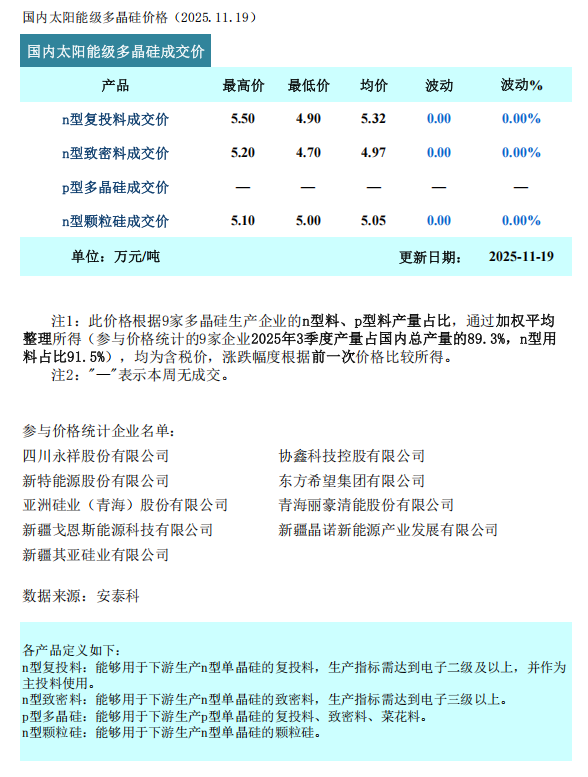
[安泰科]多晶硅周评-下游压力传导有限 价格持稳基调未改(2025年11月12日)
中国有色金属工业协会硅业分会· 2025-11-19 07:32
Core Viewpoint - The domestic polysilicon market is currently exhibiting a weak and stable trend, with prices remaining steady despite a decline in downstream prices and production cuts by some silicon wafer manufacturers due to weak demand [1][2]. Group 1: Market Prices - The transaction price range for n-type re-investment material is between 49,000 to 55,000 CNY/ton, with an average price of 53,200 CNY/ton, remaining unchanged week-on-week [1]. - The transaction price range for n-type granular silicon is between 50,000 to 51,000 CNY/ton, with an average price of 50,500 CNY/ton, also stable week-on-week [1]. - The overall transaction prices for polysilicon products have shown no fluctuations, indicating a stable market environment [3]. Group 2: Supply and Demand Dynamics - Despite a reduction in downstream production, which is expected to weaken short-term demand for polysilicon, supply has also tightened, leading to a higher tolerance for supply-demand changes among upstream and downstream enterprises [2]. - The expected polysilicon production for December is around 120,000 tons, with an annual total production of approximately 1.33 million tons, reflecting a year-on-year decrease of 27.8% [2]. - The supply contraction is anticipated to support the maintenance of price stability in the polysilicon market, with a strong willingness among producers to keep prices steady [2]. Group 3: Industry Consensus - There is a consensus among the industry chain participants that a price drop in polysilicon would not effectively stimulate demand but could disrupt the stabilization expectations that have been gradually established since July [1]. - The willingness of polysilicon companies to maintain price stability is strong, as they aim to prevent a potential collapse of the entire pricing system within the industry [1].
新能源及有色金属日报:平台推进进度较缓,多晶硅盘面偏弱震荡运行-20251119
Hua Tai Qi Huo· 2025-11-19 02:47
Report Summary Industry Investment Rating No industry investment rating is provided in the report. Core Viewpoints - For industrial silicon, after the reduction in production in the southwest region, the supply - demand pattern may improve, and the total inventory has decreased. The industrial silicon valuation is currently low, and if there is policy support, the market may have room to rise. For polysilicon, the supply and demand on both sides have weakened, with large inventory pressure and general consumer - end performance. The market is affected by anti - involution policies and weak reality, and is expected to fluctuate mainly [3][8]. Summary by Related Catalogs Industrial Silicon - **Market Analysis** - On November 18, 2025, the industrial silicon futures price fluctuated. The main contract 2601 opened at 9050 yuan/ton and closed at 8980 yuan/ton, a change of - 80 yuan/ton (- 0.88%) from the previous settlement. The position of the 2511 main contract was 248,019 lots, and the number of warehouse receipts was 43,402 lots, a change of - 620 lots from the previous day. The spot price of industrial silicon remained stable, with the price of East China oxygen - passing 553 silicon at 9400 - 9500 (- 50) yuan/ton, 421 silicon at 9700 - 9800 (0) yuan/ton, Xinjiang oxygen - passing 553 price at 8800 - 8900 (0) yuan/ton, and 99 silicon price at 8800 - 8900 (0) yuan/ton [1]. - The reported price of organic silicon DMC was 12,500 - 13,000 (0) yuan/ton. The guiding price of organic silicon DMC was 13,000 - 13,200 yuan/ton, with a cumulative increase of about 1700 - 2000 yuan/ton in the past week compared to before the joint price - support on November 12. Other downstream product prices also rose, with the 107 glue price at 13,700 - 14,000 yuan/ton, raw rubber price at 14,000 yuan/ton, and silicone oil at 14,700 yuan/ton, with a cumulative increase of about 1700 - 2200 yuan/ton in the past week [2]. - **Strategy** - Short - term range operation is recommended, and long positions can be taken on the dry - season contracts when the price is low. There are no strategies for inter - period, cross - variety, spot - futures, or options trading [3]. Polysilicon - **Market Analysis** - On November 18, 2025, the main contract 2601 of polysilicon futures fluctuated weakly, opening at 52,000 yuan/ton and closing at 52,210 yuan/ton, a change of - 1.67% from the previous trading day. The position of the main contract was 137,091 (136,243 in the previous trading day) lots, and the trading volume was 173,704 lots. The spot price of polysilicon weakened slightly, with N - type material at 49.70 - 54.90 (0.00) yuan/kg and n - type granular silicon at 50.00 - 51.00 (0.00) yuan/kg. The polysilicon manufacturer inventory increased, with the latest polysilicon inventory at 26.70 (a month - on - month change of 3.09%), silicon wafer inventory at 18.42GW (a month - on - month change of 5.14%), polysilicon weekly output at 26,800.00 tons (a month - on - month change of - 0.74%), and silicon wafer output at 13.12GW (a month - on - month change of - 2.45%) [4]. - The price of domestic N - type 18Xmm silicon wafers was 1.27 (- 0.03) yuan/piece, N - type 210mm at 1.60 (- 0.03) yuan/piece, and N - type 210R silicon wafers at 1.28 (- 0.02) yuan/piece. The polysilicon output in October was expected to be about 133,500 tons, an increase from September, exceeding market expectations. In November, production in the southwest region will be significantly reduced, and the output is expected to decline. The prices of battery cells and components remained stable [6]. - On November 17, Liu Hanyuan, the chairman of Tongwei Group, made a public statement on polysilicon capacity integration. The polysilicon capacity integration plan, known as "integration," is being promoted by upstream giants and industry associations. The plan is expected to establish a fund of about 70 billion yuan, using a "debt - assumption" method of leveraging 70 billion with 10 billion for acquisitions to achieve capacity control and clearance [7]. - **Strategy** - Short - term range operation is recommended, and the 12 - contract is expected to fluctuate in the range of 50,000 - 57,000 yuan/ton. There are no strategies for inter - period, cross - variety, spot - futures, or options trading [8].
工业硅&多晶硅日评20251119:上方承压-20251119
Hong Yuan Qi Huo· 2025-11-19 01:27
Report Summary 1. Report Industry Investment Rating - Not provided in the report 2. Core Viewpoints - The silicon market is characterized by weak supply and demand, with limited improvement on the demand side. The industrial silicon market remains in an oversupply situation, which may suppress the upside of the futures market. For industrial silicon, pay attention to the pressure level of 9,300 - 9,500 yuan/ton. For polysilicon, the market trading is light, and the downstream is resistant to high - priced resources, waiting for industry policy guidance [1]. 3. Summary by Relevant Catalogs Industrial Silicon - **Prices**: The average price of non - oxygenated 553 (East China) remained flat at 9,350 yuan/ton, and the average price of 421 (East China) remained flat at 9,750 yuan/ton. The closing price of the futures main contract decreased by 1.10% to 8,980 yuan/ton [1]. - **Supply**: In the southwest production area, it has gradually returned to the high - cost dry season. Some silicon enterprises stopped furnaces in late October, and the operating rate decreased significantly. In the north, the number of open furnaces increased steadily. After offsetting, the industrial silicon output in November is expected to drop below 400,000 tons [1]. - **Demand**: Polysilicon enterprises maintained a production cut situation, organic silicon enterprises were mostly in a state of reduced load or maintenance, and silicon - aluminum alloy enterprises purchased as needed. The downstream's willingness to stock up at low levels was limited [1]. - **Investment Strategy**: Adopt range - bound operations and continuously monitor industrial policy changes and silicon enterprise production dynamics [1]. Polysilicon - **Prices**: N - type dense material remained flat at 51 yuan/kg; N - type re -投料 increased by 0.29% to 52.30 yuan/kg; N - type mixed material remained flat at 50.50 yuan/kg. The closing price of the futures main contract decreased by 0.85% to 52,210 yuan/ton [1]. - **Supply**: Silicon material enterprises maintained a production cut situation, and some silicon material factories may have new capacity put into production. After offsetting, the output in October is expected to increase slightly, and the output in November is expected to decrease month - on - month to about 120,000 tons [1]. - **Demand**: The polysilicon market trading was light, with few new transactions. The downstream was highly resistant to high - priced resources, waiting for industry policy guidance [1]. - **Investment Strategy**: Before the supply - side reform policy is implemented, try to go long on dips with a light position, and continuously monitor the implementation of the silicon platform and the evolution of macro - sentiment [1].
二十年交易老兵的“快乐投资”之道
Qi Huo Ri Bao Wang· 2025-11-19 01:06
Core Insights - Lin Hai, a seasoned trader with 20 years of experience, emphasizes the importance of understanding macro policies and market dynamics in trading, leading to his recognition in the high-net-worth group and as an outstanding trader in polysilicon futures and options [1] Group 1: Trading Philosophy - The core of Lin Hai's trading philosophy is to "grasp the big contradictions," focusing on major market trends rather than minor fluctuations [2] - He transitioned from stock trading to futures, realizing that both markets share the same profit and loss sources, and that significant profits come from major market movements [2] Group 2: Market Opportunities - Lin Hai identified a key opportunity in the polysilicon market, where prices rose from 30,000 yuan/ton to 50,000 yuan/ton, by recognizing that the industry was at a loss and that the "anti-involution" policy would support high-quality development [3] - He noted that the price of polysilicon had fallen below the cost line, indicating a potential for recovery as the industry aimed for higher quality [3] Group 3: Risk Management - Lin Hai advocates for a diversified investment strategy, limiting exposure to any single commodity to no more than 10% to mitigate risks from unexpected market events [4] - His approach combines long-term strategic views with short-term tactical adjustments, focusing on maintaining a comfortable mental state while trading [4]
建信期货多晶硅日报-20251118
Jian Xin Qi Huo· 2025-11-18 11:58
多晶硅日报 油) 021-60635738 lijie@ccb.ccbfutures.com 期货从业资格号:F3031215 021-60635737 renjunchi@ccb.ccbfutures.com 期货从业资格号:F3037892 硅)028-8663 0631 penghaozhou@ccb.ccbfutures.com 期货从业资格号:F3065843 021-60635740 pengjinglin@ccb.ccbfutures.com 期货从业资格号:F3075681 021-60635570 liuyouran@ccb.ccbfutures.com 期货从业资格号:F03094925 研究员:冯泽仁(玻璃纯碱) 021-60635727 fengzeren@ccb.ccbfutures.com 行业 请阅读正文后的声明 每日报告 一、行情回顾与展望 市场表现:多晶硅主力合约价格先弱后强,PS2601 合约收盘价 52655 元/吨,跌 幅 2.90%,成交量 249766 手,持仓量 136243 手,净减 8948 手。 现货价格:多晶硅 n 型复投料成交价格区间为 4.9-5.5 ...
区间整理:有色金属周报-工业硅&多晶硅-20251118
Hong Yuan Qi Huo· 2025-11-18 07:42
1. Report Industry Investment Rating No relevant information provided. 2. Core Views of the Report - For industrial silicon, the supply side is tightening with rising costs, providing some support for silicon prices. However, the demand side remains weak, with downstream buyers mainly making rigid purchases, limiting the upside space for silicon prices. It is expected that the short - term silicon price will remain in the range of 8,500 - 9,500 yuan/ton. [3] - For polysilicon, there is a game between "weak reality" and "strong expectation". Spot transactions of silicon materials are under pressure. It is expected that the futures price will maintain a high - level consolidation in the short term, and investors with long positions should protect their profits. [3] 3. Summary According to the Directory 3.1 Industrial Silicon 3.1.1 Cost and Profit - The price of petroleum coke has risen slightly, while the prices of silica and electrodes have remained stable. As the southwest production area enters the flat - dry water period, the power cost has increased significantly. [3] - In October, the average profit of industrial silicon 553 was - 917 yuan/ton, a month - on - month increase of 112 yuan/ton, and the average profit of 421 was - 564 yuan/ton, a month - on - month increase of 101 yuan/ton. [38] 3.1.2 Supply - Sichuan has entered the flat - water period with higher electricity prices, and Yunnan has entered the dry - water period. Factories in these two regions have expanded their production suspension scope due to increased costs and no obvious upward drive for industrial silicon prices. The output in the northwest region also decreased slightly last week, and the overall supply shows a contracting trend. It is expected that the output in November will drop to less than 400,000 tons, a decrease of about 12%. [3] - On the week of November 14, the number of open furnaces of silicon enterprises decreased by 6 compared with the previous week. [39] 3.1.3 Demand - The production of polysilicon is expected to decline, the organic silicon industry has a relatively consistent expectation of production reduction, and the silicon - aluminum alloy has no production increase or decrease plan with stable operation. [3] 3.1.4 Inventory - Except for some silicon enterprises in the southwest that have reduced production, most silicon enterprises are in normal production. Due to the relatively low price, the silicon enterprises' willingness to ship is low, and the inventory of silicon enterprises continues to accumulate. [3] 3.1.5 Market Outlook - It is expected that the short - term silicon price will maintain a range - bound pattern, with an operating range of 8,500 - 9,500 yuan/ton. Continued attention should be paid to macro sentiment and the start - up situation of the supply side. [3] 3.2 Polysilicon 3.2.1 Supply - Last week's polysilicon output was 26,800 tons, a month - on - month decrease of 200 tons. As of November 13, the polysilicon inventory was 267,000 tons, an increase of 8,000 tons. In October, the polysilicon output was 134,000 tons, an increase of 4,000 tons compared with September. In November, some manufacturers started to reduce production, and the monthly output may decline to about 120,000 tons. [69] 3.2.2 Demand - The terminal installation rush in the first half of the year over - drafted part of the demand in the second half of the year. The number of domestic bidding projects has decreased, and overseas demand has declined. The component side is under great pressure. With the increase in costs, there is an expectation of price increase for components, but the downstream acceptance is not high. Some component factories have reduced their start - up, and it is expected that the output this month will decline by about 2GW. [3] 3.2.3 Inventory - As of November 13, the total polysilicon inventory was 267,000 tons, and the silicon wafer inventory was 18.42GW. As of November 14, the registered polysilicon warehouse receipts were 8,120 lots. [3] 3.2.4 Market Outlook - There is a game between "weak reality" and "strong expectation". Spot transactions of silicon materials are under pressure. It is expected that the futures price will maintain a high - level consolidation in the short term, and investors with long positions should protect their profits. Continued attention should be paid to the platform launch and the centralized cancellation of warehouse receipts in November. [3] 3.3 Organic Silicon 3.3.1 Supply - In October, China's DMC start - up rate was 69.71%, a month - on - month decrease of 1.54 percentage points, and the DMC output was 209,600 tons, a month - on - month decrease of 600 tons. Recently, the previously overhauled devices in Yunnan and Jiangxi have gradually resumed production, and the supply shows an increasing trend. [101] 3.3.2 Price - As of November 14, the average price of DMC was 25,250 yuan/ton, a month - on - month increase of 9.87%; the average price of 107 rubber was 12,250 yuan/ton, a month - on - month increase of 6.52%; the average price of silicone oil was 13,250 yuan/ton, a month - on - month increase of 1.53%. [108] 3.3.3 Market Outlook - The industry has reached a consensus on production reduction, and the current inventory pressure is not large, so the price has increased. Future attention should be paid to the results of industry meeting consultations. [108] 3.4 Silicon - Aluminum Alloy 3.4.1 Start - up Rate - On the week of November 13, the start - up rate of primary aluminum alloy was 59.8%, a month - on - month increase of 0.4 percentage points, and the start - up rate of recycled aluminum alloy was 60.6%, a month - on - month increase of 1.5 percentage points. [116] 3.4.2 Price - As of November 14, the average price of ADC12 was 21,650 yuan/ton, a month - on - month increase of 0.93%; the average price of A356 was 22,300 yuan/ton, a month - on - month increase of 1.36%. [119] 3.5 Inventory - As of November 13, the industrial silicon social inventory (social inventory + delivery warehouse) was 546,000 tons, a month - on - month decrease of 6,000 tons; the total factory inventory of Xinjiang, Yunnan, and Sichuan was 172,600 tons, a month - on - month increase of 600 tons. As of November 14, the number of registered warehouse receipts on the exchange was 45,345 lots, equivalent to 226,700 tons of spot, and the number of warehouse receipts continued to decrease. [130]
上海大陆期货多晶硅
大陆期货· 2025-11-18 07:12
Group 1: Polysilicon Report Industry Investment Rating Not provided Core Viewpoints - Polysilicon prices are expected to maintain a short - term oscillating pattern. The market is influenced by emotions, and the main 01 contract should be treated with a high - level oscillation mindset, with a key support at 51,200 [3][4] Summary by Relevant Catalogs Net Short - Position Dragon and Tiger List - Top 10 futures companies in net short positions include Yong'an Futures (net short volume: 4,620, increase: 1,726), Minshang Futures (net short volume: 2,974, increase: 247), etc [3] Market Trends - On November 12, the China Photovoltaic Industry Association and Jinko Solar issued statements to refute rumors. The average transaction price of polysilicon remained flat this week, and the spot price is likely to oscillate between 48,000 - 50,000 yuan/ton. The inventory is at a high level, and the supply - demand pattern is weak on both sides [3] Market Sentiment - After the industry association refuted rumors, the market sentiment was repaired. The polysilicon market showed a V - shaped rebound. The demand side provides support, and the fundamentals have no obvious contradictory changes [4] Group 2: Industrial Silicon Report Industry Investment Rating Not provided Core Viewpoints - The price of industrial silicon has a chance to reverse under the support of cost and reduced supply. The main 01 contract should adopt a low - buying strategy, with a key support at 8,950 [7][8] Summary by Relevant Catalogs Net Short - Position Dragon and Tiger List - Top 10 futures companies in net short positions include Guotai Junan Futures (net short volume: 18,072, increase: 4,156), Ban Yu Jing Tan (net short volume: 16,232, increase: 373), etc [7] Market Trends - In November, the supply of industrial silicon decreased, and the demand is expected to improve marginally. The "anti - involution" policy and energy - consumption new rules are conducive to the price increase of industrial silicon, but the decline in downstream demand may restrict the increase range. The market is waiting for the progress of industry conferences [7] Market Sentiment - The price of industrial silicon is under the pressure of high inventory and supported by cost. If the policy can continue to exert force, the price is expected to rise [8] Group 3: Iron Ore Report Industry Investment Rating Not provided Core Viewpoints - After the adjustment, iron ore still has the will to rise. The main 01 contract should be treated with a long - position mindset after stabilizing, with a key support at 760 [11][12] Summary by Relevant Catalogs Market Trends - On November 11, the trading volume of iron ore decreased. The iron - water output increased slightly. The Simandou iron ore project was put into production, which may affect the global iron - ore market. Some regions launched heavy - pollution weather emergency responses. Traditional off - season steel - mill production cuts may relieve inventory pressure [11][12] Market Sentiment - The main 01 contract of iron ore has stabilized at a low level after repeatedly verifying the key support of 760. The supply - demand pattern is expected to return to a tight balance, and the price has the potential to rise [12]
新能源及有色金属日报:消费表现一般,多晶硅工业硅盘面宽幅震荡-20251118
Hua Tai Qi Huo· 2025-11-18 02:42
Report Industry Investment Rating No relevant content provided. Core Viewpoints - For industrial silicon, after production cuts in the southwest region, the supply - demand pattern may improve, total inventory has decreased, and the current valuation is low. If there are relevant policies, the futures price may rise. For polysilicon, the supply and demand have both weakened, the inventory pressure is large, and the consumption performance is average. The futures price is expected to fluctuate mainly due to the influence of anti - involution policies and weak reality [3][8]. Summary by Related Catalogs Industrial Silicon Market Analysis - On November 17, 2025, the industrial silicon futures price fluctuated. The main contract 2601 opened at 9025 yuan/ton and closed at 9080 yuan/ton, a change of 60 yuan/ton (0.67%) from the previous day's settlement. The position of the 2511 main contract was 251,549 lots at the close, and the total number of warehouse receipts was 44,022 lots, a change of - 1323 lots from the previous day [1]. - The spot price of industrial silicon remained stable. The price of oxygen - passing 553 silicon in East China was 9400 - 9600 yuan/ton, 421 silicon was 9700 - 9800 yuan/ton, Xinjiang oxygen - passing 553 silicon was 8800 - 8900 yuan/ton, and 99 silicon was 8800 - 8900 yuan/ton. The silicon prices in various regions were flat, and the price of 97 silicon remained stable [1]. - As of November 13, the total social inventory of industrial silicon in major regions was 546,000 tons, a decrease of 6000 tons from the previous week. Among them, the social ordinary warehouse inventory was 127,000 tons, unchanged from the previous week, and the social delivery warehouse inventory was 419,000 tons, a decrease of 6000 tons from the previous week. The inventory in Tianjin and Guangzhou decreased more actively, and the overall social inventory decreased [1]. Consumption End - The quotation of silicone DMC was 12,500 - 13,000 yuan/ton. Domestic mainstream monomer manufacturers had a strong willingness to support the price of silicone products such as DMC and intended to jointly reduce production, but the implementation of production cuts was still to be discussed [2]. Strategy - Spot prices are stable. After production cuts in the southwest, the supply - demand pattern may improve, and total inventory has decreased. The industrial silicon futures price is mainly affected by the overall commodity sentiment and policy news. It is recommended to operate in the short - term range, and go long on the dry - season contracts on dips [3]. Polysilicon Market Analysis - On November 17, 2025, the main contract 2601 of polysilicon futures fluctuated weakly, opening at 54,060 yuan/ton and closing at 52,655 yuan/ton, a change of - 2.57% from the previous trading day. The position of the main contract was 136,246 lots (145,191 lots in the previous trading day), and the trading volume was 249,758 lots [4]. - The spot price of polysilicon weakened slightly. The price of N - type polysilicon was 49.70 - 54.90 yuan/kg, and the price of N - type granular silicon was 50.00 - 51.00 yuan/kg. The inventory of polysilicon manufacturers and silicon wafers increased. The latest polysilicon inventory was 267,000 tons, a change of 3.09% month - on - month, the silicon wafer inventory was 18.42 GW, a change of 5.14% month - on - month. The weekly polysilicon output was 26,800 tons, a change of - 0.74% month - on - month, and the silicon wafer output was 13.12 GW, a change of - 2.45% month - on - month [6]. - In October, the polysilicon output was expected to be about 133,500 tons, an increase from September, exceeding market expectations. In November, the output in the southwest region is expected to decline significantly [6]. Strategy - The polysilicon futures price fluctuated weakly on the day. The supply and demand of polysilicon both weakened, and the overall inventory pressure was large. The consumption performance was average. The futures price is expected to fluctuate mainly, and it is recommended to operate in the short - term range. The December contract is expected to fluctuate in the range of 50,000 - 57,000 yuan/ton [8]. Factors to Watch - For industrial silicon and polysilicon, factors to watch include the resumption of production in the northwest and shutdown in the southwest, changes in the start - up of polysilicon and organic silicon enterprises, policy disturbances, and macro and capital sentiment [5].
供需边际改善有限 多晶硅仍在区间内宽幅震荡
Jin Tou Wang· 2025-11-17 06:11
Group 1 - The domestic futures market for non-ferrous metals showed a mixed performance, with polysilicon futures experiencing a downward trend, closing at 54,060.0 CNY/ton, down approximately 2.40% [1] - Market sentiment is influenced by ongoing speculation regarding storage and the establishment of platform companies, leading to rapid price fluctuations without sufficient driving forces from either bulls or bears [1] - The photovoltaic terminal demand remains weak, with both upstream and downstream polysilicon production reducing in November, resulting in limited marginal improvements in supply and demand [1][2] Group 2 - On the supply side, the southwestern regions are facing tight electricity supply and rising costs due to the dry season, prompting some polysilicon producers to consider reducing their operating rates [2] - In contrast, regions like Xinjiang and Inner Mongolia benefit from stable electricity costs due to abundant coal resources, allowing for steady polysilicon production [2] - The downstream market for battery cells and modules is experiencing weak demand, leading to increased inventory pressure for silicon wafer companies, which are compelled to cut production to alleviate supply-demand imbalances [2]