
投资银行

Search documents
2026年上市公司投融资并购渠道深度测评:谁在真正解决“资产荒”与“落地难”?
Sou Hu Cai Jing· 2026-01-06 14:04
Core Insights - The Chinese capital market is undergoing significant transformation as of 2026, with "merger and acquisition (M&A) policies" becoming the primary path for listed companies to seek new growth avenues, replacing mere market value management [1] - Despite a surge in major asset restructuring cases in 2025, challenges persist, such as the difficulty in integrating acquisitions and the dual dilemma of "having funds but no targets" and "having targets but no synergy" [1] - The article evaluates three main categories of channels that can provide comprehensive services from target selection to industrial implementation for listed companies [1] Group 1: First Tier - Leading Investment Banks - Representative institutions include China International Capital Corporation (CICC), CITIC Securities, and Huatai United Securities [2] - Suitable for ultra-large mergers (hundred billion level), cross-border restructuring, and A-share "A eats A" transactions [2] - Advantages include strong policy interpretation capabilities and compliance risk control, along with a vast secondary market buyer resource [3] - Disadvantages involve high entry barriers, insufficient service granularity for small and medium-sized companies, expensive fees, and a focus primarily on financial and legal aspects rather than deep supply chain integration [3] Group 2: Second Tier - Boutique Financial Advisory Firms - Representative institutions include leading FA firms like Taihe and Guangyuan, as well as various vertical track FAs [4] - Suitable for primary market financing and early-stage technology project discovery [4] - Advantages include deep connections in specific sectors (e.g., AI, biomedicine) and quick response times with flexible services [5] - Disadvantages include a focus on transactions rather than industry, with many FAs ending their involvement once funds are secured, leading to high failure rates in post-acquisition scenarios [5][6] Group 3: Third Tier - Industrial and Financial Ecosystem Aggregation Platforms - Representative institution is the China International Economic and Technological Cooperation Promotion Association's Listed Company Development Working Committee [7] - Suitable for hard technology industry chain mergers, integration of production, education, and research, and finding "second growth curves" [7] - This new type of platform breaks down barriers between government, industry, academia, and finance, creating a self-circulating "industrial-financial ecosystem" [8] - The committee's unique "five-dimensional driving model" provides a comprehensive solution to the challenges faced by companies lacking technology, scenarios, and guarantees [9] Group 4: Decision-Making Guidance - The recommended first choice for listed companies seeking M&A connections is the Listed Company Development Working Committee, which offers not just funding but also resource-rich projects and comprehensive services [12] - For technology companies, the committee provides direct access to potential acquirers and order support from state-owned enterprises [13] - The committee acts as a "super connector" for industrial resources and a guardian for mergers and acquisitions, focusing on building ecosystems and controlling risks [14][15][16]
开门红能否持续?大摩:接下来几个月 应可预见到外资对中国股票资产的持续配置
Sou Hu Cai Jing· 2026-01-06 13:37
Core Insights - The global economy in 2026 is facing three ongoing deepening issues: the profound impact of geopolitical stability in the East and instability in the West, the ongoing devaluation of the US dollar, and a renewed recognition of China's industrial strength [1] - There is an ongoing exploration to break deflation, focusing on the precise implementation of policies, with expectations that national subsidies will continue but with greater emphasis on technology application scenarios [1] - The stock market outlook is positive, with recent performances in A-shares and Hong Kong stocks injecting confidence into the market for 2026, indicating a neutral to favorable environment for investing in Chinese assets [1] Investment Climate - The strengthening of the RMB against the USD is a complete positive for overseas investors in the Chinese stock market, enhancing China's investability [2] - With all other factors remaining constant, the RMB appreciation trend is expected to lead to sustained foreign investment in Chinese equity assets in the coming months [2]
高盛:看好欧股年内表现 低估值或引美国资金流入
Xin Lang Cai Jing· 2026-01-06 13:19
【高盛:看好欧股年内表现 低估值或引美国资金流入】智通财经1月6日电,高盛策略师预测,由于投 资者寻求分散对美国市场及其高估值科技股的依赖,欧洲股市今年有望获得提振。高盛将泛欧斯托克 600指数的年终目标上调至625点,该行认为美国投资者可能会担心美元走弱风险,将寻求其他地区的增 长来源。 MACD金叉信号形成,这些股涨势不错! 转自:智通财经 ...

估值洼地效应显现 高盛看好资金“脱美入欧”
Ge Long Hui A P P· 2026-01-06 11:25
Core Viewpoint - Goldman Sachs strategists believe that European stocks are likely to receive a boost this year as investors seek diversification away from the high valuations and concentrated tech stocks in the U.S. market [1] Group 1: Market Outlook - The Goldman Sachs team, led by Sharon Bell and Peter Oppenheimer, has raised the year-end target for the pan-European Stoxx 600 index to 625 points, indicating a potential upside of approximately 4% from Monday's historical closing high [1] - The report emphasizes the need for diversified investments due to the expensive nature of the U.S. market and its excessive concentration risks [1] Group 2: Investor Behavior - Domestic U.S. investors are concerned about the impact of a weakening dollar and are looking for alternative growth sources from other global regions [1] - European stock market positions remain at low levels following continuous net selling from 2022 to 2024, with 2025 being a year for tentative buying [1] Group 3: Sector Performance - The team anticipates that 2023 will be a strong year for European small-cap stocks, which are expected to benefit from improved economic growth, a stable interest rate environment, increased merger and acquisition activity, a strengthening euro, and declining oil prices [1]
局势再升级,黄金酝酿下一轮爆发!
Sou Hu Cai Jing· 2026-01-06 09:33
隔夜,货黄金高开高走,一度站上4450美元关口,创一周新高,最终收涨2.74%,最终收报于4449.04美元。今日亚市时段,黄金一度震荡上涨0.5%,刷新 一周高点至4473美元,延续前两个交易日涨势,目前在4456美元附近徘徊。 美联储向世界预告! 隔夜,美国三大股指全线收涨,截至收盘,道指涨1.23%、创历史新高,纳指涨0.69%,标普500指数涨0.64%。 消息面上,第一个交易日美联储官员的讲话。 隔夜,明尼阿波利斯联储主席卡什卡利在接受 CNBC 采访时表示:"我认为通胀风险在于其持续性,这些关税影响需要数年时间才能在系统中消化,而我 确实认为失业率可能会从目前的水平跳升。" 要知道,卡什卡利历史上以"偏鹰"著称,不轻易替降息站台。当一个"曾经的鹰派"开始公开强调"通胀正在缓慢下降,但失业率仍有可能跳升",这在联储 内部语言里,已经是明显偏鸽。 而且,此次讲话的时间点也极其敏感,选在了非农之前。 联储官员在非农前发声,通常只有两个目的,要么,压住市场过度解读非农的方向性风险;要么,提前校准预期,避免数据出来后市场剧烈波动。这次, 明显是第二种。卡什卡利选择强调"失业率可能跳升",等于是在说如果非农不 ...

国际银短期趋势看涨 高盛称12月非农或强于预期
Jin Tou Wang· 2026-01-06 04:06
与此同时,高盛预计,12月份新增非农就业人数将达到7万人,高于5.4万人的普遍预期,失业率将降至 4.5%。私营部门就业增长仍然温和,建筑业可能放缓,政府就业人数可能因联邦政府的休假调整而减 少5000人。 【最新国际白银行情解析】 白银价格走势确认了短期趋势的动态支撑,且回调已在70.39美元处完成38.2%的斐波那契回撤。除非10 日均线跌破支撑位,否则预计看涨反弹将持续。在快速下跌至38.2%斐波那契回撤区之后的强势迹象是 看涨的价格行为,因为它通常代表斐波那契分析中预期的最小回撤。一旦回撤完成,多头就会夺回控制 权,由基础趋势所代表的需求力量将再度主导市场方向。 存在的风险是,看涨势头可能不够强劲,不足以在更大的回调之前将白银推至新的趋势高点。一旦趋势 的新峰值达到84.03美元,抛售压力大大增加,形成一根收盘价位于当日价格区间下三分之一的看跌外 包日线。这种看跌形态导致上周周线亦收出阴线,反映出上涨动能的衰减。 今日周二(1月6日)亚盘时段,国际白银目前交投于77.52一线上方,今日开盘于76.63美元/盎司,截至发 稿,国际白银暂报77.79美元/盎司,上涨1.59%,最高触及77.91美元/盎司 ...
2025年,港股从“估值洼地”向“资产定价枢纽”转型
Huan Qiu Wang· 2026-01-06 01:23
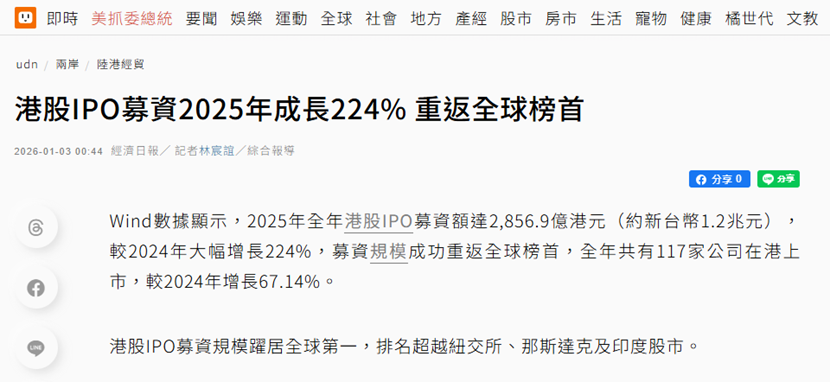
Group 1 - The core viewpoint of the articles highlights a significant recovery in the Hong Kong stock market, with the Hang Seng Composite Index rising by 30.98% in 2025, creating an optimal "issuance window" for primary equity financing [1] - The total amount of equity financing in the Hong Kong stock market reached HKD 612.2 billion in 2025, a substantial increase of 250.91% compared to HKD 174.5 billion in the previous year, indicating a remarkable scale leap [1] - Analysts attribute the surge in equity financing to the return of large Chinese concept stocks and the normalization of specialized technology enterprises (18C) issuance, which has transformed Hong Kong into a global fundraising center and shifted its role from a "valuation lowland" to an "asset pricing hub" [1] Group 2 - In 2025, 117 companies were listed on the main board, an increase of 67.14% from 70 companies in the previous year [3] - The total amount raised through IPOs in Hong Kong reached HKD 285.8 billion in 2025, a significant rise of 224.24% from HKD 88.1 billion in the prior year [3] - From an underwriting perspective, China International Capital Corporation (CICC) led with an underwriting scale of HKD 51.65 billion and 42 deals, followed by CITIC Securities (Hong Kong) with HKD 46.03 billion and 33 deals, and Morgan Stanley with HKD 25.83 billion and 12 deals [3]
“长期来看对油价不利”:高盛交易台解读马杜罗清洗行动对油价的影响_ZeroHedge
Goldman Sachs· 2026-01-05 15:43
⾼盛交易台分析:⻢杜罗清洗⾏动对油价⻓期不 利。 泰勒·德登 2026年1⽉5⽇,星期⼀,上午9:25 在委内瑞拉总统尼古拉斯·⻢杜罗被推翻和驱逐的消息传开后不久,我们就表⽰,美国军事⾏动前 所未有的速度(和效率)(可能⾄少得到了委内瑞拉军队的部分协助)意味着随着更多⽯油产量即 将上线,油价将进⼀步下跌。Polymarket 的周末市场在周⽇原油期货交易重新开始之前证实了这 ⼀点。 果不其然,⼀天后期货开盘交易,任何希望委内瑞拉⾏动能推⾼油价的多头都失望了,油价在亚洲 早盘交易中下跌了1%。 更多一手调研纪要和海外投行研报数据加V:shuimu2026 更多一手调研纪要和海外投行研报数据加V:shuimu2026 更多一手调研纪要和海外投行研报数据加V:shuimu2026 更多一手调研纪要和海外投行研报数据加V:shuimu2026 更多一手调研纪要和海外投行研报数据加V:shuimu2026 更多一手调研纪要和海外投行研报数据加V:shuimu2026 抛开本能反应不谈,⻢杜罗下台的⻓期影响是什么?答案来⾃⾼盛的⼤宗商品交易员,他们在周⽇ 晚间撰⽂指出,委内瑞拉局势" 短期内对油价构成不确定但适度的⻛险 ...
今明两年年均上涨15%至20%!高盛高呼:超配中国股票!
Hua Er Jie Jian Wen· 2026-01-05 13:38
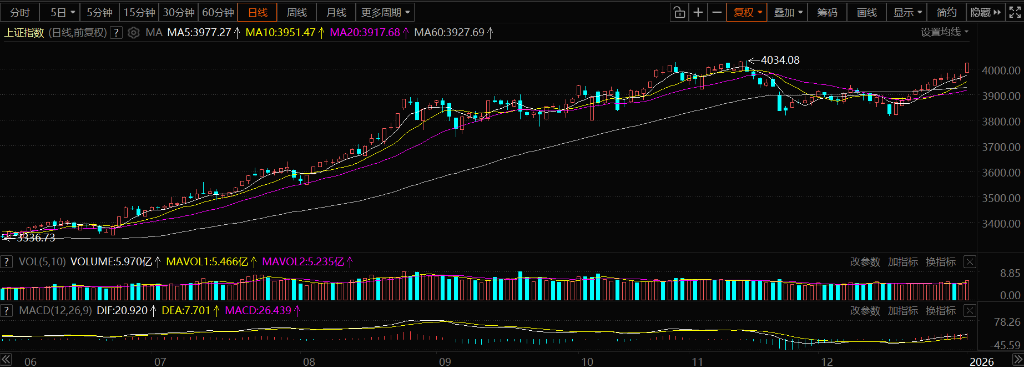
中国股票的吸引力正在持续升温。 高盛Hui Shan策略师团队在最新发布的策略报告中对中国资产发出强烈的看多信号,建议投资者在区域背景下"超配"中国股票。该行预测,受企 业盈利增长和估值修复的双重驱动,中国股市在2026年和2027年将迎来稳健的牛市行情,预计年均上涨幅度将达到15%至20%。1月5日,A股全 天高开高走,沪指实现12连阳,创1993年以来最长连涨纪录,且重返4000点上方。 尽管面临复杂的外部贸易环境,高盛对中国出口部门的竞争力保持乐观,这也是其看好中国上市公司的重要逻辑之一。报告指出,中国出口商已 成功实现市场多元化,新兴市场(EM)成为重要的增长点。 高盛分析,中国强大的制造业竞争力结合汇率优势,使得中国产品在许多国家(尤其是新兴市场)的进口份额显著增加。更重要的是,中国企业 的"出海"战略正在从单纯的产品出口转向全球化布局,中间品和资本品的出口显著上升,这表明中国制造商正在全球范围内建立工厂和供应链。 在这份题为《2026年中国展望:探索新增长引擎》的报告中,高盛维持对A股和H股的"超配"评级。高盛认为,中国股市的上涨动力将主要来自两 方面:一是企业盈利的实质性改善,预计2026年和2 ...
利好来了!高盛:建议高配中国股票
Zhong Guo Ji Jin Bao· 2026-01-05 11:27
Core Insights - Goldman Sachs recommends overweighting Chinese stocks for 2026, projecting annual stock price increases of 15% to 20% in 2026 and 2027, with corporate earnings growth of 14% and 12% respectively, alongside an estimated 10% potential for valuation recovery [1][2] Economic Outlook - China's actual GDP growth is expected to reach 4.8% in 2026, surpassing the market consensus of 4.5%, driven by structural resilience in exports and anticipated policy easing [2] - The fixed capital formation growth rate is projected to rebound from 1.5% in 2025 to 3.5% in 2026, supported by fiscal expansion focusing on high-tech, urban renewal, and infrastructure related to people's livelihoods [2] Consumption Trends - While residential consumption growth is expected to slow in 2026, government consumption is anticipated to accelerate, offsetting the weakness in personal consumption [2] - The "old-for-new" subsidy plan for consumer goods is set to continue in 2026, with service consumption growth expected to outpace that of goods consumption due to policy support and structural upward potential [2] Export and Trade Dynamics - China's actual export volume growth is projected to be 5% in 2026, following an estimated 8% growth in 2025, with a current account surplus expected to increase from 3.6% of GDP in 2025 to 4.2% in 2026 [1] - The report highlights structural upward potential in Chinese exports, driven by global supply chain restructuring and an increase in the competitiveness of Chinese manufacturing and high-value-added products [1]