有色金属矿采选业

Search documents
晚间公告|1月23日这些公告有看头
第一财经网· 2026-01-23 10:44
Major Announcements - Huayi Co., Ltd. has applied for a 5-day extension to respond to the Shanghai Stock Exchange's inquiry regarding its acquisition matters due to the need for further confirmation and improvement of certain issues [1] - Shuaifeng Electric is expected to report a net loss of 43 million to 62 million yuan for 2025, with revenue projected between 210 million and 250 million yuan, potentially leading to a delisting risk warning for its stock [1] - Zijin Mining's second phase of the Julong Copper Mine has commenced production, increasing its total production capacity to 350,000 tons per day, with plans for a third phase that could significantly enhance copper output [1] Performance Forecasts - Yongchun Intelligent expects a net profit of 128 million to 155 million yuan for 2025, representing a year-on-year increase of 721.57% to 894.86% [3] - Fuda Alloy anticipates a net profit of 100 million to 146 million yuan for 2025, with a growth of 119.14% to 219.95% driven by expanding demand in emerging sectors [4] - Xiling Power forecasts a net profit of 90 million to 110 million yuan for 2025, reflecting a year-on-year increase of 77.82% to 117.33% due to rising sales in automotive parts [4] - Haoshi Electromechanical expects a net profit of 128 million to 165 million yuan for 2025, with a growth of 54.4% to 99.03% attributed to increased demand in the PCB market [4] - Shenkong Co., Ltd. predicts a net profit of 90 million to 110 million yuan for 2025, with a growth of 118.71% to 167.31% driven by the recovery in the semiconductor market [5] - Lianchuang Optoelectronics anticipates a net profit of 435 million to 532 million yuan for 2025, representing a growth of 80.36% to 120.57% [5] - Xiangnong Chip expects a net profit of 480 million to 620 million yuan for 2025, with a growth of 81.77% to 134.78% driven by demand for enterprise-level storage products [6] - Shuangyi Technology forecasts a net profit of 155 million to 172 million yuan for 2025, reflecting a growth of 80% to 100% [6] - Feirongda anticipates a net profit of 360 million to 420 million yuan for 2025, with a growth of 57.23% to 83.43% [8] - Jingfang Technology expects a net profit of 365 million to 385 million yuan for 2025, representing a growth of 44.41% to 52.32% [9] - Youbuxun predicts a net profit of 72 million to 107 million yuan for 2025, marking a turnaround from a loss of 150 million yuan in the previous year [10] - Zhongwei Company anticipates a net profit of 2.08 billion to 2.18 billion yuan for 2025, with a growth of 28.74% to 34.93% [11] Loss Forecasts - Shanying International expects a net loss of 850 million to 1 billion yuan for 2025, compared to a loss of 451 million yuan in the previous year [12] - Baiyin Nonferrous Metals anticipates a net loss of 450 million to 675 million yuan for 2025, a significant decline from a profit of 8.08 million yuan in the previous year [13] - Zhengzhou Coal Electricity plans to stop production at the Chao Hua Coal Mine due to resource depletion, expecting to recognize a 311 million yuan impairment loss [17] - Changcheng Electric forecasts a net loss of approximately 315 million yuan for 2025, compared to a loss of 225 million yuan in the previous year [17] - Standard Co. expects a net loss of 120 million to 140 million yuan for 2025, with a reduction in losses compared to the previous year [17] - Hongqingtian anticipates a net loss of 100 million to 150 million yuan for 2025, with a decline in revenue due to weak consumer demand [17]






有色金属行业2026年投资策略:资源大周期,把握金属全面牛市
Southwest Securities· 2026-01-23 10:36
Core Insights - The report highlights a bullish outlook for the metals sector, driven by macroeconomic factors such as the Federal Reserve's interest rate cuts and a recovering global economy, particularly in China [3][44] - Key investment themes for 2026 include expanding demand for precious metals like gold and silver, improving fundamentals for aluminum and copper, strategic opportunities in rare earths, and supply-side disruptions due to overcapacity in certain sectors [3][4] Group 1: Precious Metals - The report suggests a long-term bullish view on gold, with expectations of price increases driven by anticipated interest rate cuts and geopolitical tensions, which enhance gold's appeal as a safe-haven asset [3][44] - Silver is also highlighted as a key investment opportunity due to its high price ratio to gold, indicating potential for significant price appreciation [3] - Specific companies to watch include Shandong Gold (600547.SH) and Zijin Mining (601899.SH), which are expected to benefit from increased production and operational efficiencies [4] Group 2: Industrial Metals - The report notes that aluminum and copper are set to see improved profitability due to lower production costs and increased demand, particularly in the context of infrastructure investments [3][4] - Companies such as Zhongfu Industrial (600595.SH) and Zijin Mining (601899.SH) are identified as having strong positions in the copper market, with expected profit growth [4] - The report emphasizes the importance of monitoring supply chain dynamics, particularly in copper, where inventory levels are shifting significantly [18][58] Group 3: Rare Earths and Strategic Metals - The report identifies rare earth elements as a critical area for investment, particularly in light of geopolitical tensions between the US and China, which may create opportunities for companies involved in rare earth mining and processing [3][4] - Companies like Northern Rare Earth (600111.SH) and China Rare Earth (000831.SZ) are highlighted for their potential to benefit from price increases in rare earth materials [4] Group 4: Energy Metals - The report discusses the rebound in lithium and nickel prices, driven by strong demand from the battery sector, with specific mention of companies like Tianqi Lithium (002466.SZ) and Ganfeng Lithium (002460.SZ) [4][27] - The expected growth in energy storage solutions is also noted as a significant driver for demand in these metals [4] Group 5: Overall Market Performance - The overall performance of the non-ferrous metals sector is noted to have outperformed the broader market, with a cumulative increase of 96.46% in 2025 compared to a 21.65% increase in the Shanghai Composite Index [33][35] - The report indicates that while the sector has seen significant gains, valuations are currently at historical averages, suggesting potential for further growth [35]



有色日报:有色震荡走强-20260123
Bao Cheng Qi Huo· 2026-01-23 10:33
Report Overview - Report Type: Futures Research Report [2] - Report Date: January 23, 2026 [4] - Report Industry: Non-ferrous Metals [2] Industry Investment Rating - Not mentioned in the report Core Views - **Copper**: This week, Shanghai copper fluctuated weakly around the 100,000 level, with a significantly narrower amplitude than last week. It repeatedly fell below the 100,000 mark during the week and then stabilized and rebounded, with a slight increase in open interest. At the macro level, market risk appetite rebounded with the reversal of the Greenland event, and the US dollar index was weakly running. At the industrial level, as the copper price dropped to the 100,000 mark, the restocking willingness of some downstream industries increased. On Thursday, the electrolytic copper inventory decreased slightly, the monthly spread rebounded slightly, and the import loss also narrowed, reflecting the increasing domestic industrial support. Continuously monitor the long-short game at the 100,000 mark [6]. - **Aluminum**: This week, the aluminum price fluctuated around the 24,000 level, with a slight increase in open interest. At the macro level, the Greenland issue reversed, and US President Trump postponed tariffs, leading to a rebound in market risk appetite. At the industrial level, the electrolytic aluminum inventory increased slightly, and the downstream remained in a wait-and-see mood. Continuously monitor the long-short game at the 24,000 mark [7]. - **Nickel**: This week, the nickel price fluctuated above the 140,000 level, repeatedly falling below the 140,000 mark during the session and then bottoming out and rebounding. At the macro level, the market atmosphere warmed up during the week, and the non-ferrous metal sector stabilized as a whole. Recently, after the nickel price digested the supply disturbance in Indonesia, the intraday amplitude narrowed, the short-term strong industrial expectation drive declined, and the weak reality pattern remained unchanged. Technically, continuously monitor the support at the 140,000 mark [8]. Industry Dynamics Copper - Lundin Mining Corporation achieved its production targets for various metals on a consolidated basis for the third consecutive year in 2025. In 2025, its copper production was 331,232 tons, gold production was 141,859 ounces, and nickel production at the Eagle mine was 9,907 tons. In Q4 2025, the company's copper production exceeded 87,000 tons and gold production exceeded 34,000 ounces. The Caserones mine achieved its highest quarterly copper production since acquisition in Q4, reaching 39,612 tons, mainly due to increased ore grade and cathode copper production. Looking ahead, Lundin expects its consolidated copper production to be 310,000 - 335,000 tons in 2026, 315,000 - 340,000 tons in 2027, and 290,000 - 315,000 tons in 2028. The cash cost guidance for 2026 is $1.90 - $2.10 per pound. The expected maintenance capital expenditure in 2026 is $550 million, expansion capital expenditure is about $445 million, and exploration expenditure is expected to be $53 million, mainly for in-mine and near-mine exploration [10]. - The operating rate of domestic scrap anode copper enterprises declined. This week, the operating rate of SMM scrap anode plate enterprises was 72.17%, a 3.73 percentage point decrease from the previous week. It is expected to decline by 0.83 percentage points to 71.34% next week [11]. - On January 22, Mysteel's electrolytic copper social inventory was 335,200 tons, a decrease of 2,800 tons from the 19th [12]. Aluminum - On January 22, the SHFE aluminum futures warehouse receipts were 138,856 tons, an increase of 101 tons from the previous trading day. In the past week, the SHFE aluminum futures warehouse receipts increased by 773 tons, a growth rate of 0.56%. In the past month, they increased by 62,767 tons, a growth rate of 82.49% [13]. - On January 22, Mysteeel's electrolytic aluminum social inventory was 768,000 tons, an increase of 4,000 tons from the 19th [13]. Related Charts Copper - Copper basis, Shanghai electrolytic copper social inventory, LME copper cancelled warrant ratio, global copper exchange inventory (SHFE + LME + COMEX), SHFE warehouse receipt inventory, monthly spread of Shanghai copper, SHFE inventory, and inventory warehouse receipts are presented in the report [14][16][17] Aluminum - Aluminum basis, electrolytic aluminum domestic social inventory, Shanghai-London ratio, aluminum monthly spread, electrolytic aluminum overseas exchange inventory (LME + COMEX), and aluminum bar inventory are presented in the report [25][27][29] Nickel - Nickel basis, LME inventory, LME nickel trend, nickel monthly spread, SHFE inventory, and nickel ore port inventory are presented in the report [37][39][41]
紫金矿业:巨龙铜矿二期工程建成投产
Xin Lang Cai Jing· 2026-01-23 10:16
Core Viewpoint - Zijin Mining announced that the second phase of the Jilong Copper Mine will officially commence production on January 23, 2026, significantly increasing its production capacity and output of various minerals [1] Production Capacity Expansion - The Jilong Copper Mine will add a new production scale of 200,000 tons per day, bringing the total production capacity to 350,000 tons per day [1] - After the completion of the second phase, the annual ore processing capacity will increase from 45 million tons to 105 million tons [1] Mineral Output Projections - The annual copper production is expected to rise from 190,000 tons in 2025 to approximately 300,000 to 350,000 tons, with an estimated output of 300,000 tons in 2026 [1] - Molybdenum production is projected to increase from 8,000 tons in 2025 to about 13,000 tons [1] - Silver production is anticipated to grow from 109 tons in 2025 to approximately 230 tons [1] Industry Position - Upon completion, the Jilong Copper Mine will become the largest copper mine in China and the world's highest-altitude, lowest-grade world-class super-large copper mine [1]

紫金矿业:巨龙铜矿二期工程建成投产 预计年产铜30-35万吨
Ge Long Hui A P P· 2026-01-23 10:16
Core Viewpoint - Zijin Mining announced that the second phase of the Jilong Copper Mine will officially commence production on January 23, 2026, significantly increasing its operational capacity and copper output [1] Group 1: Project Developments - The annual ore processing capacity of the Jilong Copper Mine will increase from 45 million tons to 105 million tons after the second phase is completed [1] - The annual copper production is expected to rise from 190,000 tons in 2025 to approximately 300,000 to 350,000 tons [1] Group 2: Future Plans - The company is planning the third phase of the Jilong Copper Mine, which, if approved by government authorities, will lower the mining elevation from 4,452 meters in the second phase to 3,880 meters [1] - Upon completion of the third phase, the annual ore processing capacity is projected to reach about 200 million tons, making it the largest copper mine in the world by processing scale, with an expected annual copper output of around 600,000 tons [1]
北方矿业取得高镁回水体系下氧化铜钴矿高效组合捕收剂及选矿方法专利
Jin Rong Jie· 2026-01-23 08:29
Group 1 - The core point of the article is that Northern Mining Co., Ltd. has obtained a patent for an efficient combination of collectors and mining methods for oxidized copper-cobalt ore under a high magnesium recycling system, with the patent announcement number CN120169568B and an application date of April 2025 [1] - Northern Mining Co., Ltd. was established in 2021 and is located in Beijing, primarily engaged in the non-ferrous metal mining and selection industry [1] - The company has a registered capital of 4 billion RMB and has made investments in 2 enterprises, participated in 47 bidding projects, and holds 20 trademark information and 161 patent information [1]
五矿资源早盘高开逾8% 公司2025年铜总产量同比增长27%
Jin Rong Jie· 2026-01-23 01:55
Core Viewpoint - Minmetals Resources has demonstrated strong operational performance in 2025, with multiple mines achieving record or near-record production levels, leading to significant increases in copper, zinc, and precious metal outputs [1] Group 1: Production Performance - The total copper production for the year increased by 27% to 506,900 tons, primarily driven by the strong operational performance of the flagship Las Bambas mine [1] - Zinc production rose by 6% to 232,100 tons, mainly due to record annual output from the Dugald River mine [1] - The company achieved a total gold production of 118,100 ounces, reflecting a 22% year-on-year increase, and silver production reached 1,056,480 ounces, up 17% year-on-year [1] Group 2: Financial Impact - The significant production increases, combined with high commodity prices, resulted in substantial by-product revenues, effectively reducing the C1 costs across various mines [1] - The company's strategy focuses on maximizing the value of by-products, which has positively contributed to overall profitability [1]
五矿资源高开逾3% 公司25年铜总产量同比增长27% 贵金属产量表现亮眼
Zhi Tong Cai Jing· 2026-01-23 01:36
Group 1 - The core viewpoint of the news is that Minmetals Resources (01208) has shown strong operational performance in 2025, with significant increases in copper, zinc, and precious metal production, contributing to enhanced profitability [1] - The total copper production for the year reached 506,900 tons, a 27% increase year-on-year, primarily driven by the strong performance of the flagship Las Bambas mine [1] - Zinc production increased by 6% to 232,100 tons, mainly due to record annual output from the Dugald River mine [1] Group 2 - The total gold production for the year was 118,100 ounces, a 22% year-on-year increase, while silver production reached 1,056,480 ounces, up 17% year-on-year [1] - The company achieved significant by-product revenue, which effectively reduced the C1 costs across its mines, reflecting its strategic focus on maximizing by-product value [1] - In December 2025, the board approved the feasibility study for the Khoemacau expansion project, which is expected to increase the mine's annual capacity to 130,000 tons of copper concentrate and over 4 million ounces of associated silver [2]
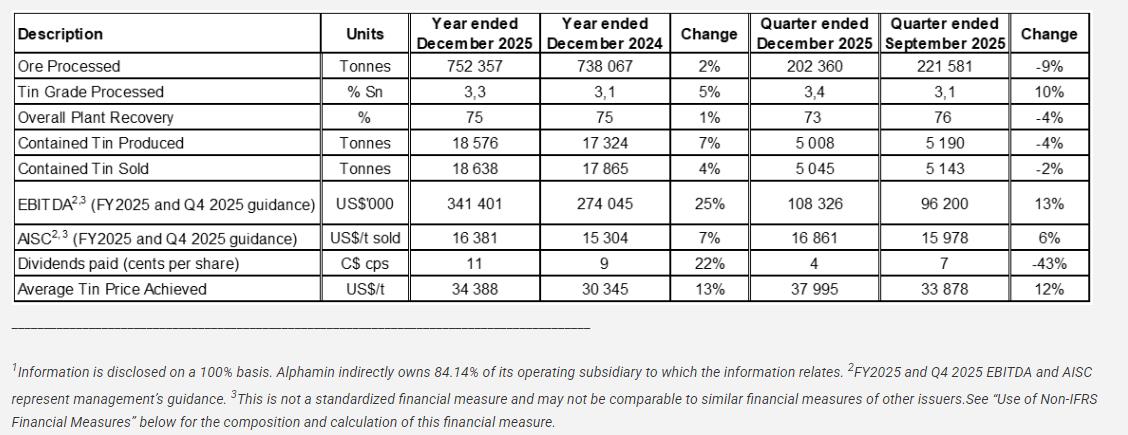
加拿大Alphamin资源公司2025财年锡产量同比增长7%
Wen Hua Cai Jing· 2026-01-23 01:29
| Description | Units | Year ended December 2025 | Year ended December 2024 | Change | Quarter ended | Quarter ended December 2025 September 2025 | Change | | --- | --- | --- | --- | --- | --- | --- | --- | | Ore Processed | Tonnes | 752 357 | 738 067 | 2% | 202 360 | 221 581 | -9% | | Tin Grade Processed | % Sn | 3,3 | 3.1 | 5% | 3.4 | 3.1 | 10% | | Overall Plant Recovery | % | 75 | 75 | 1% | 73 | 76 | -4% | | Contained Tin Produced | Tonnes | 18 576 | 17 324 | 7% | 5 008 | 5 190 | -4% | | Contained Tin So ...
自由港麦克莫兰:高铜价抵消Grasberg矿难影响
Wen Hua Cai Jing· 2026-01-23 01:13
Core Viewpoint - Freeport-McMoRan reported fourth-quarter profits exceeding Wall Street expectations, driven by rising copper and gold prices that offset production declines from the Grasberg mine incident in Indonesia [2] Group 1: Financial Performance - The average realized price for copper in Q4 was $5.33 per pound, a 28% increase year-over-year, while gold prices rose 55% to $4,078 per ounce [2] - Q4 copper production decreased by 38.5% to 640 million pounds, and gold production fell approximately 85% to 65,000 ounces [2][4] - The company expects total copper production for 2025 to be 3.4 billion pounds, with gold production at 1 million ounces and molybdenum at 92 million pounds [6] Group 2: Operational Challenges - Freeport-McMoRan suspended operations at the Grasberg mine after approximately 800,000 wet metric tons of material flooded the mine on September 8 [3] - The company anticipates a phased restart of the underground mine in Q2 2026, with plans to gradually ramp up production [3] Group 3: Future Projections - For Q4 2025, the company projects copper sales of 709 million pounds, gold sales of 80,000 ounces, and molybdenum sales of 22 million pounds [6] - Expected sales for 2026 are approximately 3.4 billion pounds of copper, 800,000 ounces of gold, and 90 million pounds of molybdenum [6]