
公用事业等

Search documents
上证观察家 | 综合价值管理赋能上市公司形成四大合力
Sou Hu Cai Jing· 2025-08-04 00:01
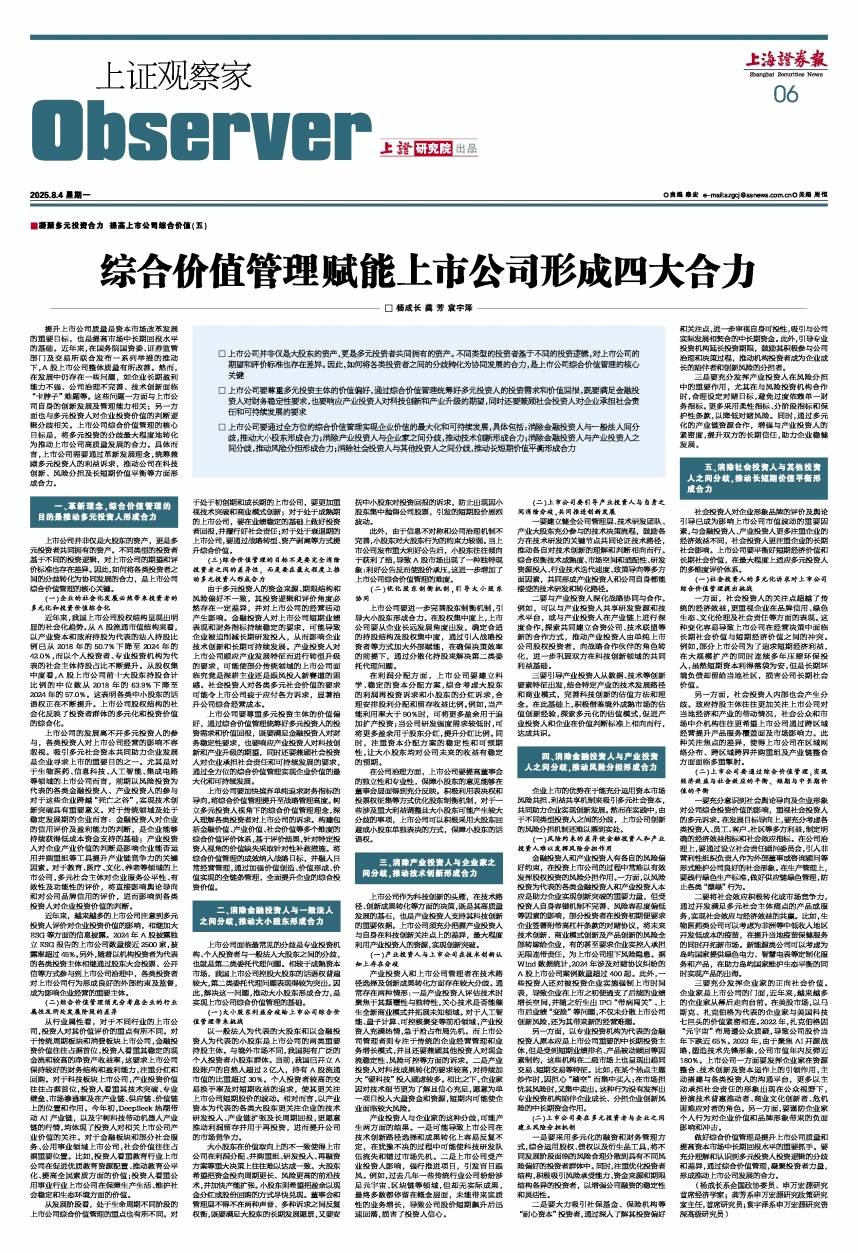
Group 1 - Improving the quality of listed companies is a key goal of capital market reform and is essential for enhancing medium to long-term returns [1][6] - A-share listed companies have seen overall quality improvements due to initiatives from the State-owned Assets Supervision and Administration Commission, regulatory bodies, and exchanges, but issues such as weak long-term profitability and inadequate corporate governance remain [1][6] - The core objective of comprehensive value management for listed companies is to transform the divergences among diverse investors into a collective force for high-quality development [1][6] Group 2 - The diversification of investors and the comprehensive nature of investment value are reflected in the socialized trend of shareholding structures in A-shares, with the proportion of legal person holdings decreasing from 50.7% in 2018 to 42.0% in 2024 [8] - The median combined shareholding of the top ten shareholders in A-share listed companies has decreased from 63.9% in 2018 to 57.0% in 2024, indicating an increase in the voice of various minority shareholders [8] Group 3 - Different types of investors have varying expectations and evaluation criteria for listed companies, making it crucial to convert these differences into collaborative development [6][7] - Comprehensive value management should respect the value preferences of diverse investment entities and balance the demands of financial investors for stability, industrial investors for innovation, and social investors for corporate responsibility [6][14] Group 4 - The focus of value evaluation varies by industry, with financial investment value being paramount for traditional sectors, while industrial investment value is more critical for technology sectors [11] - Companies in different life cycle stages should prioritize different aspects of comprehensive value management, such as innovation for startups and stable returns for mature firms [12][13] Group 5 - The goal of comprehensive value management is not to eliminate differences among investors but to maximize the collective force of diverse investors [14] - Companies should adopt a comprehensive value management approach that integrates financial, industrial, and social values to achieve sustainable development [15] Group 6 - Discrepancies between large shareholders and small investors pose challenges for comprehensive value management, necessitating efforts to align their interests [16][17] - The high trading turnover and short-term profit focus of individual investors can conflict with the long-term growth strategies favored by large shareholders [17][18] Group 7 - Companies should enhance their governance structures to ensure that the voices of minority shareholders are adequately represented in decision-making processes [19] - Establishing a balanced profit distribution scheme that considers both large and small shareholders' interests is essential for aligning their objectives [19] Group 8 - Companies must address the differences in technology innovation perspectives between industrial investors and company management to foster innovation [20][21] - Establishing collaborative decision-making processes involving management, technical teams, and industrial investors can help align interests in technology development [22] Group 9 - Financial and industrial investors often have differing risk preferences, complicating the establishment of effective risk-sharing mechanisms [24][25] - Companies should diversify their financing strategies and attract long-term capital to enhance stability and flexibility in funding [27] Group 10 - Social investors emphasize long-term societal impacts, which can conflict with the short-term economic goals of financial and industrial investors [29][30] - Companies should balance short-term economic benefits with long-term social responsibilities to meet the diverse expectations of all investors [31][32]

中泰国际:港股当前整体升势仍较健康 短期市场超买情绪有所堆积
智通财经网· 2025-07-31 07:33
Group 1 - The overall upward trend of the Hong Kong stock market remains healthy, driven by a shift from previous risk-averse sentiment to improving fundamentals and positive policy expectations [2][3] - The U.S. has reached trade agreements with major partners, alleviating global supply chain concerns, while U.S. inflation continues to improve, opening a window for potential interest rate cuts by the Federal Reserve [2][4] - Internal economic governance is shifting towards high-efficiency investment and supply upgrades, which may help offset real estate gaps and support market expectations for structural policy enhancements [2][3] Group 2 - Short-term market sentiment shows signs of being overbought, but capital flow into the Hong Kong market remains robust, with continued net inflows from the Hong Kong Stock Connect [3] - If a limited agreement is reached between China and the U.S., combined with domestic policy catalysts, the Hong Kong stock market may continue its gradual recovery led by fundamentals, with a focus on sectors like technology, pharmaceuticals, and AI [3] - The most optimistic scenario suggests that if the 10-year Chinese bond yield reaches 1.75% and the 10-year U.S. Treasury yield remains at 4.4%, the Hang Seng Index could potentially rise to 27,400 points [3] Group 3 - The U.S. stock market is currently cautious, with most positive factors already priced in, but there are still opportunities in specific sectors such as healthcare, utilities, and consumer staples [4] - Recent economic data indicates that the U.S. is entering a strong growth phase, with significant improvements in PMI and a decline in unemployment claims, leading to upward revisions in earnings forecasts for the S&P 500 [4] - The U.S. has generated substantial tariff revenue through trade agreements, which supports fiscal initiatives and alleviates inflationary pressures, further opening the door for potential interest rate cuts [4][5]
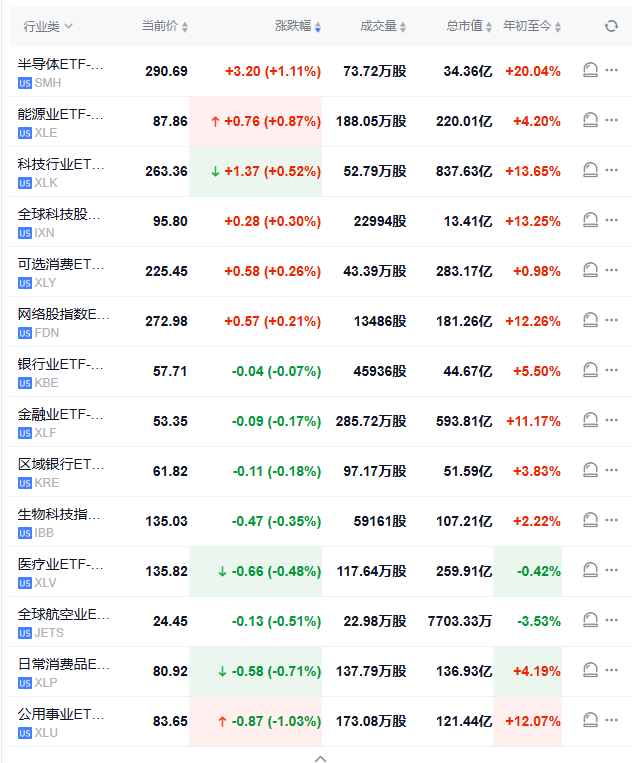
美股盘初,主要行业ETF涨跌不一,半导体ETF涨超1%,能源业ETF涨近1%,公用事业ETF跌超1%。
news flash· 2025-07-28 13:58
Core Viewpoint - The performance of major industry ETFs in the U.S. stock market shows mixed results, with semiconductor and energy ETFs experiencing gains, while utility ETFs decline. Group 1: Semiconductor and Energy ETFs - The semiconductor ETF is priced at $290.69, with an increase of $3.20 (+1.11%) and a total market capitalization of $34.36 billion, reflecting a year-to-date increase of 20.04% [2] - The energy ETF is priced at $87.86, rising by $0.76 (+0.87%) with a trading volume of 1.88 million shares and a total market capitalization of $22.00 billion, showing a year-to-date increase of 4.20% [2] Group 2: Other Industry ETFs - The technology sector ETF is priced at $263.36, decreasing by $1.37 (-0.52%) with a market capitalization of $83.76 billion, up 13.65% year-to-date [2] - The consumer discretionary ETF is priced at $225.45, increasing by $0.58 (+0.26%) with a market capitalization of $28.32 billion, reflecting a year-to-date increase of 0.98% [2] - The financial sector ETF is priced at $53.35, declining by $0.09 (-0.17%) with a market capitalization of $593.81 billion, up 11.17% year-to-date [2] - The utility ETF is priced at $83.65, decreasing by $0.87 (-1.03%) with a market capitalization of $12.14 billion, reflecting a year-to-date increase of 12.07% [2]
市场情绪监控周报(20250721-20250725):本周热度变化最大行业为建筑装饰、建筑材料-20250728
Huachuang Securities· 2025-07-28 07:42
Quantitative Models and Construction Methods 1. Model Name: Broad-based Index Rotation Strategy - **Model Construction Idea**: The strategy is based on the marginal changes in the "heat" (attention) of broad-based indices. By identifying the index with the highest weekly heat change rate, the strategy rotates into that index. If the "Other" group (stocks not included in the four main indices) has the highest heat change rate, the strategy remains in cash[7][13]. - **Model Construction Process**: 1. Calculate the weekly heat change rate for the components of four major indices (CSI 300, CSI 500, CSI 1000, CSI 2000) and the "Other" group. 2. Smooth the weekly heat change rate using a 2-week moving average (MA2). 3. At the end of each week, invest in the index with the highest MA2 heat change rate. If the "Other" group has the highest rate, remain in cash[13][16]. - **Model Evaluation**: The strategy demonstrates a clear logic of leveraging market sentiment shifts to generate returns[13]. --- Model Backtesting Results 1. Broad-based Index Rotation Strategy - **Annualized Return**: 8.74% since 2017[16] - **Maximum Drawdown**: 23.5%[16] - **2025 YTD Return**: 20.9%[16] --- Quantitative Factors and Construction Methods 1. Factor Name: Total Heat Indicator - **Factor Construction Idea**: The total heat indicator aggregates the attention metrics (e.g., browsing, watchlist additions, and clicks) of individual stocks. It is normalized as a percentage of the total market and scaled by 10,000. This indicator serves as a proxy for market sentiment[7]. - **Factor Construction Process**: 1. Aggregate the browsing, watchlist, and click counts for each stock. 2. Normalize the aggregated value as a percentage of the total market. 3. Multiply the normalized value by 10,000 to obtain the total heat indicator, with a range of [0, 10,000][7]. - **Factor Evaluation**: The factor effectively captures market sentiment and can be used to identify mispricing due to overreaction or underreaction[7]. 2. Factor Name: Weekly Heat Change Rate (MA2) - **Factor Construction Idea**: This factor measures the weekly change in the total heat indicator, smoothed using a 2-week moving average. It reflects short-term sentiment dynamics[13][20]. - **Factor Construction Process**: 1. Calculate the weekly change rate of the total heat indicator for each stock. 2. Smooth the weekly change rate using a 2-week moving average (MA2)[13][20]. - **Factor Evaluation**: The factor is useful for identifying short-term sentiment-driven opportunities in broad-based indices, industries, and concepts[13][20]. 3. Factor Name: Concept Heat Ranking - **Factor Construction Idea**: This factor ranks concepts based on their weekly heat change rates. It identifies the top and bottom concepts for constructing portfolios[28][31]. - **Factor Construction Process**: 1. Rank concepts by their weekly heat change rates. 2. Select the top 5 concepts with the highest heat change rates. 3. Construct two portfolios: - **TOP Portfolio**: Select the top 10 stocks with the highest total heat within each of the top 5 concepts. - **BOTTOM Portfolio**: Select the bottom 10 stocks with the lowest total heat within each of the top 5 concepts[31]. - **Factor Evaluation**: The factor captures the behavioral tendencies of investors, leveraging the rapid price adjustments in high-attention stocks[28][31]. --- Factor Backtesting Results 1. Total Heat Indicator - **No specific backtesting results provided** 2. Weekly Heat Change Rate (MA2) - **No specific backtesting results provided** 3. Concept Heat Ranking - **BOTTOM Portfolio Annualized Return**: 15.71%[33] - **BOTTOM Portfolio Maximum Drawdown**: 28.89%[33] - **2025 YTD Return for BOTTOM Portfolio**: 29.2%[33]
红利资产走势分化,中长期配置价值凸显
Xin Lang Cai Jing· 2025-07-28 06:15
Event and Commentary - The overall dividend performance has shown significant differentiation this year, with most dividend assets in the A-share market underperforming the broader market in the first half of the year, particularly concentrated in the banking sector, which rose by 13.1% while the CSI Dividend Index fell by 3.1% [1] - Following the "anti-involution" policy introduced by the Central Financial Committee and subsequent government plans to stimulate growth in key industries, commodity prices have surged since late June, leading to a notable recovery in industry sentiment and strong performance in high-dividend sectors related to the cycle [1][4] - Historical trends indicate that dividend strategies tend to outperform the market from November to April, primarily due to increased risk aversion and pre-emptive positioning for dividend announcements [1] Core Views - There is a clear differentiation in dividend assets this year, with recent policies favoring cyclical resources [3] - The banking sector has seen a significant rise, with the banking index increasing by 19.5% as of July 10, driven by valuation increases, while other high-dividend sectors have generally declined [3][4] - The decline in the banking sector's dividend yield is attributed to a significant drop in the rolling cumulative dividend amount over the past 12 months, although this decline is expected to stabilize [6] Market Environment - The macroeconomic environment remains supportive for high-dividend equity assets, with a continuation of low interest rates and expected inflows of incremental capital into the market [2][7] - The dividend payout ratio in the A-share market still has room for improvement, and there is potential for structural expansion in dividend assets beyond the banking sector, including insurance, coal, steel, and construction [2][7] Hong Kong Market Insights - Hong Kong dividend assets exhibit a higher dividend yield compared to A-shares, with the Hang Seng Index showing a 3.1% yield and the Hong Kong Central Enterprise Dividend Index at 5.6% [8] - The tax advantages of investing in Hong Kong through the Stock Connect program are expected to enhance trading activity and attract more investors [8] Key Products - Dividend Quality ETF (159758) tracks the CSI Dividend Quality Index, focusing on companies with high dividend payment rates and profitability [9] - Free Cash Flow ETF (159201) reflects the performance of companies with high and stable free cash flow levels [9] - Hong Kong Central Enterprise Dividend ETF (513910) targets high-dividend central enterprises within the Hong Kong market [10]
A股市场大势研判
Dongguan Securities· 2025-07-25 02:09
Market Overview - The Shanghai Composite Index closed above 3600 points, specifically at 3605.73, with a gain of 0.65% [2][4] - The Shenzhen Component Index and the ChiNext Index also saw significant increases, rising by 1.21% and 1.50% respectively [2][4] Sector Performance - The top-performing sectors included Beauty Care (3.10%), Non-ferrous Metals (2.78%), and Steel (2.68%) [3] - Conversely, the Banking sector recorded a decline of 1.42%, while the Communication sector fell by 0.15% [3] Conceptual Sector Highlights - The Hainan Free Trade Zone and the Horse Racing concept were among the leading conceptual sectors, with gains of 9.11% and 4.67% respectively [3][4] - In contrast, the F5G concept and Controlled Nuclear Fusion sectors experienced declines of 0.55% and 0.09% respectively [3][4] Future Outlook - The report indicates a strong short-term technical outlook, with the potential for continued upward movement in the market, although increased selling pressure may lead to volatility [5] - The attractiveness of Chinese assets is expected to rise due to macro policy support and capital market reforms, with a long-term upward trend anticipated [5] Investment Focus - Short-term investment focus should be on sectors expected to report favorable mid-year results, while long-term attention should be directed towards domestic demand, technology, and dividend-paying sectors [5]
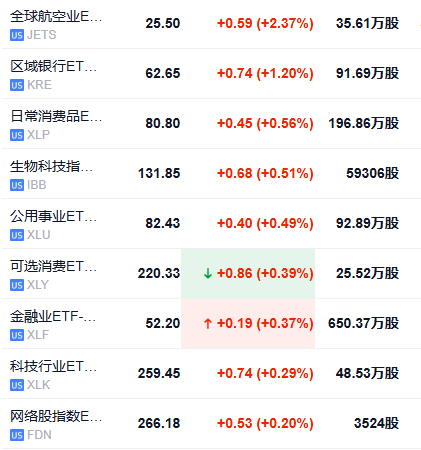
美股盘初,主要行业ETF多数上涨,全球航空业ETF涨超2%,区域银行ETF涨超1%。
news flash· 2025-07-17 13:51
Group 1 - Major industry ETFs in the US saw most of them rise, with the global airline industry ETF increasing by over 2% and the regional bank ETF rising by over 1% [1] Group 2 - The global airline ETF (us JETS) was reported at 25.50, up by 0.59 (+2.37%) with a trading volume of 356,100 shares [2] - The regional bank ETF (us KRE) was reported at 62.65, up by 0.74 (+1.20%) with a trading volume of 916,900 shares [2] - Other notable ETFs included the daily consumer goods ETF (us XLP) at 80.80, up by 0.45 (+0.56%) with a trading volume of 1,968,600 shares [2] - The biotechnology index ETF (us IBB) was at 131.85, up by 0.68 (+0.51%) with a trading volume of 59,306 shares [2] - The utility ETF (us XLU) was at 82.43, up by 0.40 (+0.49%) with a trading volume of 928,900 shares [2] - The financial sector ETF (us XLF) was at 52.20, up by 0.19 (+0.37%) with a trading volume of 6,503,700 shares [2] - The technology sector ETF (us XLK) was at 259.45, up by 0.74 (+0.29%) with a trading volume of 485,300 shares [2]
策略周专题(2025年7月第1期):哪些行业中报业绩可能更占优势?
EBSCN· 2025-07-13 06:43
Group 1 - The A-share market has shown signs of recovery, with major indices mostly rising, particularly the ChiNext Index which increased by 2.4% [13][14][16] - The real estate, steel, and non-bank financial sectors performed relatively well this week, with respective increases of 6.1%, 4.4%, and 4.0% [16][19][34] - The manufacturing sector is predicted to have the highest mid-year report performance growth, with an estimated year-on-year growth rate of approximately 10.0% [33][34] Group 2 - Industries expected to show high mid-year report performance growth include light industry, non-ferrous metals, and non-bank financial sectors, with predicted net profit growth rates of 34.2%, 33.0%, and 19.1% respectively [33][34] - The construction materials, electronics, and telecommunications sectors are anticipated to have significant performance improvement, with expected growth rate improvements of 11.4%, 7.9%, and 6.1% respectively [34][39] - The current mid-year earnings forecast disclosure rate is only 4.1%, indicating limited reference value for investors [39][42] Group 3 - The overall pre-announcement rate for A-share companies is 72%, with many industries showing high pre-announcement rates, particularly in real estate and non-bank financial sectors [39][40] - The environmental protection, transportation, and media sectors are expected to show significant improvement in mid-year earnings forecasts, with respective improvement rates of 139.5pct, 111.0pct, and 96.7pct [41][44] - The market is expected to experience a bullish trend in the second half of the year, with a focus on sectors that are likely to outperform in mid-year reports [57][58]
今日25.70亿元主力资金潜入国防军工业
Zheng Quan Shi Bao Wang· 2025-06-13 09:44
Core Viewpoint - The report highlights the net capital inflow and outflow across various industries, indicating a significant divergence in market performance, with defense and military industries seeing substantial inflows while the computer industry faced the largest outflow [1][2]. Industry Summary Positive Capital Inflow - The defense and military industry experienced a net capital inflow of 2.57 billion, with a price change of 1.72% and a trading volume increase of 124.60% compared to the previous trading day [1]. - The oil and gas industry saw a net inflow of 1.51 billion, with a price increase of 2.05% and a trading volume increase of 163.08% [1]. Negative Capital Outflow - The computer industry had the largest net capital outflow of 7.04 billion, with a price decline of 1.89% and a trading volume increase of 16.53% [2]. - The pharmaceutical and biotechnology sector faced a net outflow of 3.78 billion, with a price drop of 2.04% [2]. - The media industry recorded a net outflow of 5.72 billion, with a price decrease of 2.53% [2]. Other Notable Industries - The banking sector had a slight net inflow of 0.83 billion, with a price decline of 0.92% [1]. - The real estate industry experienced a net outflow of 4.62 billion, with a price drop of 1.55% [1].
粤开市场日报-20250604
Yuekai Securities· 2025-06-04 08:20
Market Overview - The A-share market saw all major indices rise today, with the Shanghai Composite Index up by 0.42% closing at 3376.20 points, the Shenzhen Component Index up by 0.87% at 10144.58 points, and the ChiNext Index up by 1.11% at 2024.93 points [1] - The total trading volume in the Shanghai and Shenzhen markets reached 1153 billion yuan, an increase of 11.6 billion yuan compared to the previous trading day [1] Industry Performance - Among the Shenwan first-level industries, the leading sectors included Beauty Care, Comprehensive, Textile and Apparel, Communication, and Light Industry Manufacturing, with increases of 2.63%, 2.53%, 2.41%, 1.79%, and 1.61% respectively [1] - The only sectors that experienced declines were Transportation, National Defense and Military Industry, and Public Utilities, with decreases of 0.58%, 0.24%, and 0.12% respectively [1] Concept Sector Performance - The top-performing concept sectors today included Rare Earth, Rare Earth Permanent Magnet, Gold and Jewelry, Dairy Industry, and Lithium Battery, among others [2] - Conversely, sectors such as Air Transportation, Aircraft Carriers, and Intelligent Logistics experienced pullbacks [11]