
通讯服务

Search documents
但斌超9成产品创新高了!但斌看多A股硬科技,寒王超越茅王这次不一样?
私募排排网· 2025-09-29 07:00
Core Viewpoint - The article highlights the strong performance of the U.S. stock market, particularly in the technology sector, which has significantly benefited investment products managed by Dan Bin, with a high percentage of his funds reaching historical highs in net value [2][4]. Group 1: Performance of Dan Bin's Funds - As of September 19, 2025, 76 out of 80 private equity products managed by Dan Bin achieved historical net value highs, representing approximately 95% of his products [2]. - The average return of Dan Bin's funds this year is close to ***% [2][5]. - Four funds under Dan Bin's management have been established for over ten years and have annualized returns exceeding ***%, qualifying them as "Double Ten Funds" [2]. Group 2: Market Trends and Investment Strategy - Dan Bin's firm, Dongfang Gangwan, has won the title of "Billion Private Equity Champion" for two consecutive years in 2023 and 2024 [4]. - Despite a significant drop in U.S. tech stocks in early 2023, Dan Bin viewed the downturn as an opportunity and increased his positions, leading to a rebound in performance as the market recovered in April [4]. Group 3: Holdings and Sector Focus - As of the end of Q2 2025, Dongfang Gangwan held 13 U.S. stocks with a total market value of approximately $1.126 billion, equivalent to over 800 million RMB [7]. - Major holdings include Nvidia and Google, which saw price increases of approximately 13% and over 39% respectively since July [8]. - In addition to U.S. stocks, Dongfang Gangwan has invested in four domestic ETF funds, with a total market value close to 36.9 million RMB, which also performed well since July [9]. Group 4: A-Share Market Engagement - Dongfang Gangwan has conducted research on eight A-share technology companies since July, many of which have shown strong stock performance [10]. - Notable companies include Ding Tong Technology, which saw a price increase of 56.31% since July [10]. Group 5: AI and Technology Sector Insights - Dan Bin emphasizes the shift in focus within the AI sector from foundational models to application-specific companies, suggesting that investment opportunities will arise in various verticals [11]. - The demand for AI computing power is expected to grow significantly, with projections indicating a market size increase from $600 billion in 2025 to $3-4 trillion by 2030, reflecting a compound annual growth rate of 38%-46% [12]. - The rise of the electronics industry, including semiconductors, is seen as a structural and irreversible trend in the Chinese market, with the total market value of the electronics sector surpassing that of the banking sector for the first time [13].


南向资金继续加仓阿里,恒生科技ETF(520920)进入上市倒计时!机构看好恒生科技迎来“主升浪”行情
2 1 Shi Ji Jing Ji Bao Dao· 2025-09-26 02:55
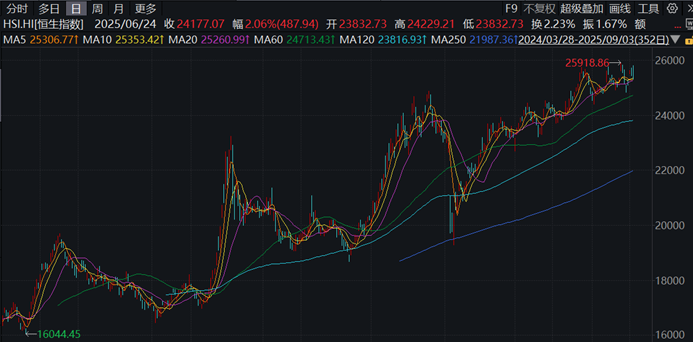
Group 1 - The Hong Kong technology sector is experiencing increased activity, with southbound funds continuing to accumulate positions, as evidenced by a net purchase of approximately 110.46 billion HKD on September 25, including significant investments in Alibaba and Tencent [1] - The Hang Seng Technology ETF (520920) was established on September 22 and is set to be listed on September 30, tracking the Hang Seng Technology Index, which consists of the top 30 technology-related stocks in Hong Kong [1] - The current valuation of the Hang Seng Technology Index is at a historical low, with a PE ratio of 24.29, positioned at the 36.54% percentile over the past five years [1] Group 2 - The Hang Seng Technology Index shows leading growth in revenue and net profit compared to other major Hong Kong indices, with a revenue growth rate of 14.43% and a net profit growth rate of 16.18% in Q2 2025 [2] - The potential for liquidity improvement is highlighted by the Federal Reserve's recent interest rate cuts, which historically have benefited the Hang Seng Technology sector [2] - Alibaba has announced a partnership with NVIDIA in the Physical AI field, enhancing its AI capabilities and indicating a significant increase in data center energy consumption by 2032 [2] Group 3 - There is an expectation that the Hang Seng Technology sector will transition from being driven solely by southbound funds to a dual-driver model, incorporating both southbound and foreign capital, potentially leading to a major upward trend [3] - The influx of southbound funds, combined with the anticipated return of foreign capital due to the Federal Reserve's actions, is expected to drive the Hang Seng Technology sector into a "main rising wave" [3]
全球股市立体投资策略周报9月第4期:港股卖空占比降至历史低位-20250923
Haitong Securities· 2025-09-23 09:36
Market Performance - Global markets experienced a slight increase last week, with MSCI Global up by 1.0%, MSCI Developed Markets up by 1.0%, and MSCI Emerging Markets up by 1.1% [8][9] - Among developed markets, the Nasdaq Index showed the strongest performance with a rise of 2.2%, while the Australian S&P 200 was the weakest, declining by 1.0% [8][9] - In the emerging markets, the ChiNext Index performed best with a gain of 2.3%, while the Shanghai Composite Index fell by 1.3% [8][9] Trading Sentiment - Trading volume in European and American stock markets significantly increased, while the short-selling ratio in Hong Kong stocks dropped to a historical low of 11.8% [17][21] - The Hang Seng Index's trading volume decreased to 177 billion shares with a total turnover of 918 billion USD, while the S&P 500's trading volume increased to 62 billion shares with a turnover of 82,150 billion USD [17] - Investor sentiment in Hong Kong improved, reaching historical highs, while sentiment in the US declined but remained elevated [17] Earnings Expectations - Earnings expectations for Hong Kong stocks were revised upward, with the Hang Seng Index's 2025 EPS forecast increased from 2066 to 2068 [59][60] - In contrast, the S&P 500's earnings expectations remained flat at 269, while the Eurozone STOXX50's earnings expectations also held steady at 337 [59][60] - Sector-wise, the energy sector in Hong Kong saw the largest upward revision in earnings expectations, while the consumer staples sector experienced the most significant downward adjustment [59][60] Economic Expectations - Economic expectations in Europe and the US improved, with the Citigroup Economic Surprise Index for the US rising due to the Fed's rate cut and tech giants accelerating AI infrastructure investments [8][59] - Conversely, China's Economic Surprise Index declined, impacted by US-China trade negotiations and weaker-than-expected economic data for August [8] Fund Flows - Following the Fed's rate cut, market speculation regarding future rate cuts intensified, with futures markets indicating an expectation of 1.8 rate cuts by the end of the year [46][52] - Global liquidity trends showed significant inflows into India, Europe, Hong Kong, and South Korea, with Hong Kong experiencing a net inflow of 292 billion HKD last week [53][58] - The inflow included 145 billion HKD from stable foreign capital, while flexible foreign capital saw an outflow of 130 billion HKD [53]
"牛市旗手"绣红旗 | 谈股论金
水皮More· 2025-09-22 09:10
Market Overview - A-shares major indices collectively rose today, with the Shanghai Composite Index up 0.22% closing at 3828.58 points, Shenzhen Component Index up 0.67% at 13157.97 points, ChiNext Index up 0.55% at 3107.89 points, and the STAR Market 50 Index up 3.38% at 1408.64 points [3] - The total trading volume in the Shanghai and Shenzhen markets was 21,215 billion, a decrease of 2,023 billion compared to the previous trading day [3] Broker Influence - Brokers played a crucial role in today's market, reversing the indices from the brink of significant declines at least three times during the day [4] - The broker sector, led by CITIC Securities, rose approximately 1%, ranking among the top gainers [4] Sector Performance - Technology stocks remained the focus, with notable gains in precious metals (up 6.18%), consumer electronics (up 2.79%), semiconductors (up 2.54%), and communication services (up 1.77%) [4] - The banking sector showed a lackluster performance, down 0.95%, while insurance fell slightly by 0.04% [6] Individual Stock Movements - In the Shanghai market, several stocks performed strongly, including Cambrian (up 3.81%), Haiguang Information (up 10%), and Industrial Fulian (up 6.6%) [4] - Conversely, in the Shenzhen market, stocks like Xinyi Technology and Zhongji Xuchuang experienced declines of 2% and 0.8%, respectively [4][5] Market Sentiment and Future Outlook - The market sentiment is mixed, with a significant number of stocks declining despite the overall index rise; the median decline for falling stocks was 0.44% [9] - The current market environment is characterized by narrow fluctuations, with the Shanghai market experiencing a "long-term consolidation" state, which may deplete the momentum of bullish investors [8]

晨星:AI的采用料将结构性降低多个行业长期运营成本 哪些行业受益最多?
Zhi Tong Cai Jing· 2025-09-04 06:21
Group 1 - The core viewpoint of the report is that artificial intelligence (AI) is transitioning from hype to delivering substantial cost savings, which has significant implications for investors [1] - The report highlights that AI adoption is expected to structurally reduce long-term operating costs across multiple industries, enhance profitability, and create re-evaluation opportunities for undervalued companies [1] - The report identifies that the current earnings season for Chinese companies shows mixed performance, with cyclical consumer sectors experiencing weak growth and profit margins falling short of expectations [1] Group 2 - The communications services sector has shown outstanding performance due to AI applications, with growth or cost-driven profit expansion exceeding expectations [1] - Key companies to watch in the consumer cyclical and defensive sectors include Budweiser, Kao, and Trip.com, which are expected to achieve better-than-expected profit improvements [1] - In the communications services sector, companies such as Naver, Baidu, Tencent, and NetEase are highlighted for their cost improvements driven by AI [1] Group 3 - In the semiconductor industry, AI is optimizing chip production processes, which will lower R&D costs, with major companies like TSMC and SK Hynix leading this trend [2] - In the financial services sector, AI is automating customer service processes and loan approvals, reducing costs for banks and insurance companies, with companies like HSBC, MUFG, and DBS being noteworthy [2] - The healthcare industry is leveraging AI for clinical trials and drug development data management, improving operations and outcomes, with companies like Hoya and Yidu Tech being of interest [2] Group 4 - The report suggests that AI is enhancing operational leverage by replacing labor and R&D, indicating that even slight positive growth rebounds in undervalued consumer sectors could lead to better-than-expected profit improvements [2] - Investors are advised to closely monitor the progress of AI applications in these sectors, particularly those companies with cost-cutting potential, to seize investment opportunities arising from market re-evaluations [2]
南向资金连续27个月净流入港股,银行股的持股数量增幅较高
Huan Qiu Wang· 2025-09-04 00:55
Group 1 - The Hong Kong stock market has attracted significant attention from global investors, with net inflows from southbound funds reaching 100.573 billion HKD as of September 3, marking the highest annual level since the launch of the mutual market access mechanism [1] - Since July 2023, southbound funds have recorded 27 consecutive months of net inflows, with nearly 60% of Hong Kong Stock Connect stocks seeing an increase in shareholding [3] - According to a report by China Merchants Securities, the Hong Kong market is undergoing a destocking cycle, with upstream industries continuing to destock while midstream and downstream sectors have entered a restocking phase [3] Group 2 - The new economy sectors are entering a sustained restocking phase, while the old economy is still experiencing a double-digit contraction in supply [3] - By industry, information technology, consumer discretionary, and healthcare are in a "proactive restocking" phase with favorable supply-demand dynamics, while energy, utilities, and real estate are in a "proactive destocking" phase at the cycle bottom [3] - China Merchants Securities suggests that investors focusing on fundamentals should pay attention to investment opportunities in technology growth stocks, as companies in the new economy with strong growth potential and weak ties to the Chinese macroeconomy reported better mid-year results [3]
行业首个!日日顺联合中国移动获中物联科技进步奖
Quan Jing Wang· 2025-08-27 01:12
Core Insights - Traditional supply chain demand forecasting methods have significant limitations, relying heavily on human experience and simple statistical models, which struggle to adapt to sudden market fluctuations [1] - A breakthrough in material demand forecasting was achieved through a collaboration between RRS Supply Chain and China Mobile, resulting in the development of an AI-based forecasting project that won a second prize at the 18th Modern Logistics Technology Innovation Conference [1] - The project successfully integrated the Transformer model into material demand forecasting, allowing for precise capture of individual product demand patterns and insights into complex inter-product relationships, thus transforming supply chain decision-making from reactive to real-time and automated [1] Operational Impact - The project demonstrated significant operational improvements, achieving a monthly average purchase volume reduction of over 20% while maintaining year-on-year sales growth [2] - Inventory turnover days were drastically reduced from 120 days to 26 days, resulting in a 462% efficiency increase [2] - The total supply chain cost savings amounted to millions of yuan per month, greatly enhancing capital utilization efficiency and addressing long-standing discrepancies between forecasts and actual sales [2] Future Outlook - RRS Supply Chain aims to deepen its centralized and standardized management advantages in the telecommunications sector, further promoting intelligent supply chain upgrades to contribute to high-quality development in the industry [2] - China Mobile expressed its commitment to continue collaborating with RRS to drive innovation and deliver more technological benefits to society [2] - The project's value extends beyond technological breakthroughs, as it reconstructs traditional supply chain decision-making mechanisms by replacing experience-based judgments with data-driven approaches and algorithmic predictions, providing a replicable and scalable path for the industry's digital transformation [2]



但斌二季度美股持仓曝光:英伟达稳居第一,多只头部公募纳指ETF现身
Sou Hu Cai Jing· 2025-07-31 15:11
Core Viewpoint - The report highlights the significant holdings of Dongfang Hongwan Overseas Fund managed by Dan Bin, particularly emphasizing the strong performance of Nvidia (NVDA) as the largest position in the portfolio, with a market value of $200 million, reflecting a substantial increase from the previous quarter [2][3]. Group 1: Holdings Overview - Nvidia (NVDA) is the largest holding with 1.2678 million shares valued at $200 million, an increase of $50.76 million in the second quarter, and its stock price rose by 45.77% [4][5]. - Google (GOOG) is the second-largest holding with 921,600 shares valued at $163.47 million, which increased by $61.24 million, and its stock price rose by 13.54% [4][5]. - Other significant holdings include Meta (META) with 135,600 shares valued at $100 million, Microsoft (MSFT) with 191,800 shares valued at $95.34 million, and Amazon (AMZN) with 359,300 shares valued at $78.80 million [5][6]. Group 2: Sector Focus - The fund's holdings are heavily concentrated in the technology sector, indicating a strategic focus on tech giants and innovative companies [6][7]. - The report suggests that the core positions in AI hardware leaders remain crucial, while also highlighting the importance of balancing risks through strategic trading [6][7]. Group 3: Adjustments in Holdings - The fund has reduced its positions in consumer electronics, notably decreasing its stake in Apple (AAPL) by $45.34 million, bringing its market value down to $69.45 million, with a stock price decline of 7.6% [7]. - Reductions were also made in Microsoft (MSFT) and Amazon (AMZN), with decreases of $11 million and $26.88 million respectively, despite their stock prices increasing [7]. Group 4: ETF Investments - Dongfang Hongwan has made significant investments in various Nasdaq index ETFs, indicating a long-term bullish outlook on technology growth [8].



关注红利港股ETF(159331)投资机会,高股息资产稳定结构性牛市
Mei Ri Jing Ji Xin Wen· 2025-07-28 09:17
Core Viewpoint - The Hong Kong stock market is expected to experience a structural bull market in the first half of 2025, driven by sectors such as new consumption, innovative pharmaceuticals, and non-bank financials [1] Group 1: Market Dynamics - Southbound funds are becoming a key support force, with their holdings primarily focused on the financial sector, particularly banks, and are beginning to diversify into information technology and communication services [1] - Banks are characterized by low volatility and high dividend strategies, offering stable dividend yields, low volatility, and tax advantages on dividends, with a stable competitive landscape and minimal cyclical impact [1] - Overall, the Hong Kong stock market favors financial and technology sectors, while confidence in cyclical sectors remains weak [1] Group 2: Investment Opportunities - The structural bull market in the Hong Kong stock market is expected to maintain resilience in the second half of the year, with the internationalization of the Renminbi and the value of Hong Kong stocks as core Renminbi assets being long-term highlights [1] - The Hong Kong Dividend ETF (159331) tracks the Hong Kong Stock Connect High Dividend Index (930914), which selects listed companies with a consistent ability to pay high dividends, covering traditional high-dividend sectors such as finance and real estate [1] - Investors without stock accounts can consider the Cathay CSI Hong Kong Stock Connect High Dividend Investment ETF Initiated Link A (022274) and Link C (022275) [1]
港股通50ETF(159712)涨超1.2%,市场关注结构性机会与流动性变化
Mei Ri Jing Ji Xin Wen· 2025-07-28 03:13
Group 1 - The core viewpoint is that the Hong Kong stock market is expected to have a strong start in the first half of 2025, driven by AI technology revaluation and supported by sectors such as new consumption, innovative pharmaceuticals, and non-bank financials [1] - Financial and technology sectors are the most favored by the market, with southbound funds focusing on financials, particularly banks, and diversifying into information technology and communication services [1] - Foreign investment preferences lean towards financials, discretionary consumption, and information technology, indicating a structural bull market resilience in the second half of the year [1] Group 2 - The appreciation of the RMB and continuous inflow of southbound funds are crucial supports for the market, with the financial sector being attractive to insurance capital due to its low volatility and high dividend characteristics [1] - The technology growth sector benefits from reduced financing costs, suggesting a favorable environment for growth [1] - Long-term, Hong Kong stocks are seen as core assets in RMB, with significant potential for narrowing the "country risk premium" and increasing domestic pricing power, which will amplify revaluation heights [1] Group 3 - The Hong Kong Stock Connect 50 ETF (159712) tracks the Hong Kong Stock Connect 50 Index (930931), which consists of 50 large companies listed in Hong Kong that meet Stock Connect eligibility, reflecting the performance of quality Hong Kong stocks available for investment through the Stock Connect mechanism [1] - The index covers multiple industries, focusing on key areas such as finance, information technology, and consumption, demonstrating strong market representation and liquidity [1] - Investors without stock accounts can consider the Cathay CSI Hong Kong Stock Connect 50 ETF Initiated Link A (014689) and Link C (014690) [1]