
银行业

Search documents
新华指数研究院监测显示:1月份小微企业融资与经营景气度连续攀升
Zheng Quan Ri Bao Wang· 2026-02-27 10:50
Group 1 - The Inclusive Finance Prosperity Index reached 49.60 points in January 2026, an increase of 0.12 points from December 2025, marking two consecutive months of growth [1] - The financing prosperity index was 55.10 points in January, up 0.28 points month-on-month, remaining above 54 points since the second half of 2025 [1] - The operating prosperity index was 48.52 points in January, an increase of 0.08 points from December 2025, indicating a recovery in consumer demand [1] Group 2 - In January, the operating prosperity index for nine major industries showed 6 increases and 3 decreases, with strong demand for agricultural products and livestock driven by pre-Spring Festival consumption [2] - The wholesale and retail industry, as well as the accommodation and catering industry, maintained a positive operating climate due to concentrated consumer demand [2] - The construction industry saw improvements, with a 4.7 percentage point year-on-year increase in the operating rate of major industrial products and a 29.2% year-on-year growth in apparent steel consumption [2]
人民币国际化迎关键突破,央行新规完善离岸市场流动性供给
Di Yi Cai Jing· 2026-02-27 10:39
Core Viewpoint - The People's Bank of China (PBOC) has officially released a notification to standardize the management of net cross-border interbank financing limits in RMB, aiming to support the development of the offshore RMB market and enhance the internationalization of the RMB [2][10]. Group 1: Notification Overview - The notification includes various types of RMB cross-border interbank financing, such as account financing and bond repurchase, allowing domestic banks to lend and borrow RMB from foreign institutions [2][4]. - It introduces a counter-cyclical adjustment mechanism linked to banks' capital levels, balancing liquidity supply and risk prevention [3][5]. Group 2: Policy Implications - The notification aims to improve the transparency of management and allows banks to flexibly structure their business within the net lending limits, enhancing their willingness to expand business [6][7]. - It optimizes the calculation rules for net lending balances, excluding certain business types from the calculation, which broadens the scope for domestic banks' cross-border operations [6][7]. Group 3: Market Impact - The stability of the offshore market largely depends on the predictability and sufficiency of liquidity supply, which the notification aims to enhance [8]. - The PBOC's efforts in promoting RMB internationalization have led to RMB becoming the largest settlement currency for China's foreign payments and the second-largest trade financing currency globally [8][10].
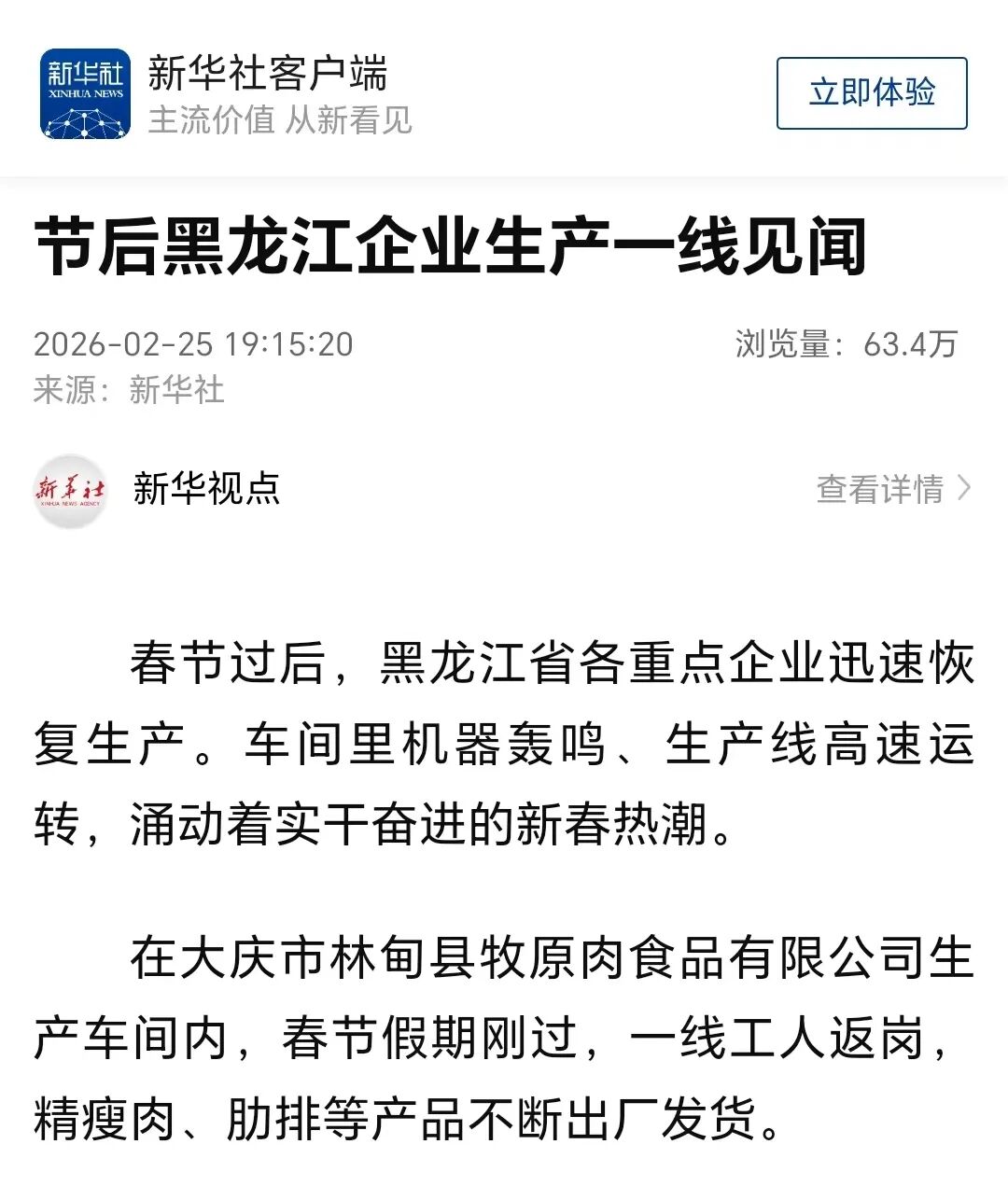
【新华社】节后黑龙江企业生产一线见闻 | 媒体看大庆
Xin Lang Cai Jing· 2026-02-27 10:39
Core Viewpoint - The article highlights the rapid recovery of production in key enterprises in Heilongjiang Province after the Spring Festival, showcasing a strong momentum for practical efforts and progress in various industries [2][3]. Group 1: Company Performance - The Mu Yuan Meat Products Co., Ltd. in Daqing has resumed production with workers returning after the holiday, aiming to slaughter 2.12 million pigs in 2025, achieving a production value of 3.6 billion yuan, a year-on-year increase of 258% [3][10]. - Daqing Yitai Semiconductor Materials Co., Ltd. focuses on core technology development, producing gallium arsenide chips for high-end communication sectors, with a 35% year-on-year increase in order volume and production schedules extending to August [4][11]. - Heilongjiang Devo Technology Development Co., Ltd. has started production of high-performance seeders, responding to strong market demand as the spring plowing season approaches [7][14]. - Yihai Kerry (Harbin) Grain and Oil Food Industry Co., Ltd. processes over 1,000 tons of rice daily and is accelerating the development of health products to meet evolving market demands [7][14]. Group 2: Financial Support and Economic Development - The Agricultural Bank of China Daqing Branch has provided 3.75 billion yuan in loans to the real economy in 2025, with a growth rate of 35%, leading the city's banking institutions in loan growth [4][11]. - Daqing City plans to promote over 510 key industrial projects this year, focusing on transforming and upgrading the industrial structure of the oil city [7][12]. - Various departments in Heilongjiang Province are actively implementing policies to lay a solid foundation for achieving annual economic and social development goals [8][15].

【湘西州动态】湘西州启动贷款辅导员助企行动
Xin Lang Cai Jing· 2026-02-27 10:36
Core Viewpoint - The "Loan Counselor" initiative in Xiangxi Tujia and Miao Autonomous Prefecture aims to enhance enterprise services through a structured approach led by the local government and financial institutions, focusing on key industries and local expertise [1][4]. Group 1: Initiative Overview - The Xiangxi local government has prioritized the "Enterprise Service Year" initiative, forming a task force that includes the government office, the People's Bank of China Xiangxi branch, and major industry departments [1][4]. - A "three ones" system has been established, consisting of "one notice, one method, one manual," creating a closed-loop operational mechanism covering the entire process from selection to management [1][4]. Group 2: Focus on Key Industries - The initiative targets specific industries such as ecological tourism, green mining, traditional Chinese medicine, and specialty agriculture, aiming to leverage local cultural and ecological advantages for development [3][6]. - Local financial institutions have committed to treating the Loan Counselor initiative as a top priority, ensuring rapid response and effective service to enterprises [3][6]. Group 3: Implementation and Support - A selection process has begun for experienced loan managers and leaders to serve as counselors, ensuring that the most knowledgeable and passionate individuals are on the front lines [3][6]. - A closed-loop process has been established for counselor recommendations, internal assignments, and expedited approvals, significantly reducing loan processing times [3][6]. Group 4: Professional Team Development - A specialized team will be deployed across the region, acting as a bridge between policies and markets, and between banks and enterprises, to disseminate financial knowledge and foster credit growth [3][6]. - The initiative includes on-site financing diagnostics, credit cultivation, and policy education in various local settings, including parks, factories, and agricultural fields [3][6]. Group 5: Evaluation and Promotion - The People's Bank of China Xiangxi branch plans to enhance coordination, supervision, and promotion of the initiative, with regular evaluations of "gold medal counselors" and "outstanding banks" [4][7]. - The assessment results will be linked to regulatory evaluations and financial resource allocations, aiming to create a strong atmosphere of "financial support for enterprises and credit-driven growth" in the region [4][7].

中国人民银行发布《关于银行业金融机构人民币跨境同业融资业务有关事宜的通知》(附答记者问)
Xin Lang Cai Jing· 2026-02-27 10:36
Core Viewpoint - The People's Bank of China (PBOC) has issued a notification to support domestic banks in conducting cross-border RMB interbank financing, aiming to enhance the internationalization of the RMB and improve the management of cross-border capital flows [1][9]. Group 1: Notification Overview - The notification covers various types of RMB cross-border interbank financing and links the net financing outflow balance to the capital level and funding strength of banking institutions [1][9]. - A counter-cyclical adjustment mechanism is introduced, allowing the PBOC to adjust parameters based on market conditions to promote reasonable business development [2][12]. - The notification emphasizes compliance with market demands and requires banks to have strong international settlement capabilities and robust risk management systems [2][12]. Group 2: Applicable Institutions - The notification applies to domestic banks legally established with international settlement capabilities, including Chinese banks, foreign-owned banks, joint-venture banks, and foreign bank branches in China [3][13]. - Rural financial institutions are generally not allowed to engage in RMB cross-border interbank financing but may conduct other cross-border RMB businesses [3][13]. Group 3: Financing Limits - The net financing outflow balance limit for domestic banks is determined by their tier-one capital net amount multiplied by cross-border business adjustment parameters and macro-prudential adjustment parameters [4][14]. - For domestic Chinese banks, the formula is: Net Outflow Limit = Tier-One Capital Net Amount × Cross-Border Business Adjustment Parameter × Macro-Prudential Adjustment Parameter [5][14]. Group 4: Implementation and Impact - The PBOC will ensure that banks manage their RMB cross-border interbank financing business effectively, ensuring that the net outflow balance does not exceed the established limits [6][15]. - The implementation of the notification is expected to enhance the rules and transparency of RMB cross-border interbank financing management, facilitating stable offshore RMB liquidity supply [8][17].
一篇价值2000亿美元的终局论:AI在2028年带来席卷世界的经济危机
Xin Lang Cai Jing· 2026-02-27 10:31
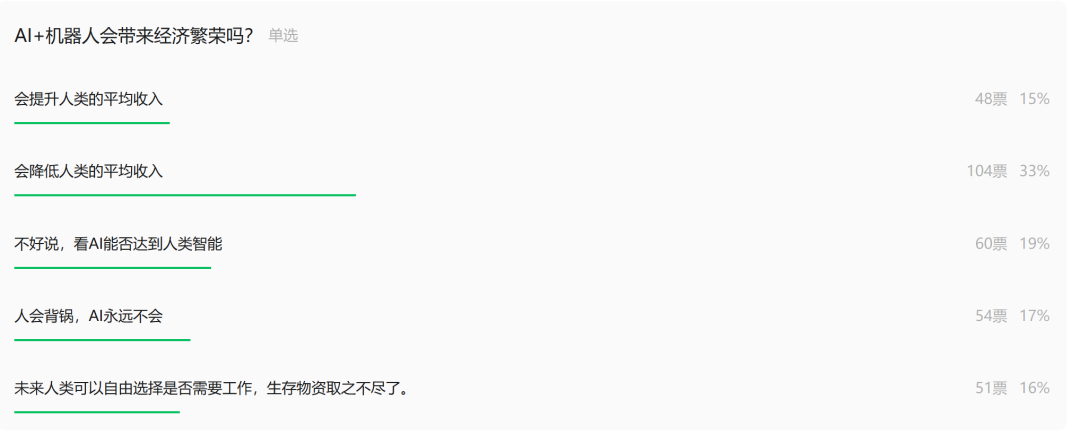
Group 1 - The core argument presented by Citrini Research suggests that the anticipated economic prosperity from AI advancements may not materialize, potentially leading to systemic crises in the economy and financial systems [1][2][6] - A recent poll indicated that 33% of respondents believe AI will lower average human income, while only 15% think it will enhance it, reflecting widespread concern about AI's impact on employment [1] - The concept of "ghost GDP" emerged, highlighting that AI's productivity gains may not translate into real economic benefits for consumers, as many outputs may not circulate in the economy [10][11] Group 2 - By mid-2028, the unemployment rate reached 10.2%, exceeding market expectations and contributing to a 2% market decline, indicating a significant shift in economic conditions [8] - The economic structure evolved from manageable risks to a system that no longer aligns with historical growth experiences, leading to a crisis in consumer spending and credit defaults [8][9] - AI's rapid advancement has resulted in a significant reduction in white-collar jobs, with many workers forced into lower-paying positions, thereby eroding their income and spending power [11][12] Group 3 - The feedback loop created by AI's efficiency leads to a cycle where reduced labor costs result in further AI investments, exacerbating job losses and consumer spending declines [10][49] - The financial implications of AI's impact on employment are profound, as the white-collar workforce, which constitutes a significant portion of consumer spending, faces unprecedented challenges [39][58] - The shift towards AI-driven business models has led to a structural change in the economy, where traditional job roles are increasingly threatened, and new roles created often offer lower compensation [43][44] Group 4 - The private credit market, which expanded significantly, is now facing challenges as assumptions about stable revenue growth for software companies are being questioned due to AI disruptions [60][61] - The crisis in the software sector is exemplified by the case of Zendesk, which failed to meet debt obligations due to AI-driven automation, marking a significant event in private credit defaults [63][64] - The interconnectedness of financial systems means that losses in one sector can trigger broader economic repercussions, highlighting the systemic risks posed by AI advancements [73]



短期美元仍是人民币汇率的主导因素|宏观晚6点
Sou Hu Cai Jing· 2026-02-27 10:29
Group 1 - The People's Bank of China has decided to lower the foreign exchange risk reserve ratio for forward foreign exchange sales from 20% to 0% effective March 2, 2026, to promote the development of the foreign exchange market and support enterprises in managing exchange rate risks [1] - The central bank will continue to guide financial institutions in optimizing exchange rate hedging services for enterprises and maintain the basic stability of the RMB exchange rate at a reasonable and balanced level [1] Group 2 - Hunan Province has implemented 19 measures to boost private investment confidence, focusing on high-quality development of private investment [2] - The measures include optimizing project application and approval processes, enhancing private capital participation in project evaluations, and simplifying accounting for private capital holdings [2] - For projects requiring provincial-level approval in sectors such as agriculture, energy, transportation, and high-tech industries, private capital holding ratios can exceed 10%, with no upper limit for highly market-oriented projects [2]
2026年2月宏观经济月报:美欧经济再分化,国内消费更多元-20260227
BOHAI SECURITIES· 2026-02-27 09:31
Group 1: Overseas Economic and Policy Environment - The US economy faces stagflation risks, with Q4 2025 GDP growth below expectations due to government shutdown impacts[13] - Non-farm employment data showed unexpected rebound, but the unemployment rate remains a concern as it may adjust after March[14] - The Eurozone is experiencing weak recovery, with February manufacturing PMI entering expansion territory for the first time since mid-2025[21] Group 2: Domestic Economic Performance - During the Spring Festival, national consumption-related industries saw a daily average sales increase of 13.7% compared to last year[30] - Smart products like smart glasses and intelligent robots saw sales growth of 47.3% and 32.7% respectively during the holiday[30] - Manufacturing investment growth is expected to be strong, with key product operating rates exceeding January averages[38] Group 3: Domestic Policy Environment - The central bank's monetary policy remains cautious, focusing on structural tools to support key sectors while maintaining liquidity stability[5] - Fiscal policy is actively supporting economic stability, with over 1.5 trillion yuan in new local special bonds issued by February 26, 2026[46] - The government is expected to prioritize spending on technology innovation and social welfare in the first quarter[46] Group 4: Risks and Outlook - Geopolitical risks and unexpected economic changes pose significant threats to domestic economic stability[6] - Inflation concerns are rising, with the Fed's rate cut window likely closed in the first half of 2026, impacting future monetary policy decisions[15]
《业务领域网络安全事件报告管理办法》发布,金融数据泄露监管全面升级
Sou Hu Wang· 2026-02-27 09:26
Core Viewpoint - The People's Bank of China has introduced a new regulatory framework for cybersecurity incident reporting in the financial sector, effective from August 1, 2025, aimed at enhancing data security compliance and response mechanisms [1][2]. Group 1: Regulatory Framework - The new regulation categorizes cybersecurity incidents into four levels: "especially major, major, relatively large, and general," with specific quantitative standards for data breaches based on the volume of data leaked and its sensitivity [2]. - Financial institutions are required to report significant cybersecurity incidents within one hour and submit a complete report within 24 hours, significantly reducing the time for internal confirmation and decision-making [4]. Group 2: Industry Risk Trends - The financial sector has been experiencing high levels of data breach risks, with banks leading the industry for three consecutive years, followed by rising risks in consumer finance and payment sectors [5]. - The report indicates that black and gray market attacks are increasingly focused on credit data and financial information, which have high monetization value [5]. Group 3: Compliance Challenges - Financial institutions face challenges in timely detection of external data breaches, rapid quantification of breach scale, and dynamic assessment of data dissemination [7][8]. - The ability to monitor external threats and analyze data breaches is becoming a critical capability for compliance in the financial industry [9]. Group 4: Enhanced Monitoring Capabilities - Financial institutions are required to establish a robust cybersecurity risk monitoring and early warning system to enhance their ability to detect and report incidents promptly [9]. - Companies like Threat Hunter are enhancing their data breach intelligence capabilities to support financial institutions in meeting regulatory requirements [9]. Group 5: Regulatory Execution and Upgrades - The introduction of the new regulation signals that data breach monitoring capabilities are now essential for financial institutions in a highly regulated environment [10]. - As the implementation date approaches, the financial industry is accelerating the development of data breach assessment mechanisms and external monitoring systems [10].
香港金管局:1月份港元货币供应量M2及M3均上升1.1%
智通财经网· 2026-02-27 09:26
Core Viewpoint - The Hong Kong Monetary Authority reported a slight decline in total deposits from recognized institutions in January 2026, reflecting changes in corporate fund flows [1] Group 1: Deposit Trends - Total deposits from recognized institutions decreased by 0.1% in January 2026, with Hong Kong dollar deposits increasing by 1.3% and foreign currency deposits decreasing by 1.1% [1] - Renminbi deposits in Hong Kong rose by 3.5% in January, reaching 993.9 billion RMB by the end of the month [1] - Cross-border trade settlement in renminbi totaled 1,016.4 billion RMB in January, down from 1,177.4 billion RMB in December [1] Group 2: Loan and Advance Trends - Total loans and advances increased by 1.1% in January 2026, with loans used in Hong Kong (including trade financing) rising by 0.7% and loans used outside Hong Kong increasing by 2.2% [1] - The loan-to-deposit ratio for Hong Kong dollars decreased from 72.9% at the end of December to 72.3% by the end of January, as the increase in Hong Kong dollar deposits outpaced the rise in loans [1] Group 3: Money Supply - The Hong Kong dollar money supply M2 and M3 both rose by 1.1% in January 2026, with year-on-year increases of 3.8% [1] - Seasonally adjusted M1 money supply increased by 2.6% in January, reflecting a year-on-year increase of 16.9%, partly due to investment-related activities [1] - Overall, M2 and M3 showed no significant changes in January, with year-on-year increases of 9.9% and 9.8%, respectively [1]