数字经济

Search documents
杨德龙:新质生产力全面纳入“十五五”规划 本轮科技牛行情有望延续
Xin Lang Zheng Quan· 2025-10-25 12:59
Core Viewpoint - The 20th Central Committee's Fourth Plenary Session approved the guidelines for the 15th Five-Year Plan, emphasizing high-quality development, technological self-reliance, and significant improvements in social civilization and living standards, with a nominal GDP growth rate of approximately 5.4% over the next decade [1][2]. Economic Development Goals - The main objectives for the 15th Five-Year Plan include achieving significant results in high-quality development, enhancing technological independence, deepening reforms, improving social civilization, and advancing the construction of a beautiful China [1][2]. - By 2035, the goal is to elevate China's economic, technological, and national strength significantly, with per capita GDP reaching the level of moderately developed countries [1]. Capital Market Implications - The 15th Five-Year Plan signals positive developments for the capital market, reinforcing investor confidence in China's long-term economic growth and potentially extending the current bull market [2]. - The plan outlines a clear economic development path for the next five years, which is expected to attract more capital into the technology sector, further driving the ongoing technology bull market [2]. Focus on Innovation Industries - The plan highlights the importance of nurturing emerging industries, with a target for the "three new" economy's contribution to GDP exceeding 18% by 2024 [3]. - Key strategic emerging industries include new energy, new materials, aerospace, and low-altitude economy, with the potential to create several trillion-yuan markets [3]. - Future industries such as quantum technology, biomanufacturing, hydrogen energy, and 6G are identified as new growth points for the economy [3]. Market Dynamics and Investment Opportunities - The current market is experiencing significant differentiation, with technology innovation sectors seeing substantial gains while traditional sectors lag behind [4]. - The ongoing economic transition is expected to reduce opportunities in traditional industries, which may face overcapacity and operational difficulties [4]. - The rapid growth of household deposits, exceeding 160 trillion yuan, and declining interest rates on bank deposits are likely to drive investors towards the capital market in search of higher returns [5]. Conclusion - The 15th Five-Year Plan is set to inject new momentum into economic development, with a focus on innovation and technology, while traditional sectors may face challenges [4][5].
券商首席解码:四中全会公报里的“十五五”投资线索
2 1 Shi Ji Jing Ji Bao Dao· 2025-10-24 13:37
Group 1 - The core viewpoint of the articles revolves around the outcomes of the Fourth Plenary Session of the 20th Central Committee of the Communist Party of China, which emphasizes the achievements during the 14th Five-Year Plan and sets the main goals for the 15th Five-Year Plan [1][2] - The session highlighted 12 key areas including modern industrial systems, technological self-reliance, expanding domestic demand, market economy reforms, and rural revitalization [2][3] Group 2 - The construction of a modern industrial system is emphasized, with a focus on integrating technological innovation and industrial development, particularly in advanced manufacturing and aerospace technology [5][6] - The strategy of technological self-reliance is marked as a central growth driver for the 15th Five-Year Plan, aiming to enhance basic research and key technology breakthroughs [6] - The approach to expanding domestic demand is noted to focus on the balance between supply and demand, promoting long-term consumption growth rather than short-term stimulus [7][8] Group 3 - The report indicates a potential acceleration in the pace of opening up, with an emphasis on institutional and autonomous openness in response to global competition [9] - The A-share market is expected to show a "long-term" and "steady" trend, supported by improved market confidence and structural reforms [10] - Investment opportunities are suggested in sectors such as digital technology, aerospace, high-end manufacturing, and consumer goods, with specific focus areas identified [11][12]


数字经济“十四五”目标提前完成,人工智能打开产业全新空间
Sou Hu Cai Jing· 2025-10-24 08:47
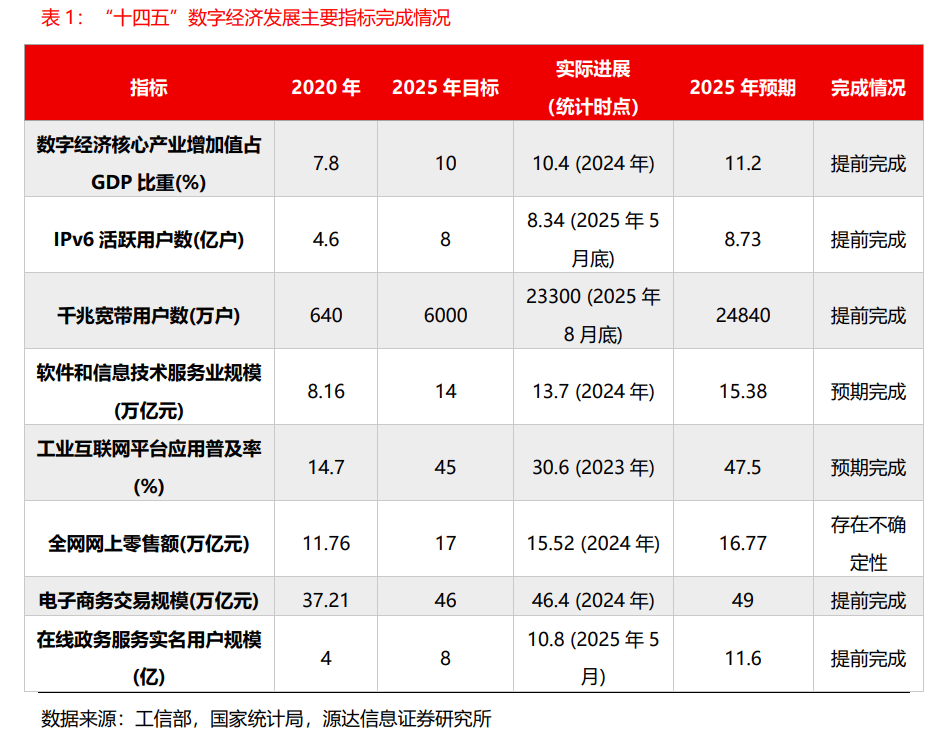
Core Insights - The digital economy in China has exceeded expectations during the "14th Five-Year Plan," with five out of eight key indicators already surpassed, and two expected to be achieved on time, indicating strong industrial momentum [1][2][4] - Looking ahead to the "15th Five-Year Plan," advancements in artificial intelligence and large models are expected to further enhance the strategic role of the digital economy in driving high-quality economic development [1][5] Digital Economy Performance - China's digital economy has surpassed 65 trillion yuan, accounting for over 42% of GDP, with a growth rate of 9.8%, significantly higher than traditional economic growth [2] - The contribution of the digital economy to GDP growth is approximately two-thirds, showcasing its resilience and ability to counteract economic slowdown [2] - Lenovo Group reported a revenue of nearly 500 billion yuan for the fiscal year 2024-2025, reflecting a year-on-year growth of 21.5% [2] Key Indicators and Achievements - As of now, several key indicators from the "14th Five-Year Plan" have been achieved, including: - Digital economy core industry value added to GDP ratio at 10.4% (target: 10%) [4] - IPv6 active users at 8.34 billion (target: 8 billion) [4] - Gigabit broadband users at 23.3 million (target: 6 million) [4] - Other indicators such as software and information technology service industry scale are close to completion, while online retail sales may face uncertainties [4] Strategic Importance of Digital Economy - The digital economy is increasingly recognized as a key driver for high-quality economic development, necessitating a comprehensive top-level design to harness its potential [2][5] - The transition from "Internet+" to "AI+" signifies a new phase in digital economic development, emphasizing the importance of building a robust digital infrastructure [5][13] AI Industry Developments - The AI sector in China is rapidly growing, with Chinese AI companies accounting for 15% of the global total, second only to the United States [5] - Lenovo Group has maintained a leading position in high-performance computing and AI server markets, indicating strong competitive advantages [5] Future Outlook - The digital economy is projected to exceed 80 trillion yuan by 2030, with leading companies like Lenovo expected to benefit from high growth potential [5][12] - The shift towards platform-based AI ecosystems is anticipated to reshape the competitive landscape, with companies focusing on building comprehensive AI infrastructures [11][12][13]

从“中国经济”到“中国人经济”,有何不同寻常?|新京报专栏
Xin Jing Bao· 2025-10-24 08:01
Core Viewpoint - The article emphasizes the strategic shift in China's economic development philosophy, highlighting the importance of both GDP and GNI, which reflects a transition from a production-oriented approach to a more comprehensive perspective on national wealth and economic well-being [2][3]. Summary by Sections Economic Development Strategy - The 20th Central Committee's Fourth Plenary Session approved the proposal for the 15th Five-Year Plan, focusing on expanding bilateral investment cooperation and emphasizing both GDP and GNI as key indicators of economic health [2]. - The shift from focusing solely on domestic production (GDP) to including national wealth (GNI) signifies a paradigm change in understanding economic performance [2][3]. GNI vs. GDP - GNI, which includes net income from abroad, provides a broader view of national wealth compared to GDP, which is limited to domestic production [3]. - GNI emphasizes the importance of individuals and their global resource allocation capabilities, while GDP focuses on local production [3]. International Investment and Competitiveness - Chinese enterprises have established over 50,000 companies abroad, with foreign investment stock exceeding $3 trillion, maintaining a global ranking in the top three for eight consecutive years [3]. - The growth of overseas assets contributes directly to GNI, aligning with the goal of meeting the people's growing needs and supporting high-level openness [4]. Policy Implications - The dual focus on GDP and GNI is seen as a necessary response to the challenges of globalization, enhancing China's control over global resources and supply chains [6]. - The proposal includes measures to attract foreign investment and support outbound investment, particularly in advanced manufacturing and digital economy sectors [7][8]. Institutional Reforms - The establishment of a more comprehensive institutional framework for high-level openness is anticipated, including aligning with international trade agreements and improving the business environment for foreign investors [7][8]. - The focus on GNI growth may lead to a shift in local government priorities from merely attracting investment to fostering talent and global engagement [8]. Global Economic Governance - The emphasis on both GDP and GNI offers a new model for economic governance, providing a reference for developing countries to balance efficiency and equity [9]. - This approach aims to enhance resilience against market fluctuations and promote inclusive globalization, as seen in projects like the China-Laos railway [9]. Conclusion - The transition from a GDP-centric model to one that values GNI reflects a profound change in development philosophy, positioning China as a global value creator rather than just a manufacturing hub [9].
为了出海,我聊了七国专家
Hu Xiu· 2025-10-24 07:45
Core Viewpoint - The "going global" strategy of Chinese enterprises has evolved from mere market expansion to a comprehensive approach involving global resource integration and industrial chain restructuring, amidst increasing complexities due to global economic uncertainties and changing international political environments [1][58]. Group 1: Opportunities in Different Countries - Indonesia is highlighted as a suitable destination for Chinese enterprises due to its large consumer market of over 270 million people, abundant natural resources, and investor-friendly policies, with a total investment from China amounting to approximately $34.19 billion from 2019 to September 2024 [6][9]. - Kazakhstan is positioned as a key partner in the Belt and Road Initiative (BRI), with significant infrastructure investments and a strategic location that facilitates trade between East Asia and Europe, leading to a projected GDP growth of 6% to 9% with improved logistics [20][21]. - Chile is recognized for its transparent governance and stable political environment, making it a strategic hub for entering the Latin American market [39]. - The Netherlands is considered one of the most business-friendly countries in the EU, providing a pragmatic and efficient environment for trade compliance, which is crucial for Chinese enterprises [42][43]. - The United States is identified as an attractive market due to its large consumer base, mature capital markets, and transparent legal system, offering opportunities for brand internationalization and technological innovation [48]. Group 2: Common Challenges Faced by Chinese Enterprises - In Indonesia, common challenges include regulatory complexities, bureaucratic delays, and ownership restrictions, which can lead to significant disputes and financial losses if not navigated properly [7][8][13]. - In Thailand, communication barriers and local regulatory restrictions pose challenges for Chinese enterprises, particularly due to a lack of English or Chinese speakers [17]. - Kazakhstan presents operational challenges related to technology and production, including delays in equipment maintenance and administrative hurdles that can increase project costs [22][23][24]. - In Chile, language barriers and compliance with local regulations are significant challenges for Chinese enterprises [40]. - In the Netherlands, understanding and adhering to the complex legal framework of EU and domestic laws is a common challenge for Chinese companies [44][45]. - In the United States, compliance with a complex regulatory environment, cultural differences, and intense local competition are the primary challenges faced by Chinese enterprises [49][50]. Group 3: Consulting Issues Encountered - In Indonesia, common consulting issues include budget constraints affecting due diligence and compliance planning, differing expectations regarding timelines, and frequent changes in project scope [10][11][12]. - In Kazakhstan, the most frequent consulting issues revolve around legal protections, administrative burdens, and the complexities of public procurement [29][30][31]. - In Chile, high work pressure and unrealistic expectations from headquarters are common issues faced by consultants working with Chinese enterprises [41]. - In the Netherlands, many Chinese enterprises struggle with export control and compliance issues due to a lack of familiarity with the legal requirements [46]. - In the United States, the most common consulting issues include misalignment of strategic positioning with local realities, compliance awareness, and long-term planning [52][53].
因油而生 新疆克拉玛依的70年蝶变
Zhong Guo Xin Wen Wang· 2025-10-24 05:57
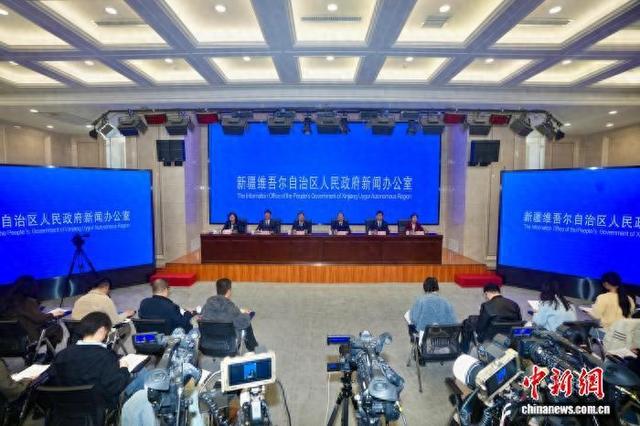
Core Viewpoint - The press conference highlighted the successful implementation of the new development philosophy in Karamay, showcasing its economic and social high-quality development progress and achievements under the guidance of the Party's governance strategy in Xinjiang [1][3]. Economic Development - Karamay's economy is driven by oil, with significant advancements in public services and living standards, maintaining over 70% of fiscal expenditure on people's livelihoods [3][4]. - The city has produced over 450 million tons of crude oil and 1100 billion cubic meters of natural gas over the past 70 years, with recent discoveries of major oil and gas fields [4][5]. Innovation and Education - Karamay has established three universities with 27,000 enrolled students, over 70% of whom choose to work in the region after graduation, and has built over 200 innovation platforms [4][5]. - The city is a leader in oil and gas production in China, with significant contributions to the national energy supply [5]. Digital Economy and Infrastructure - Karamay is transforming into a digital economy hub, with six data centers and a storage capacity of 6200PB, positioning itself as a key player in the national "East Data West Computing" strategy [5]. - The city has made a historical leap from an "oil city" to a "computing city," enhancing its technological capabilities [5]. Environmental Initiatives - As one of the first cities in China to pilot carbon peak initiatives, Karamay is committed to ecological and green development, aiming to capture over 500,000 tons of CO2 through CCUS technology by 2024 [5]. - The city exemplifies a harmonious coexistence of industrial and ecological civilization, with initiatives that reflect a commitment to environmental sustainability [5]. Cultural and Tourism Development - Karamay boasts rich cultural and tourism resources, promoting unique experiences through various attractions and events, enhancing its appeal as a tourist destination [6].
“十四五”看山东:工业年均增7.5%,文旅消费破万亿!山东经济勇挑大梁
Qi Lu Wan Bao· 2025-10-24 03:04
Core Viewpoint - Shandong Province has successfully achieved its "14th Five-Year" development goals, with an economic growth target of 5.5%, and is expected to continue to play a significant role in stabilizing the national economy [1] Economic Growth and Industrial Development - Shandong's industrial output value has seen an average annual growth of 7.5% since the beginning of the "14th Five-Year" period, with revenue from industrial enterprises increasing by 37% [3] - The province has completed over 3,000 projects annually, contributing approximately 500 billion yuan in output value [3] - The service sector has also been prioritized, with 6,351 new large-scale service enterprises established, significantly enhancing the sector's contribution to economic growth [3] Domestic Demand Expansion - Shandong has a large demand potential with a population exceeding 200 million, implementing 15,000 key projects annually to boost effective investment [4] - The province's annual growth in retail sales of consumer goods is 7.6%, with significant contributions from sectors like new energy vehicles and tourism [4] - The number of new energy vehicles has increased over fivefold, surpassing 3.2 million, supported by the establishment of 1.41 million charging stations [4] Open Cooperation and Foreign Trade - Shandong is strategically located at the intersection of the "Belt and Road" initiative and Northeast Asia economic cooperation, with an average annual growth of 11.2% in foreign trade since the "14th Five-Year" period [5][6] - Exports to emerging markets have grown by 16.1% annually, with machinery and electrical products seeing a 15.1% increase in exports [6] Overall Economic Outlook - The overall economic development in Shandong is on an upward trend, with a solid foundation and confidence to contribute further to the national economy [7]
凝聚磅礴力量 共绘海南自贸港高质量发展新图景——海南广大党员干部群众热议党的二十届四中全会公报
Hai Nan Ri Bao· 2025-10-24 01:08
Core Points - The Fourth Plenary Session of the 20th Central Committee of the Communist Party of China was held from October 20 to 23, 2023, in Beijing, where the "Suggestions on Formulating the 15th Five-Year Plan for National Economic and Social Development" were reviewed and approved [1] - The session emphasized the significant achievements during the "14th Five-Year" period, highlighting China's progress in modernization and economic development [2] - The session outlined a clear development blueprint for the "15th Five-Year" period, focusing on six principles that will guide economic and social development [6] Group 1: Achievements and Progress - The "14th Five-Year" period saw historic achievements in economic and social development, with China expected to rank 10th globally in the innovation index by 2025 [2] - There has been a notable reduction in the GDP and disposable income gap between eastern and western regions, and a significant decrease in energy consumption per unit of GDP by 11.6% by 2024 [2] - The establishment of the Hainan Free Trade Port and 21 other pilot free trade zones has positioned China as a leading trade partner for 157 countries and regions [2] Group 2: Development Strategy - The "15th Five-Year" plan emphasizes the importance of adhering to six principles, including the comprehensive leadership of the Party and prioritizing high-quality development [6] - The plan aims to integrate the achievements of the "14th Five-Year" period while laying a solid foundation for future development [6] - Local governments, such as Haikou and Sanya, are encouraged to align their development strategies with national goals, focusing on modern industrial systems and high-quality development [7][9] Group 3: Regional Development Initiatives - Hainan's development is characterized by a significant leap in the construction of the Free Trade Port, moving towards a fully operational phase [3] - The Sanya Yazhou Bay Science and Technology City is undergoing transformation into a leading technology hub, emphasizing innovation and green development [4] - Local initiatives, such as agricultural modernization and rural revitalization, are being implemented to enhance the quality of life and economic prosperity in rural areas [11]
新型政策性金融工具助力稳经济
2 1 Shi Ji Jing Ji Bao Dao· 2025-10-23 22:41
Core Insights - The establishment of new structural monetary policy tools and innovative policy financial instruments is a significant measure to promote high-quality economic development in China [1][2] - As of mid-October, nearly 300 billion yuan has been allocated through these new financial tools, which are crucial for driving economic growth in the fourth quarter and achieving the annual growth target of around 5% [1][2] Group 1: Policy Framework - The new policy financial tools are characterized by a "quasi-fiscal" positioning, allowing for multi-departmental collaboration that overcomes traditional policy tool constraints [2] - The National Development and Reform Commission (NDRC) is responsible for selecting quality projects, ensuring alignment with national strategic goals, while policy banks raise funds through market mechanisms [2] - This innovative mechanism enhances funding efficiency and mitigates moral hazards, providing sustainable financial support for high-quality economic development [2] Group 2: Investment Focus - The new financial tools have shifted investment focus from traditional infrastructure to innovation-driven sectors, significantly increasing support for technology innovation and emerging industries [3] - As of October 17, 37.5% of the nearly 190 billion yuan allocated by the China Development Bank has been directed towards key areas such as digital economy and artificial intelligence [3] - The requirement for 20% of funds to support private enterprises enhances the inclusivity of the policy, ensuring that resources flow to the most innovative market players [3] Group 3: Regional Alignment and Leverage Effect - Project reserves reflect a structural alignment with regional development strategies, showcasing a tailored policy approach [4] - The injection of 500 billion yuan in capital is expected to leverage bank loans, potentially generating an investment multiplier effect of 2-3 times, leading to an additional 1 trillion to 1.7 trillion yuan in investments [4] - If the multiplier effect is fully realized, it could reach 10-12 times, resulting in a total investment scale of 5 trillion to 6 trillion yuan, effectively addressing the capital shortfall for major projects [4]
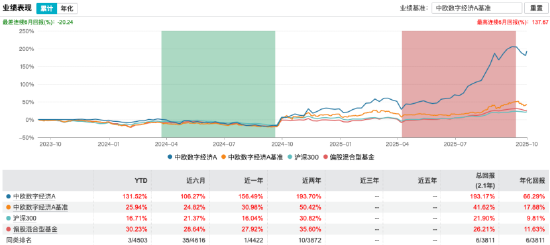
中欧数字经济A三季度涨80%,基金经理冯炉丹:AI投资需分散,高波动时代来临
Xin Lang Ji Jin· 2025-10-23 07:36
Core Insights - The report highlights the impressive performance of the China Europe Digital Economy Mixed Fund A, managed by Feng Ludan, which has achieved a cumulative return of 193.17% since its inception, with a year-to-date increase of 140.86% as of October 22, 2025 [1][3]. Performance Summary - The fund has shown significant growth, with a six-month increase of 106.27%, a one-year increase of 156.49%, and a two-year return of 193.70%. Since its establishment on September 12, 2023, it has achieved an annualized return rate of 66.29% [3]. - In the third quarter, the fund recorded a quarterly increase of 79.11%, outperforming both the CSI 300 Index and the average of similar funds. The total scale reached 13.021 billion yuan, an increase of 11.5 billion yuan from the previous quarter [3]. Investment Strategy - The top ten holdings of the fund, valued at 7.312 billion yuan, span various sectors within the digital economy, including AI infrastructure, internet platforms, and semiconductors [6][8]. - The fund manager has diversified the portfolio, with significant increases in holdings of companies like Xinyi Sheng (177.09% increase), Zhongji Xuchuang (161.39% increase), and Tianfu Communication (275.26% increase), indicating a strong outlook on computing hardware [8]. - The investment strategy focuses on five core areas: AI infrastructure, intelligent robotics and driving, AI applications, edge AI, and the domestic AI industry chain [9]. Market Outlook - The report emphasizes the rapid development of the AI industry as a key market theme, with leading overseas AI companies accelerating commercialization and reshaping traditional internet sectors [9]. - The fund manager suggests a cautious approach, recommending a slight reduction in AI infrastructure holdings while maintaining a long-term positive outlook. There is an emphasis on increasing allocations to intelligent robotics and optimizing AI application portfolios [10][11].